
Laminated and Toughened Glass: UK Comparison Guide
When you’re deciding between laminated and toughened glass, it really boils down to one crucial question: what do you need […]

When you’re deciding between laminated and toughened glass, it really boils down to one crucial question: what do you need […]
When you’re deciding between laminated and toughened glass, it really boils down to one crucial question: what do you need it to do if it breaks? Toughened glass is engineered to shatter into thousands of tiny, blunt pieces, prioritising immediate impact safety. Laminated glass, however, will crack but hold together, maintaining a solid barrier. Getting your head around this fundamental difference is the first, most important step for any homeowner or contractor in Northern England looking to choose the right glass for the job.
For projects like balustrades, partitions, or any architectural feature, the words ‘laminated’ and ‘toughened’ pop up constantly. While both are rightly classified as safety glass under UK regulations, they get there via two very different manufacturing routes, resulting in distinct safety features that make them suitable for very different situations.
Toughened glass is made by taking a standard sheet of glass, heating it to extreme temperatures, and then rapidly cooling it. This thermal shock treatment creates immense compression on the surface, making it about four to five times stronger than ordinary glass. Its real party piece, though, is how it fails – it disintegrates into small, granular chunks instead of dangerous jagged shards, drastically reducing the risk of serious injury.
Laminated glass is a different beast altogether. Think of it as a glass sandwich. It’s made from two or more sheets of glass bonded together with a tough plastic interlayer, usually Polyvinyl Butyral (PVB). This construction is its greatest asset. If the glass breaks, the fragments stick firmly to the interlayer, keeping the panel intact and preventing a dangerous opening from forming. This is absolutely critical for any application where fall protection is a must.
To put it simply, here’s how they stack up against each other:
| Feature | Toughened Glass | Laminated Glass |
|---|---|---|
| Manufacturing Process | Thermal tempering (heating & rapid cooling) | Bonding glass layers with a polymer interlayer |
| Primary Strength | High resistance to direct impact | Post-breakage integrity (holds together) |
| Breakage Pattern | Shatters into small, blunt fragments | Cracks in a spider-web pattern, stays intact |
| Best For | Impact safety where a barrier isn’t critical post-breakage | Fall protection, security, UV filtering, sound insulation |
| Common Uses | Shower screens, vehicle side windows, splashbacks | Balustrades, overhead glazing, shop fronts, windscreens |
This decision tree gives you a straightforward way to think about the choice, based on what your project’s main safety requirement is.
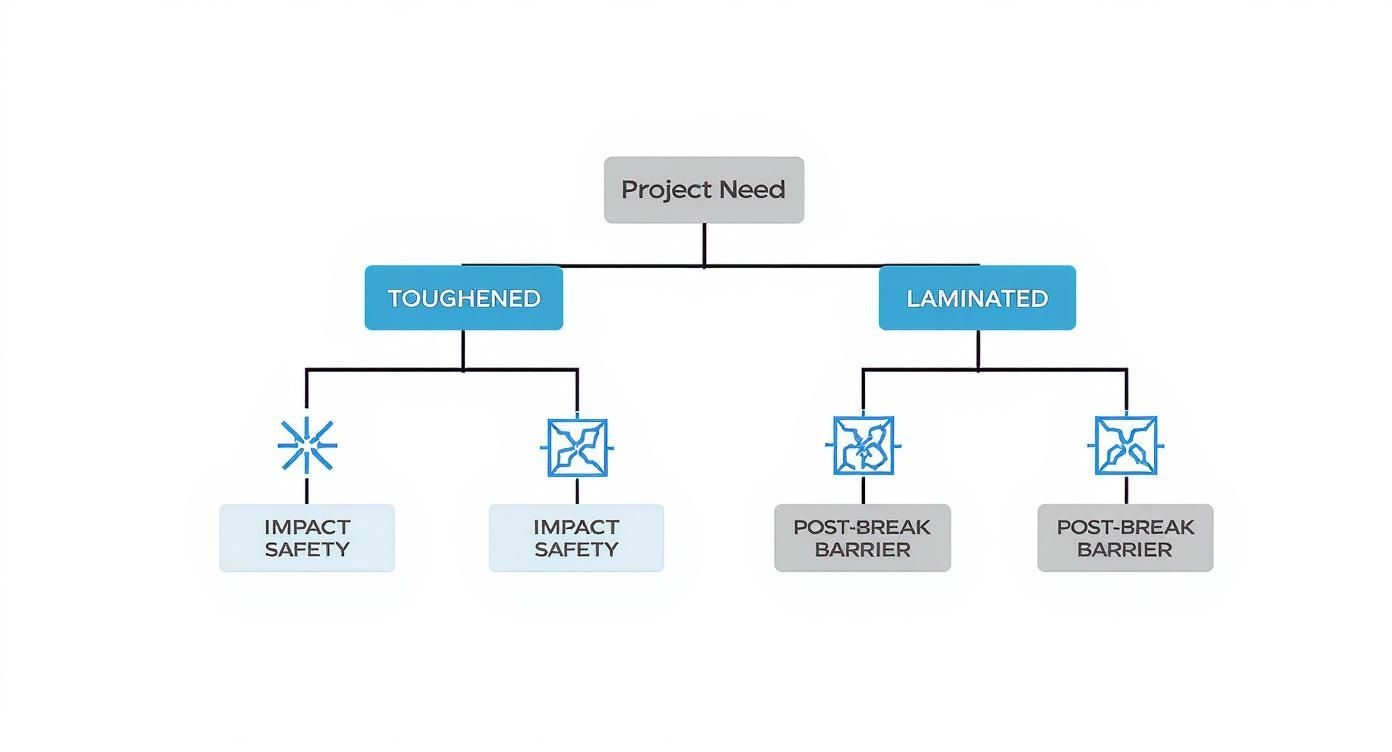
As the flowchart shows, if your main concern is withstanding an initial impact, toughened glass is your go-to. But if maintaining a protective barrier even after a break is non-negotiable (like on a balcony), then laminated glass is the only real choice.
It’s no surprise that the UK’s flat glass manufacturing industry, which produces both these materials, is seeing consistent demand. Revenue is projected to hit £248.6 million in 2025, a figure that reflects just how essential high-quality safety glass has become in modern construction right across the North. You can read more about the UK flat glass manufacturing sector and its economic landscape.
The very different safety features of laminated and toughened glass don’t happen by chance. They’re the direct result of two completely different manufacturing methods. Getting to grips with these processes is the key to understanding why one is engineered for massive impact resistance, while the other is all about integrity after a break.
Each method fundamentally changes the internal structure of the glass, giving it unique properties for very specific safety jobs.
At its heart, making toughened glass is a story of controlled thermal stress. It’s a process that turns ordinary annealed glass into a material that’s four to five times stronger. This intense, two-stage procedure builds immense tension within the glass, ensuring that if it ever does fail, it does so predictably and much more safely.
The process follows a precise sequence:
This balancing act of internal forces is what gives toughened glass its incredible strength. However, if an impact is sharp enough to break through that compressive outer layer, all that stored energy is released at once. The result? The panel shatters into those familiar small, blunt, dice-like pieces.
Laminated glass, on the other hand, is all about containment. It’s an assembly of different materials designed to hold together when broken, which is a non-negotiable feature for balustrades in places like Harrogate or Leeds where preventing a fall is the primary concern.
The core principle behind laminated glass is that the whole is greater than the sum of its parts. The polymer interlayer acts as a tenacious adhesive, ensuring the glass panel maintains its form and function as a barrier even after a severe impact.
The lamination process involves bonding these layers together under very specific conditions:
This layered construction is exactly why laminated and toughened glass perform so differently in the real world. While toughened glass is brilliant at withstanding an initial force, laminated glass provides that crucial residual safety by staying in the frame long after it has failed.
Choosing between laminated and toughened glass means looking well beyond their basic definitions. While both are a massive safety upgrade on standard annealed glass, how they perform in the real world couldn’t be more different. It’s these nuances that are critical, whether you’re an architect specifying a commercial atrium in Manchester or a homeowner planning a new balcony in York.
We need to get past simple pros and cons and dig into how each glass type really behaves – from the moment it breaks to its ability to block out UV rays and traffic noise.
The most critical distinction, and the one that often dictates which glass is suitable—or legally required—is what happens at the moment of failure.
Toughened glass is all about impact safety. When it fails, the immense internal stress is released, causing it to shatter into thousands of small, blunt-edged pieces. This breakage pattern dramatically reduces the risk of serious cuts, but it also means the barrier is gone in an instant, leaving a gaping void where there was once solid glass.
Laminated glass, on the other hand, is built for containment. If it takes a hit, the glass layers might crack into a spider-web pattern, but the tough polymer interlayer between them holds every single fragment firmly in place. This ensures the panel remains a physical barrier, which is absolutely non-negotiable for preventing falls from height.
For any balustrade where maintaining a barrier after breakage is essential—especially a frameless system—laminated glass isn’t just the best choice; it’s the only safe and compliant choice. A failed toughened panel in that situation would create an immediate and severe fall hazard.
When it comes to resisting an initial impact, toughened glass definitely has the edge. The thermal tempering process creates a highly compressed surface that makes it four to five times stronger than ordinary glass of the same thickness. It can take a significant hit and withstand thermal shock without breaking.
Laminated glass is still strong, of course, but a panel will typically crack under a lower level of impact force than a toughened panel of the same thickness. Its real strength isn’t in resisting the initial break, but in what it does afterwards.
For the absolute best of both worlds, toughened laminated glass is the premium solution. This hybrid involves bonding two sheets of toughened glass together, giving you the high impact resistance of toughened glass and the post-breakage integrity of laminated glass.
For properties in busy urban areas or near noisy roads, acoustic performance is a huge factor. This is where laminated glass truly excels. The polymer interlayer (PVB) is a viscoelastic material that is brilliant at dampening sound.
For a residential balcony overlooking a bustling street in Leeds or Sheffield, the superior sound insulation of laminated glass can make a real difference to your peace and quiet.
Another hidden benefit of laminated glass is its ability to protect what’s inside your home. The PVB interlayer naturally blocks up to 99% of harmful ultraviolet (UV) radiation. This is a huge bonus, as it helps prevent the fading of sofas, flooring, and artwork exposed to direct sunlight, all without affecting the clarity of the glass.
Toughened glass offers no such UV protection. In terms of looks, both glass types provide excellent optical clarity when new. It’s worth noting that if a laminated panel is poorly sealed, its edges could potentially be susceptible to moisture ingress over many years, but this is incredibly rare with modern manufacturing standards.
To pull all these key attributes together, the table below gives a clear, at-a-glance comparison of laminated and toughened glass.
| Attribute | Toughened Glass | Laminated Glass |
|---|---|---|
| Post-Breakage Safety | Shatters completely, leaving a void | Cracks but remains in place, maintaining a barrier |
| Initial Impact Strength | Very high (4-5x stronger than standard glass) | Good, but typically breaks under less force than toughened |
| Acoustic Insulation | Minimal improvement over standard glass | Excellent noise reduction due to the dampening interlayer |
| UV Filtering | Negligible UV filtering capability | Blocks up to 99% of harmful UV rays |
| Optical Clarity | Excellent, consistent clarity | Excellent, with minimal impact on light transmission |
| Typical Use Case | Where post-breakage barrier is not critical (e.g., shower doors) | Where fall protection is critical (e.g., balustrades, overhead glazing) |
The growing preference for these advanced safety features is clear in the construction industry. The global market for laminated glass is expanding significantly, driven by a greater demand for safety solutions and the rise of energy-efficient green building projects. You can find more analysis on the laminated glass market on mordorintelligence.com. This trend shows a definite shift towards specifying materials that offer multiple benefits well beyond basic strength.
Getting your glass balustrade right isn’t just about the aesthetics; it’s about safety, compliance, and getting that all-important sign-off from building control. For anyone embarking on a project in Yorkshire or across the North of England, understanding the rules is the foundation of a successful installation. This isn’t just about ticking boxes – it’s about ensuring your beautiful new feature is fundamentally safe.
The key documents you need to know about are Approved Document K (Protection from falling, collision and impact) and the British Standard BS 6180:2011 (Barriers in and about buildings). Think of these as the official rulebook. They’re what architects, installers, and building inspectors rely on to define what makes a barrier safe, and they have a lot to say about the glass you choose.
Approved Document K lays down the law on preventing falls. It’s what tells us the minimum barrier heights required in different settings – for example, 0.9m for indoor stairs and landings, rising to 1.1m for external balconies where the drop is greater.
BS 6180 then provides the technical “how-to” guide for meeting those legal requirements. It dives into the specifics of structural strength, load-bearing capabilities, and exactly which materials are suitable for the job.
Together, these two documents remove the guesswork from one of the most vital decisions you’ll make: whether to use laminated or toughened glass. Their guidance is crystal clear and puts public safety first. If you want to see how these fit into the bigger picture, this overview of navigating general building codes and regulations is a helpful read.
The rules get particularly strict where a glass panel failure could lead directly to a fall from height. In these scenarios, the ability of laminated glass to stay in one piece after breaking makes it the only acceptable choice.
BS 6180 is very specific about this, and it all comes down to the balustrade design:
The principle is straightforward: if the glass is the only thing stopping a fall, it must not vanish if it breaks. That’s why building inspectors from Cheshire to County Durham will insist on laminated glass for frameless balconies and high-level mezzanines.
The regulations talk about “critical locations,” which simply means any area where a fall would be dangerous. Think of those stunning apartment balconies overlooking the Leeds skyline or the coastal homes in Northumberland with their panoramic views. The glass barriers that make those views possible have to be impeccably safe. This makes knowing the right glass for different settings crucial when planning new railings for balcony projects.
Here’s a quick rundown of where laminated glass is generally the go-to choice:
Choosing the right glass is about more than just looks; it’s about fulfilling a duty of care. By following the guidance in BS 6180, you can be confident that your installation is fully compliant, completely safe, and built to last.
Knowing the theory behind laminated and toughened glass is one thing, but seeing how it all plays out on real projects across Northern England is where the choices really start to make sense. Local factors are a huge deal – the punishing coastal weather, specific architectural styles, and how a space gets used day-to-day all steer the decision.
Let’s walk through a few common scenarios you’ll find right on our doorstep, from windswept balconies to busy city-centre offices. This should help you picture the right solution for your own project, whether you’re a homeowner in Harrogate or a contractor in Hull.
Picture a frameless glass balcony on a beautiful coastal property in Scarborough or Bamburgh. It’s there for one reason: to provide a completely uninterrupted view of the North Sea. But that view comes with a price – exposure to gale-force winds, corrosive salty air, and the odd clumsy seagull.
In a high-stakes spot like this, toughened laminated glass isn’t just an option; it’s the only sensible choice. While standard toughened glass is strong enough to handle wind loads, a complete failure would be catastrophic, instantly leaving a dangerous void. Laminated glass guarantees that even if a panel cracks under impact, it stays firmly in place as a solid barrier, keeping everyone safe. It’s this post-breakage integrity that UK regulations demand for such critical locations.
Now, let’s head inland to a modern townhouse renovation in Sheffield. The vision is a minimalist floating staircase with a glass balustrade, designed to flood the space with light. For a busy family home, though, safety is non-negotiable.
Here, the final choice often hinges on the specific design of the balustrade.
The crucial factor here is structural redundancy. If the glass is doing all the protective work on its own, it has to be laminated. If other parts like a handrail share that load, toughened glass can often be sufficient.
It’s also worth noting that the strength of toughened glass makes it useful far beyond architecture. For example, its durability and impact resistance are critical in toughened glass in solar panel applications, where it has to withstand the elements for decades.
Think about a bustling commercial office in the heart of Leeds, where large glass partitions create meeting rooms and divide open-plan areas. These spaces see a lot of foot traffic, and the glass needs to be safe while also providing some acoustic privacy.
For these large, floor-to-ceiling partitions, laminated glass is almost always the superior choice. Its PVB interlayer is fantastic at dampening sound, helping to cut down on office chatter and keep meetings confidential. More importantly, if someone accidentally bumps into it, the glass will crack but stay intact, preventing a shower of dangerous glass fragments in a crowded workplace.
When it comes to smaller-scale projects like glass panel decking, balancing style, safety, and your budget is just as important. In Northern England, choosing materials that can withstand the changeable weather is key. By exploring different options, you can bring a sleek, modern, and durable look to your garden while making sure everything is up to code.
By looking at these local examples, the ideal choice of laminated and toughened glass for your specific project should become much clearer.
Even after covering the technical details and regulations, a few key questions about laminated and toughened glass pop up time and again. We often get calls from clients across Northern England who are on the verge of making a final decision, and it’s these practical queries that clear up the last bits of confusion.
This section gives you direct, straightforward answers to the most frequent questions we hear. Each one builds on what we’ve already discussed, aiming to give you total confidence in your choice, whether you’re finalising plans for a balcony in York or a staircase in Manchester.
This is probably the number one question we get asked, and the answer really depends on what you mean by ‘strong’. Each type of glass has a very different kind of strength, which is what makes it suitable for certain jobs.
When it comes to resisting a direct, blunt impact, toughened glass is the clear winner. That thermal tempering process makes it a remarkable four to five times stronger than standard annealed glass. It can take a serious knock before it fails.
But that strength is brittle. When it does fail, all that stored tension is released at once, and the entire panel shatters. This is where laminated glass shows its unique strength.
The true strength of laminated glass lies in its post-breakage integrity. It might crack under less force than toughened glass, but its polymer interlayer holds all the broken pieces together, maintaining a crucial physical barrier.
So, for something like a frameless balustrade where stopping a fall after an impact is the absolute priority, the residual strength of laminated glass makes it the superior—and safer—choice.
Under UK Building Regulations, specifically BS 6180, using a single sheet of toughened glass (monolithic) for a frameless balustrade without a continuous, load-bearing top rail is generally not allowed. This is especially true in any situation where there’s a risk of falling from a height.
The logic behind this is simple and entirely focused on safety. If a toughened glass panel in a frameless system were to fail, it would completely disintegrate, instantly leaving a gaping hole. There would be absolutely nothing left to prevent a fall.
For this exact reason, building control officers throughout the North of England will almost always insist on toughened laminated glass for these critical safety applications. The laminated structure gives you vital redundancy, ensuring that even if one or both glass layers break, a protective barrier remains securely in place.
Yes, as a rule, laminated glass is more expensive than toughened glass of the same thickness. The higher price tag comes directly from its more complex manufacturing process and the extra materials needed.
Making laminated glass involves several key stages that add to the final cost:
Toughened laminated glass, which gives you the best of both worlds, is the premium option and naturally comes with the highest cost. While the initial investment is greater, you have to weigh it against the enhanced safety, superior performance, and regulatory compliance it provides for critical areas like balustrades.
Fortunately, both toughened and laminated glass are incredibly low-maintenance. They both benefit from the same simple cleaning routine to keep them looking pristine, with no special products or complicated steps required.
For the best results, just use a soft, non-abrasive cloth—a standard microfibre cloth is perfect. You can use a mild, pH-neutral glass cleaner or even a simple solution of water with a dash of white vinegar.
It’s really important to avoid using abrasive pads, scrapers, or harsh chemical cleaners. These can easily scratch the glass surface or, in the worst cases, damage specialist coatings.
With laminated glass, it’s good practice to occasionally check the edges for any signs of delamination (where the layers start to separate), though this is extremely rare with modern, high-quality manufacturing and correct installation. Regular, gentle cleaning is all it takes to guarantee the long-term clarity and performance of your safety glass.
Ready to bring clarity, safety, and style to your Northern England property? The team at Binks Glass Solutions has the local expertise to guide you through every step, from choosing the right safety glass to finalising a design that meets all UK regulations. Explore your options and get a tailored quote for your project today.