
Difference between Laminated and Toughened Glass: A Clear Guide for Balustrades
The core difference between laminated and toughened glass boils down to what happens when they break—a critical factor for safety. […]

The core difference between laminated and toughened glass boils down to what happens when they break—a critical factor for safety. […]
The core difference between laminated and toughened glass boils down to what happens when they break—a critical factor for safety. Toughened glass shatters into small, blunt cubes on impact, which minimises the risk of serious cuts. In complete contrast, laminated glass cracks but stays held together by a tough internal layer, keeping the barrier intact even when damaged.
When you’re planning a glass balustrade, the choice between toughened and laminated options is the most important decision you'll make. Both are classed as ‘safety glass’, yet their manufacturing, fracture behaviour, and performance are worlds apart. This is a crucial consideration for projects across Yorkshire and the North of England, where our weather and the way we use our outdoor spaces demand reliable, robust materials.
.
Laminated glass, on the other hand, is engineered using a completely different principle. It’s all about adhesion, not internal stress. Instead of a single pane, it’s built like a high-tech sandwich, bonding two or more layers of glass together.
The bond is created with a tough, resilient polymer interlayer, typically Polyvinyl Butyral (PVB) or SentryGlas Plus (SGP). The glass and interlayer are fused under intense heat and pressure inside a specialised oven called an autoclave. This process creates a single, unified panel that is incredibly strong and durable.
The real magic of laminated glass isn't its ability to resist breaking, but how it behaves when it does. If the glass cracks under impact, the fragments stick firmly to that tough polymer interlayer. Instead of shattering and falling away, the pane remains held in place, maintaining a protective barrier. This prevents a dangerous opening from forming, which is a critical safety requirement for balustrades at height in locations from Leeds to York. This structural integrity after impact is the defining characteristic that truly separates it from toughened glass.
Now that we've covered the science behind the glass, let's get down to what really matters: how do toughened and laminated glass stack up in the real world? The true difference between them becomes crystal clear when you compare how they perform day-to-day, especially when things go wrong. This is the practical, side-by-side analysis you need for any balustrade project, whether it's in a bustling city centre or a quiet suburban garden.
This is, without a doubt, the most critical point of comparison. How a pane of glass fails has a direct and immediate impact on the safety of your balustrade. Understanding this isn't just a technical detail—it's essential for protecting your family, customers, or the public.
Toughened Glass: Because of the immense tension locked inside it during the manufacturing process, toughened glass shatters completely when it takes a hard knock. It doesn't break into large, dangerous shards; instead, it disintegrates into thousands of small, blunt, dice-like cubes. This is a deliberate safety feature designed to prevent serious cuts. The big downside? The entire panel vanishes, leaving a wide-open, unprotected gap.
Laminated Glass: Laminated glass, on the other hand, behaves entirely differently. When hit hard enough to break, the glass layers will crack, but the tough plastic interlayer holds all the pieces firmly in place, a bit like a spider's web. The panel remains within its frame or fixings, meaning the protective barrier is maintained and no one can fall through the gap.
You have to ask yourself one core safety question: Is it more important for the glass to break into harmless pieces, or for the barrier to stay put after breaking? For any balustrade at height, keeping the barrier in place is almost always the number one priority.
This fundamental difference in how they fail is precisely why UK building regulations are so specific about which glass to use, particularly in high-risk areas.
While safety is non-negotiable, you're also investing in your property's look and feel. The aesthetic and sensory impact of your glass balustrade is a major part of the decision, and each type offers distinct advantages here.
If you're after absolute visual purity, low-iron toughened glass is the champion. Standard glass has a subtle green tint from the iron content, which you can usually spot on the polished edges. Low-iron glass almost eliminates this, giving you a crystal-clear, virtually invisible barrier that lets in maximum light and doesn’t distort the colours of your view.
For sound insulation, laminated glass is the clear winner. That internal polymer layer is brilliant at dampening sound vibrations, making it far more effective at blocking noise than a single pane of toughened glass. This is a game-changer for balconies overlooking busy roads in cities like Leeds or Manchester, or for creating a more peaceful garden terrace.
The image below gives a great summary of how their construction leads to these very different performance traits.
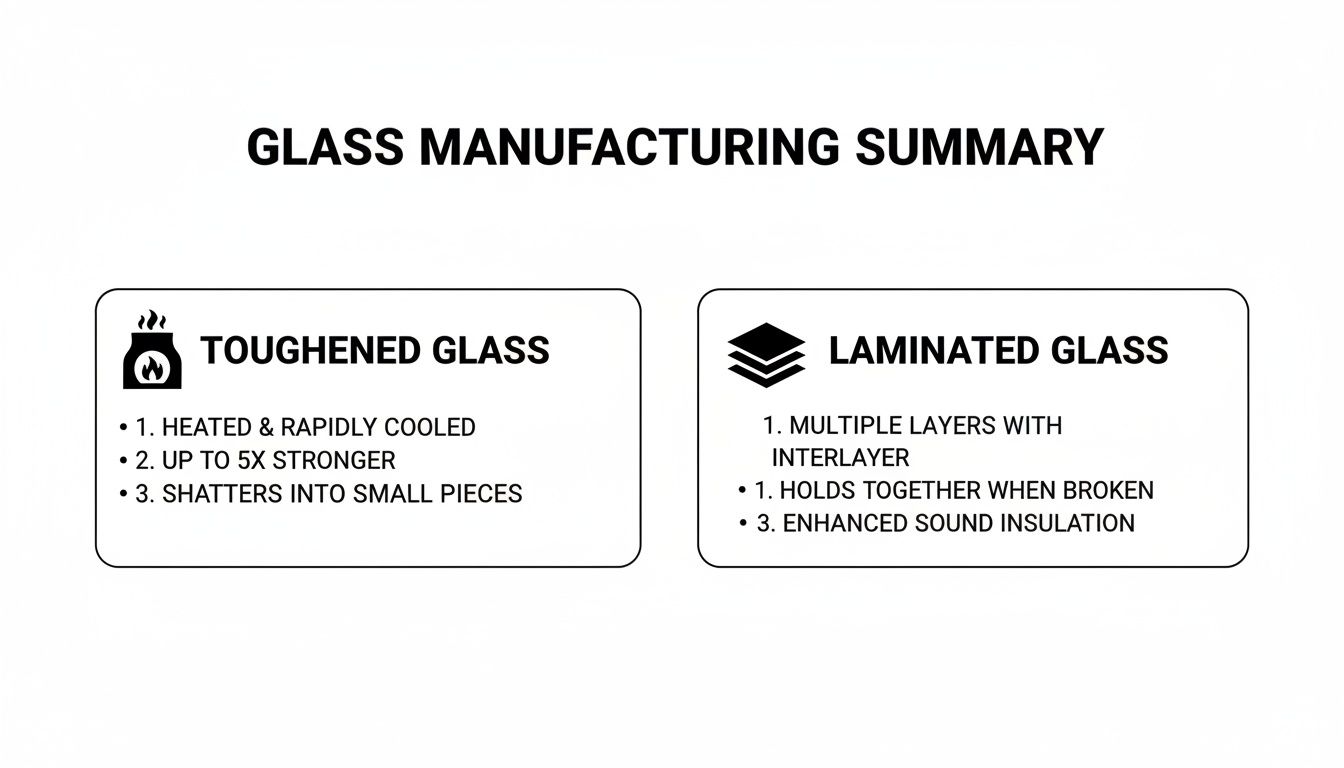
It really highlights how the heat-treating process builds internal stress for strength in toughened glass, whereas lamination is all about bonding layers together to ensure the panel stays intact after a break.
Here in the UK, balustrades are governed by strict rules, mainly laid out in BS 6180:2011. Your choice between toughened and laminated glass is often decided for you by these regulations, which exist purely to keep people safe.
The rules hinge on a few key factors:
As a general rule, for any frameless or semi-frameless balustrade with a significant drop and no continuous top rail, laminated glass is mandatory. The logic is simple: if a toughened glass panel shattered, the barrier would be gone, creating a severe fall risk. Laminated glass guarantees the barrier remains, even when damaged. Toughened glass can often be used in systems that do have a continuous handrail (which acts as a secondary barrier) or for ground-floor installations with a minimal fall height.
The practicalities of installation and the available finishes also differ. Toughened glass is a single, monolithic pane, which makes it a bit lighter and sometimes easier to handle than a laminated panel of the same thickness. It’s vital to remember that any holes for fixings, like those needed for a glass balustrade clamp, must be drilled before the glass is tempered. Once it's been through that process, it cannot be cut or altered in any way.
Laminated glass is heavier, thanks to its extra layers and interlayer. A key point for laminated glass is the need to protect the exposed edges of the interlayer from moisture. If water gets in over time, it can cause the layers to separate (delamination). This is why you’ll often see it installed within a protective base channel or finished with a cap rail.
Finally, let's talk about the cost. Toughened glass is typically less expensive to produce than laminated glass. Its simpler manufacturing process and widespread use make it a cost-effective choice for projects where it ticks all the safety and regulatory boxes.
Laminated glass comes with a higher price tag. This is down to the extra materials (the interlayer) and the more complex manufacturing involved in bonding the layers together under heat and pressure. However, for many projects, this higher initial outlay represents far greater long-term value. The superior post-breakage safety, enhanced security, and acoustic benefits deliver a level of performance that toughened glass simply can't match. It provides greater peace of mind and is often the only compliant choice for high-risk installations.
Getting from the technical specs to a real-world decision is the final, most important step. The true difference between laminated and toughened glass really comes to light when you start thinking about specific situations. Your choice boils down to the location, the potential fall height, and the level of safety your project demands—whether it’s for a family home in York or a bustling commercial space in Manchester.
This practical guidance is designed to help you confidently match the right glass to your unique environment. We want to ensure your balustrade isn't just a stunning feature, but is perfectly suited to its job and fully compliant with UK regulations.
Toughened glass is often the go-to choice when strength, pristine clarity, and cost are the main considerations. It shines in lower-risk locations where a fall from height isn't a factor. Its impressive resistance to direct impact makes it a durable and reliable option for many domestic projects.
Think about these common situations where toughened glass is a perfect fit:
For ground-level applications or any system that includes a sturdy, independent handrail, toughened glass delivers exceptional strength and value. In these settings, its main job is to provide a physical barrier and resist impact, which it does superbly.
In these kinds of scenarios, the risk of someone falling through the balustrade if it breaks is minimal. That’s why the cost savings and flawless clarity of toughened glass make it the most logical and practical choice.
Laminated glass takes centre stage when post-breakage safety becomes the absolute top priority. In any situation where a fall could happen if the glass barrier failed, laminated glass becomes essential. Its ability to crack but stay held together in its frame is a critical safety feature that toughened glass simply can't provide.
While toughened glass is more common, laminated glass serves a crucial role in UK construction, particularly in commercial settings and high-end residential projects where extra safety measures are mandated. It's especially valued in heritage property updates and premium commercial builds. For more on its industry role, you can explore some market research on balustrade materials.
Here are the key scenarios where you absolutely must choose laminated glass:
In these elevated or high-risk environments, the decision is made for you. The superior safety and security offered by laminated glass aren’t just a nice-to-have; they are a fundamental requirement for protecting lives and ensuring your installation is fully compliant and fit for purpose.
Knowing the technical differences between laminated and toughened glass is one thing, but applying that knowledge to your own project is where it really counts. Getting this right ensures your new balustrade is not just a stunning feature but also safe, compliant, and perfectly suited to its environment, whether it's a family home in Darlington or a busy commercial space in Cumbria.
To make things simple, we've boiled it down to a practical checklist. Just by answering a couple of key questions about your plans, you can quickly see which glass type is the right fit for your needs and UK safety standards. This kind of clarity is vital for a successful, stress-free project.
Before you go any further, just run through these two critical questions. The answers will point you straight to the safest and most appropriate glass for your balustrade.
What is the fall height from where the balustrade will be?
If there's a significant drop—usually anything over 600mm for homes—the safety rules get much tighter. Preventing a fall from height is the whole reason laminated glass exists. It's the mandatory choice for high-risk areas like first-floor balconies, raised terraces, and Juliet balconies. For a simple ground-floor patio with a minimal step, toughened glass is usually perfectly fine.
Will your design include a continuous, structural handrail?
A strong, load-bearing handrail provides a vital secondary barrier if a glass panel ever fails. In systems that have this continuous top rail, toughened glass can be a compliant option because the handrail offers that extra layer of protection. However, for the popular fully frameless designs without a top rail, laminated glass is nearly always required to guarantee the barrier stays in place even if the glass itself breaks.
Honestly, answering just these two questions will solve the vast majority of specification dilemmas. They get right to the heart of what UK regulations are designed to do: keep people safe. For a deeper dive into the specifics, take a look at our guide on building regulations for balustrades.
By focusing on fall height and the role of the handrail, you align your project with the core principles of balustrade safety. It takes the guesswork out of the equation and ensures your installation is both beautiful and responsibly built.
Once you have a clearer idea of your project's safety needs, the next step is to get some expert input. Chatting through your answers with our specialists here at Binks ensures you end up with a system that's not only gorgeous but also fully compliant and safe for your home or business. Our team has fitted countless balustrades across the North of England, from Harrogate to Hull, and we can offer advice tailored to your specific situation.
We can walk you through the options, explain how the choice of glass affects the cost, and make sure every last detail is covered. It's this collaborative approach that guarantees you get a balustrade that you'll love, without ever cutting a single corner on safety.
When you’re finalising the details of a new balustrade, a few key questions always come up. Getting confident in your choice between toughened and laminated glass means knowing exactly how they stack up in terms of strength, regulations, and long-term performance. Here are the clear, straightforward answers to the queries we hear most often from our clients across Harrogate, Leeds, York, and the North of England.
This is the question we get asked more than any other, but the answer isn't as simple as one being stronger than the other. The real difference is how they are strong.
Toughened glass is incredibly strong when it comes to resisting a direct blow. The thermal tempering process makes it roughly four to five times stronger than normal glass of the same thickness. It can take a serious impact before it fails.
Laminated glass, on the other hand, offers superior strength after it breaks. When laminated glass fractures, the tough polymer interlayer clamps the broken pieces together, keeping the panel in place. This post-breakage integrity is a completely different kind of strength—and it’s a critical safety feature for balustrades at height.
To put it simply: toughened glass is harder to break in the first place, but laminated glass is far stronger and safer once it has been broken. For a balustrade, that post-breakage performance is often the most important factor of all.
Whether you need a handrail or not depends entirely on the system design and the type of glass you’re using. UK Building Regulations, specifically BS 6180, give clear guidance on this to guarantee safety.
A continuous, structural handrail is designed to act as a backup barrier. If a glass panel were to fail completely, the handrail remains in place to prevent a fall. For this reason:
It’s absolutely vital to get expert advice to ensure your specific project is fully compliant with all building regulations.
This is a critical point to understand during the measuring stage of your project, as the manufacturing process dictates whether the glass can be altered.
Toughened glass cannot be cut or drilled after it has been tempered. The manufacturing process locks immense stress into the glass, and any attempt to cut it will cause the whole panel to explode into its signature small, blunt cubes. All shaping, drilling for fixings, and polishing must be done before the glass goes into the tempering furnace.
Laminated glass can be cut after manufacturing, but it’s a highly specialised job. It requires specific tools to slice cleanly through both glass layers and the inner polymer without causing damage. While this offers some flexibility, it should only ever be attempted by a professional glass processor.
When it comes to day-to-day cleaning, there’s no difference at all. Both toughened and laminated glass look their best with a standard, non-abrasive glass cleaner and a soft cloth. Neither is more prone to scratching from normal use.
The only real difference in maintenance comes down to the panel edges.
This is precisely why the design and installation method for laminated glass is so important in ensuring it looks flawless for decades to come.
Ready to choose the perfect glass for your balustrade? The expert team at Binks Glass Solutions is here to provide clear advice and a personalised quote for your project in Harrogate, Leeds, York, and across the North of England. Contact us today to discuss your requirements.