
A Homeowner’s Guide to Choosing the Perfect Balcony Glass Panel
Picture this: you step out onto your balcony, greeted not by bars or spindles, but by a completely clear, uninterrupted […]

Picture this: you step out onto your balcony, greeted not by bars or spindles, but by a completely clear, uninterrupted […]
Picture this: you step out onto your balcony, greeted not by bars or spindles, but by a completely clear, uninterrupted view of the Yorkshire countryside or your city skyline. That’s the feeling a modern balcony glass panel system delivers. This guide is for homeowners across the North of England, from Leeds to Harrogate, who are ready to transform their property with a perfect blend of style, safety, and crystal-clear views.
A balcony glass panel system isn't just a window turned on its side; it's a sophisticated, engineered safety barrier designed to give you total protection without spoiling the view. Forget those traditional wood or iron railings that can make you feel boxed in. Glass panels create a seamless, see-through boundary that completely opens up your space.
They do more than just look good. They pull natural light deep into adjoining rooms and lend a clean, contemporary feel to any home. For property owners in places like Cheshire or York, these systems are the ultimate fusion of form and function. They’re built tough, ready to stand up to the unpredictable British weather while keeping their pristine look for years. It's no wonder they've become the go-to choice for modernising everything from terraces and patios to Juliet balconies.
The move towards glass in architecture isn't just a local fad. It's a global shift towards minimalist, light-filled living spaces, and it's a trend that's especially strong right here in the UK. More and more, homeowners are swapping out dated, heavy materials for sleek, modern alternatives that open up their homes.
This isn't purely about looks, though. A glass balcony panel is also a surprisingly effective windbreak, making your outdoor space more comfortable and usable for more of the year. The market reflects this growing appreciation; the global value for glass balustrades hit USD 1.3 billion in 2023 and is set to climb. The UK holds a major share of that market, driven by our love for renovation and contemporary design.
In simple terms, a balcony glass panel is a structural feature that delivers safety, opens up your view, and seriously boosts your home's kerb appeal. It turns a necessary barrier into a stunning design statement.
Whether you're looking to refresh a city apartment or a countryside home, understanding the basics is the first step. For a deeper dive into the impact these systems can have, you can read more about how glass balustrades are transforming homes. In the sections that follow, we'll get into the different types of glass, style options, and the all-important safety regulations you'll need to know.
When you start exploring options for a balcony glass panel, one of the first and most critical choices you'll face is the type of safety glass. This isn't just about getting a clear view; it's about understanding how the glass performs under pressure and what that means for the safety of your home and family.
The two main players in the world of architectural glass are toughened and laminated. Let's break down what they are and when to use them.
Think of toughened glass as the workhorse of the glass world. It’s made by taking standard glass, heating it to over 600°C, and then cooling it rapidly. This intense process creates huge stress within the glass, making its surface four to five times stronger than ordinary float glass.
But its real superpower is revealed when it breaks. Instead of shattering into long, dangerous daggers of glass, it crumbles into small, blunt, pebble-like pieces. This dramatically reduces the risk of serious injury, which is why it's such a popular and trusted choice for homes across Yorkshire and the North.
Toughened glass is a fantastic all-rounder, offering excellent strength and a safe breaking pattern that meets strict British safety standards. Because of its robust nature, it’s often our go-to recommendation for domestic balconies or patios where there isn’t a significant drop below.
Now, let's look at laminated glass. A great way to picture it is as a safety sandwich. It’s built from two panes of glass that are permanently bonded together with a tough, transparent plastic interlayer (usually Polyvinyl Butyral, or PVB). This construction gives it a unique safety feature that toughened glass can't match.
If laminated glass is hit with enough force to break, the glass will crack, but the pieces stay firmly glued to that plastic interlayer. The panel remains in one piece, preventing a dangerous hole from opening up in the barrier. This "fail-safe" characteristic is absolutely vital in certain situations.
The core difference is simple: toughened glass breaks safely into thousands of tiny pieces, while laminated glass breaks but stays in place as a single panel. This makes laminated glass the superior choice where protecting against a fall from height is the number one priority.
For balconies, terraces, or any balustrade guarding a significant drop, UK building regulations often require laminated glass. If your balcony is high up, or if there's no secondary barrier like a handrail, the structural integrity of the balcony glass panel is everything.
Laminated glass ensures that even if a panel gets damaged, the barrier stays intact and continues to prevent a fall. This makes it the non-negotiable option for high-rise apartments in Leeds or raised terraces overlooking the Cumbrian fells. While it does come at a higher cost, the extra layer of protection it provides is priceless.
For a deeper dive into these materials, you can explore more about the unique properties of laminated and toughened glass.
To help you decide, this quick guide shows how your priorities—whether style, safety, or clarity—might point you toward one type of glass over the other.
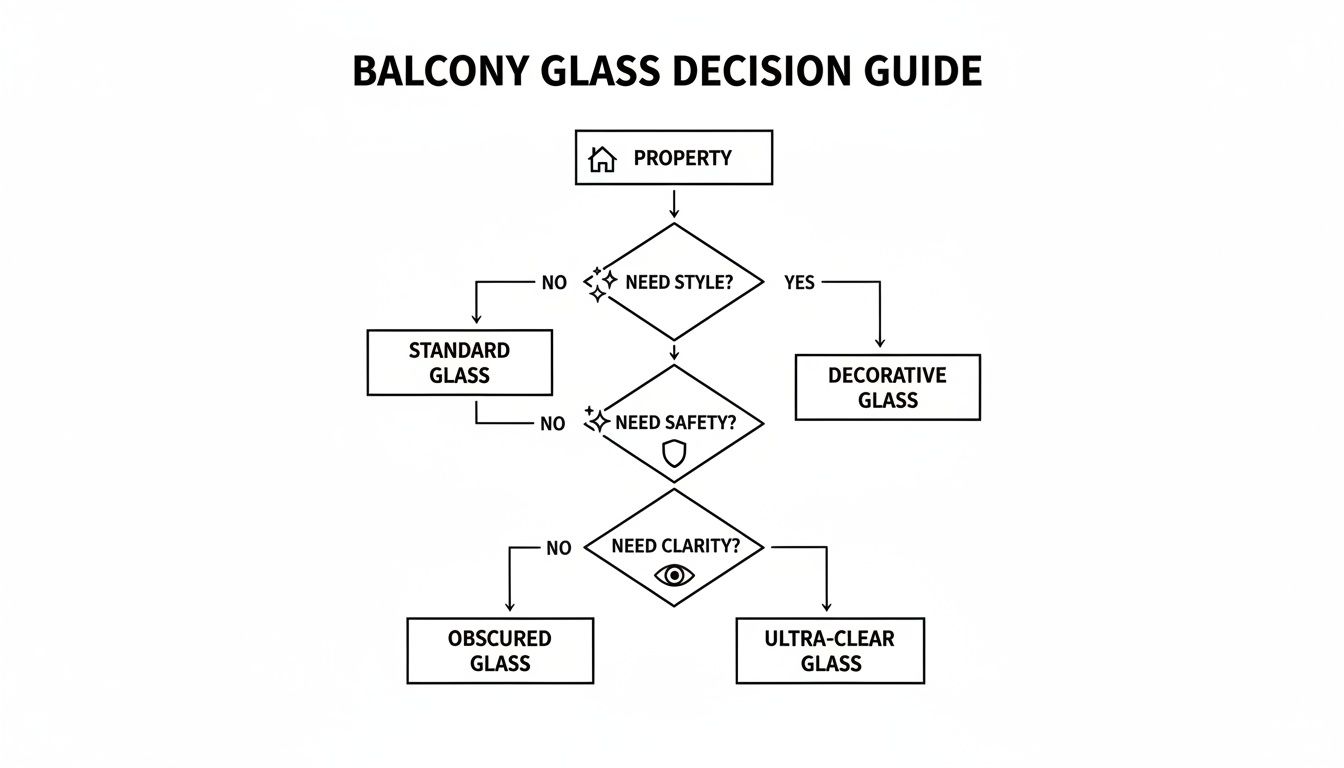
As the flowchart shows, while both options deliver on style, the path splits when safety becomes paramount, with laminated glass offering the ultimate protection.
To make things even clearer, here’s a straightforward table comparing the two side-by-side.
| Feature | Toughened Glass | Laminated Glass |
|---|---|---|
| How It Breaks | Shatters into small, blunt cubes. | Cracks but stays in one piece. |
| Safety Level | High – prevents serious cuts. | Highest – also acts as a fall barrier after breaking. |
| Best For | Ground-floor patios, internal stairs, decks. | High balconies, Juliet balconies, any area with a fall risk. |
| Strength | Very high impact resistance. | High impact resistance, but maintains structural integrity. |
| Cost | More cost-effective. | Higher initial cost due to complex manufacturing. |
Ultimately, this table highlights that the best choice depends entirely on your project's specific safety needs.
So, which one is right for you? It all boils down to a balance of safety regulations, location, and budget.
Here’s a simple summary to guide your thinking:
Choosing the right balcony glass panel is the bedrock of a safe and successful project. By understanding the key differences between toughened and laminated glass, you can make an informed decision that will protect your family and enhance your home for years to come.
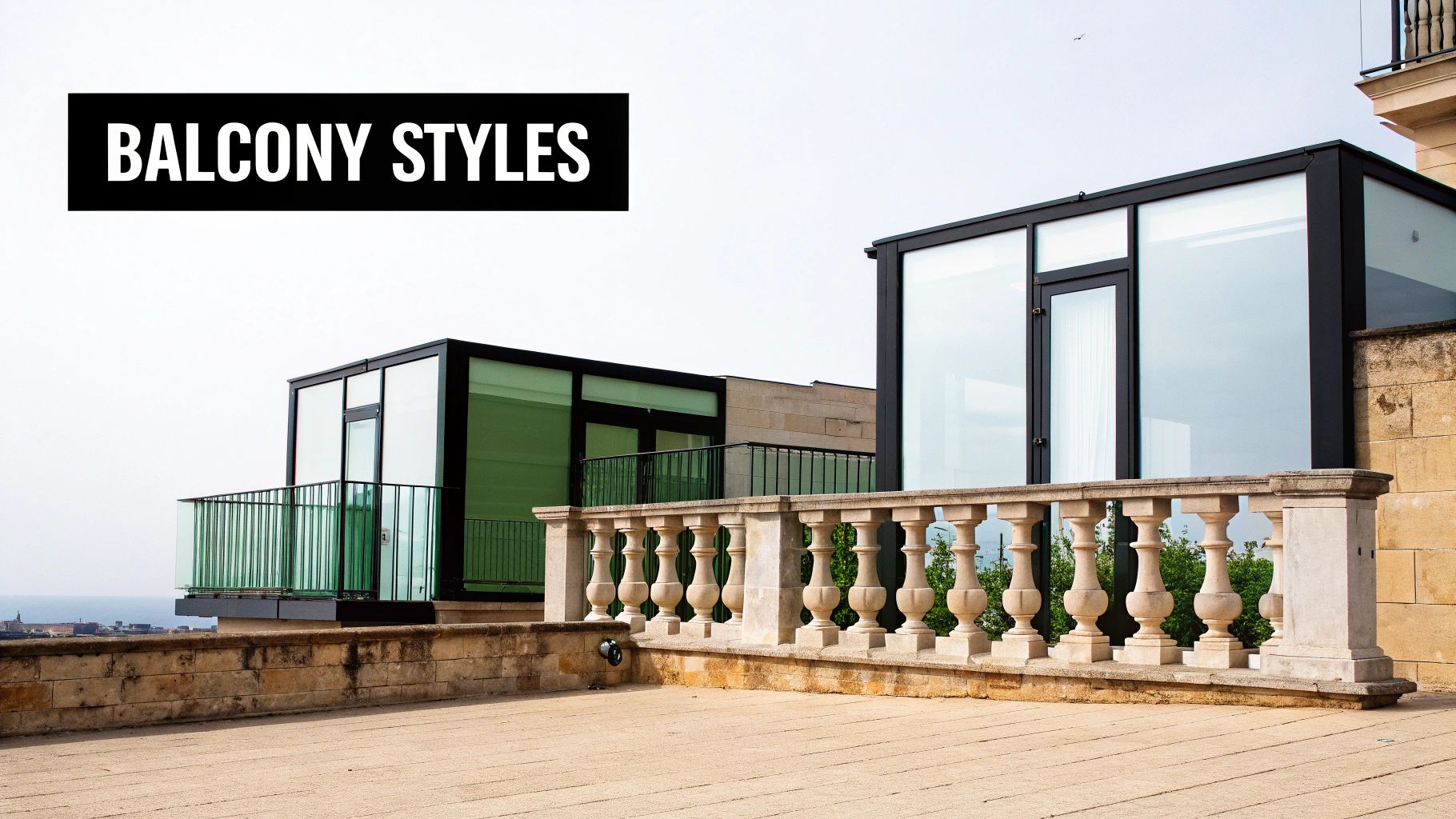
Once you’ve settled on the right type of safety glass, the really exciting part begins: choosing a style that looks like it was always meant to be part of your home. A balcony glass panel system isn't just a safety feature; it's a major architectural statement. The right design should enhance your property's character, not fight against it.
Whether you live in a sleek, contemporary new-build or a classic stone terrace in the Yorkshire Dales, there's a glass balustrade style that will feel like a perfect fit. The choice really boils down to one simple question: how much hardware do you want to see? Let's walk through the main options to help you picture what would look best on your own balcony.
If you’re after the purest, most seamless view possible, then a frameless glass balustrade is the only way to go. This stunning system uses thick, structural glass panels that are strong enough to stand entirely on their own, held securely by a robust channel at the base. The effect is a completely invisible barrier that floods your space with light and makes it feel incredibly open.
Picture looking out from your home, with nothing but a sheet of pure glass between you and the view. That's the magic of a frameless system. They are an especially brilliant choice for:
The semi-frameless style strikes a beautiful balance between the pure minimalism of frameless and the solid presence of a fully framed system. With this design, the glass panels are supported by slim, intermittent posts, but you typically won't have a top or bottom rail running between them. This creates a clean, sophisticated look that adds a bit of structure without overpowering the view.
These discreet posts, often in stainless steel or powder-coated aluminium, provide a subtle architectural detail. A semi-frameless system is a fantastic, versatile option for homeowners who want a defined edge for their balcony but still want to keep the overall feeling light and airy.
For a more traditional look that feels reassuringly solid, a classic framed glass balcony panel system is the ideal choice. This style encases each glass panel within a complete frame, which includes a top handrail, a bottom rail, and vertical support posts. This creates a strong, clearly defined boundary that neatly outlines your balcony or terrace.
This sturdy framework can be a wonderful complement to older properties, like a Yorkshire stone house, adding a modern touch that still feels grounded and secure. The frame itself can be customised in different finishes to match your existing window frames or other architectural details, pulling the whole look together.
It's this kind of quality and versatility that's driving growth in the UK's flat glass manufacturing industry, which is projected to hit £248.6 million in revenue in 2025. People are increasingly looking for building materials that are both beautiful and high-performing. You can learn more about trends in the UK flat glass market to see how these innovations are shaping the future of home design.
Getting your head around the safety standards for a balcony glass panel installation can feel a bit daunting. But at the end of the day, the rules are there for one simple reason: to keep you and your family safe. Understanding the basics of UK Building Regulations means you can ask the right questions and feel confident that your beautiful new balcony is completely compliant, whether it’s for a city apartment in York or a coastal home in Cumbria.
Try to think of these regulations not as red tape, but as a blueprint for a safe, secure, and long-lasting installation. They set out the non-negotiable standards that every balustrade must meet to protect against falls from height.
The easiest rule to get to grips with is the height of the balustrade itself. For any external balcony, raised patio, or terrace in a single-family home where there's a drop of more than 600mm (that’s about two feet), the top of the handrail has to be at least 1100mm (1.1 metres) from the finished floor level.
This specific height isn’t just a random number; it’s carefully calculated to provide an effective barrier that stops an average adult from accidentally toppling over. It’s a crucial measurement that any professional installer will double-check to ensure full compliance.
Beyond height, the regulations get a bit more technical, focusing on the strength of the balustrade. This is where you might hear terms like 'line load' and 'kN/m' (kilonewtons per metre). Don't let the jargon put you off, though—the concept is actually pretty straightforward.
Just imagine a few people leaning against your balcony railing at the same time. The 'line load' is simply the minimum horizontal force that the top edge of the balustrade must be able to handle without breaking a sweat. It’s a direct measure of its strength and resilience under real-world pressure.
For domestic properties like houses, the required line load for a balcony is 0.74 kN/m. This is roughly equivalent to a force of 74kg being applied to every one-metre section of the handrail.
This standard makes sure your balcony glass panel system is robust enough to cope with the demands of daily life, giving you complete peace of mind.
To make things simple, here are the core principles of UK Building Regulations for domestic glass balconies broken down:
Making sure your project meets these standards isn't just about ticking boxes; it's a fundamental part of a professional job. Any reputable supplier will always design and install a system that meets, or even exceeds, these regulations. For a deeper dive, you can find a wealth of information by reading our guide to the building regulations for glass balustrades.
Ultimately, a compliant balcony is a safe balcony. By getting familiar with these key rules, you can be sure that your stunning new feature is built not just for incredible views, but for unwavering safety.
This is where your vision starts to become a reality. Moving from inspiration to action is the most rewarding part of any project, and for your new balcony glass panel system, it begins with two things: accurate measurements and a clear, honest quote. Getting the measurements right is the foundation of a flawless installation, making sure every panel fits perfectly and your quote is spot-on.
Don't worry, you don’t need to be a professional surveyor to get this done. The process is pretty straightforward. All you need is a good tape measure, a bit of care, and a keen eye. Getting this initial information right empowers you from the get-go, helping you understand the costs involved and explore your options with confidence.
To kick things off, you'll need the total linear length of the area where you want the balustrade to go. Just grab a reliable tape measure and follow these simple steps:
For more complex commercial jobs, professionals often rely on specialised tools like glazing takeoff software to ensure every single detail is captured with absolute precision. For most home projects, however, a good tape measure will do the trick perfectly.
Once you have your measurements in hand, you're ready to get an instant, no-obligation quote. We built our online Balustrade Calculator to take the mystery out of pricing and put you firmly in control. It's a simple, four-step tool that gives you a clear cost breakdown in just a few minutes.
Our instant quoting tool is designed to remove all the guesswork. It lets you play around with different styles and materials, so you can find a solution that fits both your design ideas and your budget.
The whole process is quick and intuitive. Here’s how it works:
The calculator instantly generates an accurate price for your chosen balcony glass panel system. This transparent approach means you can plan your project with complete confidence, knowing exactly what to expect. This desire for clarity and style is something we're seeing across the entire home improvement industry. For instance, the UK patio door market, a closely related sector, was valued at a huge £4.7 billion in 2024 and is set to grow, highlighting just how much homeowners appreciate glass-based architectural features. Discover more insights about UK home renovation trends to see how this demand is shaping the market.
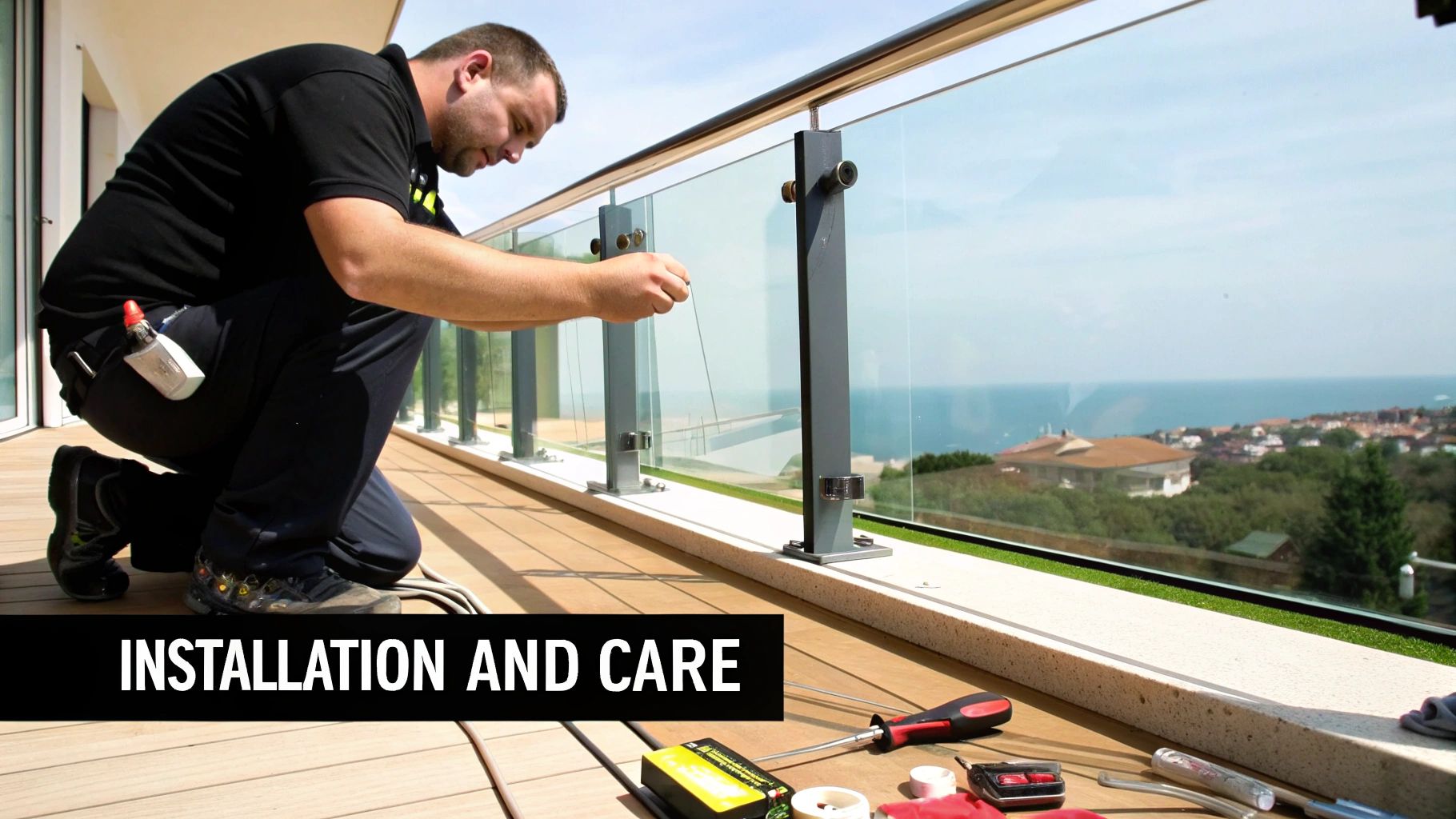
You’ve picked your style and nailed down the measurements. Now comes the final, crucial step: turning that plan into a stunning, lasting feature. While the DIY route might seem tempting, we can't stress this enough: professional installation for a balcony glass panel system is the only way to go. These panels are seriously heavy, and getting the precise, secure fit required to meet safety standards takes specialist know-how and tools.
A pro team knows exactly how to anchor the system securely to different surfaces. Think about it—the fixings needed for a timber deck on a home in Cheshire are worlds apart from those for a concrete balcony in Leeds or a steel frame in York. Using the wrong anchor doesn’t just look bad; it can compromise the safety and integrity of the entire structure.
A professional installation is a well-oiled machine. The team will start by prepping the area, meticulously marking out every fixing point for the base channel or posts. It's all about precision at this stage—making sure everything is perfectly level and aligned before a single piece of glass is even touched.
Once the framework is rock-solid, the glass panels are carefully maneuvered into place. For everything to go smoothly, the fitters need decent weather, which means avoiding rain and high winds. This is as much about their safety as it is about ensuring any sealants or adhesives can cure properly, guaranteeing a robust finish that will last for years.
One of the best things about a balcony glass panel is how ridiculously easy it is to maintain. Keeping that crystal-clear view is simple. Just forget about harsh chemicals or abrasive scourers, as they can easily damage protective coatings and leave scratches on the glass.
Honestly, all you need is a bucket of warm water with a few drops of mild washing-up liquid. That’s it. This simple, gentle solution is perfect for cutting through everyday grime and fingerprints without leaving any streaks or residue behind.
The real secret to a streak-free shine isn’t some expensive chemical cleaner. It’s all in the technique. A simple soapy solution, a quality squeegee, and a microfibre cloth are the only tools you’ll ever need for a perfect finish.
Just follow these easy steps to keep your glass balustrade looking brand new:
If you live in a coastal area like Cumbria, it’s a good idea to rinse the glass with fresh water more often. This stops salt deposits from building up and potentially etching the glass over time. This tiny bit of effort ensures your balcony glass panel remains a stunning, low-maintenance asset. If you ever have specific questions about looking after your balustrade, you can always contact us for some friendly advice.
Even after going through all the details, you probably have a few specific questions buzzing around. That’s perfectly normal. Here are some of the most common queries we get from homeowners across Yorkshire and the North of England, with clear, straight-to-the-point answers.
Honestly, it varies quite a bit, and anyone who gives you a flat price without knowing your project isn't being upfront. The final figure really hinges on a few key choices you'll make.
The type of glass is a big one. Laminated glass, with that extra protective layer sandwiched in the middle, naturally costs a bit more than standard toughened glass. Then there’s the style. A completely frameless system—which needs thicker, structural glass to support itself—will have a higher price tag than a semi-frameless or a classic framed design.
Of course, the overall length and any tricky bits, like corners or odd angles on your balcony, will also play a part. The best way to get a solid number is to use a tool like our Balustrade Calculator for a quick estimate, or better yet, have a chat with us. We can give you a proper quote based on your actual space, with no hidden surprises.
Absolutely. When it's designed and fitted correctly to meet the UK’s strict building regulations, a balcony glass panel system is one of the safest barriers you can choose. Forget any old ideas about fragile glass; these systems are engineered from the ground up for security, using specialised safety glass that’s incredibly tough.
Think about the design itself. There are no vertical bars for a curious child to try and climb, and no gaps for a small dog or cat to squeeze through. What you get is a solid, seamless, and secure barrier that offers total peace of mind. It allows the whole family to relax and enjoy the view without a single worry.
While it might look like a tempting weekend DIY project, we strongly advise against it. This is one of those jobs where professional installation really is essential. For starters, the glass panels themselves are seriously heavy and awkward to manoeuvre. It takes specialist lifting gear and a lot of know-how just to get them into position safely.
But it’s about more than just the weight. The real skill is in the fixing. Securing the panels correctly so the whole structure meets UK safety standards for load-bearing and wind resistance is a precise science. A professional installer knows exactly which fixings to use for your specific base—whether it’s timber, concrete, or steel—and guarantees the job is done right. It's about ensuring long-term safety, not just for today, but for years to come.
You'll be pleasantly surprised at how low-maintenance a glass balcony is. Keeping it sparkling is incredibly simple. All you really need is a soft cloth or a squeegee, a bucket of warm water, and a drop of mild washing-up liquid. Just be sure to avoid any gritty, abrasive cleaners or scouring pads, as they can scratch the glass or damage its protective coating.
If you happen to live near the coast, say in Cumbria or along the Yorkshire coast, it’s a good idea to give the panels a quick rinse with fresh water every now and then. This one simple step is enough to wash away any salt spray before it builds up, keeping your view perfectly clear.
Ready to bring that stunning clarity and modern style to your own home? The team at Binks Glass Solutions is here to help homeowners all across Yorkshire and the North of England. Get in touch today for a free, no-obligation quote and let’s start transforming your view.