
Your Guide to Clamped Glass Balustrade Systems
When people talk about modern, minimalist design that doesn’t compromise on safety, the clamped glass balustrade is often what springs […]

When people talk about modern, minimalist design that doesn’t compromise on safety, the clamped glass balustrade is often what springs […]
When people talk about modern, minimalist design that doesn’t compromise on safety, the clamped glass balustrade is often what springs to mind. It's the system that lets you have it all: robust protection, a sleek aesthetic, and a completely unobstructed view.
Imagine standing on your Harrogate balcony or looking down a stylish new staircase in Leeds, with nothing but clear glass framing the world around you. That’s the magic of a clamped glass balustrade. It acts like a crystal-clear picture frame for your view, where the glass panels offer safety and the clamps provide the strength, all without needing bulky posts or frames.
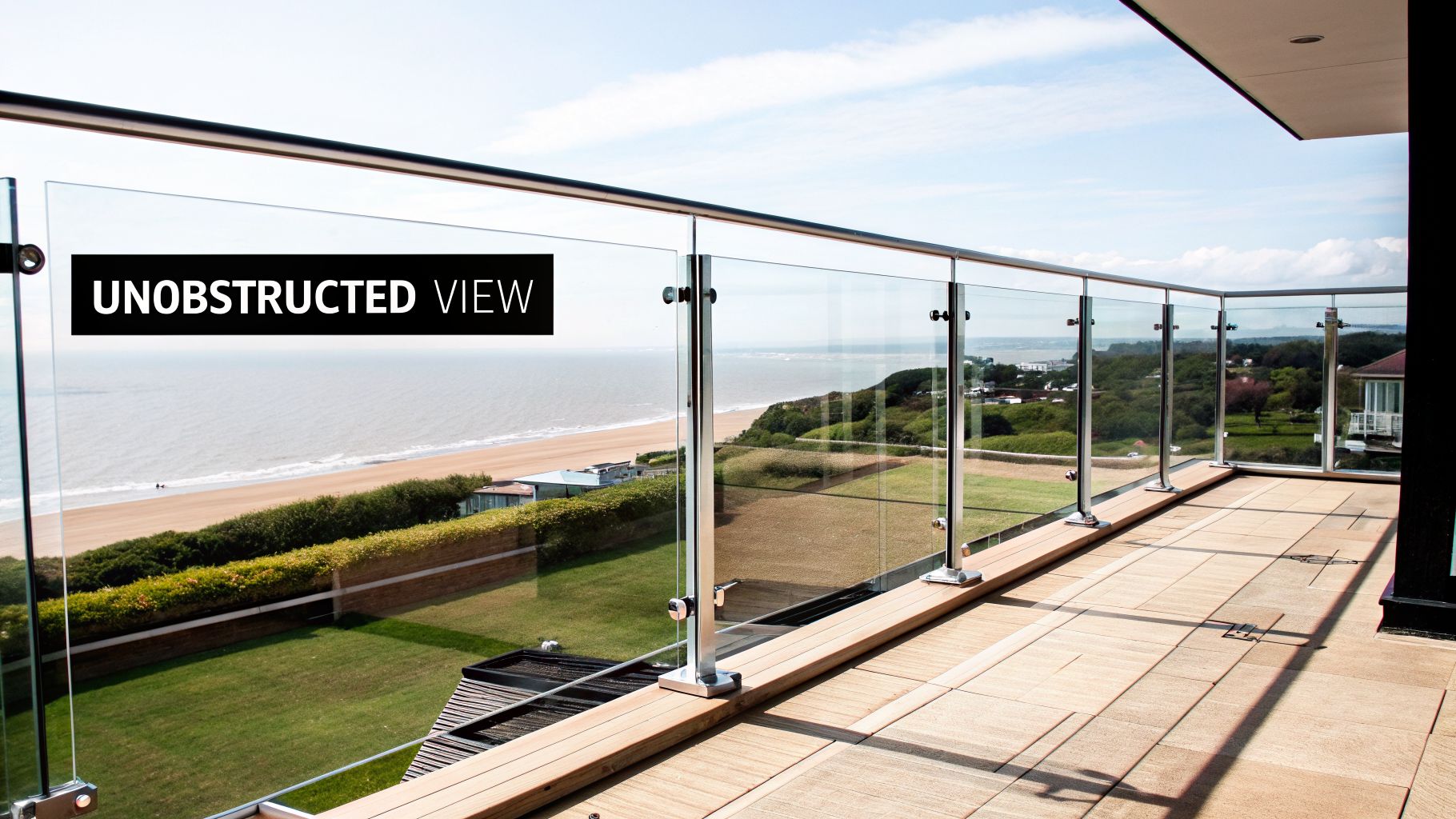
The entire design is defined by how it’s fixed together. Large, tough panels of safety glass are held in place by small, incredibly strong metal clamps. These clamps are mounted directly onto a solid surface – be it a floor, a wall, or a structural post – creating a look that is as strong as it is elegant.
A clamped glass system is beautifully simple, with just a few key parts working in perfect harmony. Once you understand their roles, you’ll see why this design is so popular and effective.
This clean, minimalist approach has become a signature of modern architecture across the North of England, from patios in York to new-builds in Cheshire. It's the perfect blend of safety, light, and sophistication.
The real beauty of a clamped glass balustrade lies in its simplicity. It's a system where robust engineering and minimalist design meet, providing security without sacrificing the view. It makes spaces feel more open, airy, and connected to their surroundings.
The desire for modern, unobtrusive safety solutions has led to a huge rise in the popularity of clamped glass balustrades, especially across Yorkshire and the North. Homeowners want features that open up their space while being fully compliant with building regulations.
In fact, the entire balustrade market is growing, with glass systems projected to see a compound annual growth rate of 5.5% between 2026 and 2034. It's easy to see why. These systems comfortably meet crucial standards like BS 6187:2011, which specifies barrier heights of 1100mm for external balconies, ensuring your stunning view is also a safe one. For a deeper dive into market trends, you can explore UK balustrades market insights on IndexBox.io.
A clamped glass balustrade looks wonderfully simple, but its elegant appearance is the result of a few crucial parts working in perfect harmony. Getting to grips with these components is the first step in seeing how a system will come together, whether it’s for a modern staircase in your Cheshire home or a garden terrace in Cumbria.

At its core, the system comes down to two things: the high-strength safety glass panels that create the clear barrier, and the stainless steel clamps that hold them securely in place. How these two interact is what defines the balustrade’s strength, lifespan, and visual appeal.
The glass is obviously the main event, but it’s a highly engineered product. For any balustrade, safety is non-negotiable, which is why UK regulations demand specific types of reinforced glass.
For ground-level projects or sheltered indoor spots, toughened glass is a great choice. But for any balustrade at height where a fall would be dangerous, laminated glass is the only real option. It provides a continuous safety barrier even after an impact, giving you total peace of mind while a replacement is sorted.
It might not look like much, but the humble glass clamp is the powerhouse of this system. It acts like a small, powerful vice, gripping the glass panel and transferring all the forces into the post or structure it’s fixed to.
The secret lies inside the clamp. Each one contains specialist rubber gaskets, and they do two vital jobs. First, they create an incredible amount of friction to stop the glass from ever slipping. Second, they form a protective cushion, absorbing tiny vibrations and preventing any direct metal-on-glass contact which could cause stress fractures over time. If you want to dive deeper into the engineering, you can learn more about the crucial role of the balustrade glass clamp here.
A classic mistake we see in failed DIY projects is using the wrong size gasket for the glass. Even a 2mm mismatch can ruin the clamp’s grip, making the entire system unsafe. Precision here is everything.
The clamps you choose have a huge say in both the final look and the long-term durability of your balustrade. You have a lot of freedom to pick a style that complements your property, from clean and contemporary to something more classic.
Picking the right style and material for your clamps is a crucial part of the design process. Not only does it define the aesthetic, but it's also vital for the balustrade's long-term durability, especially outdoors. Here's a quick look at the most common options and where they work best.
| Clamp Style | Appearance | Best For | Material |
|---|---|---|---|
| Square | Clean, geometric, sharp lines | Modern, minimalist designs, complements angular architecture. | 304 & 316 Steel |
| D-Shape | Soft, contemporary curve | Versatile choice, works well with both square and round posts. | 304 & 316 Steel |
| Round | Fluid, classic look | Pairing with tubular handrails and posts for a cohesive, softer aesthetic. | 304 & 316 Steel |
While the shape is a matter of taste, choosing the right material is a technical necessity.
Even more important than the shape is the material itself. Stainless steel is the go-to for its strength and finish, but it’s not all the same. It comes in different grades for different environments.
When you install a balustrade, whether it's for a modern balcony in Hull or a classic staircase in Leeds, its number one job is keeping people safe. It’s easy to focus on the stunning, minimalist look of a clamped glass system, but what you can't see is the robust engineering that ensures it meets, and often surpasses, the UK’s tough safety standards.
For us, understanding these rules isn't just about ticking boxes. It’s about giving you peace of mind, knowing that your stylish new feature is a fully compliant and life-saving barrier. In the North of England, two key documents are our bible: Approved Document K (Protection from falling, collision and impact) and the British Standard BS 6187. These aren't just suggestions; they are legal requirements that ensure every balustrade we install is absolutely fit for purpose.
The first thing we look at is height. This isn't just a random number – it's carefully calculated based on the risk of a fall in any given location, designed to prevent an adult from overbalancing.
Just as crucial are the rules on gaps. To protect small children, the regulations are crystal clear: no gap anywhere in the balustrade can be big enough for a 100mm sphere to pass through. This applies to the space between panels and the gap underneath. For a deeper dive into how these rules apply, you can read our complete guide to balustrade building regulations.
Think of that 100mm sphere as a stand-in for a small child's head. It’s a simple but incredibly effective test. If the sphere can't get through, you can be confident your balustrade is safe for the whole family.
A balustrade has to do more than just look good; it has to stand firm. Building Regulations specify the minimum forces, or "loads," a barrier must be able to resist without breaking. This simulates the real-world pressure of someone leaning or stumbling against it.
This is where a professionally installed clamped glass system really proves its worth. The engineering is all about handling these forces. UK Health and Safety Executive (HSE) data from 2021-2025 revealed that falls from balconies contributed to 14% of domestic accidents. This has driven a 32% increase in glass balustrade retrofits across Yorkshire and the North. Clamped systems are specifically designed to provide an infill load resistance of over 0.74kN/m as required by Part K—that’s more than double the 0.36kN/m typical of older wooden systems. In fact, in 2026, Leeds City Council approved over 1,200 new-build projects incorporating clamped glass, a real testament to its trusted status.
The final piece of the safety puzzle is the glass itself. You can't just use any old pane of glass. UK standards demand the use of specialist safety glass, which breaks in a predictable and much safer way.
For any balustrade that protects a drop in height, laminated glass is the only real choice. It provides ultimate peace of mind, ensuring that even if the worst happens and the glass takes a heavy impact, the barrier remains in place. This commitment to using the right materials is what makes your installation safe, compliant, and built to last.
Choosing the right balustrade system is about much more than just picking a design; it's about finding the perfect balance between your aesthetic vision, day-to-day practicalities, and your budget. A clamped glass balustrade delivers a stunning, minimalist look, but to be sure it's the right fit for you, it’s worth seeing how it stacks up against the other popular options out there.
We find that an honest, straightforward comparison is the best way to help our customers in Yorkshire and across the North of England feel confident in their decision. After all, this is a long-term investment in your property.
Let's put it head-to-head with two common alternatives: fully frameless channel systems and the more traditional post-and-rail designs.
A feature-by-feature breakdown helps to quickly see where each system shines. Here’s how clamped glass compares to the ultimate minimalist choice (frameless channel) and the classic go-to (post and rail).
| Feature | Clamped Glass | Frameless Channel | Post and Rail |
|---|---|---|---|
| Aesthetics | Minimalist look with discrete clamps. Maximises light and views. | Ultimate minimalism with no visible fixings for a "floating glass" effect. | Traditional look. Posts and rails create visual breaks. |
| View Obstruction | Extremely low. Small clamps have a negligible impact on the view. | None. Offers a completely uninterrupted, panoramic view. | High. Vertical posts and horizontal rails significantly block sightlines. |
| Installation | Versatile and more forgiving on different surfaces. | Requires a perfectly level, structurally sound base. More complex. | Straightforward, but requires multiple components and fixings. |
| Maintenance | Low. Simple cleaning of glass and occasional wipe-down of stainless steel clamps. | Low. Easy to clean the glass, but the base channel can collect debris. | High. Timber requires regular painting, staining, or sealing to prevent rot. |
| Cost | Mid-range. Offers a great balance of premium aesthetics and value. | Higher-end. The most expensive option due to engineering and material costs. | Lower initial cost, but higher long-term maintenance costs. |
This table gives a great overview, but let's dive into the specifics of what these differences mean for your home.
A frameless channel system is what many people picture when they think of ultimate architectural minimalism. The glass panels are set into a continuous aluminium channel along the floor, which hides every single fixing.
While this creates a truly breathtaking "floating glass" effect, the installation is more involved and almost always more expensive. Channel systems demand a perfectly level and incredibly strong base, which can mean more prep work for your builder. Clamped systems, on the other hand, are more adaptable to slight imperfections in the mounting surface.
The choice here often comes down to budget and priorities. If you want that flawless, edge-to-edge glass wall with zero visible hardware, and your budget allows, a channel system is second to none. If you want a clean, modern look that's a bit more forgiving to install and cost-effective, the clamped system is the ideal solution.
This simple flowchart is a great tool for understanding how location influences design, which is a crucial safety factor no matter which system you choose.
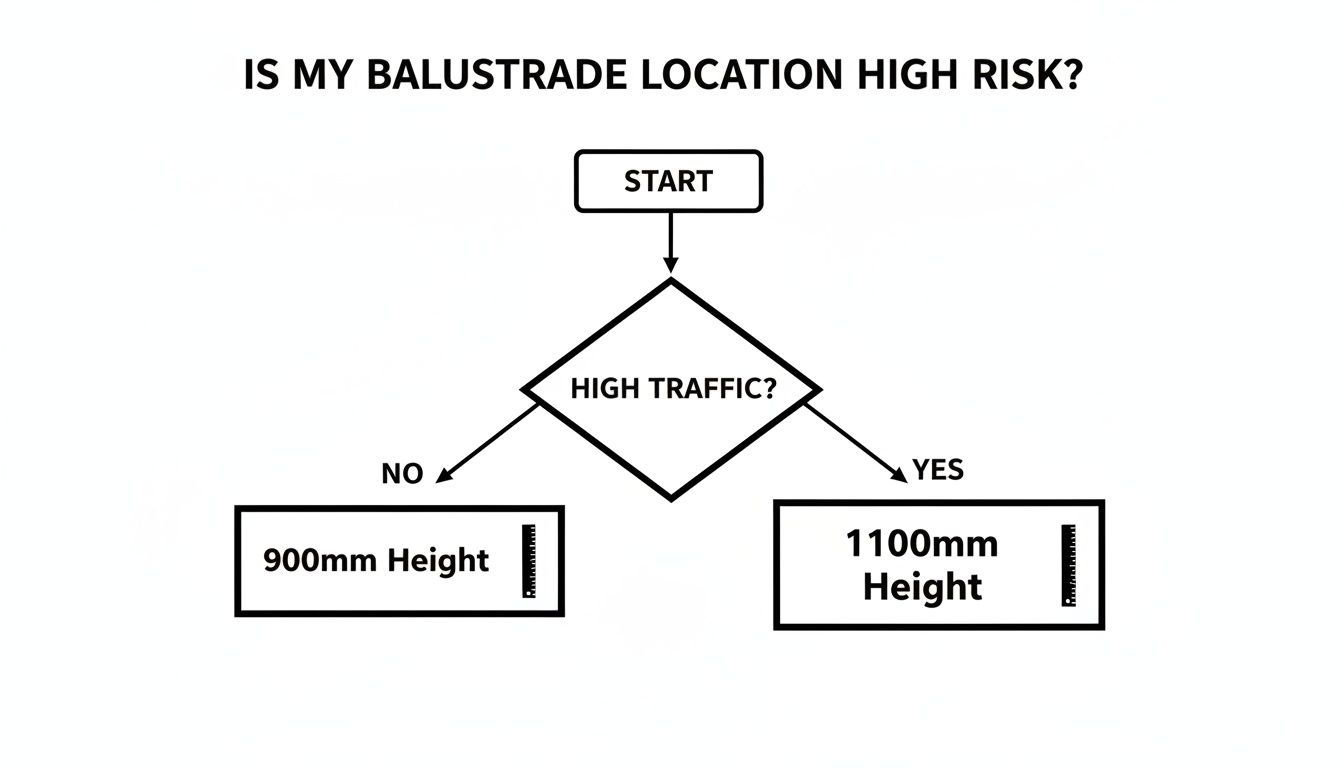
As you can see, areas with more footfall demand a taller barrier to meet safety regulations. It's a non-negotiable part of any professional installation.
Traditional balustrades, usually with timber or steel posts, have been a fixture in UK homes for generations. They can suit classic properties and often have a lower upfront cost. But these initial savings come with some serious trade-offs, both in looks and long-term effort.
Views and Light: This is the biggest difference by a country mile. A post-and-rail system, by its very nature, creates a cage-like effect that carves up your view and blocks light. A clamped glass system is designed to do the exact opposite—to protect you while preserving every bit of that view.
Maintenance: Anyone with a wooden deck or fence knows the drill. Timber needs regular staining, painting, and sealing to stop it from rotting, especially in our damp northern climate. In contrast, the grade 316 stainless steel clamps and toughened glass we use just need a simple clean to look brand new.
Ultimately, a clamped glass balustrade occupies a fantastic sweet spot. It delivers the high-end, contemporary aesthetic that people love, backed by robust performance and sensible long-term value. It’s no wonder it has become one of the most versatile and popular solutions we install.
A professional installation is the very foundation of a safe, stunning, and long-lasting clamped glass balustrade. That flawless, minimalist finish you’re aiming for doesn’t happen by accident; it’s the direct result of meticulous planning and expert hands-on work. Understanding what’s involved helps to show why getting a specialist in is so critical for a secure, perfect result.
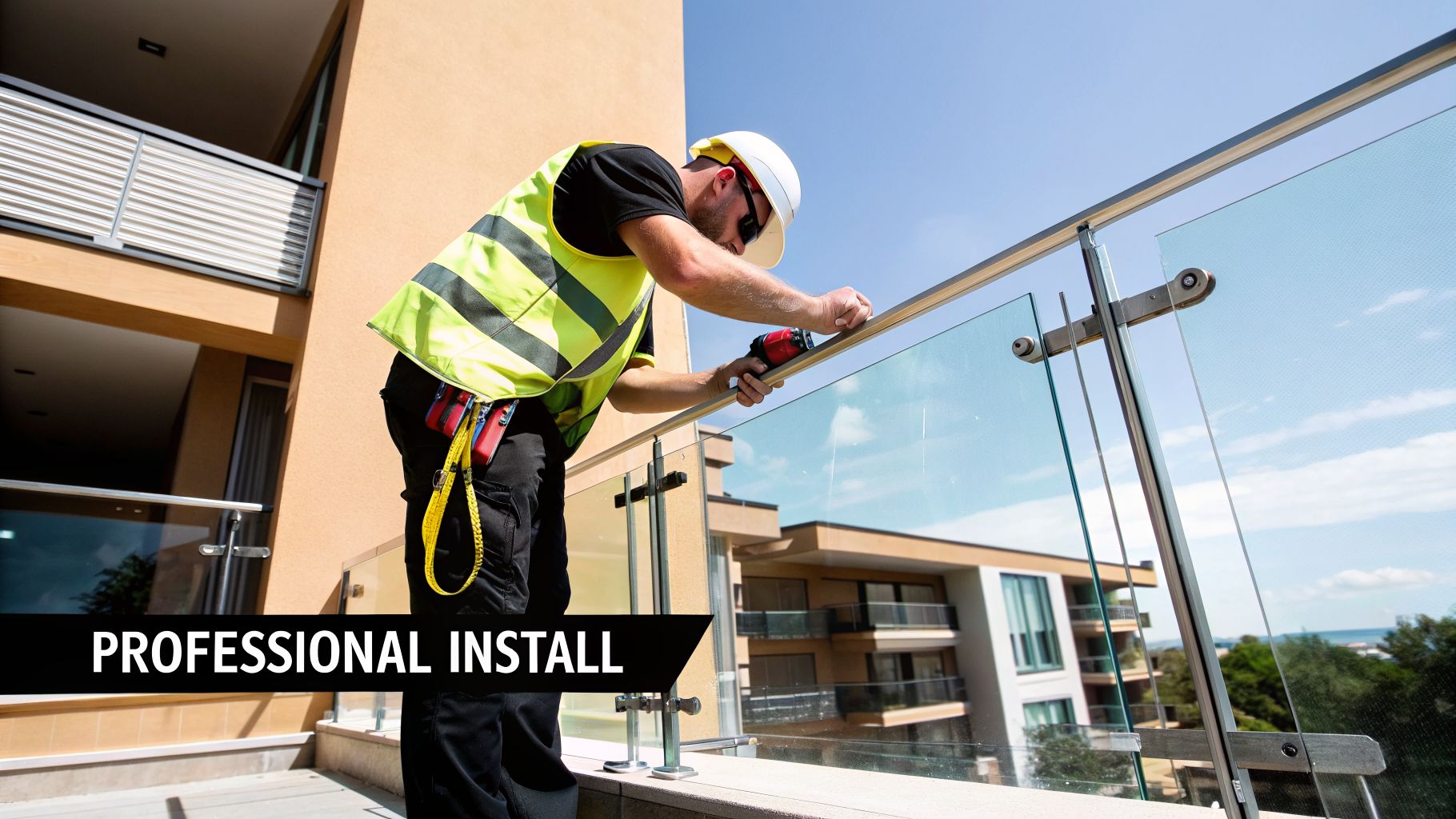
The real work starts long before a single tool is picked up. Step one is always a detailed site survey. One of our specialists will visit your property, whether it's a home in York or a business in Leeds, to take exact measurements and properly assess the site. This is where we answer the most critical questions.
One of the most important jobs during the survey is checking the structural integrity of whatever the balustrade will be fixed to. A clamped glass system transfers its entire load directly into the mounting surface, so that foundation has to be rock-solid.
This initial analysis is absolutely crucial. It’s what separates a safe, professional installation from a potential hazard, and it’s a key reason we advise against DIY attempts that might overlook these essential structural checks.
A common DIY pitfall is underestimating the forces involved. A balustrade doesn't just hold its own weight; it must resist leaning pressure, wind load, and impacts. Professional installation ensures the fixings are engineered to handle all these forces safely.
Once the site survey is complete and your glass has been manufactured to precise specifications, our team can get started on the physical installation. The process is methodical, clean, and exact.
First, we prepare the mounting surface, making sure it’s perfectly clean and ready. The positions for every single clamp are marked out with millimetre accuracy. This guarantees the perfect alignment of your glass panels—any mistake here, however small, would be immediately obvious in the final look.
Next, the clamps are securely fixed to the structure using the correct heavy-duty bolts or anchors. The rubber gaskets are then fitted inside the clamps before we carefully lift the glass panels into position. Finally, we tighten the clamps to the correct torque. It’s a delicate balance: tight enough to create immense friction and grip, but not so tight that it risks damaging the glass.
This precision ensures each panel is held rigidly, forming a single, solid, and beautiful barrier. For all our projects across the North of England, from Darlington to Hull, this professional process is our promise of a flawless and compliant finish, every single time.
Working out the investment for a new clamped glass balustrade is a natural and important part of the planning process. While a bespoke system certainly has a premium feel, the final price really comes down to a few key choices you get to make along the way. It’s not one fixed figure, but a total shaped by your material choices and the size of your project.
The brilliant part is that you’re in the driver’s seat. Every decision, from the type of glass you choose to the specific finish on the clamps, gives you the flexibility to guide the project towards your budget without ever having to compromise on style or, most importantly, safety.
A few core elements come together to shape the final price of your clamped glass balustrade. The biggest drivers are the materials you select and the overall length you need to cover.
To take the mystery out of budgeting, we’ve built a simple tool to help you get a personalised estimate in just a few minutes. Whether you’re a homeowner in York planning a patio or a contractor in Leeds scoping out a new build, our Balustrade Calculator is designed for you.
Our calculator is all about clarity. You just enter your project details, and it gives you an instant estimate. It removes the guesswork and lets you plan your budget with real confidence.
The process is incredibly straightforward. Just select your balustrade style, choose your glass, decide if you want a handrail, and pop in the total length. You’ll get a detailed price for your project there and then. For a more in-depth look at what goes into the numbers, feel free to explore our complete guide on the cost of glass balustrades.
Once you start picturing a sleek, modern clamped glass balustrade for your home, a few practical questions naturally come to mind. It’s a normal part of the process, and we get asked these all the time by clients across Yorkshire and the North of England.
Here, we’ve put together straightforward answers to the most common queries, giving you the clarity and confidence to move forward with your project.
One of the best things about a clamped glass balustrade is how simple it is to keep it looking pristine. For the glass panels themselves, a bit of warm water with a mild detergent on a soft cloth is usually all you’ll ever need. Your standard household glass cleaner works a treat, too.
The stainless steel clamps just need a quick wipe with a damp cloth to clear away dust and fingerprints. If you’re in a coastal spot like Hull, the salty air means you’ll want to clean them a bit more often with a proper stainless steel cleaner. This prevents any surface deposits from building up and keeps that finish looking perfect for years.
For a truly flawless look, knowing the pros' secrets is key. You can discover the best way to clean glass for a streak-free finish. It’s also good practice to give the clamps a quick check every now and then to make sure everything is still tight and secure.
Yes, absolutely. In fact, fitting a clamped glass system onto a wooden deck is one of our most popular projects. It creates a stunning, contemporary feature that opens up any garden.
There is one non-negotiable rule, though: the deck's substructure has to be robust enough to handle the weight and forces involved. This means the clamps must be bolted directly into the deck’s main structural joists, not just the top decking boards.
A professional site assessment is essential for any decking project. This step ensures that we can identify and fix to the structural joists, guaranteeing a safe installation that fully complies with UK Building Regulations. It's the most important step for long-term safety.
This is a great question, and the answer depends on the type of glass we use and where the balustrade is being installed. In some situations, using a thicker, laminated safety glass creates a barrier that’s strong enough on its own, without any need for a handrail on top.
However, UK Building Regulations often lean towards including a handrail. It adds extra rigidity across the entire system and provides a secure handhold, which is especially important for commercial spaces or on any staircase. We’ll always advise on the exact requirements for your project, whether you're in Leeds, Harrogate, or anywhere in between, to ensure 100% compliance and safety.
Choosing a local specialist who operates in Yorkshire and the North of England gives you a real home-field advantage. You get advice that’s genuinely tailored to our region—from understanding the coastal weather patterns in Cumbria to navigating the specific planning quirks in cities like York or Darlington.
As a proud local company, we offer:
Ready to bring your vision to life with a modern, secure clamped glass balustrade? The team at Binks Balustrades is here to help homeowners and developers across the North of England. For expert advice and a no-obligation quote, get in touch with us today. Contact us now.