
A Practical Guide to Balustrade Glass Clamps
When it comes to creating a safe, minimalist barrier, balustrade glass clamps are the essential fittings that securely grip the […]

When it comes to creating a safe, minimalist barrier, balustrade glass clamps are the essential fittings that securely grip the […]
When it comes to creating a safe, minimalist barrier, balustrade glass clamps are the essential fittings that securely grip the glass panels, getting the job done without the need for bulky frames. These small but mighty components are responsible for both the structural integrity and the clean, modern aesthetic that makes glass balustrades so popular.
For any project here in the North of England, choosing the right clamps is absolutely crucial for achieving a finish that's not just stylish, but built to last.
Think of balustrade glass clamps as the strong, silent heroes of any contemporary glass barrier. They are the cleverly engineered components that hold the entire system together, providing a firm, secure grip on each individual glass panel. Their main job is to create a safe, robust structure while being as discreet as possible.
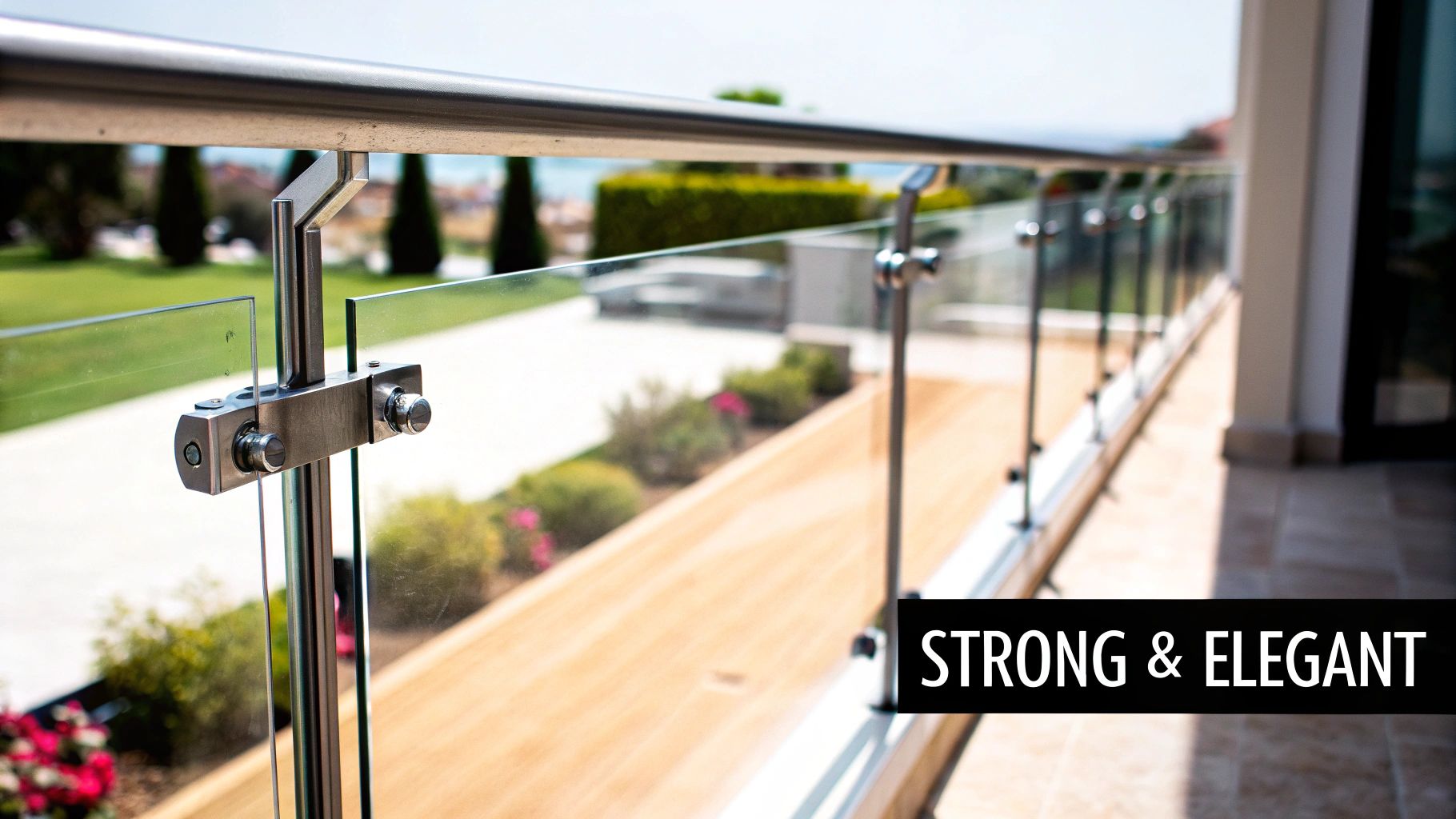
A good analogy is a firm handshake—strong enough to give you complete confidence, yet elegant enough that it doesn't draw all the attention. It's this perfect balance that makes them a go-to choice in modern architecture, especially for homeowners wanting to maximise light and open up their views.
For property owners all across Yorkshire and the North, from Leeds to Harrogate, these clamps are the key to unlocking those sought-after minimalist designs. They allow for uninterrupted sightlines, whether you're looking out over a garden, a city skyline, or down onto an interior landing. The frameless effect they create instantly makes spaces feel larger and more open.
But their role goes far beyond just looking good. The core function of balustrade glass clamps is safety, plain and simple. These components are meticulously engineered to:
A well-designed balustrade relies completely on the performance of its clamps. They are the critical connection point where aesthetic ambition meets non-negotiable safety standards, ensuring the final installation is both beautiful and completely secure.
Choosing the right clamp isn’t a minor detail you can overlook; it’s a foundational decision that impacts the entire project's success. An incorrectly specified clamp could compromise the safety of the whole system. Likewise, a poor-quality material could lead to rust and deterioration, a real concern in the often-damp Northern English climate.
This guide will walk you through everything you need to know about these vital components. We'll explore the different types, materials, and sizing considerations, setting you up to make the perfect choice for your specific project. By understanding their fundamental purpose, you can ensure your balustrade is as safe as it is stylish.
Picking the right material for your balustrade glass clamps is one of the most important decisions you'll make. It’s a choice that directly impacts how long your balustrade will last, how it looks, and how well it stands up to the elements. Not all clamps are created equal, and the wrong one can lead to rust, ugly discolouration, and even safety problems down the line.
Think of the material as the clamp's DNA—it determines how it’s going to behave in a specific environment. For the famously varied and often damp climate we have across the North of England, from the salty sea winds in Cumbria to the urban air in Leeds, getting this right is absolutely critical.
The vast majority of high-quality balustrade glass clamps are made from stainless steel, but you need to know that the grade of that steel makes a world of difference. The two you’ll come across most are Grade 304 and Grade 316.
Grade 304 Stainless Steel: This is the workhorse for anything happening indoors. It offers fantastic durability and corrosion resistance in controlled, dry environments. It’s the perfect choice for an indoor staircase, a mezzanine in a Harrogate home, or a sleek glass partition in a York office where it won’t ever see a drop of rain.
Grade 316 Stainless Steel: Often called ‘marine grade’ steel, this is the only sensible choice for any project that's outside. It contains an element called molybdenum, which gives it far superior resistance to corrosion from salt, chlorine, and pollution. If your balustrade is going outdoors, Grade 316 is non-negotiable.
Let’s paint a real-world picture: imagine a stunning new balcony being installed on a coastal property in Cumbria. The air is heavy with salt and damp. Using Grade 304 clamps here would be a classic false economy; within just a few years, they’d almost certainly show signs of rust and 'tea staining', ruining both the look and the structural integrity. For a job like this, only Grade 316 steel offers the long-term protection needed.
Beyond the raw material, the finish of your glass clamps plays a massive part in the final look and feel of your balustrade. The finish isn’t just about style; it can also affect how much cleaning is involved. The two most popular finishes offer very distinct looks to match different architectural designs.
Brushed Satin Finish
A brushed or satin finish has a subtle, matte appearance with very fine parallel lines brushed into the surface. It’s an incredibly popular choice because it’s brilliant at hiding fingerprints and small scuffs, making it a very practical option for busy areas. This understated look blends perfectly with contemporary and minimalist designs, giving a sophisticated feel without being too shiny or reflective.
Mirror-Polished Chrome Finish
For a bolder, more luxurious statement, you can't beat a mirror-polished finish. It’s highly reflective and gleams just like chrome, creating a bright, eye-catching effect that works beautifully in modern and classic interiors alike. While it looks absolutely stunning, just be aware that it will show up fingerprints and water spots more easily, so it needs a bit more of a regular wipe-down to keep it looking its best.
To help you decide, here’s a quick rundown of your main options.
Use this quick reference table to match the right clamp material and finish to your project's location and desired aesthetic.
| Material or Finish | Ideal Location | Primary Advantage | Best For Aesthetics |
|---|---|---|---|
| Grade 304 Steel | Indoor staircases, landings, mezzanines | Cost-effective and durable for interiors | Matches most indoor metalwork |
| Grade 316 Steel | Outdoor balconies, patios, coastal areas | Superior corrosion and rust resistance | Essential for longevity outdoors |
| Brushed Satin | High-traffic areas, modern minimalist designs | Hides fingerprints and minor marks | Understated and sophisticated |
| Mirror Polished | Feature staircases, luxury interiors | Bright, reflective, and decorative | Bold and eye-catching statement |
Ultimately, your choice should create a cohesive look with the other fittings in your space. For instance, if you have brushed steel door handles and light switches, brushed satin clamps will tie everything together beautifully. Likewise, if you're after a specific vibe, like the warm, rich tones found in certain designs, you might even explore custom options. You can see just how much finishes can transform a project by exploring options like bronze frameless glass balustrades, which really showcase how colour and finish can create a unique atmosphere.
When it comes to a glass balustrade, getting the technical details right isn't just a good idea—it's completely non-negotiable. The safety and stability of the entire system hinge on correctly matching your balustrade glass clamps to the thickness of your glass panels. This pairing is the absolute foundation of its strength.
Think of it like this: you wouldn't hang a heavy, ornate mirror with a tiny picture hook. It’s just common sense. The hook would fail, and the mirror would come crashing down. The exact same principle applies here. An undersized clamp simply doesn't have the muscle or the grip to safely hold a thick, heavy panel of toughened safety glass.
For contractors and specifiers working on projects across Cheshire and York, this kind of knowledge is second nature. A correctly specified system is the difference between a durable, compliant installation that provides peace of mind for years and one that's a ticking time bomb.
In the UK, glass balustrades almost always use toughened or laminated glass, which comes in a few standard thicknesses. Each one has a corresponding clamp size designed to hold it perfectly, often using interchangeable rubber gaskets to get that snug, secure fit.
This quick visual guide helps distinguish between the two most common clamp materials and where they should be used.
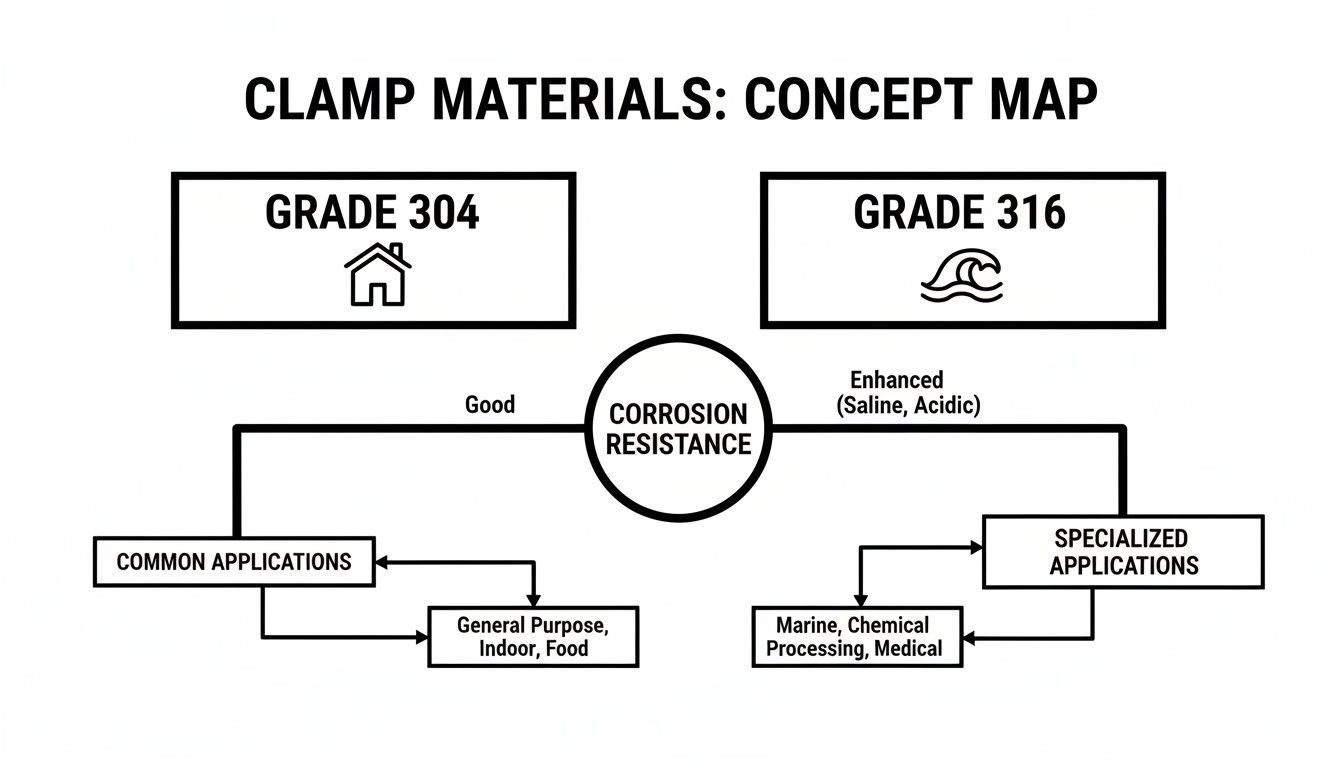
As you can see, Grade 304 stainless steel is fine for protected indoor settings. But for anything outside exposed to the British weather, the superior corrosion resistance of Grade 316 is absolutely essential.
It’s not just about glass thickness. You also have to consider the load the balustrade is expected to bear. Load-bearing capacity is a technical term for the amount of force the whole system—glass, clamps, and fixings—can withstand without failing. This includes steady pressure from people leaning on it (line load) and sudden impacts from wind or objects (point load).
The number and spacing of your balustrade glass clamps are just as critical as their size. Correct spacing ensures that any load is distributed evenly across the panel and transferred safely to the structural posts or wall, preventing dangerous stress points from forming in any single area.
As a rule of thumb, a standard one-metre-wide panel of 10mm glass usually needs at least two clamps on each side (four in total) to meet safety standards. But this is just a general guideline. To really get to grips with the capabilities and differences between glass types, it’s worth reading up on laminated and toughened glass, as this is vital for making an informed choice.
Always, always follow the manufacturer's specifications. For larger or more complex projects, you should consult a structural engineer. They'll run the numbers based on your project's specific needs, ensuring the final installation isn't just beautiful but is 100% compliant with UK safety regulations. This is the technical diligence that separates a professional, lasting installation from a potential disaster.
Navigating the world of building regulations can often feel like a maze, but it all boils down to one simple, crucial goal: keeping people safe. When you're installing a glass balustrade, these rules aren't just red tape; they are a non-negotiable promise that your beautiful new feature offers real protection from falls. And at the heart of that promise are the strength and reliability of your balustrade glass clamps.
In England, the go-to guide is Approved Document K, which covers 'Protection from falling, collision and impact'. Think of it as the safety blueprint for all balustrades and guardrails, whether they're in a private home in Harrogate or a busy commercial space in Leeds.
One of the clearest parts of the regulations is the minimum height of the barrier. This isn't a one-size-fits-all rule; it changes based on where the balustrade is and the potential risk of a fall.
These heights aren’t just plucked from thin air. They’re carefully calculated to prevent an average adult from accidentally toppling over. Your entire balustrade system, held firmly by its clamps, has to meet these minimums to be considered compliant and safe.
Height is only half the story; strength is the other, absolutely critical part. A balustrade has to withstand specific forces without buckling or failing. This is measured as a ‘line load’—a term that simulates the real-world pressure of people leaning against the top of the barrier. It's measured in kilonewtons per metre (kN/m).
The required strength depends entirely on the building's use:
| Building Type & Location | Required Line Load (kN/m) |
|---|---|
| Single-family dwellings | 0.74 kN/m |
| Public areas (offices, restaurants) | 1.5 kN/m |
| High-traffic areas (theatres, shopping centres) | 3.0 kN/m |
This is precisely where the quality of your balustrade glass clamps becomes non-negotiable. It's the clamps' job to transfer every bit of that force from the glass panel through to the posts or structural fixings. Using properly tested, high-quality clamps rated for the right load is the only way to guarantee the system is strong enough. Getting this wrong isn't an option—underspecified clamps can fail under pressure, leading to catastrophic collapse.
Meeting these regulations isn’t about just ticking a box for an inspector. It’s about creating genuine peace of mind for your family, guests, or customers, knowing that every single component was chosen to keep them safe. For a deeper dive, check out our detailed guide on building regulations for balustrades.
The UK's dedication to these high safety standards has built a strong market. The frameless structural glass balustrade sector here enjoys a healthy 4.6% growth rate and makes up a huge 24.6% of the entire European market. This shows a real appreciation for both great design and uncompromising safety. For installations in public or commercial settings, the UK workplace safety compliance guide offers further valuable insights. Every project we undertake across the North of England is built to these exacting standards, ensuring it's not only beautiful but fundamentally safe.
Choosing the right balustrade glass clamps can feel daunting, but it doesn't have to be. By breaking it down into a logical checklist, you can turn a complicated task into a straightforward process. Think of this as your practical guide, pulling all the crucial considerations into one place so you don't miss a thing.
Whether you're a homeowner in Leeds planning a new patio, an architect in York drawing up specifications, or a contractor on-site in Cheshire, this checklist will give you the confidence that every choice you make is the right one. Following these steps ensures your balustrade will be safe, compliant, and a perfect match for your design vision.
Before you even think about clamp styles or finishes, you need to know one thing: the exact thickness of your glass panels. This is the single most important piece of information you'll need. Clamps are precisely engineered to fit specific thicknesses—usually 8mm, 10mm, or 12mm.
Trying to use a 12mm clamp on a 10mm panel will create a dangerously loose fit. On the flip side, forcing a 10mm clamp onto 12mm glass is impossible and risks damaging the panel. Always confirm your glass specification first to guarantee a secure, snug grip.
Next up, think about the environment. Where exactly is this balustrade going to live? The location directly dictates the material your clamps need to be made from to ensure they last.
With the technical bits sorted, you can now focus on the aesthetics. The shape and finish of your balustrade glass clamps play a huge role in the final look and feel of your project.
The demand for stylish, practical barriers is growing, and glass balustrades are a huge part of that. The global balustrade market was valued at USD 4.68 billion in 2024 and is projected to hit USD 7.24 billion by 2032. You can find more insights into these market trends over at Verified Market Research.
Finally, you need to calculate the correct number of clamps for each glass panel. This isn’t just about stability; it's about safety and meeting UK building regulations.
While a common rule of thumb is two clamps per side for a standard one-metre panel, this should only be treated as a rough guideline. The final number will always depend on the panel’s width, height, and thickness, as well as the specific load-bearing requirements for your project. Always consult the manufacturer’s data sheets or speak with a structural engineer to confirm the precise number and spacing needed to create a robust and secure system.
A stunning glass balustrade is only as good as its installation. Getting the setup right is what makes the difference between a system that just looks good and one that is safe, secure, and will stand the test of time. Precision is everything.
While this isn't a full DIY manual, understanding the fundamentals will ensure your investment looks fantastic for years to come.
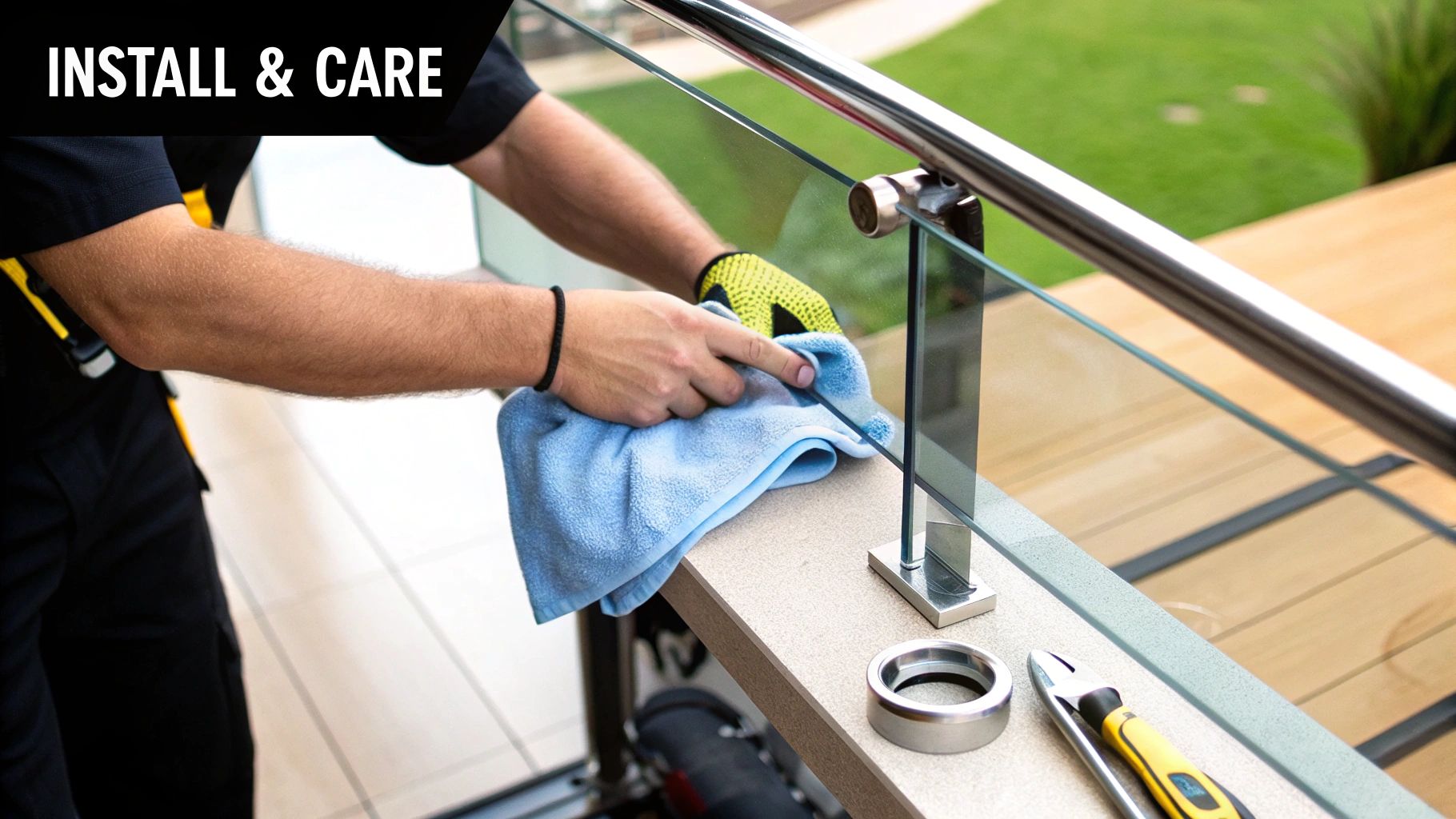
The secret to a secure grip often comes down to the smallest details. Every high-quality clamp is supplied with rubber gaskets, and these are non-negotiable. They cushion the glass, preventing direct metal-on-glass contact which could create dangerous stress points. Think of them as shock absorbers, spreading the pressure evenly and stopping vibrations from causing fractures.
A rock-solid installation boils down to three key things: perfect alignment, correct torque, and using all the right parts. Nail these, and you’re guaranteeing the safety and longevity of the whole system.
The goal is a firm, confident hold—not a crush grip. A professionally installed clamp secures the glass with precisely the right amount of pressure, guaranteeing stability without introducing any risk of stress-related failure.
Once everything is installed, keeping your clamps in top condition is straightforward, but crucial—especially with the damp climate we often get across the North of England.
A little regular cleaning doesn't just keep your balustrade looking pristine; it protects the materials. To maintain that brilliant stainless steel finish, just wipe the clamps down with a soft cloth and soapy water, then give them a good rinse and dry.
This simple job prevents dirt from building up, which can lead to ‘tea staining’ – those small brown spots that can appear on stainless steel in damp environments. Whatever you do, avoid abrasive creams or scouring pads, as they’ll scratch the surface.
In the unfortunate event of a glass panel breaking, knowing how to handle it safely is key. Having a plan for safely disposing of broken glass protects everyone. A little care goes a long way in ensuring your balustrade looks as good as the day it was installed.
As you get closer to finalising your plans, a few last-minute questions are bound to pop up. This final section tackles some of the most common queries we hear about balustrade glass clamps. Think of it as a handy cheat sheet to clear up any lingering uncertainties about safety, materials, and getting the installation just right.
Getting these details sorted will give you the confidence to move forward, knowing your new balustrade will be both stunning and completely secure.
The number of clamps you need isn't a one-size-fits-all answer. It depends entirely on the glass panel's size and thickness, along with the specific load-bearing demands of your project. You might hear a rule of thumb about using four clamps for a standard one-metre-wide panel of 10mm toughened glass, but you should treat this as a rough guide only.
The only way to guarantee safety and compliance is to follow the manufacturer's data sheets and any structural calculations provided for your job. This ensures you meet UK safety standards without question. When in doubt, consulting a specialist is always the smartest move.
Crucial Takeaway: Never, ever guess the number of clamps. Stick to the official specifications to ensure the system can safely handle the required loads and protect everyone who uses it.
We get asked this a lot, and the answer is a firm no. We strongly advise against it. Grade 304 stainless steel is designed purely for indoor use and simply can't stand up to the damp, unpredictable UK weather we're all used to.
For any outdoor project—especially in coastal areas like Cumbria or industrial spots—you must use Grade 316 'marine grade' stainless steel. It’s a small detail that makes a huge difference, ensuring your clamps stay strong, safe, and rust-free for years to come.
While you'll need standard tools like a drill, level, and tape measure, the one specialist tool we highly recommend is a torque wrench. Using one is the secret to a professional and truly safe installation.
A torque wrench lets you tighten the fixings to the exact force recommended by the manufacturer. This prevents the two most common installation mistakes: leaving the glass dangerously loose, or over-tightening and creating stress points that could cause the glass to fail. For a perfect, secure finish, precision is key.
Ready to start your project with confidence? The team at Binks Glass Solutions offers local expertise for homeowners and contractors across Harrogate, Leeds, York, and the North. For advice, pricing, or to get a tailored quote with our Balustrade Calculator, contact us today.