
Your Guide to Glass Balustrade Clamps in Northern England
Glass balustrade clamps are the unsung heroes of modern design. These small but mighty fittings are what allow you to […]

Glass balustrade clamps are the unsung heroes of modern design. These small but mighty fittings are what allow you to […]
Glass balustrade clamps are the unsung heroes of modern design. These small but mighty fittings are what allow you to have a sleek, minimalist glass barrier without needing a bulky, view-blocking frame. Think of them as discreet but powerful hands, gripping the glass panels firmly to keep them safe and secure, all while letting the light flood in.
Put simply, glass balustrade clamps are expertly engineered fittings designed to hold toughened or laminated glass panels securely in place. They’re the key component in semi-frameless and post-supported balustrade systems – the kind you see in homes all across Northern England, from contemporary renovations in Leeds to scenic balconies in Cumbria. Their job is to create a stable, safe barrier without spoiling the clean, open aesthetic that makes glass so popular.
Without these robust little components, a glass barrier would have no structural integrity. It wouldn’t be able to withstand any force, making it completely unsafe. That’s why choosing the right clamp isn't just a minor detail; it’s the critical first step for any successful balustrade project, ensuring you get both beautiful design and complete peace of mind.
Modern architecture is all about celebrating light, space, and clean lines. Glass balustrade clamps are central to achieving this look because they get rid of the need for cumbersome frames that interrupt your view. It's an approach that's becoming more and more popular across the UK, for both brand-new builds and renovation projects.
The market certainly reflects this. The frameless structural glass balustrade sector in the UK now commands a 24.6% share of the entire European market, which shows just how dominant this style has become. This isn't just a trend for big city projects; it's being embraced in regional hubs like Harrogate and York, where homeowners want that blend of modern style and unwavering safety. You can discover more about the balustrade market trends and their UK growth.
A well-chosen clamp does so much more than just hold a piece of glass. It’s what enables a design that connects your indoor and outdoor spaces seamlessly. It's the small detail that makes a grand architectural vision possible, turning a simple safety feature into a real statement of style.
Choosing the right clamp means thinking about a few key things:
Picking the right material for your glass balustrade clamps is one of the most critical decisions you’ll make. It directly affects how long your installation will last and, of course, how it looks. Think of it like choosing the right coat for the weather – a vital consideration, especially with the famously unpredictable climate across Northern England. Get it wrong, and you could be looking at rust and a weakened system; get it right, and you’re set up for years of strength and beauty.
Your main choice will be between two different grades of stainless steel. Each is engineered for a specific job, and understanding the difference is the key to a project that not only looks great on day one but stays that way for the long haul.
When you’re installing a balustrade indoors—say, for a staircase in a Leeds townhouse or a mezzanine in a smart York apartment—Grade 304 stainless steel is the industry standard. It’s more than tough enough to handle a controlled indoor environment, offering brilliant durability and corrosion resistance away from the rain and coastal air. It’s a solid, cost-effective choice for any internal project.
But the moment you step outside, the rules change. For any outdoor installation, Grade 316 stainless steel is non-negotiable. This is what’s known as ‘marine-grade’ steel, and it contains an element called molybdenum that gives it vastly superior resistance to rust and corrosion. Whether it’s for a windswept balcony in Cumbria or a garden patio in Hull, Grade 316 is the only choice to guarantee your balustrade’s structural integrity and pristine look for years to come.
By choosing Grade 316 for external projects, you're not just buying a clamp; you're investing in long-term safety and preserving the clean, modern aesthetic of your balustrade against the unpredictable northern weather.
The image below sums up the core benefits that make glass balustrades so appealing in the first place—all of which rely on getting these foundational component choices right.
Safety, style, and an open view are what it’s all about, and your choice of clamp material underpins all three.
Once you've nailed down the right grade of steel, the next step is picking a finish that fits the style of your property. This is the fun part, where you decide on the final look and feel of the entire system.
There are two main finishes to consider:
To help you decide, here’s a quick comparison of the materials and finishes available.
| Material/Finish | Best For | Corrosion Resistance | Maintenance Level | Aesthetic |
|---|---|---|---|---|
| Grade 304 Stainless Steel | Indoor applications (stairs, landings) | Good | Low | Available in satin or polished finishes. |
| Grade 316 Stainless Steel | Outdoor & coastal areas (balconies, patios) | Excellent (Marine Grade) | Low | Available in satin or polished finishes. |
| Brushed Satin Finish | High-traffic areas, contemporary designs | Dependent on steel grade | Very Low (hides marks) | Soft, modern, and understated. |
| Polished Mirror Finish | Luxury indoor spaces, feature installations | Dependent on steel grade | Low (shows fingerprints) | Bold, bright, and highly reflective. |
A great tip is to think about how your chosen finish will tie in with other metalwork like door handles or window frames to create a really cohesive, professional look. For a bit of inspiration on how these different options come together in the real world, you can explore designs featured in home and garden blogs focused on Northern England properties.
Not all glass balustrade clamps are created equal. Think of it like choosing the right tool for the job – picking the correct clamp is absolutely essential for both the final look and the structural integrity of your balustrade. Getting your head around the main options will help you match the hardware to your project's goals, whether you’re after a classic post-supported system or a sleek, minimalist frameless design.
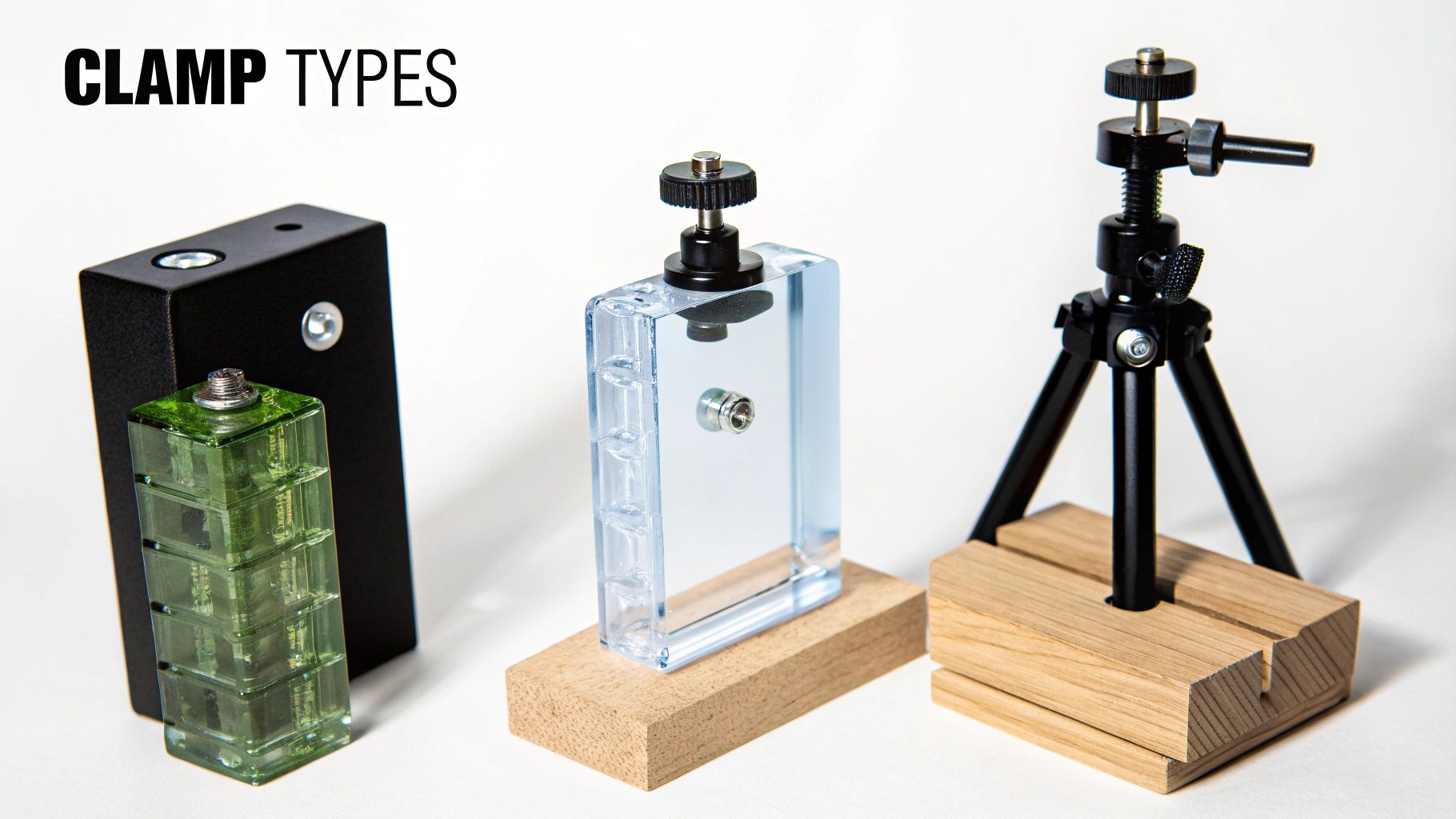
The two shapes you'll come across most often are D-shaped and square clamps. These are really the workhorses of the semi-frameless balustrade world, designed to be fixed securely onto timber, stainless steel, or composite posts. D-shaped clamps give a softer, rounded profile that works brilliantly with circular posts, whereas square clamps offer a crisp, geometric look that's perfect for contemporary designs with sharp, clean lines.
Beyond just the shape, how the clamp is mounted is a major point of difference. Post-mounted clamps are the traditional choice, attaching directly to the vertical posts that provide the main support for the balustrade. This method is straightforward and highly effective, creating the kind of secure barrier you see in countless homes across Yorkshire and the rest of the UK.
But if you’re chasing that pure, uninterrupted frameless look, floor-mounted brackets and clamps are a seriously elegant alternative. These fittings are fixed directly into the floor or substrate, making the glass panels look as if they're rising seamlessly from the ground. It’s an approach that maximises transparency and is ideal for projects where a completely clear view is the number one priority.
Understanding the mechanical difference between clamp types is just as important as the visual. Your choice will influence everything from the installation process to the final, clean look of your balustrade.
The way a clamp actually grips the glass panel is another crucial detail. The vast majority of modern glass balustrade clamps use a friction-fit system. It’s a clever design that works like a powerful vice; inside the clamp’s housing are thick rubber gaskets that compress tightly against both sides of the glass panel when the screws are tightened.
This method has some clear advantages:
The alternative is a system using clamps that require pre-drilled holes in the glass. With this setup, a bolt passes right through the glass to secure it to the clamp, sometimes with a 'pin' for extra security. While it's a very secure method, it’s less common in residential settings today simply because of the extra complexity and cost involved in drilling toughened glass. For most domestic projects here in Northern England, the blend of simplicity and strength offered by a high-quality friction-fit clamp is by far the preferred solution.
Getting the technical details right is where safety truly begins. The strength and security of your entire balustrade system depend on the perfect partnership between your glass panels and the clamps holding them in place. This isn't just about looks; it’s about creating a robust, compliant barrier that can withstand real-world forces.
The key is to correctly match the clamp size, spacing, and quantity to your specific glass thickness and the overall height of the balustrade.
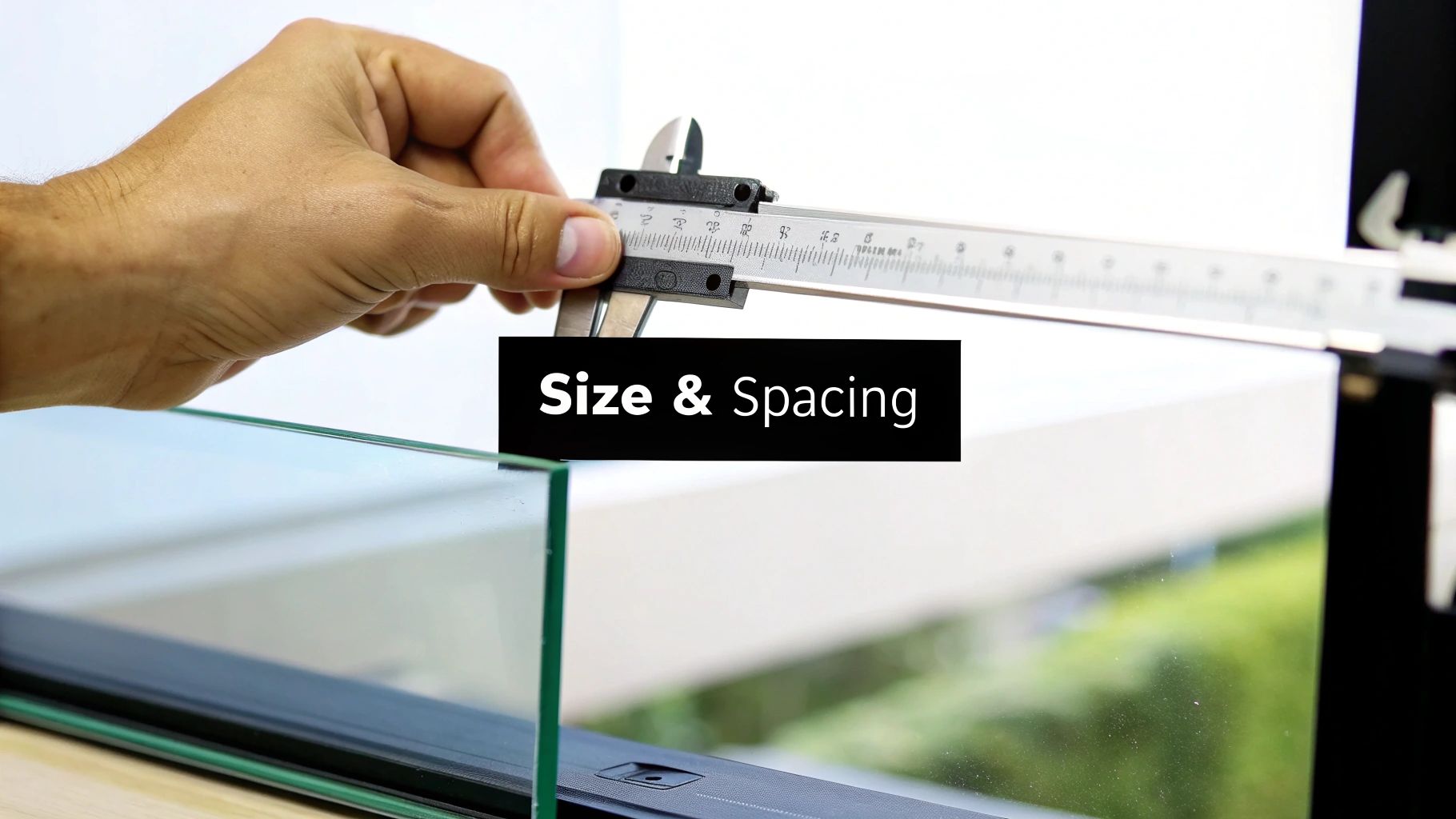
Think of it like choosing the right tyres for a car. Thicker, heavier glass is like a larger vehicle; it needs bigger, stronger clamps to handle the load safely. A clamp designed for 8mm glass simply won't provide a secure grip on a 12mm panel. Each clamp is engineered with specific rubber gaskets to create the precise friction needed for a particular glass thickness, ensuring a firm hold without putting unsafe stress on the panel itself.
In the UK, the rules for balustrade safety aren't just suggestions—they are legal requirements designed to keep people safe. These are clearly defined in Building Regulations, particularly Part K (Protection from falling, collision and impact).
The regulations set out non-negotiable minimum height requirements for balustrades, which depend on where they're installed:
These height rules directly influence the forces your balustrade must be able to resist. A taller panel acts like a longer lever, placing more strain on the fixings, which is why the number and spacing of your glass balustrade clamps are so critical.
A compliant balustrade is a safe balustrade. Adhering to these height and load requirements means your installation will be strong enough to do its job, providing lasting peace of mind for your family and guests.
This focus on safety and clean, modern aesthetics is driving huge demand. In fact, the UK balustrade market is set for steady growth, reflecting a rising desire for sleek glass systems. This trend is especially noticeable across Yorkshire and the North of England, where companies are increasingly meeting demand for projects in Leeds, York, Cheshire, Cumbria, Darlington, and Hull. You can read more about flat glass market projections to see how the industry is expanding.
While a structural engineer should always have the final say on commercial or complex projects, there are some reliable guidelines we follow for residential installations.
For a standard 10mm toughened glass panel up to 1100mm high, two clamps are typically sufficient, as long as the panel width doesn't exceed 1200mm. In this setup, we usually position the clamps around 200mm to 250mm in from each edge of the panel.
For thicker glass like 12mm, or for wider panels, you may need to reduce the spacing or add a third clamp to distribute the load evenly. Following these principles helps you plan a secure, cost-effective, and fully compliant installation without over-engineering your system.
When it comes to any balustrade project, navigating the safety standards isn't just a box-ticking exercise. It's a non-negotiable step to guarantee the absolute safety of everyone who uses the space. Here in the UK, the key document is BS 6180:2011, which lays down the essential rules for barriers in and around buildings.
This standard is what ensures your balustrade, held firmly by its glass balustrade clamps, is robust enough to handle real-world forces. This is where you’ll hear technical terms like 'loads', but understanding them is much simpler than it sounds.
Think of a 'load' as the force a balustrade must be able to withstand without breaking a sweat. The two main types you'll encounter are line loads and point loads.
A line load is a steady, uniform force pushed along the top edge – picture a group of people leaning against a balcony rail at a party. A point load, on the other hand, is a sudden, concentrated force in one small area, like someone accidentally bumping hard into a single glass panel.
Building regulations set different load requirements based on where the balustrade is installed. For example:
This is precisely why professionally tested and certified clamps are so critical. They are engineered to handle these specific forces, making sure your balustrade isn’t just a pretty feature but a structurally sound and completely safe barrier. For a deeper dive, we’ve put together a detailed breakdown in our complete guide to building regulations for balustrades.
Using certified components is the only way to be certain your balustrade is legal and, more importantly, safe. Every single clamp and fixing must be correctly specified for the glass thickness, the height of the system, and the force it's expected to bear. This knowledge empowers you to ask the right questions and feel confident that your project meets the highest safety benchmarks.
Choosing clamps that are tested and rated for the correct load isn't just a technical detail—it's the fundamental promise of safety you make to your family, guests, or customers. It ensures the system performs as a protective barrier, not just a decorative feature.
While ensuring your clamps meet these structural standards, it's also worth thinking about overall glass safety. For other parts of your property, you might want to look into general guides on reinforcing home glass for an added layer of security.
Bringing all these pieces together—the right clamp, the best material, the correct size, and full safety compliance—is the final and most exciting part of the process. This is where your vision starts to become a solid plan. For anyone planning a project in Northern England, having a local specialist in your corner can make all the difference.
Based in Harrogate, we at Binks Glass Solutions are proud to serve clients right across Yorkshire, Cheshire, Cumbria, and the surrounding areas. Our deep-rooted regional experience means we’re not just installers; we understand the architectural styles and environmental demands specific to the North, ensuring your new balustrade feels perfectly at home.
Getting started is refreshingly simple. We've stripped away the complexity to give you the tools and support you need to move forward with confidence. The best place to begin is with our online Balustrade Calculator.
This clever tool gives you a tailored, no-nonsense quote in just a few clicks, so you can get a handle on your budget right from the get-go. Just pop in your project details, and it'll generate an instant estimate. If you're still gathering inspiration, our guide to deck balustrade ideas is packed with creative concepts.
Your project deserves more than just a supplier; it needs local expertise and dedicated support. From the first sketch to the final polish, working with a specialist ensures every single detail is thought through, leaving you with a glass balustrade that's safe, stunning, and built to last.
Whether you have a quick question about glass balustrade clamps or want to dive into the details of a more complex design, our team is here and ready to help. We believe in giving you clear, expert advice without the confusing jargon, making sure you feel supported every step of the way.
Connecting with us is easy:
Let’s work together to create a gorgeous glass balustrade that not only enhances your home but also gives you complete peace of mind.
Here are a few quick answers to the most common questions we get about glass balustrade clamps. Hopefully, this helps you finalise your plans with a bit more confidence.
For a typical residential project using standard 10mm toughened glass, the rule of thumb is two clamps for every panel up to 1200mm wide. This setup provides a really secure and compliant fixing for most home situations.
But—and this is a big but—the final number always comes down to the glass thickness, the height of the balustrade, and the specific load it needs to handle. For any project, and especially for a commercial one, you should always chat with an expert or a structural engineer. It’s the only way to guarantee safety and full compliance.
Look, while it’s technically possible for a very experienced DIY pro to give it a go, we’d strongly advise against it. Getting the system completely secure, perfectly lined up, and fully compliant with UK Building Regulations is a genuinely skilled job.
Things like getting the torque settings on the screws just right and making sure the clamps are anchored solidly to the floor or post are absolutely critical. Get it wrong, and you could compromise the whole balustrade, creating a serious safety hazard.
It’s worth remembering that the safety of your balustrade hangs entirely on the quality of its installation. A professional fit ensures every single component does its job, giving you lasting security and proper peace of mind.
Yes, 100%. This is completely non-negotiable. Those little rubber gaskets are an essential part of any friction-fit clamp system, and they do a few vital jobs:
Never, ever install glass balustrade clamps without the correct gaskets for your specific glass thickness. They’re fundamental to the whole system’s safety and performance.
Ready to start your project with some friendly, expert guidance? The team at Binks Glass Solutions is here to help you choose the perfect components for your home in Yorkshire or Northern England. Get in touch with us today for a no-obligation chat.