
Hydrophobic Materials and Coatings: A UK Glass Guide
A glass balustrade always looks its best on the day it’s fitted. The lines are clean, the view is open, […]

A glass balustrade always looks its best on the day it’s fitted. The lines are clean, the view is open, […]
A glass balustrade always looks its best on the day it’s fitted. The lines are clean, the view is open, and the whole space feels lighter. Then a few days of Northern weather arrive. Rain dries into spots, wind pushes dust and grime onto the panels, and the clear finish you paid for starts to look high-maintenance.
That’s why interest in hydrophobic materials and coatings has grown so quickly on patios, balconies and terraces across Yorkshire, Cumbria, Hull, Leeds and York. They’re not magic, and they don’t remove maintenance altogether. What they do is change how water behaves on glass, which has a direct effect on cleaning frequency, staining, runoff and long-term appearance.
For anyone specifying or buying a glass balustrade in the North of England, the useful question isn’t “does hydrophobic technology exist?” It does. The real question is whether the coating being offered is suitable for your site, your exposure level and the standard of finish you expect to maintain over time.
A common pattern shows up on exposed glass balustrades. The owner loves the look of the system, especially on a raised patio or first-floor balcony. Then the weather does what it always does in the North. Rain lands, sits, dries, and leaves marks behind. Another shower arrives before the previous residue has even been cleaned away.
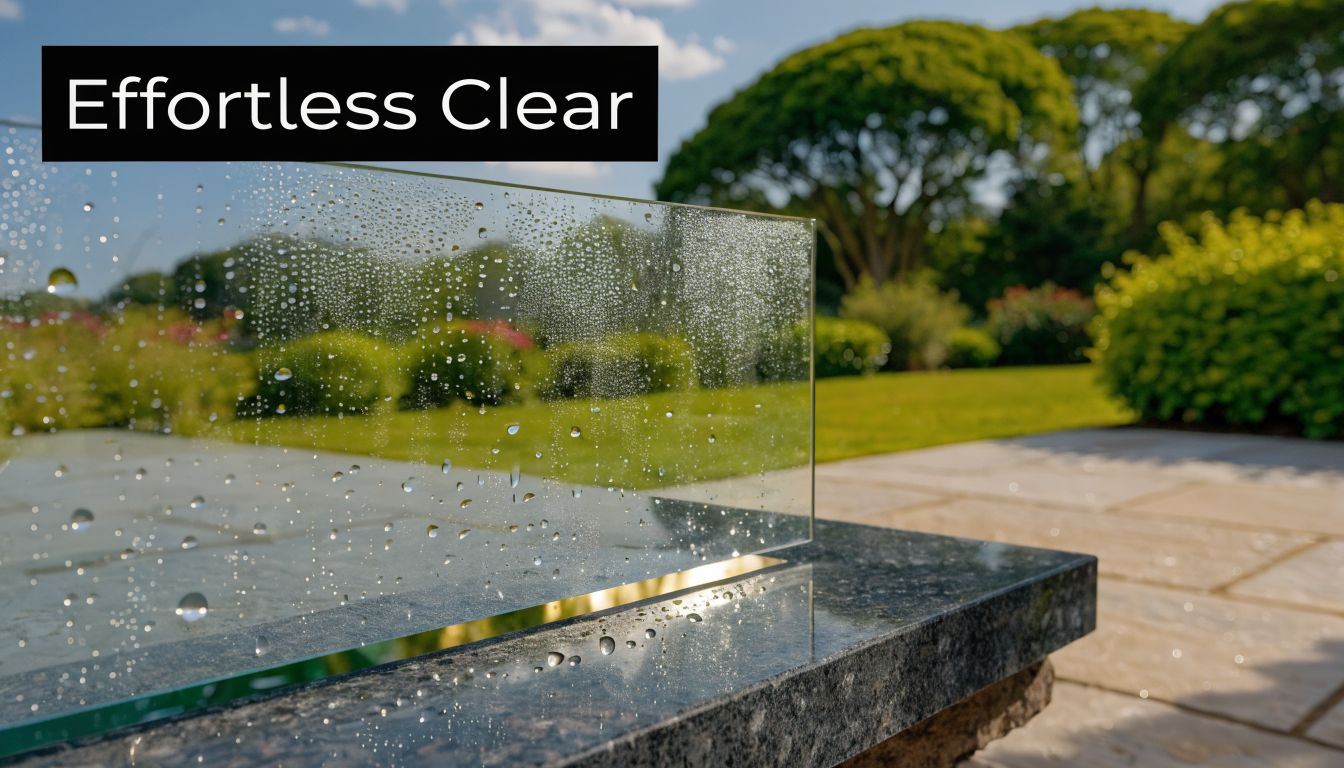
In places such as Yorkshire, where annual precipitation averages 1,200 to 1,500 mm, hydrophobic treatments on glass have been shown to reduce water adhesion by up to 90%, helping prevent streak marks that affect 65% of untreated external glass installations in urban locations including Leeds and Harrogate, according to this review of hydrophobic coatings and their history.
The practical value is simple. If water doesn’t cling to the panel in the same way, it’s less likely to dry into visible spotting and drag dust into dirty runs. On a terrace balustrade, that means the glass stays presentable for longer between cleans. On a balcony outside a bedroom or kitchen, it means you spend more time enjoying the view and less time chasing marks with a cloth.
It also changes the ownership experience. People often assume they need stronger cleaners or more frequent washing. In reality, many of the problems start with the behaviour of water on untreated glass. A coating won’t stop wind-blown grime reaching the panel, but it can stop that grime bonding so stubbornly after every spell of rain.
Practical rule: If your glass is constantly marked after light rain rather than heavy dirt exposure, the surface behaviour is often the real issue, not your cleaning routine.
For homeowners comparing products, it’s useful to see how everyday maintenance products behave on coated and uncoated glass. This glass cleaner review by Binks Balustrades gives helpful context on what effectively shifts residue and what merely moves it around.
Hydrophobic treatments tend to earn their keep fastest in locations with persistent wetting and visible exposure:
That’s why these coatings are now part of serious conversations about specification, not just aftercare.
Untreated glass likes water more than is commonly understood. Water spreads, clings and forms a film. When it dries, it leaves behind the minerals, dust and residue that spoil the finish.
Hydrophobic materials and coatings work by changing the surface energy of the glass. Instead of allowing water to flatten out, they encourage it to bead. The easiest natural comparison is the lotus leaf, where droplets sit high on the surface and roll away rather than soaking in or smearing across it.
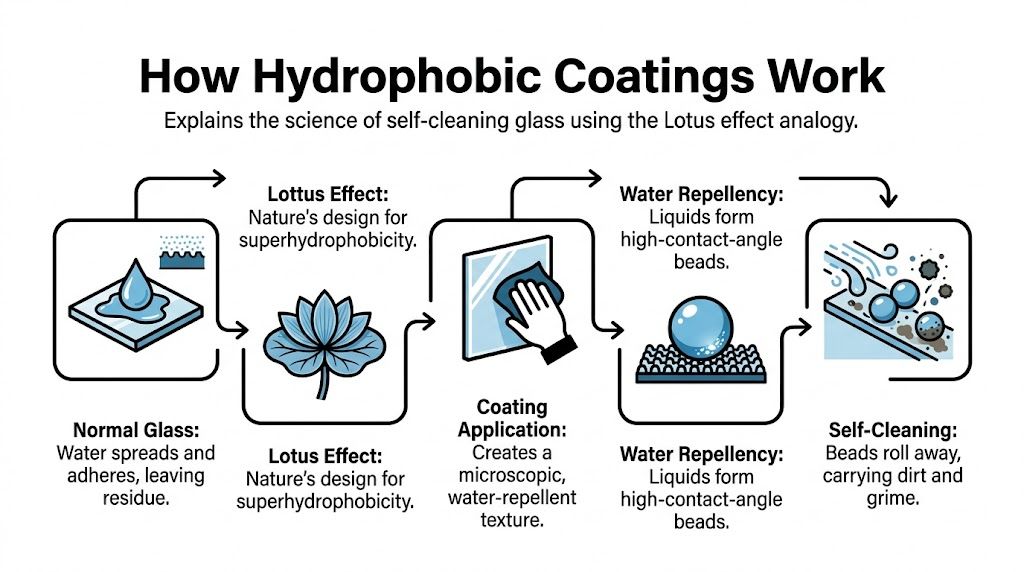
The useful technical term here is contact angle. That’s the shape a droplet makes where it meets the surface.
That higher angle means less contact between the water and the glass. The droplet sits more like a bead than a puddle. If the coating has been designed well, the water rolls off more readily and can take loose dirt with it.
A good explanation of this principle in a building-glass context appears in this guide to self-cleaning skylights, which is useful if you’re comparing how self-cleaning technology behaves on different glazed surfaces.
The chemistry is only part of the story. The better-performing systems also create a microscopic structure on the surface. Air gets trapped in that texture, and the droplet sits partly on air rather than fully on the glass. This is known as the Cassie-Baxter state.
According to Onyx’s explanation of hydrophobic coatings, that micro-roughened structure can force water droplets to maintain a contact angle greater than 150°, reduce dirt accumulation by up to 70%, and extend maintenance intervals from 2 to 3 years to 8 to 10 years.
The best coatings don’t just make glass feel slick. They change the physical interaction between water, dirt and the surface.
Balustrade glass sits at an awkward angle for maintenance. It catches rain, airborne contaminants, garden splashback and hand contact. Unlike a vertical window that gets a clean rinse in a heavy downpour, a balustrade often shows every mark because it’s viewed close-up and against open sky.
That’s why the science matters in practical terms. A properly chosen coating helps water leave the panel cleanly instead of hanging around long enough to create visible residue. It’s a surface-engineering solution to a visual problem.
A glass balustrade in Leeds or York can look excellent on handover day and tired by the end of its first winter if the coating choice is wrong. The problem is not whether water beads on day one. The key question is how the surface holds up after wind-driven rain, traffic film, bird mess, repeated cleaning and a few months of temperature swings.
That is why I separate hydrophobic coatings into three practical levels. They may all be sold under similar language, but they do very different jobs on site.
The first group is the basic wipe-on or spray-on treatment. These are usually sold for easy application and quick visual improvement. They can suit small domestic panels where access is simple and reapplication is not a major issue. On exposed balustrades, they are usually the first to fade.
The second group is the mid-range nano or ceramic-style coating. This is often the sensible middle ground for domestic work. If the glass is prepared properly and the client understands that maintenance still matters, these coatings can give a worthwhile reduction in spotting and cleaning effort without the cost of a more industrial system.
The third group is the factory-applied or specialist fluoropolymer-style system. These are the products to look at for difficult access, heavy exposure and projects where appearance has to stay consistent over time. They cost more. In the right setting, they also save repeat labour, access costs and disruption.
| Coating Type | Typical Durability | Relative Cost | Best For |
|---|---|---|---|
| Spray-on silica gel | Shorter-lived outdoors, especially on exposed elevations | Low | Small domestic screens, short-term improvement, easy-access panels |
| Ceramic or nano coating | Moderate, depending on exposure and application quality | Medium | Domestic patios, sheltered balconies, clients wanting easier cleaning without full industrial specification |
| Plasma-deposited PTFE-like coating | Longer service life where the system is properly specified and applied. Fraunhofer IFAM notes that fluoropolymer coatings such as PTFE are used where low surface energy and durable non-stick performance are needed, and that industrial plasma processes can improve coating adhesion and long-term function in production settings, as outlined in its overview of anti-adhesive fluoropolymer coatings | High | Coastal projects, commercial terraces, premium builds, difficult-access balustrades |
Lower-cost products often look convincing straight after application. Water beads tightly, the panel wipes down more easily, and the finish feels improved. On a sheltered garden balustrade, that may be enough.
Northern England is hard on coatings. Rain rarely arrives clean, airborne grit acts like a mild abrasive, and repeated washing wears away anything that only sits lightly on the surface. That is where the cheaper options start to disappoint.
For exposed sites, the better question is not "What is the cheapest coating?" It is "What will still be performing after two winters without turning into a maintenance cycle?" If you want a useful comparison point for hard-use surface protection, the marine sector is worth studying. An exterior marine ceramic coating is built around water exposure, contamination and regular washdowns, which is why marine products often offer a more realistic benchmark than retail glass treatments.
The cheapest coating can become the expensive one once re-cleaning, reapplication and access costs are added back in.
A sensible specification starts with exposure and access, not branding.
The right coating depends on how the balustrade will live, not how it looks in a sample video. Exposure drives performance. Access drives long-term cost.
The strongest argument for hydrophobic materials and coatings isn’t the brochure phrase “self-cleaning”. It’s that they help glass stay closer to the finish people want after installation: clear, sharp and low-fuss.
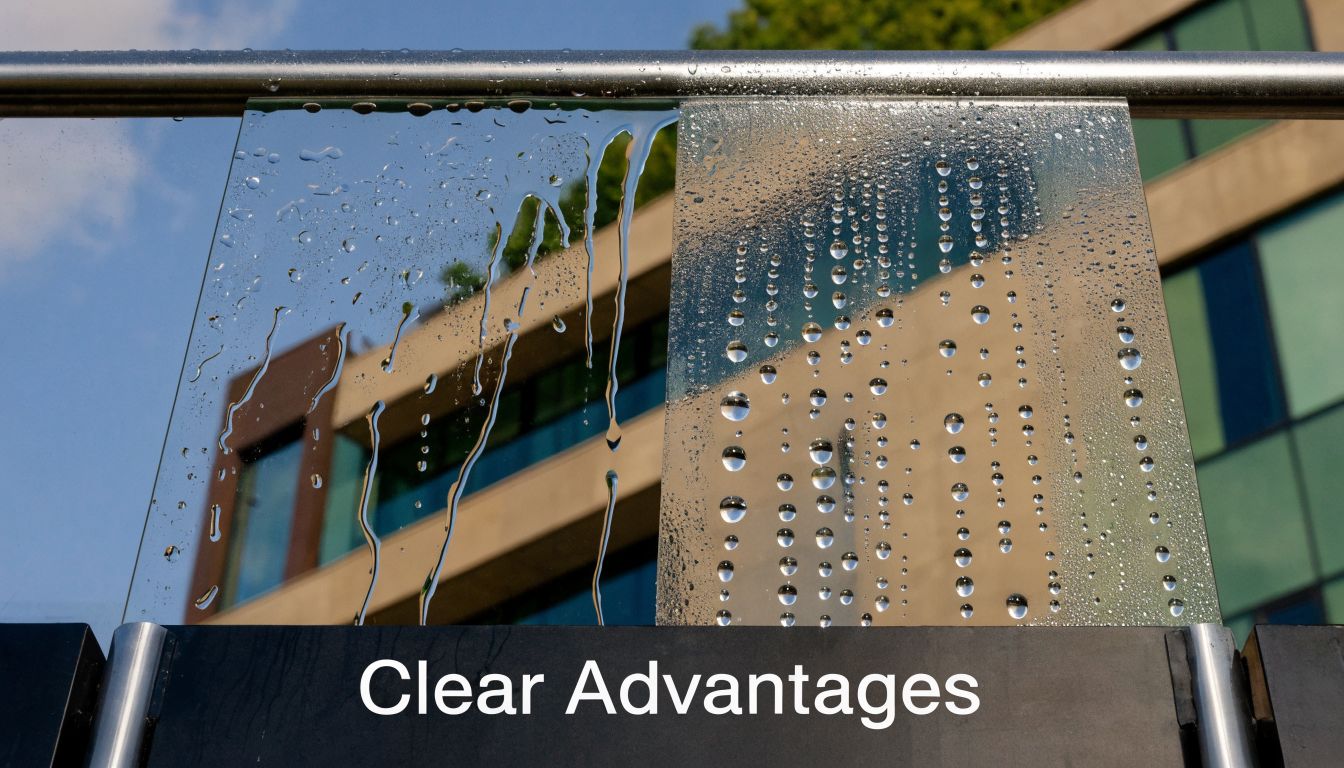
On a practical level, a good coating improves how the panel sheds rain and how easily residue releases during cleaning. That means fewer stubborn spots, less effort with cloths and squeegees, and a better-looking balustrade between maintenance visits.
There are also secondary benefits. Better runoff can help reduce lingering moisture around fittings and edges. In exposed winter settings, reducing the tendency for water to sit and freeze on the surface is useful from both a visual and operational standpoint.
For coastal and high-humidity sites, professional-grade systems can do more than repel water. UK maritime data shows superhydrophobic coatings have reduced drag by 20 to 30% and corrosion by 50% on ship hulls, according to the overview of superhydrophobic coating performance. For balustrades near Hull or other exposed waterfront locations, that marine result matters because it shows how strongly the right coating can resist wet, aggressive environments.
The common misunderstanding is that hydrophobic means maintenance-free. It doesn’t.
Pollen still lands. Airborne dust still settles. Grease from hands, outdoor cooking and drinks service still finds its way onto the glass. A coating changes how easily contamination releases. It doesn’t stop contamination arriving.
That’s especially relevant on hospitality terraces and family patios, where the glass gets touched, leaned on and splashed regularly. The balustrade will still need cleaning. It just won’t fight you as hard.
A coating should reduce cleaning frequency and effort. If someone promises you’ll never need to clean the glass again, treat that as a warning sign.
A fair assessment includes the compromises:
Here’s a practical demonstration of water behaviour on treated glass, which helps show why the effect is useful in day-to-day use.
If the goal is a pristine balustrade with less effort and a longer-lasting finish, hydrophobic coatings can be excellent. If the expectation is zero upkeep forever, disappointment usually follows.
That’s not a flaw in the technology. It’s a matter of using it for what it does well.
This is the point where marketing language usually starts to wobble. A coating may perform beautifully when first applied, but outdoor balustrades in the North of England don’t live in lab conditions. They sit through wet winters, dusty dry spells, urban pollution, salt exposure and repeated cleaning.
The result is simple. Lifespan depends less on the label and more on what the panel faces every week.
Leeds and other urban areas introduce pollutants and fine abrasive grime. Coastal areas face salt-laden air. Rural and upland locations can see long damp periods followed by cold snaps and freeze-thaw stress. Every one of those conditions chips away at coating performance.
The biggest misconception is that once water beads nicely on day one, the job is done for years. Some coatings hold up well. Others degrade quickly once exposure becomes relentless.
A useful starting point for anyone planning an exposed installation is this page on outdoor glass balustrades, because outdoor specification always has to account for weathering, not just appearance.
The clearest caution in current research is that UV exposure in Leeds or coastal salt spray in Cumbria can erode some coatings within 12 to 18 months, highlighting the need for better UK-specific guidance on reapplication frequency, as noted in this review on coating durability and performance concerns.
That doesn’t mean every coating fails in that time. It means some do, especially lower-grade or poorly matched products. A sheltered inland panel and a fully exposed coastal terrace aren’t comparable. Nor are a professionally applied system and a wipe-on treatment added at the end of a job.
You don’t need specialist equipment to notice decline. The clues are usually visible.
If the surface no longer beads consistently across the whole panel, don’t assume the glass is dirty. The coating itself may be wearing away.
The useful measure isn’t just lifespan on paper. It’s whether the coating keeps earning its place over the period you own or manage the property.
For a private patio, a shorter-life product may still be acceptable if access is easy and reapplication is straightforward. For apartment blocks, hospitality balconies or hard-to-reach terrace edges, longer-term stability matters far more. The cost of repeating the work often outweighs the initial saving from choosing a lighter-duty product.
A hydrophobic coating usually succeeds or fails before application starts. On a balustrade in the North of England, the deciding factors are often specification, surface preparation and site conditions, not the sales sheet.
Specify the coating as part of the balustrade system, not as a late add-on. Glass type, edge exposure, fixing details, access for future cleaning and the building’s location all affect whether a treatment is worth applying and what standard it needs to meet.
Useful points to define include:
On exposed schemes, I would also ask who is taking responsibility for the finished result. That sounds basic, but it matters. If one party supplies the glass, another installs it and a third wipes on a coating at the end, faults become difficult to trace and harder to put right. The technical process is shown in this ceramic coating for glass video.
Factory application gives better control in most cases. The glass can be cleaned properly, handled in a cleaner environment and cured under more stable conditions. That usually leads to a more even finish and fewer weak spots near edges or corners.
Site application still has its place, especially for retrofit work or smaller domestic projects. It just needs tighter supervision than many clients expect. Dust, silicone residue, rain in the air, cold glass and rushed handover dates can all reduce performance.
Northern weather makes that more relevant. A coating applied on an exposed terrace in Leeds, Scarborough or the Pennines is not going onto the same surface condition you get in a dry indoor workshop.
DIY products suit some jobs. A small, easy-to-reach balustrade on a sheltered patio is one example, especially if you are happy to reapply the treatment more often and accept some variation panel to panel.
Professional application is usually the better route when the glass is difficult to access, the property is close to the coast, or the finish needs to stay consistent across a full run of panels. On higher-end balconies and roof terraces, patchy beading or hazy residue stands out quickly.
Poor results usually come from process rather than chemistry. Glass may still carry polishing residue, transport film contamination, fingerprints, sealant smears or general site dust. Any of those can stop the coating bonding properly.
Specification errors are common too. Some products are sold as if they suit every job, but there is a real difference between a short-life wipe-on treatment and a system designed for longer service with controlled application. If the brief says "apply hydrophobic coating", the outcome is left open to interpretation.
The practical answer is straightforward. Set the performance standard, agree who applies it, confirm how the glass will be prepared, and make sure the maintenance guidance is handed over with the job. That is what turns a coating from a marketing extra into something that reduces cleaning effort on a glass balustrade.
The right coating matters, but the right installer matters just as much. A specialist worth speaking to should understand local conditions, not just product names. Leeds grime, Hull salt exposure, Harrogate rain and upland winter conditions all change the recommendation.
Ask direct questions. What coating options are suitable for your site? How is the glass prepared before treatment? What level of durability is realistic in your exact location? A capable specialist should answer plainly and avoid blanket promises.
It also helps to choose a firm that understands the full balustrade system rather than just the coating. Toughened or laminated glass choice, edge detailing, fixing methods and maintenance access all affect long-term results. A coating works best when it’s part of a well-thought-out installation, not a last-minute add-on.
Look for a local track record, clear guidance on care, and advice that acknowledges trade-offs. If every option is described as perfect, the conversation probably isn’t grounded in real site experience. The best specialists explain where hydrophobic materials and coatings add value, where a premium system is justified, and where a simpler approach is enough.
If you’d like practical advice on glass balustrade options for Yorkshire and the North of England, including coatings, specification and pricing, contact Binks Balustrades.