
Choosing Stainless Steel for Railings in the UK
Picture a railing that has the sleek, modern style you want, but is also tough enough to handle whatever the […]

Picture a railing that has the sleek, modern style you want, but is also tough enough to handle whatever the […]
Picture a railing that has the sleek, modern style you want, but is also tough enough to handle whatever the unpredictable UK weather throws at it. That’s exactly what you get with stainless steel for railings. It's become the first choice for contemporary systems, from glass balustrades on a Harrogate terrace to robust balcony railings in Leeds, because it delivers a brilliant combination of strength, looks, and longevity.
When you're planning a new balustrade for a patio, balcony, or staircase, your choice of material is one of the most important decisions you'll make. While traditional materials like wood certainly have their charm, stainless steel brings a unique set of advantages that make it perfect for modern homes and commercial spaces across the North of England. It’s a long-term investment in your property’s beauty and safety.
Think of it as the ultimate all-rounder. Its natural strength allows for much slimmer, more minimalist designs without ever compromising on safety. This creates a wonderful sense of space and maximises your views. It's this very quality that makes it the perfect partner for glass balustrade systems, where the main goal is an unobstructed sightline. You can learn more about how these two materials work together in our guide on stainless steel and glass balustrading.
The appeal of stainless steel goes far beyond its clean, modern appearance. Homeowners and architects choose it for a number of very practical reasons that make it a smart, lasting investment:
This shift towards materials that combine style with performance isn't just something we've noticed on projects. It's backed by market data showing a clear preference for durable, contemporary railing solutions.
This demand is fuelling steady growth in the UK railing market, which is projected to expand at a compound annual growth rate of 3.9%. A big driver of this is the strong construction and renovation activity happening across the UK, highlighting just how popular these modern designs have become.
This guide will be your practical roadmap from here. We’ll walk through the key decisions you'll need to make, like choosing the right grade of steel and the perfect finish for your specific project.
When you're planning a stainless steel railing, one of the first and most critical decisions you'll make is choosing the right grade of steel. It’s a question we get all the time, and for good reason. Getting this right from the start is the difference between a balustrade that looks pristine for decades and one that shows disappointing signs of wear far too soon.
The two main players you’ll encounter are Grade 304 and Grade 316.
Think of it like choosing a coat for the ever-unpredictable British weather. Grade 304 is your high-quality, reliable all-weather jacket. It’s fantastic for most inland spots, easily handling rain, frost, and general wear and tear.
Grade 316, on the other hand, is the specialist marine gear you’d want in a coastal storm. It contains an extra ingredient—molybdenum—that gives it superior protection against salt spray and other corrosive elements. This makes it absolutely essential for certain environments.
To help you decide, here’s a quick comparison of the two grades.
| Feature | Grade 304 Stainless Steel | Grade 316 Stainless Steel |
|---|---|---|
| Best For | Inland locations (>10 miles from the sea), internal projects. | Coastal locations, swimming pool surrounds, industrial areas. |
| Corrosion Resistance | Excellent resistance to general atmospheric corrosion (rain, pollutants). | Superior resistance to chlorides (sea salt, de-icing salts, chlorine). |
| Key Ingredient | Chromium & Nickel. | Chromium, Nickel & Molybdenum (2-3%). |
| Cost | More cost-effective. | Higher initial cost. |
| Common Use Cases | Staircase railings in a Leeds home, garden balustrades in Sheffield. | Balcony railings in Whitby, safety fencing around a pool. |
Ultimately, choosing between Grade 304 and 316 isn't about which is "better," but which is right for your specific location.
For the vast majority of residential and commercial projects located away from the coast, Grade 304 is the perfect, cost-effective choice. The chromium and nickel in its composition form a protective, passive layer on the surface that stops corrosion in its tracks.
Picture a modern glass balustrade on a terrace in York or a sleek staircase railing inside a new build in Harrogate. Here, the main environmental challenges are rain and everyday atmospheric pollutants. Grade 304 handles these conditions with ease, keeping its strength and finish for decades with just basic cleaning. It strikes the perfect balance of performance, looks, and value for most projects.
This simple flowchart can help you visualise which factors are most important for your project and guide you towards the right materials.
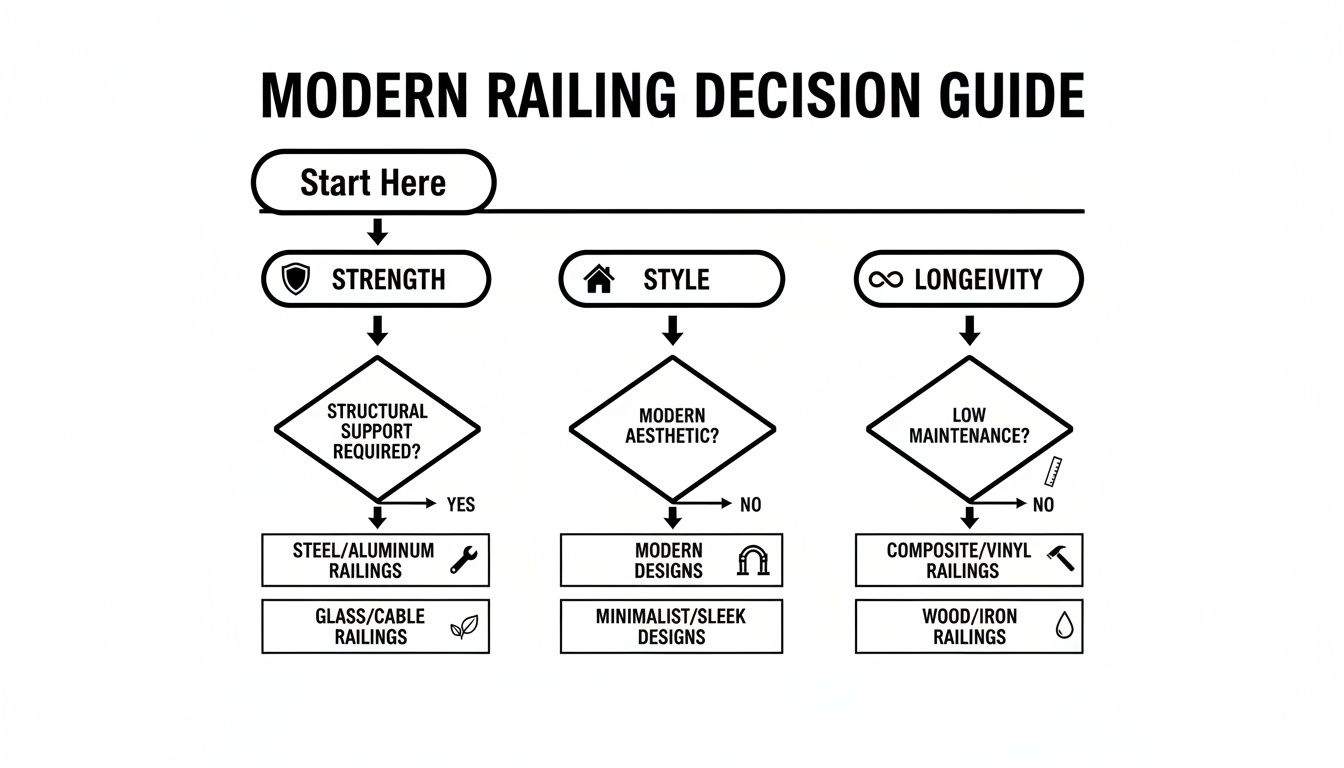
Breaking down your decision based on strength, style, and longevity really simplifies the process, ensuring you get a result that’s built to last.
When your property faces a tougher environment, upgrading to Grade 316 is non-negotiable. That small addition of molybdenum (usually 2-3%) makes a world of difference in fighting off pitting and corrosion from salt and harsh chemicals.
Think about these specific scenarios:
While Grade 316 does cost more upfront, this investment is tiny compared to the expense and hassle of replacing a corroded railing system down the line. It's simply about using the right tool for the job.
The demand for durable, long-lasting materials is a clear trend, with the metal railings market showing consistent growth as homeowners and developers prioritise quality. This isn't just a fad; it's a fundamental shift towards reliable, long-term investments in property safety and aesthetics.
Of course, the main components are only part of the story. Using the right fixings is just as vital. Even with a Grade 316 system, the wrong screws can create a weak point. To learn more, check out our guide on choosing the right stainless steel deck screws to make sure every single part of your installation is built to last.
Once you’ve settled on the right grade of steel, the next step is choosing its finish. This is where the real personality of your railing comes to life. It’s the difference between a balustrade that simply does its job and one that becomes a stunning design feature in its own right.
Getting the finish right ensures your new railing not only performs perfectly for years but also perfectly complements your home’s unique style.
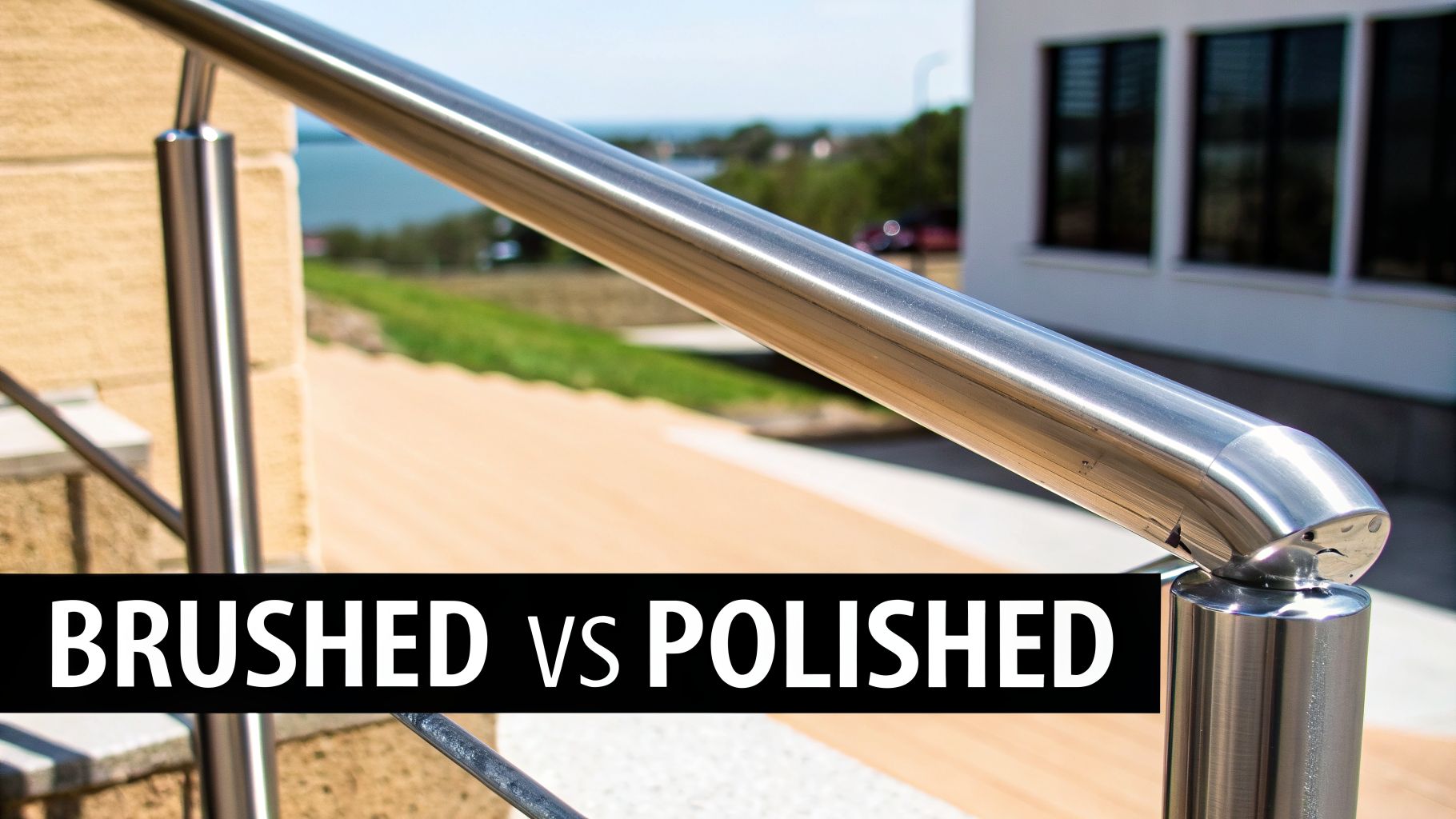
The two main contenders you’ll come across are a satin (or brushed) finish and a mirror (or polished) finish. Each one has a completely different look and feel, making them suited to different homes and architectural tastes.
A satin finish, also known as a 'brushed' finish, is by far the most popular choice for modern stainless steel railings, and it’s easy to see why. We create this finish by sanding the steel in a single direction with a very fine abrasive. The result is a beautiful, non-reflective lustre with a subtle grain that you can see and feel.
Think of it as having a soft, matte-like quality. Instead of reflecting light like a mirror, it diffuses it, lending it a sophisticated and contemporary look without being flashy.
One of its biggest selling points is how well it hides minor wear and tear. Everyday fingerprints, smudges, and small scuffs are much harder to spot on a satin finish, making it a fantastic, low-maintenance choice for busy areas like:
This forgiving nature means less time polishing and more time enjoying the clean, modern aesthetic of your balustrade. It’s incredibly versatile, blending in just as well in a rustic barn conversion in the Yorkshire Dales as it does in a chic, minimalist apartment in Manchester.
If you’re looking to make a real statement, then the mirror finish is your answer. Achieved by progressively polishing the steel with finer and finer abrasives, this finish creates a flawless, highly reflective surface that’s as smooth as glass. Its almost liquid-like appearance brings an undeniable touch of luxury and brightness to a space.
A mirror-polished railing isn’t just a safety barrier; it’s a powerful architectural feature. By perfectly reflecting its surroundings, it bounces light around and can make a room or balcony feel instantly larger and more open.
This finish isn't about blending in—it's about standing out. It’s a deliberate design choice that shouts high-end quality and adds a real 'wow' factor to any project.
A mirror finish works brilliantly in specific applications:
There is a trade-off, however. This high-shine look needs more care. Smudges and fingerprints are much more obvious, so it requires more frequent cleaning to keep it looking pristine. For this reason, it's often best reserved for lower-traffic feature areas where its stunning impact can be fully appreciated without the hassle of constant upkeep.
A stunning stainless steel railing is more than just a finishing touch; it’s a critical safety barrier. Getting it right means ensuring it’s not only beautiful but completely secure and compliant with UK law. While building regulations can sound complex, the core principles are straightforward. Understanding them gives you the confidence to know your project is being done properly from the ground up.
These rules aren’t just red tape. They are a well-thought-out system designed to prevent falls and guarantee structural safety in homes and public spaces alike. Think of them less as a rulebook to memorise and more as a blueprint for peace of mind.
The main guidance for this in England and Wales comes from Approved Document K (Protection from falling, collision and impact), which leans heavily on the industry standard, BS 6180:2011 (Barriers in and about buildings). Let's break down what this actually means for your railing project.
When you're planning a stainless steel for railings installation, a few key numbers and rules are non-negotiable. These are the absolute cornerstones of a safe system, whether it’s for an indoor staircase or an outdoor balcony.
Minimum Railing Height: The required height changes based on where the balustrade is. For internal areas in a family home, like stairs and landings, the top rail must be at least 900mm from the floor. For any external area—a balcony, terrace, or decking—where there's a drop of more than 600mm, that minimum height jumps to 1100mm.
The 100mm Sphere Rule: This is a vital test for any gaps in your balustrade. To stop small children from squeezing through, no opening anywhere in the railing system can be large enough for a 100mm sphere to pass through. This applies to the spaces between vertical posts, underneath the bottom rail, or between glass panels.
Structural Loads: Your railing isn't just a visual guide; it must be strong enough to handle real-world forces. Regulations specify the loads a balustrade must be able to take, including a distributed load along its length (like several people leaning) and a point load on the infill (like an accidental impact). Your supplier must guarantee the entire system—from posts and fixings to clamps—is engineered to withstand these forces without fail.
Think of these regulations as a safety net built directly into your design. They ensure your railing can handle the weight of someone leaning against it or the impact of a sudden bump, providing a robust and reliable barrier when it matters most.
Nailing these fundamentals is the first step. For a deeper dive into the specifics for different installations, our comprehensive guide on building regulations for balustrades has all the details you’ll need.
These safety rules have a direct impact on the final look and components of your stainless steel railing. For example, the load requirements will determine how far apart your posts can be placed. Putting them closer together provides more strength, which is especially important for systems holding heavy glass panels.
The fixings are just as crucial. The bolts used to anchor your posts to the floor or wall must be correct for the surface you’re fixing into—whether that's timber decking, a concrete patio, or a steel beam. Using the wrong fixings creates a dangerous weak point that could compromise the safety of the entire balustrade.
This is precisely why working with a specialist is so important. An expert understands how every single component works together to create a compliant, safe, and long-lasting installation. From the handrail down to the last bolt, everything has a job to do.
While stainless steel is famously low-maintenance, it’s a common myth that it's ‘no-maintenance’. The reality is, keeping your investment looking pristine for decades requires a tiny bit of effort, but the good news is it’s incredibly simple. A consistent cleaning routine is all you need to protect the finish and ensure your stainless steel for railings remains a stunning feature of your property.
Forget what you've heard about needing expensive, specialist cleaners. For regular upkeep, that simply isn't true. A little care goes a long way, and you almost certainly have everything you need at home already.
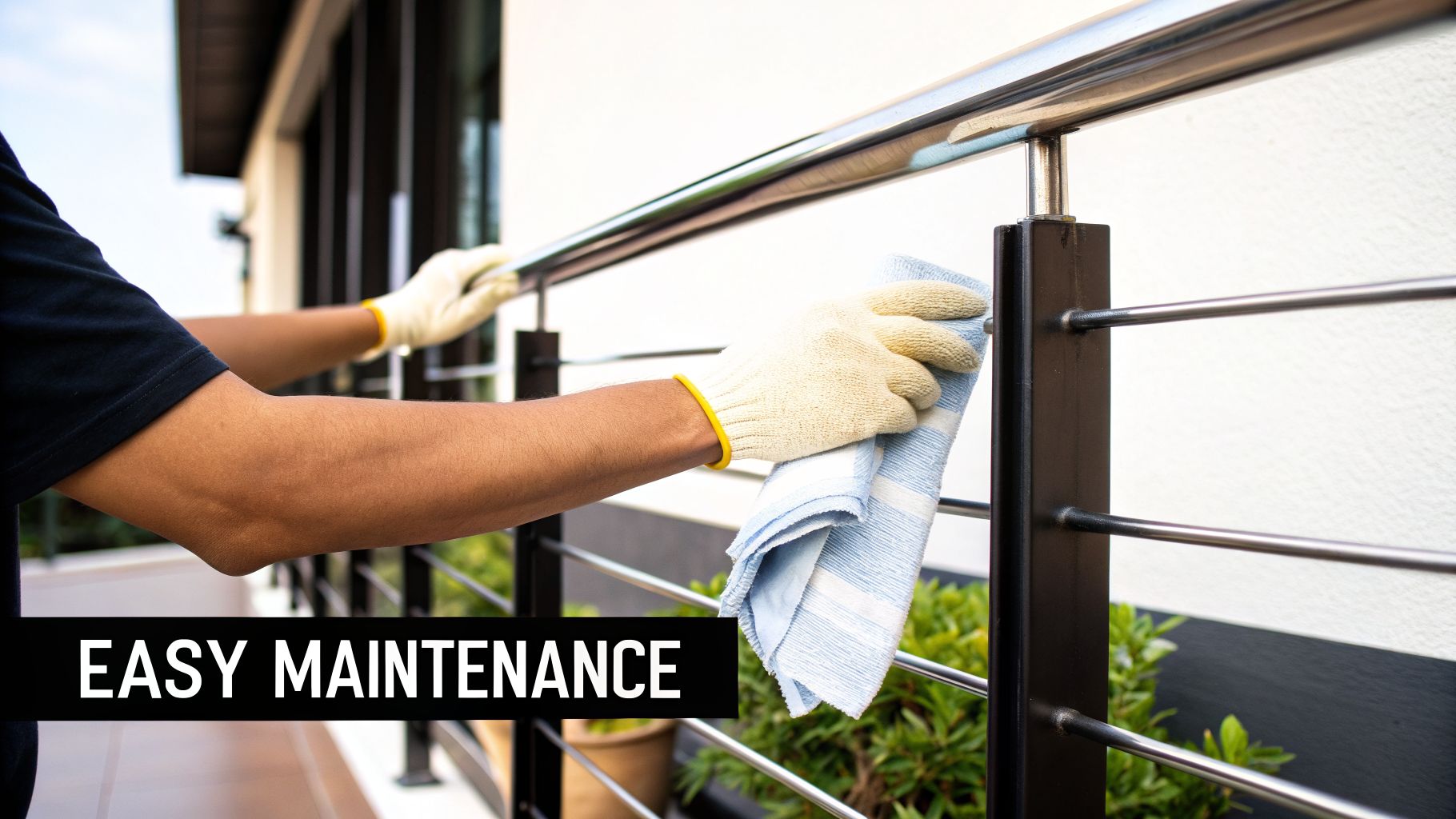
Here's our practical guide to straightforward maintenance, covering everything from a routine wipe-down to tackling specific issues that can occasionally pop up.
For most stainless steel railings, especially those located inland in places like Leeds or Sheffield, a quick clean every few months is plenty. You might want to do it a bit more often in coastal areas or if your property is near a busy road where grime builds up faster.
Your Basic Toolkit:
The process couldn't be easier. Just mix a small amount of mild soap into some warm water. Dip one cloth in the soapy water, wring it out, and gently wipe down all the stainless steel surfaces to get rid of any dust, fingerprints, or general grime.
After that, use the second clean, damp cloth to wipe away any soap residue. The final, crucial step is to dry the railing thoroughly with a third dry cloth. This prevents water spots from forming and brings back that brilliant shine.
Even the highest quality marine-grade 316 steel can sometimes develop a light brown discolouration known as ‘tea staining’. It’s important to know that this is not rust and has zero effect on the steel's strength or structural integrity. It's a purely cosmetic issue caused by surface deposits, most commonly seen in coastal locations exposed to salt spray.
If you spot tea staining, don't panic. It's quite easy to clean off.
The real key here is to address tea staining as soon as you notice it. Regular cleaning is the best form of prevention, as it stops those corrosive salt deposits from building up on the surface in the first place.
The single most important rule of stainless steel maintenance is to protect its passive layer. This is the invisible film of chromium oxide that does the hard work of preventing corrosion. If you use the wrong tools or chemicals, you can scratch or damage this layer, leaving the steel vulnerable to rust.
Never use these on your stainless steel railings:
By following these simple do's and don'ts, you’ll ensure your stainless steel railings maintain their strength and beautiful appearance for many, many years, proving to be a truly durable and wise investment for your home.
Right, you’ve done your research. You know the difference between Grade 304 and 316 steel, you’ve thought about finishes, and you’re clued up on the safety rules. But how do you turn that vision into a real plan with a real price?
This is often where the momentum stalls. In the past, budgeting for a high-quality stainless steel for railings project meant a lot of guesswork and waiting around for quotes. Thankfully, those days are over. We’ve put the tools directly in your hands, so you can move from idea to accurate pricing in minutes, not weeks.
To cut through the confusion and put you in control, we built the online Balustrade Calculator. It’s a simple, four-step tool we designed to give you a clear, itemised quote based on your exact project needs. It takes the mystery out of pricing, letting you experiment with different designs to see what fits your style and budget perfectly.
You can find the calculator right on our homepage – it’s designed to be impossible to miss.
This isn’t just about getting a number; it’s about guiding you through the key decisions that shape your final design.
We've streamlined the whole process into a few quick choices. Here’s how it works:
This approach completely changes the game. Forget waiting on vague estimates. You get instant, transparent pricing that empowers you to design and budget for your perfect stainless steel railing system on your own terms.
While a brilliant online tool gives you a fantastic head start, nothing can replace genuine local experience. As a team based in Harrogate, we live and breathe the architectural styles and environmental challenges of the North of England. Our work takes us everywhere, from the salty air of the Cumbria and North Yorkshire coasts to the bustling urban terraces of Leeds and Manchester.
This local focus is what sets our advice apart. It means we can give you practical recommendations that are genuinely right for your home. We know exactly what grade of steel will stand up to coastal spray and which fixings work best on the region’s period properties. If you need an expert eye to confirm your choices or talk through the specifics, our team is always here to help.
We’ve covered a lot of ground, from picking the right steel to making sense of building regulations. But it's natural to have a few lingering questions. To clear things up, here are some straightforward answers to the queries we hear most often from homeowners considering stainless steel railings.
This is a big one. It's a common belief that stainless steel is completely rust-proof, but the reality is a little more nuanced. The clue is in the name: it stains less than other types of steel, rather than not staining at all.
While incredibly resilient, corrosion can start to appear under very specific, harsh conditions. Think prolonged exposure to salt spray right on the coast, contact with aggressive chemicals like bleach, or if the protective surface gets scratched up with steel wool.
The good news? This is entirely preventable. By choosing the right grade for your setting (Grade 316 for coastal, Grade 304 for inland) and giving it a simple, regular clean, you can keep your railings looking immaculate for decades.
Getting this right is probably the single most important decision you'll make, and the answer comes down to one thing: your property's location.
Trying to save a bit of money by using the wrong grade in a coastal spot is a false economy. It will almost certainly lead to rust spots and cosmetic headaches down the road.
Think of it this way: choosing your steel grade is like choosing the right tyres for your car. You wouldn't use summer tyres in a snowstorm, and you shouldn't use Grade 304 in a salty sea-spray environment. It's all about matching the material to the conditions for performance and safety.
For a great look at how the unique weather shapes life and architecture across the North, blogs like the Yorkshire Reporter often have stories that really capture the character of our region.
This decision really boils down to a mix of personal taste and practicality. The satin (or brushed) finish is the most popular option, and for good reason. It has a soft, non-reflective appearance that feels both modern and elegant, and it’s fantastic at hiding fingerprints and minor scuffs, making it a dream for busy, high-traffic areas.
On the other hand, the mirror (or polished) finish is all about making a bold, high-impact statement. Its perfectly reflective surface bounces light around, adding a touch of luxury and making a space feel brighter and more expansive. The trade-off is that it shows up smudges and water spots easily, so it needs a bit more frequent wiping to keep it looking its absolute best.
Ready to bring your vision for the perfect railing to life? The team at Binks Balustrades combines expert knowledge with a deep understanding of homes across Yorkshire and the North. We're here to provide clear, practical advice to ensure your project is a complete success.
Get in touch today to discuss your project and discover how a beautifully crafted stainless steel balustrade can transform your home. Contact us now.