
Stainless Steel Handrails for Stairs: Your Modern Guide to Style and Safety
A staircase is so much more than a way to get from A to B. Done right, it can be […]

A staircase is so much more than a way to get from A to B. Done right, it can be […]
A staircase is so much more than a way to get from A to B. Done right, it can be a genuine architectural feature. With stainless steel handrails for stairs, you get a fantastic mix of sleek, modern style and sheer durability, creating a look that adds value for decades to come.
Think of a staircase that feels open, airy, and effortlessly modern. That’s what stainless steel delivers. It has quickly become the go-to choice for homeowners, architects, and designers right across Yorkshire and the North of England, and for good reason. Its clean lines and subtle sheen can turn a purely functional staircase into the centrepiece of a home.
This guide is your complete resource for planning a project, whether you're in Leeds, Manchester, or anywhere in between. We'll walk you through everything from the different grades of steel to the critical safety regulations, making sure your final choice is both stunning and built to last.
The real magic of stainless steel is its dual personality. On one hand, it gives you a sophisticated, contemporary finish that works with almost any interior design. Pair it with glass panels, and you suddenly create a wonderful sense of space, letting natural light flood through your home.
On the other hand, it's incredibly tough. Unlike timber that can warp, splinter, or need a fresh coat of paint every few years, stainless steel handles the knocks of a busy family home with barely any effort. This combination of elegance and resilience makes it a smart and stylish investment.
Stainless steel handrails provide a timeless look that doesn't go out of fashion. They offer a clean, minimalist backdrop that lets the rest of your home's design features, from artwork to furniture, really shine.
You only have to look at market trends to see how popular this material has become. In the UK, the stainless steel handrail market is seeing strong growth, with sales revenue set to climb. This is especially true for regions like Yorkshire and the North of England, where companies are meeting the huge demand for durable, stylish stair solutions. You can read more on the market trends at Cognitive Market Research.
Choosing the right material for your stairs is a big decision. Here are the main advantages that put stainless steel at the top of the list:
Picking the right stainless steel for your handrail isn't as technical as it sounds. The easiest way to think about it is like choosing the right coat for the weather—you need a smart, stylish one for everyday indoor use, and a completely different one for braving the elements outside.
Getting this choice right from the start is crucial. It ensures your stainless steel handrails for stairs not only look fantastic on day one but perform perfectly for years to come. The decision boils down to two main options: Grade 304 and Grade 316. Each has a specific job, and knowing the difference is key to a successful, long-lasting project.
Think of Grade 304 as the perfect, stylish coat for inside your home. It’s the most common type of stainless steel used for interior handrails, and for good reason. It offers excellent durability and corrosion resistance within a controlled indoor environment, making it the ideal and most cost-effective choice for the vast majority of internal staircases.
For a family home in Leeds or a modern apartment in Manchester, Grade 304 provides all the strength and sleek aesthetics you could ever need. It’s more than tough enough to handle daily wear and tear, requires very little cleaning, and will maintain its lustre without any fuss.
This diagram breaks down the core benefits that make stainless steel such a popular choice, highlighting its blend of aesthetics, durability, and long-term value.
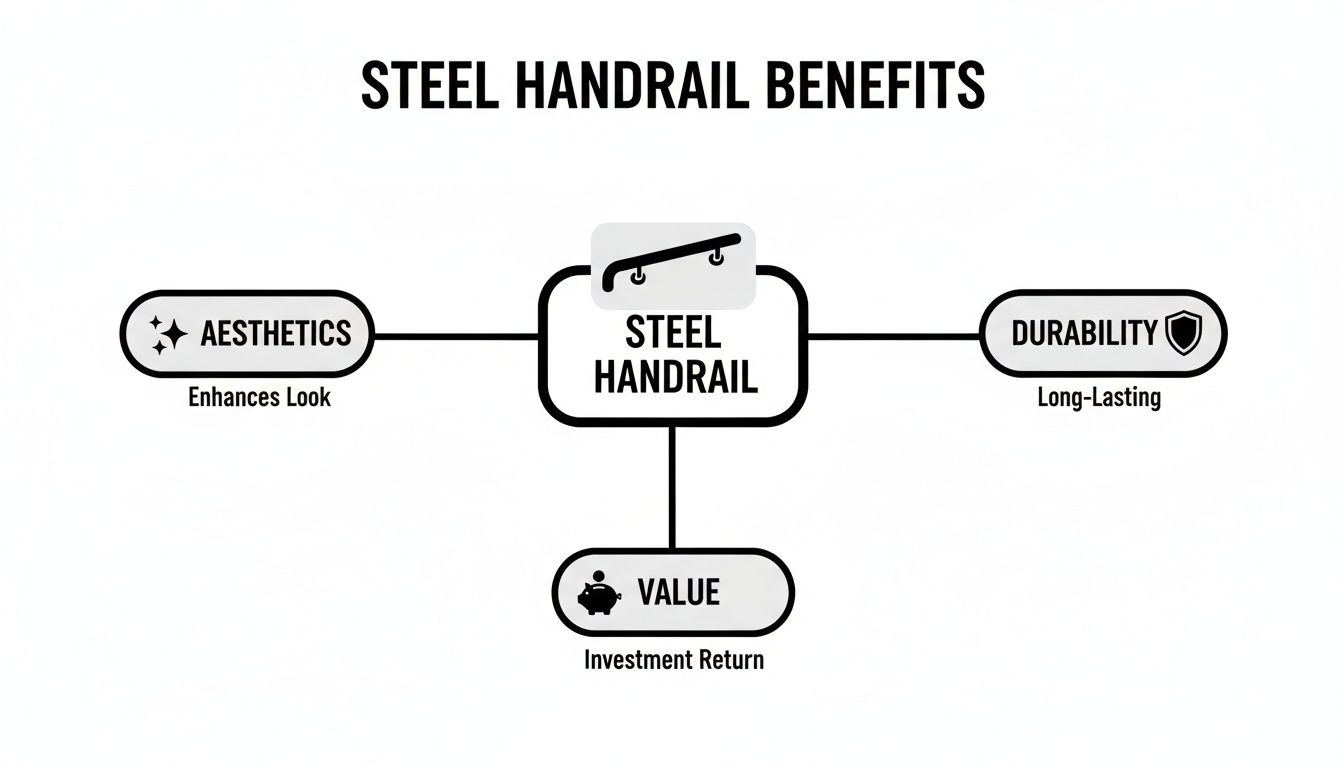
As you can see, these handrails are far more than just a safety feature. They are a genuine design element that adds tangible value and resilience to your property.
Now, let's change the scene. Imagine you need a handrail for an external staircase in Sheffield or a balcony overlooking the sea in Cumbria. This is where Grade 316 comes in. It’s the heavy-duty, all-weather waterproof jacket in your wardrobe.
Grade 316 contains an element called molybdenum, which gives it vastly superior protection against corrosion from salt, rain, and pollution. This makes it absolutely essential for any outdoor stainless steel handrails for stairs, particularly in coastal or industrial areas where the air itself can be more corrosive.
Yes, it comes at a slightly higher price point. But that extra investment is what protects your handrail from rust and pitting, preserving its appearance and, more importantly, its structural integrity for the long haul.
Choosing Grade 316 for outdoor projects isn't just a recommendation; it's a necessity. Using an internal-grade steel outside is a false economy that will almost certainly lead to ugly corrosion and premature replacement.
So, for a garden staircase in Harrogate or a terrace in York, Grade 316 is the only sensible choice to guarantee a beautiful, lasting finish that stands up to the British weather.
Once you've nailed down the right grade of steel, the fun part begins: choosing a finish that complements your home's style. This choice is all about aesthetics—how the handrail interacts with light and its surroundings.
The two most popular options are satin (or brushed) and mirror (or polished). Each creates a very different feel.
To help you decide, here's a quick comparison of the grades and finishes.
A quick comparison to help you select the ideal stainless steel grade and finish for your staircase project.
| Feature | Grade 304 (Internal) | Grade 316 (External/Marine) | Satin/Brushed Finish | Mirror/Polished Finish |
|---|---|---|---|---|
| Best For | Indoor staircases, landings | Outdoor stairs, balconies, coastal areas | High-traffic areas, modern & classic styles | Statement pieces, luxury interiors |
| Corrosion Resistance | Good for indoor environments | Excellent for outdoor/harsh environments | N/A – Finish can be applied to either grade | N/A – Finish can be applied to either grade |
| Appearance | Clean, metallic look | Identical look to 304 when new | Soft, muted lustre with fine lines | Highly reflective, bright, chrome-like |
| Maintenance | Very Forgiving – Hides fingerprints & scuffs | High – Shows fingerprints & marks easily | Very Forgiving – Hides fingerprints & scuffs | High – Shows fingerprints & marks easily |
| Cost | More cost-effective | Higher initial investment | Standard, most popular option | Often a premium, more expensive option |
This table should give you a clear idea of which combination best suits your needs, but let's break down the two main finishes.
Satin/Brushed Finish: This is the most popular finish, and it's easy to see why. It has a subtle, soft lustre created by fine brushing lines in the steel. Critically, this finish is brilliant at hiding minor scuffs and fingerprints, making it a practical and forgiving choice for busy households. Its understated, modern look fits beautifully into almost any design scheme.
Mirror/Polished Finish: A mirror finish is exactly what it sounds like—highly reflective, bright, and impossible to ignore. It creates a bold, luxurious statement and can make a space feel larger and more open by bouncing light around the room. While it's visually striking, it’s a bit more high-maintenance, requiring more frequent cleaning to keep it free from smudges.
Ultimately, the best finish comes down to your personal style and the practical demands of your home. A satin finish offers a timeless, low-maintenance solution that always looks sharp, while a mirror polish delivers a high-impact, glamorous look that can become a real focal point.
While choosing materials and finishes is the exciting part of any project, safety is the non-negotiable bedrock of a great handrail design. Getting to grips with UK Building Regulations can feel like wading through technical jargon, but these rules exist for a simple reason: to keep people safe. This section will translate the key requirements into clear, practical advice, so you can be confident your project is fully compliant from day one.
For anyone planning a project with stainless steel handrails for stairs in Yorkshire and the North of England, understanding these standards is the first step. The primary guidance comes from a government publication known as Approved Document K, which covers everything to do with protection from falling, collision, and impact.
Partnering with a specialist who lives and breathes these rules ensures that these crucial safety standards are seamlessly designed into your project, giving you complete peace of mind.
One of the most fundamental rules in Approved Document K relates to how high your handrail needs to be. For stairs and ramps inside your own home, the regulations are refreshingly straightforward.
The top of the handrail must sit somewhere between 900mm and 1000mm, measured vertically from the pitch line of the stairs. The pitch line is simply an imaginary line that runs across the nose of each step. This specific height range ensures the handrail is comfortable and supportive for the average person to hold onto.
Think of it this way: the handrail needs to be high enough to prevent you from toppling over it, but low enough to grab comfortably without having to reach up. That 900mm to 1000mm window is the sweet spot that achieves both.
When it comes to landings, balconies, and any areas with a drop of more than 600mm, the guarding height must be at least 900mm for internal domestic settings. These aren't just arbitrary numbers; they are vital for preventing serious falls.
Beyond just height, the regulations put a real emphasis on providing a continuous, secure grip. After all, a handrail is only useful if you can hold it without interruption from the top of the stairs right to the bottom.
This means your handrail should run the full length of the staircase without any awkward breaks that force you to let go. It's also best practice for the handrail to extend at least 300mm horizontally past the first and last step nosing, giving you something to hold onto as you get on and off the stairs.
Here are a few other critical points to keep in mind:
For a deeper dive into the specifics, you can explore more about balustrade regulations in our detailed guide.
Building regulations are constantly evolving, particularly around fire safety. In the wake of the Grenfell Tower fire, the Building Safety Act 2022 introduced much stricter controls on the materials that can be used in certain buildings, especially high-rise residential blocks.
This has led to a major shift towards non-combustible materials like stainless steel. In fact, it has sparked a significant wave of retrofitting work across Yorkshire, with local council reports indicating a projected 25% rise in such projects by 2025. This move really underscores the importance of choosing materials that not only look good but meet today’s rigorous safety standards.
Now that you’ve pinned down the fundamentals of steel grade and finish, we get to the really creative part: shaping the physical form of your handrail. This is where a functional safety feature starts to become a key piece of your home's character, and where your design vision truly comes to life.
The profile of the handrail and how it's fixed in place are two of the biggest decisions you'll make. They define the final look and feel more than anything else.
Think of the handrail's profile—its cross-sectional shape—as the final brushstroke on your design. It might seem like a small detail, but it has a huge impact. A simple change in shape can shift the whole aesthetic from classic and comfortable to sharp and contemporary.
Here are the most popular profiles you'll come across:
Classic Round Handrails: This is the timeless, go-to choice for a reason. Round handrails are incredibly comfortable to grip, with no sharp edges, making them a safe and practical option for any family home. Their smooth, continuous curve gives them a soft, inviting feel that works in almost any setting.
Modern Square or Rectangular Handrails: If you’re aiming for a bolder, more architectural statement, a square or rectangular profile is the way to go. It delivers clean, sharp lines and a distinctly modern edge that’s a perfect match for minimalist interiors and homes that favour strong, geometric shapes.
Slotted Handrails for Glass: Designed specifically to work with glass balustrades, these handrails have a neat channel running along their base. This groove allows glass panels to slot directly into the rail, creating a sleek, fully integrated system that provides all the necessary strength without any visual clutter.
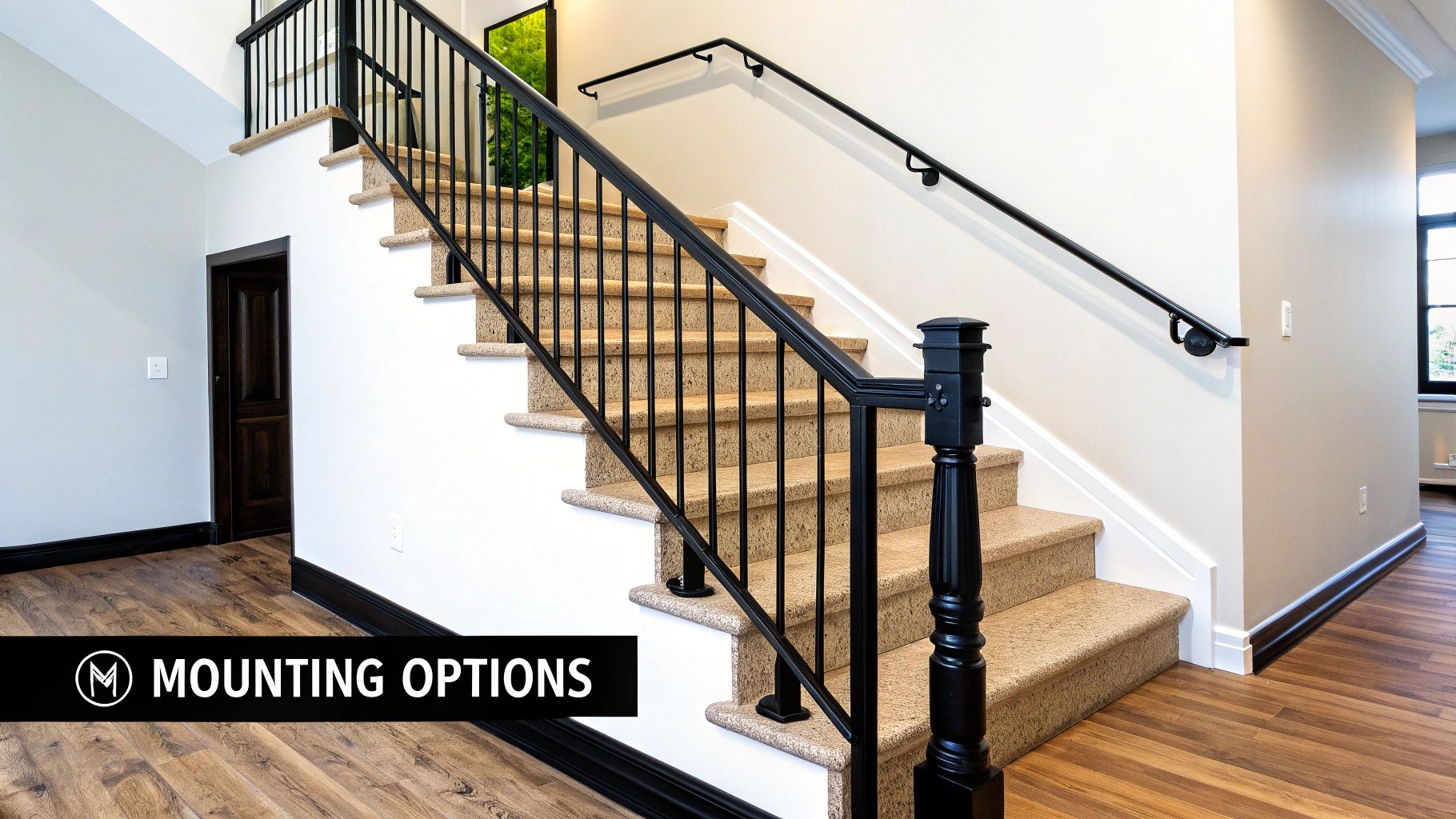
Once you've picked a profile, the next question is how to attach it. This choice fundamentally changes the final look, either creating a 'floating' effect or establishing a more traditional, grounded structure. The two main methods are wall-mounted and post-mounted.
Wall-Mounted Handrails
As the name suggests, a wall-mounted handrail is fixed directly onto an adjacent wall with strong brackets. This is a brilliant solution for any staircase that runs alongside a solid wall.
Picture a classic terraced house in York with a narrow, enclosed staircase. A sleek, wall-mounted round stainless steel handrail would give essential support without cramping the space, enhancing both safety and the feeling of openness.
Post-Mounted Handrails
In contrast, a post-mounted system is built right into the balustrade. Here, the handrail is supported by vertical posts (often called newel posts or balusters) that are fixed to the stair treads or the side of the staircase structure.
This approach is essential for any open-sided staircase, landing, or gallery where there's no adjacent wall for support. It creates a complete, self-contained safety barrier.
A post-mounted system also opens the door to more complex and visually striking designs, especially when you combine it with glass panels. For example, a stunning stainless steel and glass balustrade on a gallery landing in a converted barn near Harrogate would rely on a post-mounted system to create its secure and beautiful feature. It’s the classic structure for most balustrades.
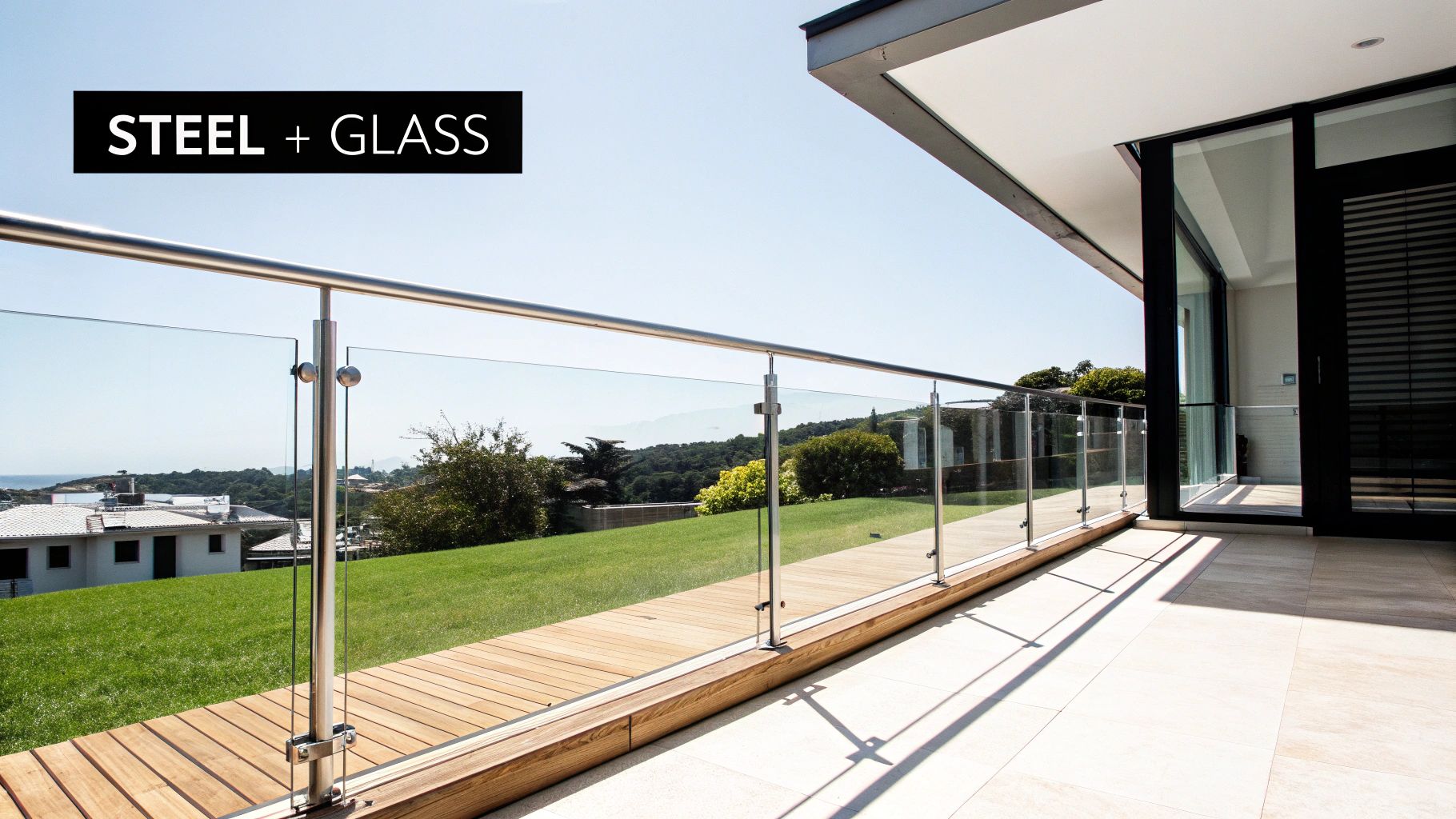
There’s a good reason you see stainless steel and glass together so often in homes across Yorkshire. It’s a classic partnership that just works, creating a timeless and open feel that lets light flood through a space while keeping everyone safe. The clean, minimal lines of a steel handrail are the perfect counterpoint to the transparency of glass, resulting in a balustrade that looks almost weightless yet feels incredibly strong.
But this combination is about more than just good looks. A stainless steel handrail for stairs gives essential structural backbone to a glass balustrade system. When used as a top rail, it ties all the glass panels together, distributing any pressure or load across the entire structure. This creates a really robust, secure barrier that feels solid to the touch—a crucial element for safety and your peace of mind.
When you’re specifying a glass balustrade, it really comes down to two types of safety glass: toughened and laminated. They might look the same, but how they behave on impact is completely different, and the right one for you depends entirely on where it’s being installed.
Toughened Glass: This glass is put through a heating and cooling process that makes it around four to five times stronger than normal glass. If it ever breaks, it shatters into thousands of tiny, blunt pieces rather than dangerous shards, which is why it’s a popular choice for many home projects.
Laminated Glass: Think of this as a glass sandwich. It’s made of two sheets of glass bonded to a tough plastic interlayer in the middle. If a panel breaks, the interlayer holds all the fragments in place, keeping the barrier intact. This is why laminated glass is a legal requirement for any balustrade that protects against a drop, like on a balcony or a high landing, because it stops a dangerous hole from opening up.
For a staircase inside your home, toughened glass will often do the job. But for an outdoor balcony in Harrogate or a mezzanine in a Leeds loft conversion, laminated glass is an absolute must. It provides that critical layer of protection, ensuring the barrier holds firm even if the glass is compromised.
Keeping those glass panels looking their best is also part of the plan. To maintain that crystal-clear look, especially in hard water areas, you might need to know how to remove hard water stains from glass panels.
Figuring out a complete stainless steel and glass system might sound complicated, but modern tools have made it surprisingly simple. Many specialists in the North of England now have online calculators that take all the mystery out of the process, turning what could be a confusing job into a few easy clicks. These tools walk you through all the key decisions, from the system style to the glass type and the measurements you need.
You can get a price tailored to your specific project in minutes. These online tools remove all the guesswork, giving you a clear, instant idea of the budget needed for a complete, stylish, and safe system for your home. You can find out more about how our stainless steel and glass balustrading systems work together in our detailed guide.
When you're thinking about a new handrail, the initial quote is just one part of the story. It's crucial to look at the bigger picture—the practical, long-term side of your investment. Let's get a clear-eyed view of what goes into the price of a stainless steel system and, more importantly, why it's such a smart choice for your home over the long run.
The real value of stainless steel handrails for stairs isn't just in how they look on day one, but how they perform year after year. Forget the endless cycle of sanding, sealing, or painting that timber demands. Stainless steel holds its own against the test of time with barely any fuss, proving its worth with enduring good looks and incredibly low maintenance.
So, what shapes the price of your new handrail? A few key things come into play, and understanding them helps you see exactly where your money is going. This way, you can make choices that fit your budget without compromising on what you really want.
This is where stainless steel really comes into its own and proves its long-term worth. Its built-in resistance to rust and wear means you can officially wave goodbye to the tedious, recurring upkeep other materials need. There’s no annual painting, staining, or sealing on the cards. Ever.
This low-maintenance advantage isn't just a win for homeowners. Think about facilities managers running residential blocks or hospitality venues—for them, it translates directly into serious long-term savings. Industry data actually shows that over a 25-year period, the lifecycle cost of stainless steel can be up to 30% lower than for a painted mild steel system, purely because you eliminate all that repainting.
Think of it like buying a high-quality, weatherproof coat. It might cost more upfront than a cheaper alternative, but it saves you money year after year because it doesn't need constant repairs or replacement. Stainless steel offers that same reliable, cost-effective performance for your home.
Keeping your stainless steel handrails looking brand new is incredibly straightforward. You can forget about harsh chemicals or abrasive scouring pads—in fact, they can do more harm than good by damaging the protective surface. All it takes is a few simple steps.
For a routine clean, a soft microfibre cloth dampened with warm water and a little mild soap is all you need. If you have a satin or brushed finish, just be sure to wipe in the direction of the grain to maintain that smooth, uniform lustre. This quick wipe-down is usually enough to banish fingerprints and daily grime, bringing back the shine in moments.
For a bit of extra TLC and a perfect finish, you might want to look into why you need stainless steel care oil. This simple routine is all it takes to ensure your investment remains a stunning feature for decades to come.
We get asked a lot of questions about stainless steel handrails, especially from homeowners here in Yorkshire and across the North. To help you get started, we’ve put together some quick, straightforward answers to the queries that come up most often.
While it might be tempting to go the DIY route, fitting a handrail—especially one involving glass—is more complex than it looks. Getting it right isn't just about aesthetics; it’s about safety. For a truly secure, regulation-compliant finish, we always recommend bringing in a professional.
An expert knows exactly which fixings to use for your specific wall type, ensuring everything meets UK load-bearing standards. A modern plasterboard wall needs a completely different approach to a classic Yorkshire stone one, and getting that detail wrong can compromise the entire staircase. It’s a small detail that makes a huge difference.
This all comes down to choosing the right grade of steel for the job. For anything indoors, Grade 304 stainless steel is perfect. It offers fantastic corrosion resistance in a controlled home environment and will look brilliant for years.
However, if your handrail is going outside, you absolutely must use Grade 316. This is non-negotiable, particularly in coastal areas like Cumbria or industrial towns where air quality can be harsher. It contains molybdenum, an element that gives it superior protection against rust and corrosion, keeping it pristine no matter what the British weather throws at it.
Using the wrong grade outdoors is a mistake that will unfortunately reveal itself over time. Grade 316 provides the necessary long-term protection against the challenging British climate, ensuring your investment remains beautiful and structurally sound.
This is one of the best things about stainless steel—it's incredibly easy to look after. For routine cleaning, all you need is a soft cloth, some warm water, and a tiny bit of mild soap. A quick wipe-down is usually all it takes.
If you have a brushed or satin finish, just remember to wipe in the direction of the grain. This simple trick helps prevent any micro-scratches and keeps the finish looking flawless and uniform.
The most important thing to remember is what not to use. Never use abrasive scourers, steel wool, or harsh chemicals like bleach. These can strip away the steel's passive protective layer, which is what gives it its rust-resistant magic in the first place. Simple care is always best.
Ready to create a stunning, low-maintenance staircase for your home? The team at Binks Glass Solutions offers local expertise across Yorkshire and the North of England. Get in touch with us for specialist advice and a no-obligation quote. Find out more or start your quote by visiting us at https://binksbalustrades.co.uk/contact-us.