
Railings for Balcony: Your Complete Guide
Choosing the right railings for your balcony is a big decision, one that sits right at the intersection of safety, […]

Choosing the right railings for your balcony is a big decision, one that sits right at the intersection of safety, […]
Choosing the right railings for your balcony is a big decision, one that sits right at the intersection of safety, style, and long-term value. When you boil it down, the choice usually comes down to three main contenders: sleek, modern glass; tough, durable metal; or classic, timeless timber. Each one brings its own character and performance to the table, and your choice will have a real impact on your home’s kerb appeal and how you enjoy your outdoor space.
Picking out the right railings is easily one of the most important parts of any balcony project. This isn’t just about ticking a safety box; it’s a defining feature that helps shape your home’s entire personality. And for those of us in Northern England, from the windswept Yorkshire Dales to the Cumbrian coast, our lovely climate adds another layer to think about. That persistent damp means any material you choose has to be tough enough to fight off rot, rust, and general wear for years to come.
This guide is designed to give you a solid, no-nonsense starting point. We’ll get into the weeds on what makes each material tick, helping you figure out which one is the perfect match for your home’s architecture and your family’s lifestyle.
It can feel like there’s a lot to juggle, but breaking down the decision into three simple stages makes it much more manageable. Think of it as a process where budget, style, and material all work together.
As you can see, your budget is often the first piece of the puzzle, guiding what styles and materials are realistically on the cards.
At the end of the day, the goal is simple: find a solution that’s completely safe, looks fantastic, and doesn’t break the bank. Whether you’re breathing new life into an old balcony or starting from scratch, the right railings will absolutely elevate your home. They can frame that perfect view, create a cosy private nook, or add a bold architectural statement. And for those spots where a full balcony isn’t an option, you might find that the minimalist elegance of Juliette balconies is the perfect way to add safety and style to upper-floor windows.
Stick with us, and we’ll walk you through everything you need to know to choose railings that don’t just protect, but properly enhance your home.
When you’re planning new railings for a balcony, safety isn’t just a recommendation—it’s the law. In the UK, a strict set of Building Regulations governs every aspect of the installation. These rules aren’t there to complicate your project; they’re a vital blueprint designed to prevent accidents and ensure your balcony is a completely secure space for you and your family.
The main rulebook for this is a document called Approved Document K, which covers “Protection from falling, collision and impact.” Think of it as the definitive guide that ensures your balustrade is fit for purpose, covering everything from its height to how strong it needs to be.
One of the most fundamental rules is all about height. To minimise the risk of falls from any external balcony with a drop of more than 600mm, the regulations are crystal clear: the minimum height for the railings must be 1100mm. If you’d like to dive deeper, you can explore more about these external balustrade regulations to ensure your project is spot on.
This specific height isn’t arbitrary; it’s designed to provide an effective barrier for the average adult, preventing any accidental tumbles. But the rules go a step further to protect the youngest members of the family.
That’s where the “100mm sphere rule” comes in. This rule dictates that no gap anywhere in your balustrade—whether it’s between glass panels, through metal bars, or underneath the handrail—can be large enough for a 100mm sphere to pass through. Why 100mm? It’s based on the size of a baby’s head, making it a non-negotiable design constraint to stop small children from getting trapped or slipping through.
Key Takeaway: The two most important numbers to burn into your memory for residential balcony railings are a minimum height of 1100mm and ensuring no gap is larger than 100mm.
A balcony railing that just looks strong isn’t good enough—it has to be strong enough to handle real-world forces. It needs to withstand the pressure of people leaning against it and hold its own against the gusty winds we often get across Northern England. This is where structural load requirements come into play.
Building Regulations specify the minimum forces, known as ‘loads’, that a balustrade must be able to resist. These are measured in kilonewtons per metre (kN/m), and the required strength changes depending on where the balustrade is. A single-family home, for instance, has different requirements than a busy public restaurant terrace, which will see much heavier use.
The regulations look at three main types of forces:
Meeting these structural demands is absolutely essential. It’s what dictates the right materials—from the thickness of the toughened glass to the grade of stainless steel fixings—and ensures they are installed by a professional who knows exactly how to secure them to your building. This is how you guarantee that your beautiful new railings for your balcony are not just a decorative touch, but a robust safety barrier built to last.
Choosing the material for your balcony railings is a bit like choosing the personality for your outdoor space. Each option brings a completely different blend of style, durability, and upkeep. Here in Northern England, where our weather is nothing if not unpredictable, that decision becomes even more critical. Your railings have to stand up to everything from driving rain to biting frosts.
So, let’s dive into the most popular choices—glass, metal, and timber—and see how they really stack up. We’ll explore what makes each one unique to help you find the perfect fit for your home’s architecture, your lifestyle, and our local climate.
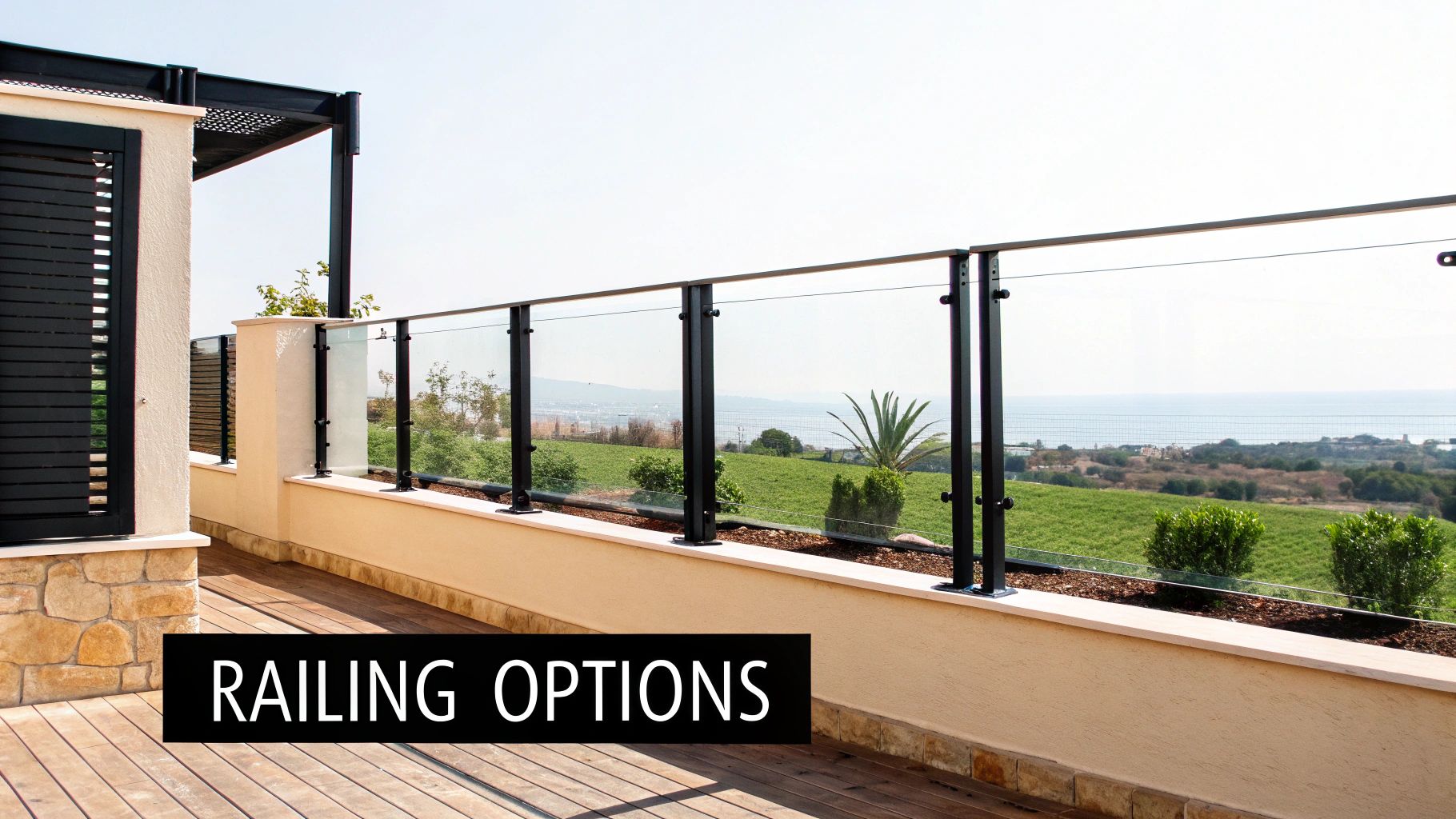
Glass has shot up in popularity for a very simple reason: it offers a clean, contemporary look that’s hard to beat. The main advantage is undeniable—it provides total safety without sacrificing an inch of your view. If your property overlooks the stunning Yorkshire Moors or a garden you’ve spent years perfecting, a glass balustrade means you get to enjoy it all, completely unobstructed.
These systems aren’t made from just any old glass. They use incredibly strong toughened or laminated safety glass, specifically engineered to withstand significant impacts. The sleek, almost invisible lines of a glass balustrade can also make a smaller balcony feel much larger and more open, creating a real sense of space.
Of course, the very transparency that makes glass so appealing can be a downside for some. If privacy is a top priority, you might want to consider frosted or tinted options. And while maintenance is simple—usually just a clean with soap and water—you’ll find that smudges, fingerprints, and water spots are more noticeable, needing a regular wipe-down to keep them looking pristine.
Metal offers a fantastic mix of raw strength and design flexibility, making it a stylish and utterly dependable choice for balcony railings. There are a few key players in this category, each with its own character.
Known for its sharp, modern look and incredible durability, stainless steel is a champion at resisting rust and corrosion. If you live in a coastal area of the North, like parts of Cumbria or Northumberland, specifying marine-grade 316 stainless steel is a must. It’s designed to fight off the corrosive salt spray that other metals can’t handle. With minimal maintenance, it keeps its polished look for years.
Lightweight yet surprisingly strong, aluminium is another brilliant low-maintenance option. It simply won’t rust, making it perfect for the damp Northern English climate. It’s usually powder-coated, a process that bakes on a tough, colourful finish. This means you can match it to your window frames or other architectural details, giving you huge design versatility.
For that classic, traditional aesthetic, nothing beats wrought iron. It has a timeless elegance and allows for ornate, decorative designs that you just can’t achieve with other materials. The main thing to keep in mind with wrought iron is its battle against rust. It needs regular care, including checking for rust spots and repainting every few years, to protect it from the elements and keep it looking beautiful.
Important Consideration: The durability of any metal railing comes down to its finish. A high-quality powder coating on aluminium or choosing the correct grade of stainless steel isn’t an upsell—it’s a crucial investment against the persistent damp of a northern climate.
To help you weigh up the options at a glance, we’ve put together this table. It breaks down the pros, cons, and typical lifespan of each material, giving you a clear picture of what to expect.
| Material | Pros | Cons | Average Lifespan |
|---|---|---|---|
| Glass | Unobstructed views, modern look, makes spaces feel larger, low maintenance cleaning. | Can show smudges easily, offers less privacy unless frosted/tinted. | 50+ years |
| Stainless Steel | Extremely durable, rust/corrosion resistant, modern and sleek appearance. | Higher initial cost, requires marine-grade (316) in coastal areas. | 50+ years |
| Aluminium | Lightweight, rust-proof, versatile with powder-coat colours, low maintenance. | Can be less strong than steel, may dent under heavy impact. | 40-50 years |
| Wrought Iron | Classic, elegant style, allows for ornate and custom designs, very strong. | Prone to rust, requires regular maintenance (painting/sealing). | 60+ years (with care) |
| Timber | Natural, warm aesthetic, versatile (can be stained/painted), pleasant to the touch. | High maintenance, susceptible to rot, warping, and pests without regular sealing. | 15-30 years (highly variable) |
Ultimately, the right choice balances your aesthetic vision with the practical demands of your location and the level of maintenance you’re prepared for.
Timber brings a natural, classic warmth that can beautifully complement almost any architectural style, from a rustic cottage to a more contemporary new-build. It feels good to the touch and creates a softer, more organic look for your balcony. One of its best features is its versatility—wood can be stained or painted in any colour you can imagine.
The big challenge with timber railings, especially in our part of the world, is their vulnerability to the weather. Without proper, consistent maintenance, wood is prone to rot, warping, and insect damage.
To get a long life out of timber railings, you need to commit to:
While timber certainly demands more upkeep than glass or metal, the timeless appeal of well-maintained wood is undeniable. If you’re looking for ways to blend that natural feel with modern materials, you might find some inspiration in our guide to glass panels for decking, which often combines the best of both worlds.
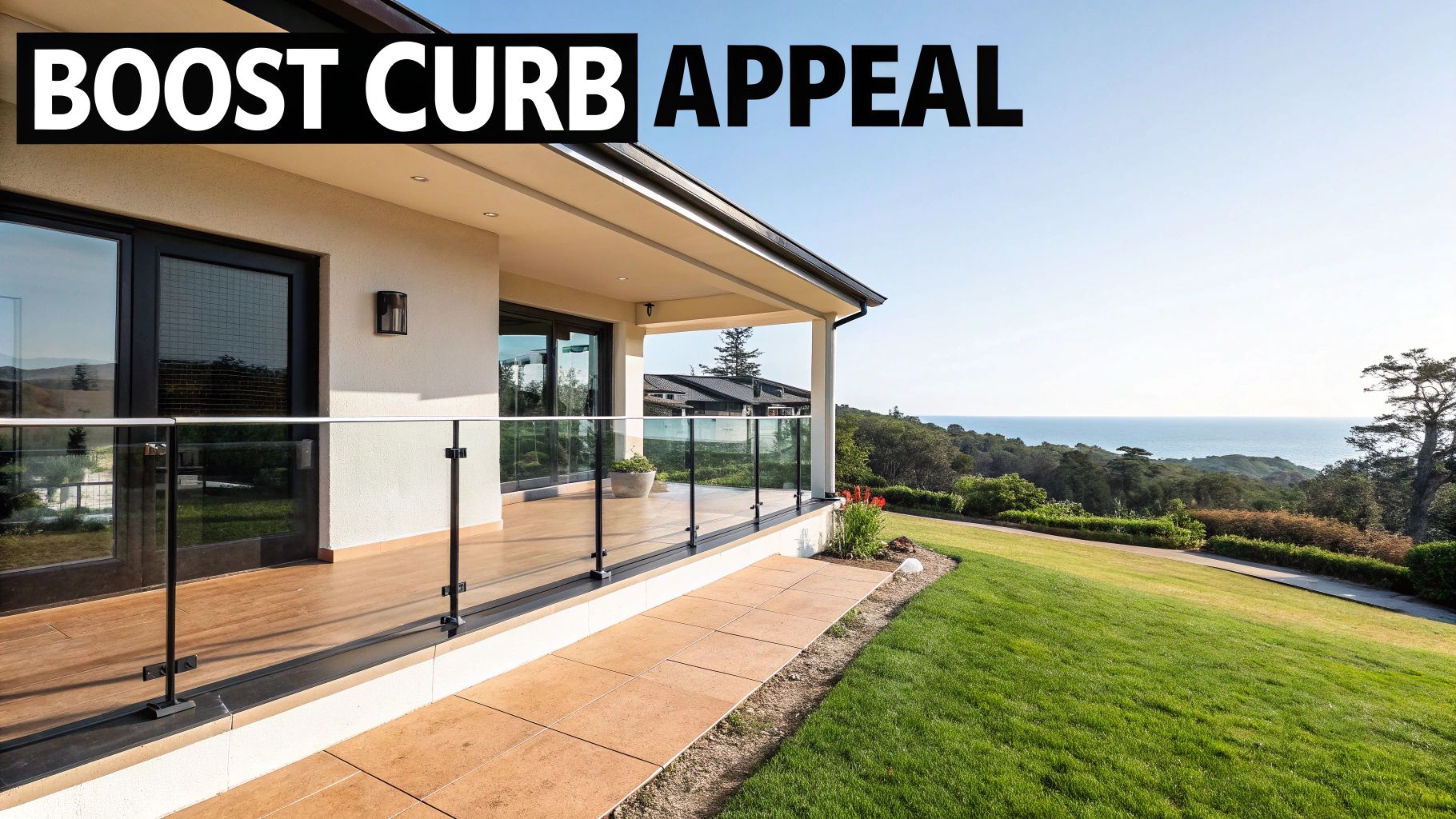
It’s tempting to view balcony railings as a purely functional safety requirement, but that’s only half the story. The right railings for a balcony are a powerful architectural tool, capable of completely transforming the character of your home. They’re often the first thing people notice, acting as the frame for your outdoor space and giving your property’s kerb appeal—and even its market value—a serious boost.
Your balcony isn’t just an add-on; it’s an extension of your home’s personality. The style you choose, whether it’s the sleek invisibility of frameless glass or the classic charm of detailed metalwork, should feel like it belongs. This one decision has a huge impact on how you experience your home, turning a simple platform into a sophisticated outdoor room.
For so many homeowners here in Northern England, the view is everything. If your home is lucky enough to overlook the rolling Yorkshire Dales or the stunning Peak District, the last thing you want is a clunky barrier getting in the way. This is where your railing design becomes absolutely critical.
Frameless glass balustrades are, without a doubt, the best choice for protecting those sightlines. By getting rid of vertical posts and using a discreet but strong base fixing, they create a totally seamless connection with the outside world. This minimalist style doesn’t just open up the view; it lets a huge amount of natural light pour into your home, making the rooms behind feel brighter, bigger, and more inviting.
It’s a concept that landscape gardeners and designers often use when planning gardens in the North of England, making the wider scenery feel like part of your own space. A glass balustrade does exactly that for your home, pulling the beauty of the outdoors right up to your window.
Think of your balcony railing as a blank canvas—a brilliant chance to express your personal style and complement your home’s unique architecture. Modern systems offer a fantastic range of options that go far beyond a simple choice of metal or wood. It’s your opportunity to add a bespoke touch that really makes your property stand out.
You can tailor almost every part of your railing system.
By thinking through these combinations, your railings for a balcony become so much more than a safety feature. They become a deliberate design choice that elevates your home’s entire appearance and creates a stunning final impression.
Before diving into any home improvement project, getting a handle on the budget is absolutely essential. When it comes to new railings for a balcony, the final price tag isn’t just one figure; it’s pieced together from several key elements that all influence your overall investment. By breaking these down, you can plan much more effectively and find a first-class solution that fits your vision and your wallet.
The cost of your balcony railings boils down to a few main drivers. Your choice of material is easily the biggest factor. Options like a sleek, frameless glass system will naturally have a higher upfront cost than a simple timber setup. After that, the total length you need and the complexity of the design—like the number of corners or bespoke fittings—will also play a major part in shaping the final quote.
To give you a clearer picture of what to expect, looking at costs on a per-metre basis is incredibly helpful. This gives you a solid baseline for comparing different materials, but remember these are estimates. The final price can always vary depending on the exact specification and your chosen supplier.
It’s so important to see your new railings as a long-term investment. While a material like frameless glass has a higher initial cost, its sheer durability and minimal maintenance can offer far better value over the decades compared to a cheaper material that needs constant upkeep and eventual replacement.
The big question: hire a professional or go it alone? It’s a major decision with significant cost implications. A professional installation might add 20-40% to the total project cost, but what you’re really buying is crucial peace of mind.
Professional fitters ensure your railings are securely anchored and fully compliant with UK Building Regulations—something that is absolutely non-negotiable for safety. They have the specialist tools and, critically, the experience to handle materials like heavy glass panels correctly, avoiding expensive mistakes or damage.
While a DIY approach can save you money on labour, it’s fraught with risks. Hidden expenses can pop up everywhere, from hiring specialist tools to the potential cost of having to fix errors. More importantly, an improper installation could seriously compromise the safety of your balcony. That’s a risk that massively outweighs any initial savings. For a secure, compliant, and beautifully finished result, professional installation is almost always the wisest path.
Choosing the perfect railings for a balcony is a huge step, but it’s the quality of the installation that truly brings your vision to life and guarantees its safety for years to come. A professional job is far more than just assembling parts; it’s a precise process ensuring every fixing is rock-solid, every panel is perfectly level, and the whole structure can stand up to real-world forces.
It all starts with a structural check to make sure the balcony itself can handle the new system. From there, installers use specialist fixings designed for your specific wall type—be it brick, concrete, or timber—to create an unshakeable foundation. This is the kind of detail that separates a safe, long-lasting balustrade from a potential hazard down the line.
Once your beautiful new railings are in place, the job isn’t quite done. A little regular maintenance goes a long way in protecting your investment, especially against the damp and changeable weather we get here in Northern England. The good news? Modern systems are designed to be incredibly low-maintenance, but each material has its own simple care routine.
By following just a few straightforward tips, you can make sure your balcony railings continue to look fantastic and perform perfectly for decades.
Different materials have different needs, but caring for them is simple. Here’s a quick breakdown of how to look after the most popular options.
Pro Tip: Set a reminder in your calendar for a quick spring and autumn check-up. A simple inspection and clean before and after the harshest weather will help you catch any potential issues early and will seriously extend the life of your railings.
Choosing new railings is a big decision, and it’s completely natural to have a few questions before you commit. We get it. To give you total confidence in your plans, we’ve put together some of the most common queries we hear from homeowners right across Northern England.
Here are some clear, straightforward answers to help you navigate those final details. We’ll cover everything from planning permission to choosing the right materials for tricky environments, making sure your finished balcony is safe, stylish, and a perfect fit for your home.
This is easily one of the most common questions we’re asked, and the answer really depends on the scale of your project.
For the most part, if you’re simply replacing existing railings on a like-for-like basis—meaning the new ones are a similar style and height—you will not need planning permission. This is usually considered ‘permitted development’.
However, you’ll likely need to get in touch with the planners if:
The best policy is always to double-check with your local planning authority before starting any work. A quick phone call can save a world of hassle and ensures your project is fully compliant from day one.
Making sure your balcony is a secure space for children is non-negotiable. The single most effective way to guarantee safety is to stick rigidly to UK Building Regulations, which are specifically designed with child safety as the top priority.
The two golden rules are the 1100mm minimum height requirement and the “100mm sphere rule.” This second rule ensures that no gap anywhere in the balustrade is large enough for a 100mm sphere to pass through, which is a good stand-in for a small child’s head.
For ultimate peace of mind, think about using solid infill panels like toughened safety glass. These designs completely eliminate any horizontal bars or wires that a curious child might be tempted to climb, creating the safest possible barrier.
Living near the coast is wonderful, but the salty sea air poses a unique challenge—it’s highly corrosive to many building materials. Choosing the right railings for a balcony in a coastal spot is absolutely crucial if you want them to last.
When it comes to metal, marine-grade 316 stainless steel is the undisputed champion. It contains an element called molybdenum, which gives it far superior resistance to the rust and corrosion caused by saltwater spray.
Powder-coated aluminium is another fantastic, low-maintenance option as it simply won’t rust. And while timber can look beautiful, it demands constant, diligent sealing to protect it from the relentless coastal weather.
Ready to find the perfect railings for your balcony? The team at Binks Glass Solutions offers expert advice and premium glass systems for homes across Yorkshire and the North of England. Get a personalised quote online in minutes with our Balustrade Calculator or contact us today to discuss your project.