
Glass Clamps for Balustrade: glass clamps for balustrade tips
Imagine opening up your home in Harrogate or Leeds to a truly breathtaking, uninterrupted view. That's the magic of a […]

Imagine opening up your home in Harrogate or Leeds to a truly breathtaking, uninterrupted view. That's the magic of a […]
Imagine opening up your home in Harrogate or Leeds to a truly breathtaking, uninterrupted view. That's the magic of a modern glass balustrade, and the unsung heroes making it all happen are the glass clamps. These small but mighty bits of hardware are what securely grip the toughened glass panels, creating the sleek, minimalist look that’s become so popular for patios, staircases, and balconies right across Northern England.
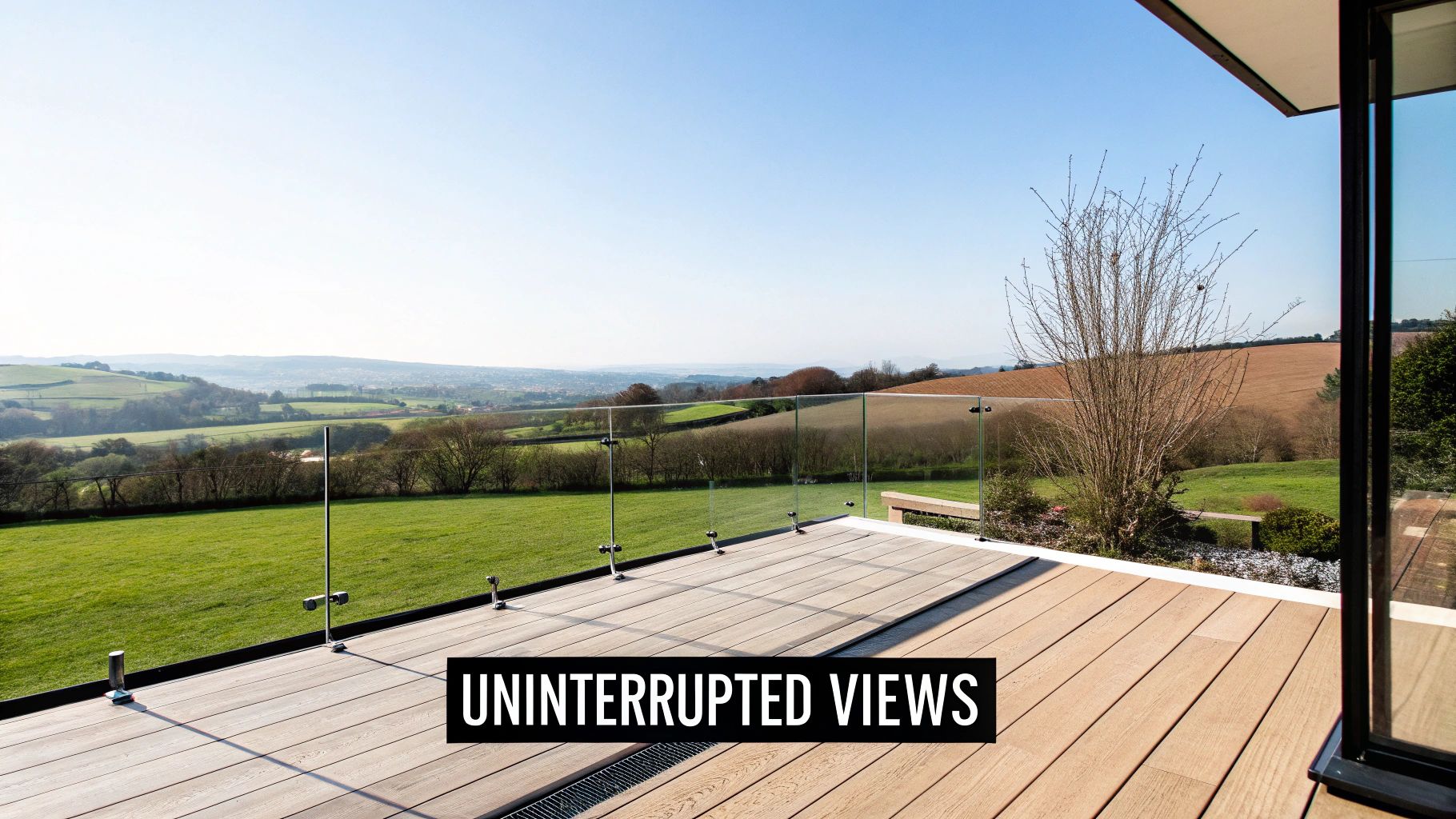
The best thing about a contemporary balustrade is its ability to provide total safety without fencing you in. Traditional barriers with chunky posts and railings can feel restrictive and visually shrink your space. Glass balustrades, on the other hand, create a wonderful sense of openness and light, seamlessly blending your indoor and outdoor areas.
This is where glass clamps for balustrade systems play their starring role. They are precision-engineered fixings designed to hold heavy glass panels firmly in place, either attached to structural posts or fixed directly to a surface like a wall or deck. Their job is to deliver that clean, minimalist aesthetic without ever compromising on structural integrity.
The appeal of using glass clamps goes well beyond just their clean, modern appearance. They offer a genuinely practical and versatile solution for homeowners and developers alike.
If you're keen to understand why glass is the go-to material for modern balustrades, it's worth taking a moment to delve deeper into the properties of glass. This background knowledge really helps you appreciate how the clamps and panels work together as a complete system.
The core principle is simple but incredibly effective: provide immense strength with the smallest possible visual footprint. This perfect balance is what makes glass clamp systems so sought-after for transforming spaces.
As local experts serving communities from Cumbria to Hull, we get the unique demands of properties in the North. This guide will walk you through everything you need to know, from the different types of clamps available to ensuring your project is fully compliant and safe. To get a head start, our Balustrade Calculator is the perfect place to begin, giving you a clear idea of what’s needed for your specific project.
At first glance, you might dismiss glass clamps as simple bits of hardware. But in reality, they are precision-engineered components doing the most important job of all: ensuring the safety and stability of your entire balustrade. Think of them as a firm, reliable handshake for your glass panels—they provide immense strength without the visual clutter of old-fashioned frames.
This minimalist design is exactly how we achieve that stunning, almost invisible, frameless look. But it does raise a question: how can these small fittings possibly hold large, heavy panels of toughened glass against gravity, wind, and the odd lean? The answer is a clever bit of engineering that combines compression, friction, and smart material choices.
The mechanics are actually quite straightforward, but incredibly effective. A typical glass clamp is made of two plates that ‘sandwich’ the glass. As you tighten the screws, these plates press inwards, creating a powerful clamping force. This is where the real magic happens.
Now, the force from the screws isn't just about metal crushing against glass—that would create dangerous stress points and almost certainly lead to cracks. Instead, every high-quality glass clamp for balustrade system uses a crucial middleman: rubber gaskets.
These gaskets, usually made from a seriously durable material like EPDM rubber, have two critical functions:
The entire system is designed to spread the pressure evenly across the gripping surface. This is vital because it stops stress from building up on any single point, which is key to preventing cracks and ensuring the glass panel stays safe for years to come.
This powerful grip is the basis of what we call a friction-fit system. For many jobs, especially with lighter or shorter panels of glass, this friction alone is more than enough to hold the glass securely. But for that extra layer of safety and total peace of mind, a second mechanism often comes into play.
This brings us to pin-secured clamps. With this design, a small hole is drilled through the glass panel when it's being made. The clamp itself then has a small metal safety pin that slots right through this hole.
It’s a real belt-and-braces approach to safety. The friction from the gaskets does the main job of holding the glass, but the pin provides absolute mechanical backup. Even if the clamp were to somehow work loose over time, the glass is physically resting on that pin and simply cannot slip down. This feature is often a non-negotiable requirement for meeting the stringent safety standards in UK building codes for balustrades that protect a drop.
The demand for these safe, stylish systems is only going up. The UK's flat glass processing sector—the industry that makes the panels for these balustrades—has seen impressive growth, with a 6.5% compound annual growth rate in revenue in the five years up to 2025. This expansion, now a £1.6 billion market, is what allows specialists like Binks Glass Solutions to provide cutting-edge clamp systems for projects across Leeds, York, and the North. You can read more about the flat glass processing industry trends and find further details.
Choosing the right glass clamps for a balustrade is about more than just what catches your eye. It’s a crucial decision that balances the look you want with the practicalities of your home's style and, most importantly, the clamp’s material and finish. Get this combination right, and you'll have a balustrade that not only looks fantastic but will stand up to whatever the British weather throws at it for years to come.
The visual style of the clamp is often where people start. Each shape lends itself to a different architectural feel, and picking the right one can be the final touch that ties your whole design together.
For a sleek, modern new-build in Cheshire, the sharp, clean lines of a square clamp often look spot on. On the other hand, the softer profile of a D-shaped or round clamp might be a better fit for a classic home in York or a gracefully curved balcony.
This thought process is laid out in the flowchart below, which helps you navigate the two main ways clamps secure the glass.

As you can see, figuring out whether you need a friction-fit or a pin-secured clamp is a foundational step. It has a direct impact on both the safety of the system and the type of glass you’ll need for your balustrade.
Beyond the shape, the actual material of the clamp is a critical choice that depends entirely on where your balustrade is going. This isn't just a small detail; using the wrong material can lead to rust, ugly staining, and a serious drop in the clamp's lifespan and structural strength.
The two main players here are Grade 304 and Grade 316 stainless steel. Zinc alloy is another option, but its use is very limited. Let's break them down.
This table offers a side-by-side look at the common options, helping you select the best material for your balustrade project, whether it's indoors or facing the elements here in the North of England.
| Feature | Grade 304 Stainless Steel | Grade 316 Stainless Steel | Zinc Alloy (Internal Only) |
|---|---|---|---|
| Best For | Internal applications (stairs, landings, mezzanines) | All external applications, especially coastal/high moisture | Dry, internal environments only; budget-conscious |
| Corrosion Resistance | Good for indoor environments | Excellent. Contains molybdenum for superior rust resistance | Low; will corrode quickly if exposed to moisture |
| Typical Use Case | An interior staircase balustrade in Manchester | A garden patio balustrade in Leeds or a coastal balcony | A decorative indoor screen or light-use landing |
| Cost | Cost-effective | Premium, but essential for longevity | Lowest cost |
| Strength | Very strong and durable | The strongest and most durable option available | Less strong than stainless steel |
Ultimately, for any project that will be exposed to the outdoors, Grade 316 stainless steel is the only sensible choice. Think of it less as an upgrade and more as a fundamental requirement for a safe, long-lasting installation that can handle our challenging climate.
Once you've nailed down the shape and material, the final flourish is the finish. This is your chance to coordinate the clamps with other bits of hardware like door handles or window frames to create a really cohesive and polished look.
Here are the most popular finishes we see:
Of course, the glass itself is a huge part of the equation. Different clamps are designed for specific types and thicknesses, and knowing the difference between toughened and laminated glass is key to a safe installation. You can learn more about laminated and toughened glass here to ensure your choice aligns with your clamps and project needs. Getting it right means your balustrade will be both beautiful and completely compliant with safety standards.
Choosing the perfect glass clamps for a balustrade is only half the story. The other, more critical half is making sure your finished installation is safe, secure, and fully compliant with UK law. This means getting to grips with the Building Regulations designed to protect people from falls.
While the rules can seem a bit technical at first, understanding the basics is essential for any homeowner. These aren't just guidelines you can choose to ignore; they are legal requirements.
Getting it wrong isn't just a safety hazard for your family and guests. A non-compliant balustrade can be a major headache when you come to sell your home, often flagged by surveyors and requiring expensive work to put right.
When it comes to balustrades, the two main documents you'll hear mentioned are Approved Document K (Protection from falling, collision and impact) and BS 6187 (Code of practice for barriers in and about buildings). These set out the minimum standards for how strong, high, and well-constructed a balustrade needs to be.
For a typical home, the most important figure to remember is the load-bearing capacity. Your balustrade must be able to withstand a horizontal line load of 0.74 kilonewtons per metre (kN/m) pushed against its top edge. It’s a technical term, but it basically means the barrier is strong enough to handle the force of a 75kg person leaning or falling against it.
This 0.74kN/m requirement is the absolute benchmark for safety in residential projects. It's the number that dictates everything from the thickness of your glass to the spacing of your clamps, ensuring the whole system works together as a secure barrier.
Achieving this standard is non-negotiable. That’s why working with a knowledgeable supplier who truly understands these figures is so important. For a deeper dive, check out our comprehensive guide covering the key points of UK building regulations for balustrades.
These regulations directly influence the real-world decisions you'll make about your balustrade's components. For instance, the spacing between your glass clamps isn't just an aesthetic choice; it’s a structural calculation based on the glass thickness and that all-important load capacity.
This interplay between glass thickness, clamp spacing, and load requirement is a fundamental principle of safe balustrade design. You simply can't guess how many clamps you need; it has to be calculated.
Another crucial part of Approved Document K deals with gaps. To prevent small children from getting trapped or falling through, the rules on spacing are incredibly strict.
These precise measurements are there for one simple reason: to keep people safe. Adhering to them is a core part of any compliant installation. It's this commitment to safety and clean lines that has made these systems so popular. Glass clamps have truly changed the game for installations across the UK, especially in the booming frameless structural glass market, where the country holds a commanding 24.6% share of the European market. This demand shows homeowners want systems that are both beautiful and safe, meeting standards like the 0.74kN/m line load. You can discover more insights about the frameless structural glass balustrade market on futuremarketinsights.com.
Partnering with an experienced supplier like Binks Glass Solutions ensures your project in Leeds, Harrogate, or anywhere in the North of England meets every one of these vital requirements, giving you total peace of mind.

Getting a glass balustrade installed successfully all comes down to attention to detail. While it might look simple enough on the surface, a few key practices separate a secure, professional finish from a project riddled with problems. Nailing these details ensures your balustrade isn't just beautiful, but safe for years to come.
One of the first and most fundamental steps is preparing the surface. The posts or wall where your glass clamps for balustrade will be fixed must be perfectly clean, level, and structurally solid. Any wobble or unevenness in the mounting surface will transfer directly to the glass, creating nasty stress points and alignment headaches down the line.
Perfect alignment and spacing are just as vital. This isn't just about making it look good; it's about making sure the loads are spread evenly across the system, just as the engineers intended. Always measure twice, and use a spirit level and laser line to guarantee every clamp is positioned precisely where it needs to be.
The final stage is securing the clamps with just the right amount of pressure. Overtightening is a common—and very costly—mistake. It can crush the rubber gaskets, ironically reducing their grip, or worse, put immense stress on the glass that can lead to cracks.
On the flip side, under-tightening is just as dangerous, as it won't create enough friction to hold the glass panel securely in place. If you can, use a torque wrench. Otherwise, tighten by hand until you feel firm resistance, then give it a final quarter-turn. The goal is a snug, immovable fit that doesn't deform the clamp or stress the glass.
The rubber gasket is the unsung hero of the installation. Using the wrong size is one of the most frequent DIY errors. A gasket that's too thin for the glass won't compress properly, leading to a dramatic loss of friction and a panel that can slip over time.
For a more detailed walkthrough, it's always best to follow professional guidance. Our guide on how to install a glass balustrade offers a much deeper dive into the process, laying out the practical steps we professionals in the North of England follow for a perfect finish.
Knowing what not to do is just as important as following the right steps. With a bit of foresight, many of the most common issues can be avoided entirely.
Here are three frequent mistakes to watch out for:
These core principles aren't just for balustrades. If you're interested in the broader subject of glass architectural wall installation techniques, you'll see they share many of the same fundamentals. It all reinforces why getting expert advice is invaluable from the very start of your project.
We’ve journeyed through the essentials of choosing, specifying, and fitting a modern glass balustrade. You should now have a solid grasp of the fundamentals, from selecting the right glass clamps for a balustrade system to navigating the all-important UK safety regulations. The next step? Turning that knowledge into a stunning, tangible feature for your home.
This is where true expertise really comes into play. Pulling together the right materials, the perfect clamp design, and ensuring full compliance is a craft in itself. Getting these details spot-on from the very beginning is what separates a good project from a great one.
At Binks Glass Solutions, we’re not just another supplier. We're your local partner, deeply committed to delivering exceptional results for properties across Northern England. We are proud to serve homeowners, architects, and developers in Harrogate, Cheshire, Cumbria, Darlington, Hull, Leeds, and York.
Our team lives and breathes the local architectural styles and understands the unique environmental demands of the region. This insight means we can offer advice that is both practical and inspiring, helping you create a balustrade that feels like it truly belongs to your home and will stand the test of time.
Choosing the right components is the foundation of a safe and beautiful balustrade. Our role is to simplify this process, offering clear guidance and premium products to ensure your project not only meets but exceeds expectations. We are here to support you from the initial design concept right through to the final specification.
The appetite for these clean, modern systems is certainly growing. The UK balustrade market is set for significant expansion, with forecasts pointing to steady growth from 2025 to 2031, driven largely by the soaring popularity of glass systems. This trend is something we're seeing first-hand in places like Harrogate, Leeds, and York, where sleek glass balustrades are fast becoming the go-to choice. You can read more about the UK balustrade market growth.
The thought of transforming your space with a glass balustrade is an exciting one. Whether it's for a patio, balcony, or an internal staircase, getting started is simple. We’ve even built a tool to help you get instant clarity.
Your journey to a breathtaking, open, and safe space starts right here. Let us help you bring that vision to life with a beautifully engineered glass balustrade that adds real value to your property and gives you complete peace of mind.
When you're planning a project, a few technical questions always pop up. To help you get clear, we've put together some straightforward answers to the queries we hear most often about glass clamps for balustrade systems. Think of this as a quick guide for homeowners across the North of England.
Glass clamps are surprisingly versatile and can handle a whole range of glass thicknesses, usually from 8mm right up to 21.5mm. The real question isn't what the clamp can hold, but what your project needs. The right thickness is all about the application – where it is, and what you’re asking it to do.
For example, a simple domestic staircase inside a home in Leeds might only require 10mm toughened glass. But take that balustrade outside to a frameless balcony in a windy spot like Hull, and you'll need something much more robust. Here, you'd be looking at 17.5mm or even 21.5mm toughened laminated glass to handle the wind load and provide total peace of mind.
Whatever thickness you choose, the secret to a secure fit is using the correct rubber gaskets inside each clamp. This is what creates that vice-like, slip-free grip on the glass.
Whether or not you need a top rail or handrail really comes down to the type of glass you've chosen. If you're using standard toughened monolithic glass, then UK regulations are very clear: you almost always need a top rail. This rail isn't just for looks; it provides critical structural support, tying all the panels together and spreading any impact across the entire system.
However, if you've set your heart on that seamless, completely frameless look, there is a way. By upgrading to toughened laminated glass, you can often do away with the top rail altogether. That's because the laminated design has a built-in fail-safe. Even if one of the glass panes were to break, the plastic interlayer holds everything together, preventing a fall. Our team can talk you through the options to find the perfect balance between safety and your desired aesthetic.
Figuring out the spacing for your glass clamps is a crucial structural calculation, not just a matter of what looks best. The correct distance depends on a cocktail of factors: the thickness and size of your glass panels, the balustrade's height, and the specific load-bearing requirements set out in building regulations.
As a general rule of thumb for a standard 1-metre high balustrade, you'll often see clamps spaced between 150mm and 250mm in from each edge of the glass. For most panels up to 1.2 metres wide, two clamps will do the job.
But please, treat this as a guideline only. For a guaranteed safe and compliant installation, you must follow the manufacturer’s data sheets or get a structural engineer to run the numbers. There's no room for guesswork here.
The good news is that maintaining stainless steel glass clamps is incredibly simple. For internal clamps made from Grade 304 stainless steel, a quick wipe with a soft, damp cloth is usually all it takes to keep them looking brand new.
For external clamps, which are made from tougher Grade 316 stainless steel, a little more regular care will keep them pristine and prevent superficial corrosion (sometimes called 'tea staining'). We recommend giving them a clean every three to six months. Just use warm, soapy water and a soft cloth, rinse with clean water, and dry them off. It's vital that you never use abrasive cleaners, wire wool, or scouring pads, as they will scratch the surface and ruin its protective layer.
Ready to bring your vision for a modern, safe, and beautiful glass balustrade to life? The expert team at Binks Glass Solutions is here to provide tailored advice and premium components for your project in Harrogate, York, Leeds, and across the North of England. Contact us today to discuss your requirements and get started.