
A Homeowner’s Guide to Outdoor Glass Balustrades
Sleek, modern, and incredibly strong, outdoor glass balustrades are safety barriers designed for spaces like patios, decking, and balconies. Made […]

Sleek, modern, and incredibly strong, outdoor glass balustrades are safety barriers designed for spaces like patios, decking, and balconies. Made […]
Sleek, modern, and incredibly strong, outdoor glass balustrades are safety barriers designed for spaces like patios, decking, and balconies. Made from specially toughened or laminated glass, they offer that perfect, rare blend of unobstructed views and robust safety. It's no wonder they've become such a popular choice for homeowners looking to add a touch of class and real value to their properties.
All across the North of England, from the rolling Yorkshire hills to the manicured gardens of Cheshire, homeowners are making a clear choice: swapping out old-fashioned railings for the clean lines of glass. This isn't just a fleeting trend; it’s a fundamental shift in how we want to experience our outdoor spaces.
These systems do away with the bulky, view-blocking barriers of the past, replacing them with elegant, transparent glass panels. The effect is immediate. You get a seamless connection between your home and garden, creating a feeling of openness that makes any area feel bigger, brighter, and more inviting. By simply removing those visual interruptions, you can finally appreciate your surroundings properly, whether that's a beautifully tended garden in Harrogate or a sweeping city view from a Leeds rooftop terrace.
At its heart, a glass balustrade is an engineered safety system. It’s there to provide a sturdy, reliable barrier for any raised area, giving you complete peace of mind when family and friends are enjoying the space. But where it truly excels is in how it delivers this safety without ever compromising on style.
This powerful combination of strength and beauty is exactly why they've become so popular. A well-designed outdoor glass balustrade can:
Choosing to install an outdoor glass balustrade is more than just a home improvement; it’s a smart investment in your property’s long-term value and your daily enjoyment. It elevates the entire look and feel of your home, turning functional outdoor areas into sophisticated extensions of your living space. This guide is here to walk you through everything you need to know, from picking the right style to understanding the costs, helping you make a decision that will enhance your home for years to come.
To really make your new installation pop, especially after dark, consider integrating it with complementary architectural lighting solutions. The right lighting can accentuate the clean lines and transparency of the glass, turning your balustrade into a stunning feature, day or night.
Choosing the perfect outdoor glass balustrade is all about finding that sweet spot where your home's character meets your personal taste. The options might seem endless at first, but it really boils down to three main styles. Each one brings its own distinct personality and visual punch to your property.
Getting your head around these styles is the first step. It's how you create a space that feels both completely secure and beautifully open. Whether you want the glass to practically disappear or stand out as a feature, there’s a design that’s perfect for you.
For anyone who wants a completely uninterrupted view, the frameless glass balustrade is the undisputed champion. This style creates a 'disappearing' barrier, relying on thick, immensely strong panels of safety glass that are secured only at their base. The result is pure, minimalist elegance.
Think of it as an invisible wall of safety. It's there to protect, but it never gets in the way of the scenery. This makes it a fantastic choice for properties in Yorkshire or Cumbria with those stunning countryside views that really deserve to be the star of the show. A frameless system delivers that high-end, modern look that seamlessly connects your garden or patio to the world beyond.
This approach isn't just about looks; it's a smart investment. Upgrading your outdoor living space with features like glass balustrades directly contributes to both the safety and the overall value of your home.
As you can see, enhancing your outdoor living is a clear path to improving safety, style, and ultimately, your home's kerb appeal and market value.
If you’d rather have a more defined edge, a semi-frameless system hits that perfect middle ground. This design uses sleek, minimalist posts—usually stainless steel or powder-coated aluminium—to support the glass panels.
This style gives you a sense of structure while still keeping everything feeling light and airy. It’s an incredibly versatile choice that looks just as good on contemporary new builds as it does on more traditional homes across the North of England.
Finally, there’s the framed system, which offers a classic and reassuringly solid look. Here, the glass panels are fully enclosed within a metal frame, creating a robust and highly visible barrier. This traditional approach has a strong visual presence and can be customised to echo existing architectural details on your property.
The key thing to remember is that the style you pick has a direct impact on how the whole system is fixed together. A frameless system needs a really robust base fixing, whereas semi-frameless designs depend on the strength of their posts.
The way your glass is secured is every bit as important as the style itself. The fixing method doesn't just hold everything together; it’s a major part of the final look and the overall strength of your new balustrade.
Getting the right combination of style and fixing is crucial. For instance, if you're upgrading a raised deck, understanding the specific options for glass panel decking will help you choose a system that’s not just beautiful but completely safe and structurally sound.
To make things a little clearer, we've put together a simple table comparing the three main styles.
This quick comparison should help you weigh up the aesthetics and practicalities of each system.
| Style | Aesthetic | Primary Fixing Method | Best For | Cost Indication |
|---|---|---|---|---|
| Frameless | Minimalist, invisible barrier | Base Channel or Spigots | Uninterrupted panoramic views and modern homes | Higher |
| Semi-Frameless | Defined yet open feel | Post System with Clamps | A balance of structure and clarity | Mid-Range |
| Framed | Classic, sturdy look | Full Post and Rail System | Traditional properties and maximum visual structure | Lower |
Ultimately, the best choice depends on your property, your budget, and the view you want to wake up to every morning.
When you're designing your perfect outdoor glass balustrade, the single most important decision you'll make is about the glass itself. This goes far beyond aesthetics; it's about the fundamental safety of your family and guests. In the world of balustrades, there are two industry standards: toughened safety glass and laminated safety glass. Getting to grips with the real-world difference between them is absolutely crucial.
This choice isn’t just a technical footnote; it’s the core of your system’s strength and safety profile. The demand for these high-performance materials is what drives the UK's flat glass industry, a sector projected to be worth £1.6 billion by 2025. This growth is a direct reflection of how popular high-quality architectural features like glass balustrades have become.
Making the right choice here ensures your balustrade isn't just a beautiful addition, but a truly fit-for-purpose safety barrier that provides complete peace of mind.
Think of toughened glass like the side window of your car. It’s created through an intense process of heating and rapid cooling, which makes it incredibly strong—about four to five times stronger than normal glass of the same thickness. It can take a serious knock.
But its real safety feature is what happens when it fails. If toughened glass does break, it doesn’t create dangerous, jagged shards. Instead, it shatters completely into thousands of tiny, blunt, pebble-like pieces. This dramatically lowers the risk of serious injury.
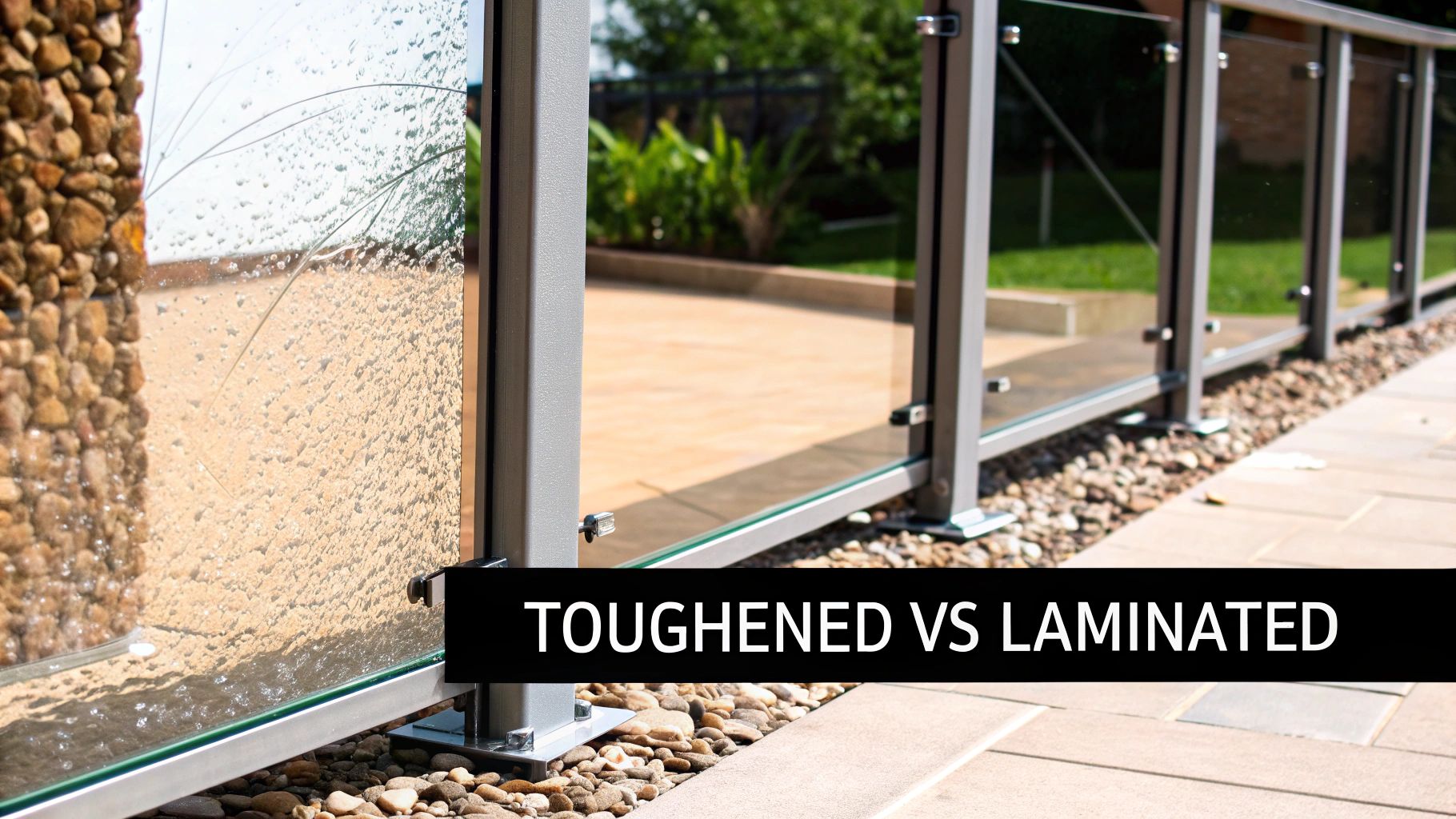
Now, picture a car’s windscreen. When a stone hits it, it might crack in a spiderweb pattern, but the glass itself stays put. That’s the genius of laminated safety glass. It’s made of two or more sheets of glass bonded together with a tough, clear plastic interlayer (usually PVB).
This sandwich-like construction is what gives it a unique safety edge. If the glass is hit hard enough to break, the fragments stick firmly to the plastic interlayer. The panel remains whole, continuing to act as a barrier and stopping anyone or anything from falling through.
Key Takeaway: The crucial difference is what happens after a break. Toughened glass shatters and falls away. Laminated glass cracks but stays in place.
This single characteristic makes laminated glass the non-negotiable choice for any balustrade at height. Whether it's for a balcony, a rooftop terrace, or raised decking in homes across Leeds, York, or Harrogate, it provides an essential layer of fail-safe protection. Even if a panel is compromised, the barrier remains.
Ultimately, the decision comes down to one simple question: where is your balustrade located? While both are officially certified safety glasses, how they behave after breaking dictates where they can be safely used.
Here’s a simple way to think about it:
| Feature | Toughened Glass | Laminated Glass |
|---|---|---|
| Breakage Behaviour | Shatters into small, blunt pebbles | Cracks but remains held in place |
| Primary Safety Feature | Reduces injury from sharp shards | Maintains a physical barrier after impact |
| Ideal Use Case | Ground-level patios and decking | Elevated balconies, terraces, and stairs |
| Handrail Requirement | Often needs a handrail for structural integrity | Can be used in frameless systems without one |
For a deeper dive into the technical details, you can learn more about the differences between laminated and toughened glass in our detailed guide.
But the bottom line is this: for any outdoor glass balustrade where there's a drop, choosing laminated glass isn't just a preference—it's a fundamental safety requirement that delivers genuine peace of mind.
Navigating building regulations might sound a bit intimidating, but it's actually pretty straightforward once you know the basics. These rules aren't there to make your project difficult; they have one crucial job: keeping everyone safe. For outdoor glass balustrades, these safety standards are non-negotiable, making sure every installation is strong enough to prevent a fall.
The go-to document for this in the UK is BS 6180:2011, which sets out the official code of practice for barriers in and around buildings. Think of it less as a dusty rulebook and more as the essential guide for a safe, secure, and fully compliant glass barrier.
This is where working with a local, experienced supplier really pays off. A team that understands the specific building codes across Northern England can cut through the jargon, remove the guesswork, and make sure your project is right from day one.
One of the first and most important rules to get right is the height of your balustrade. This isn't an arbitrary number; it's determined entirely by where the barrier is located and the height of the potential drop on the other side.
The logic is simple: the higher the risk, the higher the barrier. For homes like yours, the guidelines are very clear:
It’s not just about height. Your balustrade needs to be strong. It has to withstand certain forces without failing, which is measured in kilonewtons per metre (kN/m). In simple terms, this dictates how much horizontal pressure the system can take. Just picture a few people leaning against it during a garden party – it absolutely has to be robust enough to handle that force safely.
The specific load requirement ensures that the glass, fixings, and any posts work together as a single, strong system. For residential projects, the balustrade must be engineered to withstand a horizontal line load of 0.74 kN/m.
This is precisely why professional design and installation are so vital. Every single component, from the thickness of the glass panel to the type of base channel holding it, is specifically chosen to meet or, in our case, exceed these tough safety standards.
Whether or not you need a handrail or top rail often comes down to the type of glass you choose. This decision is directly linked to how the glass behaves if it breaks, providing an extra layer of structural integrity.
A handrail is typically required if:
But what if you want that completely seamless, top-rail-free look? You can absolutely achieve it by using toughened laminated glass. Because laminated glass cracks but stays held in place by its internal layer, it continues to act as a barrier even when damaged. This inherent safety means a top rail is no longer a requirement. To learn more, take a look at our complete guide to building regulations for balustrades.
The demand for these sleek, modern systems is undeniable. British homeowners have embraced this style, giving the UK a massive 24.6% market share of the frameless glass balustrade sector in Europe. It’s a clear sign of our preference for architectural features that are stylish, safe, and open up our homes to the outdoors.
Right, let's talk about the money side of things. Getting a handle on the budget is one of the most important steps. It ensures the vision you have for your home lines up with what you're ready to invest, helping you plan your project confidently, whether you're in Leeds, Harrogate, or anywhere in between.
The final price tag on your outdoor glass balustrade isn't just a single number pulled from thin air. It’s the sum of several key decisions you'll make, from the style of the system to the type of glass you choose. Understanding these moving parts means you can avoid any nasty surprises down the road.
The biggest single driver of cost is the style of balustrade you go for. A completely frameless system, which delivers that stunning, uninterrupted ‘sheet of glass’ look, is the premium choice. This is because it needs thicker, stronger glass and more substantial base fixings to create that minimalist effect without compromising on strength. On the other hand, semi-frameless or post-and-rail systems can often be a more budget-friendly route.
Your choice of glass is another crucial factor. While both toughened and laminated glass are fantastic safety options, laminated glass generally costs more. This is simply down to the more involved manufacturing process needed to bond the layers together. For any balustrade protecting a drop, though, that extra investment is what gives you essential fail-safe protection and total peace of mind.
Finally, the sheer size and complexity of the job play a big part. A long, straight run of balustrade is far more straightforward—and therefore less expensive per metre—than a project with lots of corners, tricky angles, or panels that need to be custom-cut to fit a unique space.
To give you a ballpark figure to start with, it's easiest to think in terms of cost per linear metre. Of course, prices will move up or down based on your exact specifications, but here are some realistic starting points for supply-only systems:
Don't forget to also consider any site preparation costs. If the surface you're fixing to isn't perfectly sound, you might need to factor in things like concrete and masonry repair services.
Remember: These figures are for guidance only. The only way to get a truly accurate cost for your project is to use a tool that can account for all your specific choices.
The days of waiting around for someone to get back to you with a price are over. Modern online tools, like our Binks Glass Solutions Balustrade Calculator, put you firmly in the driver's seat when it comes to planning your budget. It's a simple-to-use tool that lets you play around with different options and see instantly how each decision affects the final cost.
It’s incredibly straightforward. You just click through the options—select your style, pick your glass, decide if you want a top rail, and pop in the total length you need. The calculator does the rest, generating a tailored quote on the spot. It completely removes the guesswork, making it easy to design a beautiful outdoor glass balustrade that fits your home and your budget perfectly.
One of the biggest myths we hear about outdoor glass balustrades is that they’re a nightmare to keep clean. The reality is the complete opposite. Their simplicity is a massive advantage, especially when you think about the constant work timber railings need—sanding, staining, and painting to fight off our famously unpredictable Northern English weather. Glass, on the other hand, makes maintenance a breeze.
A huge part of their appeal lies in their longevity and how easy they are to look after. The global balustrade market, valued at USD 11.67 billion in 2024, is booming precisely because modern materials like glass offer real, tangible benefits. They are naturally resistant to moisture and far simpler to clean than old-fashioned alternatives, which all adds up to a much longer lifespan. You can read the full research on balustrade market trends to learn more about the industry’s growth.
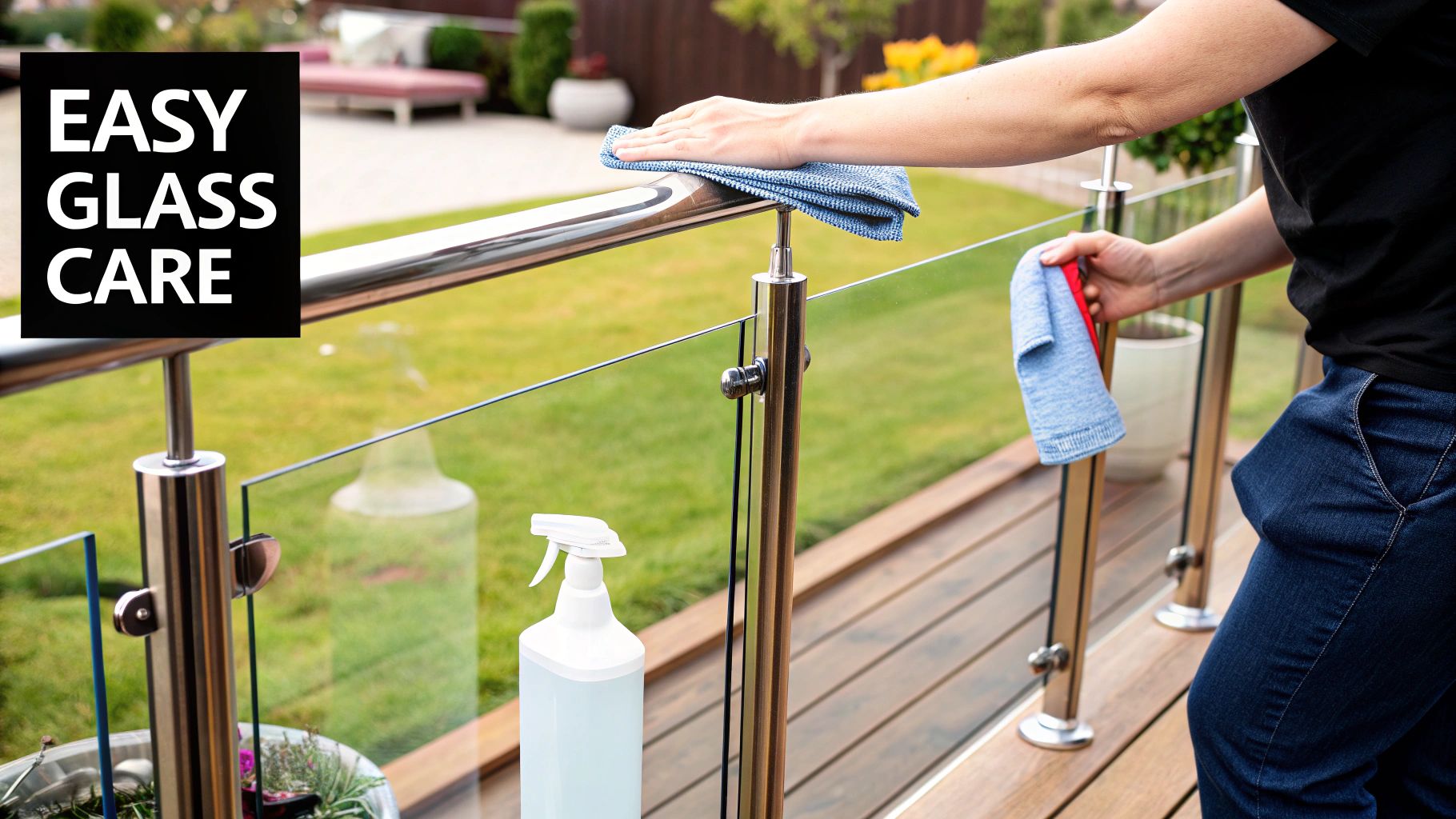
Keeping your glass panels looking brand new doesn’t require any special kit or pricey chemicals. A straightforward, regular clean is all it takes to maintain that perfect, crystal-clear view.
Just follow these simple steps every few weeks, or whenever you notice dust, water spots, or fingerprints building up:
Don't forget the metal parts of your balustrade, like the stainless steel posts, handrails, and clamps. They also need a little attention to keep them looking sharp. They’re built to be tough, but can still gather dirt over time.
A quick wipe-down of the metalwork every time you clean the glass is usually all that’s needed. Use the same soapy water and a soft cloth to clean the components, then rinse with plain water and dry thoroughly with a microfibre cloth to prevent water spots. This simple habit ensures your entire system remains pristine for years.
As you start planning your project, it’s completely natural for questions to pop up. Making the right choices now is the key to getting a result you’ll love for years to come. To help, we’ve put together clear, straightforward answers to some of the most common queries we get about outdoor glass balustrades.
This section tackles the practical concerns that homeowners across the North of England often raise, from the strength of the glass to the ins and outs of installation. Getting these details right ensures your new balustrade isn't just beautiful, but perfectly suited to your home and built to last.
This is a great question, and the answer comes down to one thing: the type of safety glass you choose. A handrail isn’t always a legal requirement, especially if you’re aiming for that ultra-minimalist, completely frameless look.
You can often go without a top rail if your system is built with toughened laminated glass. This is because if the glass were to crack, the plastic interlayer holds everything together, meaning it still acts as a protective barrier. On the other hand, if your design uses monolithic toughened glass, a handrail is generally essential. It provides crucial structural support and makes sure a barrier remains in place in the unlikely event a panel shatters.
Don’t let the elegant appearance fool you; engineered outdoor glass balustrades are exceptionally strong and resilient. The safety glass we use—whether it’s toughened or laminated—is several times stronger than standard glass and is designed to withstand significant force.
Every system we install is carefully designed to meet or exceed strict UK regulations for load-bearing capacity. In simple terms, this means it can safely handle the pressure of people leaning against it, making it a secure choice for family homes, garden parties, and even busy commercial spaces. The strength isn’t just in the glass; it’s in the entire structure, from the robust channels and posts to the specialist fixings holding it all together.
The combination of high-strength glass and engineered fixings creates a formidable safety barrier. It’s a system designed for peace of mind, providing robust protection without ever getting in the way of your view.
While the idea of a DIY installation can be tempting, we strongly recommend leaving it to the professionals. Installing an outdoor glass balustrade is a precision job that requires specialist tools, a deep understanding of structural loads, and thorough knowledge of building regulations. It’s not your average weekend project.
A professional installation guarantees that every component is perfectly aligned, securely fastened, and compliant with all safety standards. This not only ensures the system’s long-term performance and durability but also protects your investment. For complete peace of mind and a flawless finish, working with an experienced installer is always the best approach. It’s the surest way to know your beautiful new balustrade is as safe as it is stylish.
Ready to bring clarity, style, and safety to your outdoor space? The team at Binks Glass Solutions is here to help you design the perfect system for your home. Contact us today for expert advice and a no-obligation quote.