
A Complete Guide to Resin Anchor Bolt Fixings for Balustrades
A resin anchor bolt isn't just another fixing; it's a high-strength fastening system that uses a specialised chemical adhesive to […]

A resin anchor bolt isn't just another fixing; it's a high-strength fastening system that uses a specialised chemical adhesive to […]
A resin anchor bolt isn't just another fixing; it's a high-strength fastening system that uses a specialised chemical adhesive to literally fuse a steel stud into a substrate like concrete or brickwork. Unlike your typical mechanical fixings that just grip the material through friction, a resin anchor creates a powerful, stress-free chemical bond. This makes it an exceptionally secure and reliable choice for safety-critical installations like the glass balustrades we specialise in.

When you’re securing a modern glass balustrade, the fixing you choose is absolutely paramount. Think of a standard mechanical bolt as a simple screw in a piece of wood—it works, but its strength is limited by friction and the pressure it puts on the material around it.
Now, picture a resin anchor bolt as the roots of a mighty oak tree. Instead of just gripping the material, it fuses with the surrounding concrete or brick, creating a single, inseparable structure. This is the magic of chemical anchoring.
The system uses two key parts: a threaded steel stud and a powerful resin adhesive. When we combine these inside a pre-drilled hole, a chemical reaction kicks off, bonding the stud directly to the base material. The result? A fixing that is often stronger than the very concrete it’s set into.
Unlike mechanical expansion anchors, which create huge internal stress by pushing outwards, a resin anchor distributes the load evenly across the entire bonded area. This "stress-free" quality is crucial for several big reasons:
This incredible reliability is why chemical anchoring has become the gold standard for applications where safety cannot be compromised. For a glass balustrade on a Harrogate patio or a sleek Leeds office balcony, this superior bond provides lasting security and complete peace of mind.
A resin anchor bolt doesn't just hold onto the material; it becomes part of it. This chemical fusion provides an unmatched level of strength and durability, ensuring that the balustrade remains securely fixed for its entire design life.
To put it simply, here’s a quick summary of what makes these fixings so well-suited for the job.
| Feature | Benefit for Balustrade Installation |
|---|---|
| Chemical Fusion | Creates a monolithic bond that is often stronger than the base material itself. |
| Stress-Free Fixing | Prevents cracking in concrete, allowing for installations closer to edges. |
| High Load Capacity | Easily supports the immense weight and forces exerted on glass balustrade systems. |
| Vibration Proof | Ensures long-term stability in high-traffic areas or environments subject to movement. |
| Substrate Versatility | Can be used securely in a wide range of materials, from new concrete to older, weaker brickwork. |
These features combined mean we can install stunning, safe glass balustrades in almost any location with absolute confidence.
The effectiveness of this technology is clear from its rapid adoption across the United Kingdom. In the UK construction sector, resin anchors are gaining serious traction, with the market projected to grow from USD 420.5 million in 2025 to a massive USD 750.8 million by 2035. That reflects a strong annual growth rate of 6.2%.
This growth is especially relevant for specialist installers like us who rely on these anchors for secure glass balustrade projects across the North of England. You can dig deeper into the numbers with this detailed industry analysis of the UK construction anchor market. This trend shows a clear shift in the industry towards more resilient and dependable fixing solutions for modern building projects.
Choosing the right resin anchor isn’t just a technical box-ticking exercise; it’s one of the most important decisions you’ll make for the long-term safety and performance of your glass balustrade. The term "resin" actually covers a family of incredibly powerful adhesives, and picking the right one is like choosing the right tool for a job. Each has a specific strength and a distinct purpose.
Think of the three main types—Polyester, Vinylester, and Pure Epoxy—as different specialists you’d bring onto a project. Each has a unique skill set, and understanding what they do best helps everyone from architects to homeowners make the right call, every time.
Polyester resin is the most common and budget-friendly option, making it a brilliant all-rounder for a huge range of standard jobs. It’s the reliable workhorse of the resin world, perfect for medium-load requirements in dry, stable conditions.
For a residential glass balustrade on a sheltered patio in Yorkshire, for instance, a polyester resin anchor gives you more than enough strength. It’s simple to use and cures quite quickly, making it a firm favourite for straightforward projects where you aren't battling extreme loads or harsh weather. Its one drawback is lower chemical resistance, so it’s best kept for less demanding scenarios.
When the conditions get a bit more challenging, you need to call in a specialist. That’s where vinylester resin comes in. It offers far superior performance in damp environments and can handle much higher loads, engineered for situations where a standard polyester resin just wouldn’t be up to the task.
Imagine you’re securing a balustrade on a coastal property in the North East, or fixing into a concrete base that might be damp. Vinylester's beefed-up chemical resistance and its ability to bond in less-than-perfect conditions make it the ideal choice. It also cures faster than epoxy, striking a great balance between top-tier performance and efficient installation.
The decision between resin types is fundamentally about matching the product's chemical properties to the project's specific demands. Choosing correctly ensures the fixing will perform flawlessly for its entire design life, from day one to year fifty.
For the most critical applications, where failure simply isn't an option, there’s pure epoxy. This is the ultimate solution, delivering the absolute maximum bond strength and durability possible. It’s the go-to for heavy-duty structural connections and projects involving extreme loads or tricky substrates.
Its slow curing time is actually a huge advantage in complex jobs, giving installers more time to get the resin anchor bolt positioned perfectly. This resin excels in all conditions—wet or dry—and can even be used in diamond-drilled holes, which have smooth sides that other resins can struggle to grip properly. For a major commercial project in Leeds or a critical structural repair, pure epoxy provides reliability and peace of mind that nothing else can match.
To make the choice clearer, this table breaks down the key differences between the three main resin types. It’s a quick-reference guide to help you match the right product to your project’s load requirements, environment, and the material you're fixing into.
| Resin Type | Best For | Typical Load Capacity | Curing Time | Ideal Application |
|---|---|---|---|---|
| Polyester | General-purpose, non-critical, medium-load fixings | Medium | Fast | Sheltered residential balustrades, internal handrails, fixings into dry concrete. |
| Vinylester | High-load applications and damp or wet conditions | High | Medium | Coastal properties, external balustrades, fixings into damp concrete or masonry. |
| Pure Epoxy | Maximum strength, critical structural connections | Very High | Slow | Commercial projects, safety-critical barriers, fixings into diamond-drilled holes. |
Ultimately, the best resin anchor is the one engineered for your specific situation. Taking a moment to assess the loads, substrate, and environment will ensure your balustrade remains safe and secure for decades.
The material you’re fixing into—what we call the substrate—is just as crucial as the weather conditions. Here’s a quick guide:
The reliance on these advanced fixing methods has grown massively across the industry. Resin anchors are now essential for creating safe, compliant balustrade systems in the UK. One type of vinylester, epoxy acrylate, generated over USD 115.5 million in revenue in 2023 alone, prized for its exceptional chemical resistance—perfect for multi-storey residences and hospitality venues.
A fantastic real-world product is the Soudal Soudafix Chemical Anchor Resin, which is well-known for its robust performance across a huge range of applications.
When we talk about the performance of a resin anchor bolt, what we’re really talking about is safety and strength. In a glass balustrade, the fixings have to resist powerful, complex forces every single day. Getting your head around these forces is the key to appreciating why a professional installation is so vital for the long-term security of your system.
Two main forces are always at play: tensile load and shear load. Once you understand these, the technical specs start to make sense in the real world. A properly installed anchor must stand up to both to ensure your balustrade remains steadfast and secure, year after year.
Tensile load, often called pull-out force, is the force that tries to yank an anchor straight out of the ground. Think of it like trying to pull a plant directly out of the soil by its roots. The deeper and more established those roots are, the tougher it is to pull out.
A resin anchor bolt works in a surprisingly similar way. The chemical bond creates an extensive root system, fusing the steel stud to the surrounding concrete. This creates an immense resistance against any upward force, making sure the anchor stays firmly locked in place.
Shear load is a sideways or lateral force that tries to push or snap the anchor. Going back to our plant analogy, this is like trying to kick the plant's stem and snap it at its base. It’s a force acting parallel to the surface the anchor is fixed into.
For a glass balustrade, shear forces come from someone leaning against the barrier or from strong wind pushing against the glass panels. The strength of the steel stud and the integrity of the resin bond work together to resist this sideways pressure, preventing any bending or failure.
The real test of a resin anchor bolt is its ability to handle both tensile and shear loads at the same time. A high-quality installation ensures the fixing can resist a combination of pulling and pushing forces—exactly what happens on a busy commercial terrace or a family balcony.
The maximum load a resin anchor bolt can handle isn't just down to the product itself. Several critical installation factors directly impact its final performance. Getting these details right is simply non-negotiable for a safe and compliant balustrade.
In the UK, glass balustrades must comply with stringent safety regulations, primarily BS 6180:2011, which sets out the requirements for barriers in and around buildings. This standard specifies the minimum loads a balustrade must be able to withstand, depending on where it is and how it’s used.
A correctly installed resin anchor bolt provides the exceptional strength needed to meet and often exceed these standards. The robust, stress-free bond ensures the entire balustrade system can safely handle the pressures of daily use, whether it’s in a high-traffic commercial setting in Leeds or a private family balcony in Harrogate.
This reliability is exactly why professionals trust chemical anchoring for safety-critical jobs. When specified and installed correctly, it provides a permanent, high-performance fixing that guarantees peace of mind and full compliance with UK regulations.
When you're specifying a resin anchor bolt for a glass balustrade, you're doing more than just picking a product off a shelf. You're making a decision that underpins the safety, legality, and long-term durability of the entire structure. Here in the UK, a robust framework of regulations governs construction products, and understanding it is key. It’s what gives architects, installers, and homeowners total confidence that their balustrade isn't just stunning to look at, but is fundamentally sound.
This is exactly why independent, third-party certifications are so important. They cut through the marketing noise and provide impartial proof that a product does what the manufacturer says it does, taking all the guesswork out of the equation.
The single most important certification to look for is the European Technical Assessment (ETA). Think of an ETA not as a sticker, but as a product's official performance passport. It's a detailed document packed with performance data gathered from tough, standardised testing, confirming exactly what that product is capable of.
For a resin anchor bolt, an ETA provides verified data on how it holds up in a variety of real-world conditions, including:
When a specifier in Darlington or an installer in Hull chooses a resin anchor with an ETA, they are choosing a component whose strength and reliability have been independently proven.
Using ETA-approved components isn't just a 'nice to have'—it's a fundamental step in ensuring a balustrade installation is fully compliant, safe, and built to last. It creates a clear, documented chain of evidence that the products specified are truly fit for purpose.
Compliance with UK Building Regulations is completely non-negotiable for any construction project. These rules exist for one simple reason: to ensure the health and safety of people in and around buildings. A crucial part of this is making sure every single component, right down to the fixings, meets the required performance standards. You can get a deeper insight into the specific rules in our detailed overview of building regulations for balustrades.
Using an ETA-approved resin anchor bolt is one of the clearest ways to demonstrate compliance. The ETA provides the hard technical data needed to satisfy a building control officer that the chosen fixing method is safe and appropriate for the job. This also feeds directly into the Construction Design and Management (CDM) Regulations 2015, which places clear duties on everyone from the client to the contractor to manage health and safety from start to finish.
The demand for certified, high-performance fixings is only growing. In fact, the UK market for construction anchors, including chemical resin types, is projected to hit US$ 141.6 million by 2030. This boom is driven by major projects where compliance is paramount. What's more, it's known that epoxy-based formulas can deliver bond strengths up to 20% higher than mechanical alternatives, especially in the damp, aggressive conditions often found on weather-exposed terraces across the North of England. You can explore more insights on these market dynamics and product performance. Having this knowledge allows you to ask the right questions and specify with complete certainty.
While installing a resin anchor bolt is a job strictly for trained professionals, it’s worth understanding the process. You start to appreciate the precision and skill involved. This is a far cry from a simple drill-and-fill job; it’s a meticulous, multi-stage procedure where every single step is critical to achieving the immense bond strength chemical anchors are famous for.
Getting it right is what guarantees the long-term safety and stability of a glass balustrade. The entire process is methodical, starting with precise preparation and ending with a patient wait for the chemistry to do its magic. Each stage builds on the last, and rushing any part will compromise the entire fixing.
First things first: drilling the hole for the anchor. This isn't just about making a space; it’s about creating the perfect cavity for the resin to bond with. A professional uses high-quality drill bits and techniques to ensure the hole is:
This initial precision really does set the foundation for a secure installation.
This is, without a doubt, the single most important step in the entire installation.
Think of it like this: if you try to paint a dusty, grimy wall, the paint will just flake off because it never actually bonded with the surface underneath. The exact same principle applies to a resin anchor bolt.
Any dust, debris, or moisture left in the hole creates a barrier, stopping the resin from properly fusing with the concrete or brick. This is why professional installers follow a rigorous cleaning process:
This "blow-brush-blow" technique is repeated until the hole is clinically clean. Only then can the resin achieve a direct, powerful bond with the substrate.
A poorly cleaned hole is the number one cause of chemical anchor failure. Even a thin layer of dust can reduce the anchor's load capacity by more than 50%, turning a high-performance fixing into a serious safety hazard.
With the hole perfectly prepared, the two-part resin is carefully injected. It’s always injected from the bottom of the hole upwards. This simple technique is vital because it pushes the air out as the resin fills the space, preventing any air pockets that would create voids and weaken the bond.
The first couple of pumps of resin from a new tube are always discarded to make sure the two components are perfectly mixed in the nozzle.
Next, the threaded anchor stud is inserted into the resin-filled hole with a slow, twisting motion. This turning action ensures the stud is completely coated in resin and helps to push out any excess, guaranteeing a solid, void-free bond all the way around the anchor.
The infographic below illustrates the journey from rigorous product testing to a safe, compliant installation on site.
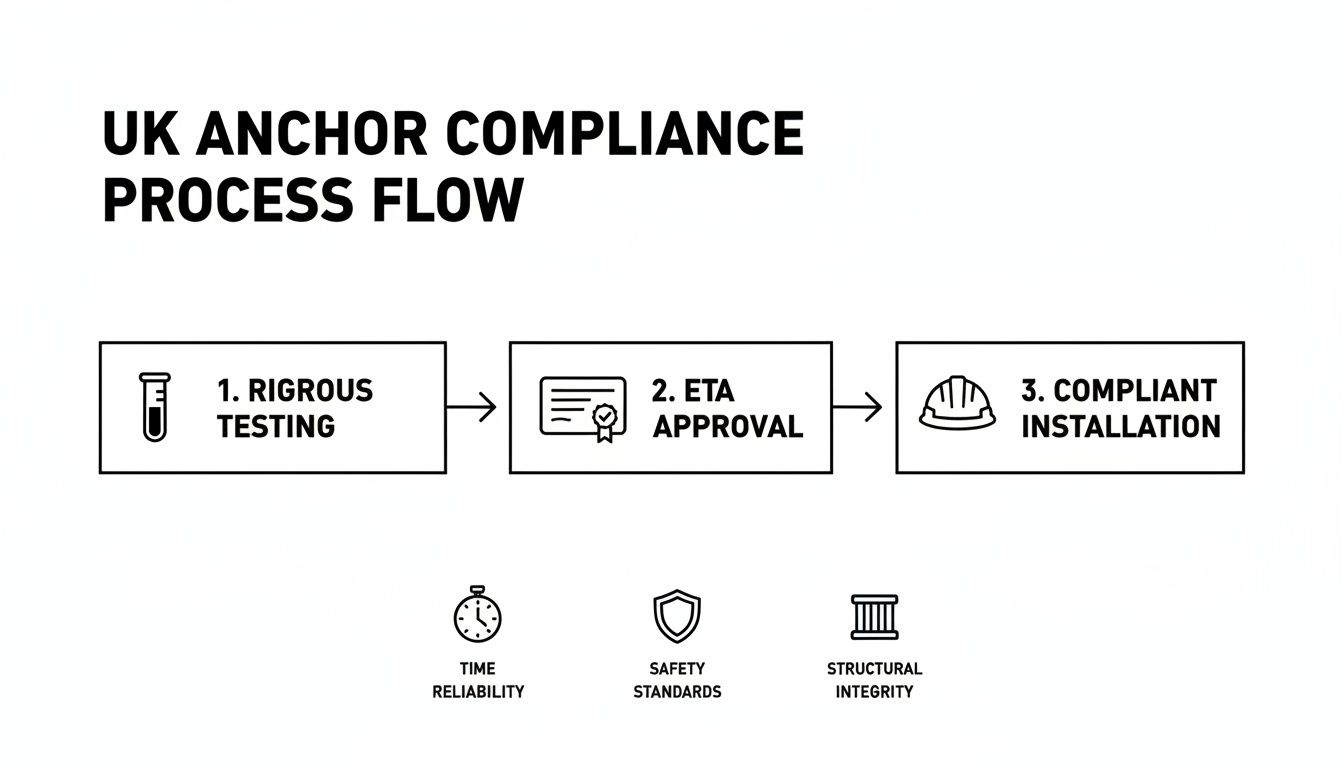
This process shows how certified products and professional application must work together to guarantee structural integrity.
The final step is all about patience. The resin needs time to cure—the chemical reaction that transforms it from a liquid into an incredibly strong, solid mass. Curing times can vary quite a bit, depending on the type of resin used and the ambient temperature on the day.
It is absolutely non-negotiable that the anchor is left completely undisturbed during this period. Applying any sort of load, or even just knocking the stud before it has fully cured, will break the bond before it’s even had a chance to form properly.
While this overview demystifies the key stages, you can see how these fixings fit into the bigger picture in our detailed guide on how to install a glass balustrade. Following these professional steps is what guarantees a secure, reliable, and safe balustrade for years to come.
One of the best things about a professionally installed resin anchor bolt is its incredible durability. Once that chemical bond has cured, it's permanent. It’s sealed tight from the elements and fiercely resistant to corrosion, meaning the fixings themselves are pretty much maintenance-free.
This is great news, as it means your focus can shift from worrying about the anchors to simply keeping an eye on the overall health of the entire balustrade system. Long-term safety is all about simple, periodic visual inspections. This common-sense approach helps you spot any minor issues before they have a chance to grow into bigger problems, protecting your investment and keeping the installation as solid as the day it was finished.
For homeowners and property managers, we recommend a quick visual check at least twice a year, and always after any particularly rough weather. It only takes a few minutes, but it provides complete peace of mind.
Here’s what you should be looking for:
This simple, routine check-up is the cornerstone of responsible balustrade ownership. It ensures that the entire system performs as intended, protecting the robust resin anchor bolt fixings that form its secure foundation.
To keep your balustrade performing at its best for years, a good preventive maintenance mindset is key. For a wider view on proactive care, a guide from a professional property maintenance blog serving North Yorkshire on the Top 10 Preventive Maintenance Best Practices offers some excellent principles. This straightforward approach is all it takes to keep your balustrade system safe, secure, and looking fantastic.
To finish up our guide, let's tackle some of the most common questions we hear from clients in Harrogate, Leeds, and across the North of England. When it comes to something as important as the fixings for your glass balustrade, it's natural to have questions. Here are some straight-talking answers.
When specified and installed by a professional, a resin anchor bolt is designed to last for the entire design life of the building it's fixed into. We're talking 50 years or even more. For some high-performance systems, certified durability can stretch to an incredible 100 years.
The chemical bond it creates isn't just strong; it's permanent. It stands up brilliantly to corrosion, environmental wear, and vibration, making it an exceptionally reliable choice for safety-critical installations like balustrades.
Yes, but this is where professional expertise really counts. You can't just use any old resin. Certain high-performance formulas, especially pure epoxies and some vinylesters, are specifically engineered to work in damp or even water-filled holes.
The key is to check the product's technical data sheet and its ETA (European Technical Assessment) approval. These documents spell out exactly what conditions the resin is tested for. For an outdoor balustrade in our lovely British weather, choosing a resin that’s rated for wet conditions is non-negotiable for a secure, long-lasting bond.
It all comes down to how they grip the material. A mechanical anchor, like an expansion bolt you might get from a DIY shop, works by brute force. It expands and pushes outwards, creating friction and pressure against the sides of the hole. This outward force can be a real problem near edges or in older materials.
A resin anchor, on the other hand, is all about adhesion. It chemically bonds the steel stud directly to the concrete or brickwork.
This chemical bond is completely stress-free. It doesn't exert any outward pressure on the surrounding material, making it the perfect solution for fixings close to an edge or into older, more fragile substrates where you can't risk causing a crack.
Modern resin systems have come a very long way. Most of the professional-grade products we use today are low-odour and styrene-free, which dramatically cuts down on the emission of volatile organic compounds (VOCs).
That said, safety is always paramount. Our installers always work in a well-ventilated space and stick rigidly to the manufacturer's safety guidelines. This means wearing the proper personal protective equipment (PPE), like gloves and safety glasses, every single time.
At Binks Glass Solutions, we take the guesswork out of it. Our expertise means we select and install the perfect resin anchor bolt solution for every single project, ensuring your glass balustrade is safe, fully compliant, and truly built to last. If you have more questions or want to chat about your project, our local specialists are here to help. Contact us today for expert advice and a no-obligation quote.