
A Homeowner’s Guide to Glass Panels Balcony Design
Picture this: your home, flooded with natural light, with a completely uninterrupted view of your garden. A glass panel balcony […]

Picture this: your home, flooded with natural light, with a completely uninterrupted view of your garden. A glass panel balcony […]
Picture this: your home, flooded with natural light, with a completely uninterrupted view of your garden. A glass panel balcony isn't just a safety rail; it’s a design choice that completely transforms your space, creating an incredible sense of openness and modern style. It’s a perfect fit for homes right across the North of England.
A glass panel balcony is a seriously stylish and practical upgrade. It swaps out old-fashioned railings, spindles, or even solid walls for sleek, see-through panels of high-strength safety glass. This one change can instantly bring a property’s exterior into the 21st century, but the real benefits are the ones you experience every day.
Instead of bulky materials that chop up your view and cast unwanted shadows, glass creates a seamless, flowing connection between your indoor and outdoor areas. It lets the sunlight pour into your home, making rooms feel significantly brighter, bigger, and more welcoming. This is a game-changer in places like Yorkshire and Cumbria, where making the most of the natural light all year round can completely change a home's atmosphere.
The move towards glass goes way beyond just looking good. Homeowners are catching on and choosing this option for some very solid reasons:
We've put this guide together specifically for homeowners in Yorkshire, Cumbria, and across the North of England who are thinking about a balcony upgrade. We get the local architecture and we know the conditions, from biting coastal winds to the demands of city living in Leeds or York.
Think of this guide as your complete roadmap. We’ll walk you through everything you need to know—from picking the right glass and design, to getting your head around the crucial UK safety regulations and accurately budgeting for your project.
Our goal is simple: to give you the confidence to move forward. We want you to be armed with all the right knowledge to create a stunning, secure, and stylish outdoor space that you'll love for years to come.
Picking the right glass panels for your balcony is more than just a technical choice; it’s a creative one that will set the tone for your home’s entire exterior. The system you go for will dictate the final look, feel, and function of your space, influencing everything from the view out of your lounge to your property’s kerb appeal.
The two main paths you can take each offer a completely distinct aesthetic, perfectly suited to the different architectural styles we see across the North of England. Your decision boils down to a fully frameless system or a semi-frameless system. They both use high-strength glass to create a safe, elegant barrier, but they get there in very different ways. Getting your head around these differences is the first step to picturing the perfect upgrade for your home.
A fully frameless glass balcony is the undisputed champion of minimalist design and truly unobstructed views. With this system, the glass panels are secured directly into a structural base channel, creating a seamless wall of glass without any posts or supports getting in the way. It’s the closest you’ll ever get to an invisible safety barrier.
This clean, contemporary look is soaring in popularity. The UK's market for frameless structural glass is growing fast, with the country holding a massive 24.6% share of the entire European market. This shift highlights a real desire for open, light-filled living spaces. In fact, glass panels are now used in 45.8% of all balustrade installations nationwide thanks to their reliability and value. You can read the full research on this growing trend to see why so many homeowners are making this choice.
In contrast, a semi-frameless system uses slim, stylish posts to support the glass panels. These posts, usually made from marine-grade stainless steel, introduce a defined structural element into the design. While your view remains wonderfully open, the posts provide a subtle visual frame that can complement other features of your property, like window frames or guttering.
This option strikes a fantastic balance between modern transparency and a more traditional, structured feel. It’s a hugely versatile choice that works brilliantly with a wide range of property styles, from classic family homes in York to modern terraces in Harrogate.
To help figure out what’s right for you, think about the main priorities for your balcony upgrade using the guide below.
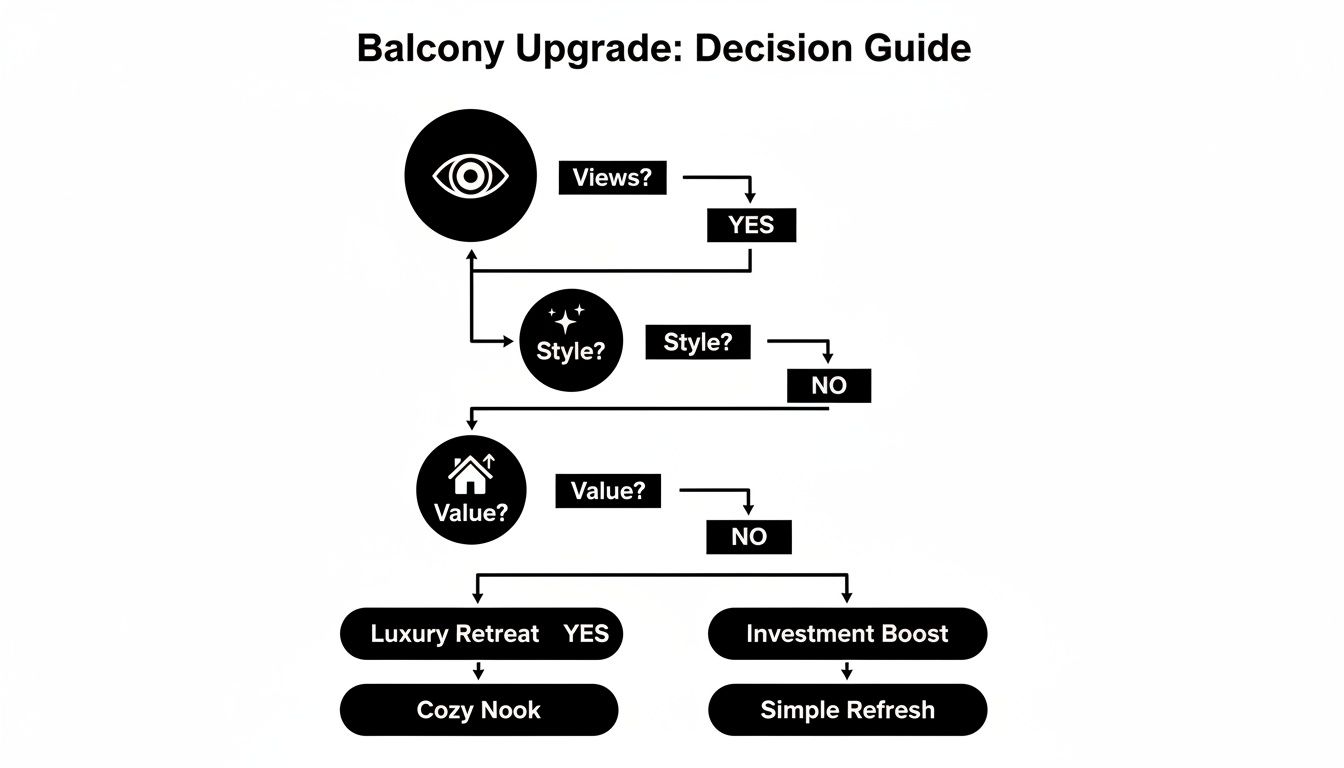
This decision tree helps you weigh up whether your main focus is on maximising those views, achieving a particular style, or adding the most value to your home.
Before we move on, here’s a quick-glance table to help you compare the two main systems side-by-side.
| System Type | Key Feature | Best For | Typical Aesthetic |
|---|---|---|---|
| Fully Frameless | Uninterrupted glass panels secured in a base channel. No visible posts. | Maximising panoramic views and creating a 'wow' factor. | Minimalist, modern, and high-end. |
| Semi-Frameless | Glass panels supported by slim stainless steel posts. | Versatility; blending modern glass with more traditional architecture. | Structured, contemporary, and defined. |
This table should make it easier to see which system aligns best with your property and your vision.
Once you’ve thought about the frame, the type of glass itself is the most critical safety decision you'll make. Your two main options are toughened glass and laminated glass, and there's a really simple way to understand the difference.
Think of laminated glass like a car windscreen. When it breaks, a special interlayer holds all the shattered pieces together, keeping the panel intact. This makes it the safest possible choice, especially for balconies at height.
Toughened glass, on the other hand, is more like a car's side window. It's incredibly strong—around five times stronger than standard glass—but if it does break under extreme force, it shatters into lots of small, blunt cubes instead of dangerous, sharp shards.
Both are officially classed as safety glass and are perfectly suitable for balconies. However, laminated glass provides a superior level of protection by ensuring the barrier stays in one piece even if the glass fractures. This gives you an essential fail-safe, offering complete peace of mind for you and your family as you enjoy your beautiful new outdoor space. Your final choice will likely come down to your budget, the balcony's location, and your specific safety priorities.
While the stunning, modern look of a glass panel balcony is what often draws homeowners in, its most important job is to act as a secure and reliable safety barrier.
Diving into building regulations can feel a bit daunting, but the core principles are actually quite straightforward—and essential. These rules aren't just bureaucratic red tape; they've been carefully designed to make sure your beautiful new balcony is a completely safe space for family, friends, and pets.
In the UK, the key document is Approved Document K, Protection from falling, collision and impact. Think of it as the blueprint for safety. It sets the non-negotiable standards that all balcony installations must meet, ensuring every single project is built to the same high standard. Any professional installer will know these regulations inside out.
One of the most fundamental rules for an external residential balcony is its height. To prevent accidental falls, UK regulations state that the top of the balustrade must be at least 1100mm (1.1 metres) from the finished floor level.
This specific height isn't just a random number; it's been calculated as the minimum required to provide an effective barrier for an average adult. It’s the first thing any reputable installer will check, ensuring your balcony creates a substantial enclosure and gives you total peace of mind.
Beyond height, the strength of the glass and its fixings is just as critical. The balustrade has to be able to withstand specific forces without breaking or failing—what’s known as its load-bearing capacity.
Imagine a couple of people leaning against the glass to admire the view, or a powerful gust of wind hitting the panels. The entire system must be strong enough to handle these real-world pressures without a problem.
The core idea is simple: the glass panel balcony must act as a robust, unmoving barrier under predictable pressure. This means the glass itself, the posts (if any), and the base fixings all work together as a single, strong system.
This focus on safety works. Building regulations enforcing a 1.1m minimum height and specific load capacities have been shown to significantly reduce fall incidents in compliant installations. The rules also ensure your balcony is built to handle everything the lovely British weather can throw at it.
To meet these demanding load requirements, you can't just use any old glass. As we touched on earlier, installations must use specialist safety glass. The two main types you'll come across for a glass panel balcony are:
The choice between them often depends on the specific system and its location. For frameless systems, especially those at a significant height, laminated glass is almost always the go-to choice for that extra layer of failsafe protection. Even if a panel were to break, the barrier remains intact.
For a deeper dive into the specifics, you can check out our guide on glass balustrade regulations in the UK. Working with an experienced installer means you'll get expert advice on the right materials for your project, guaranteeing a fully compliant and secure installation from day one.
While those expansive, clear glass panels are undoubtedly the star of the show, it's the smaller details that truly give your balcony its character. Think of the fixings, the finishes, and the optional top rail. They're like the frame around a masterpiece; they can either blend seamlessly into the background or become a deliberate, stylish accent.
Getting these elements right is key to creating a look that perfectly complements your home's unique architecture, whether it's a modern new-build in York or a period property in Darlington. How the glass is held in place is the foundation of your balcony's style and has a huge impact on the final aesthetic.
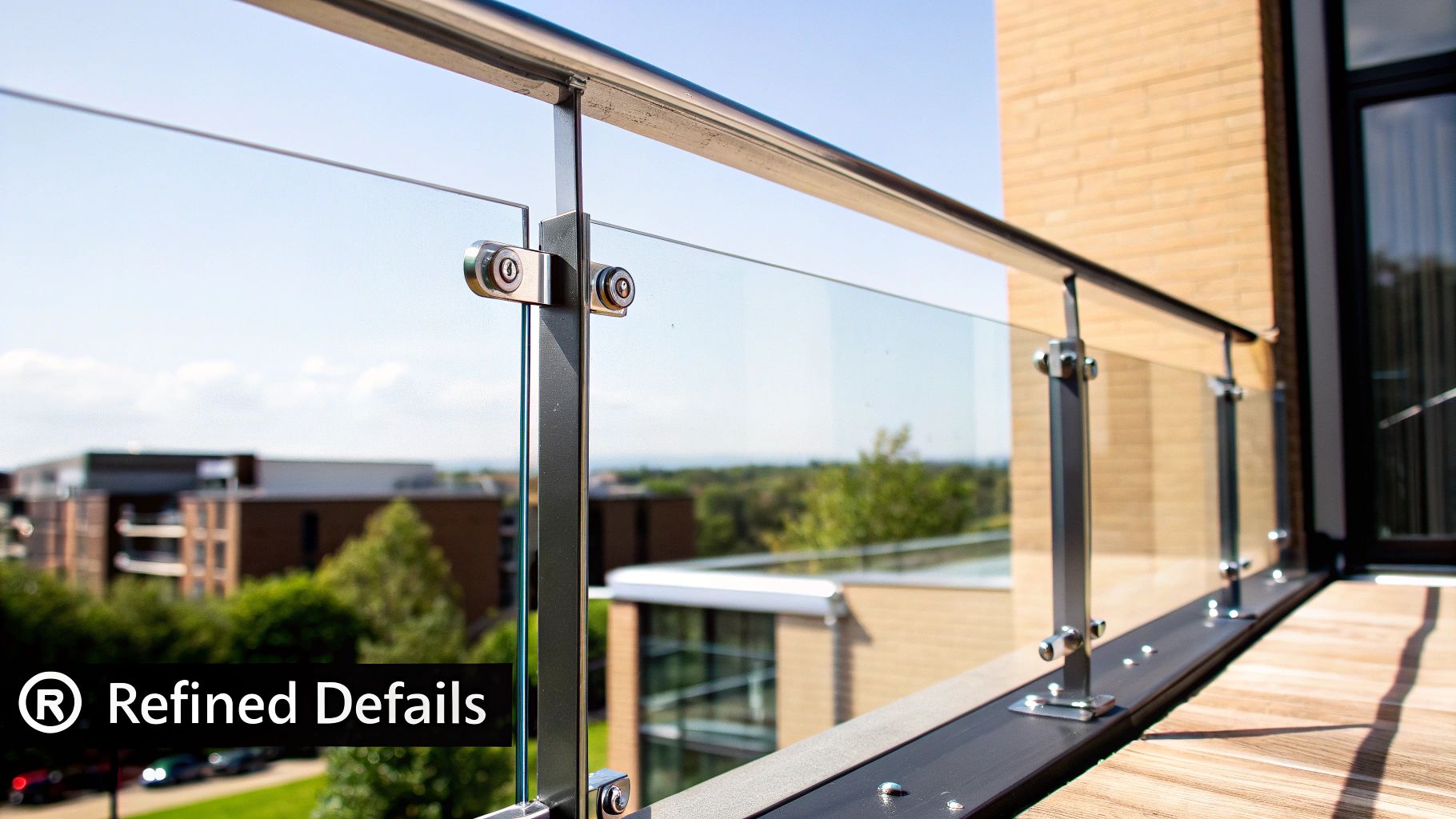
If you're after that ultimate minimalist look, the structural base channel is the way to go. This fixing is a heavy-duty aluminium track installed along the base of the balcony. The glass panels simply slot directly into it.
Once installed, the channel itself is concealed, creating a stunning, uninterrupted 'floating glass' effect with no visible supports. This method is the very hallmark of a fully frameless system, offering the most pristine and unobstructed views you can get. It’s an architectural statement that speaks of modern elegance.
Of course, you don't have to hide the fixings. You can choose to make a feature of them with glass clamps or posts. These are individual fixing points that hold each glass panel securely.
With these options, the hardware is transformed from a purely functional component into a deliberate part of the design itself. Securely anchoring these components is vital, and using the correct fixings guarantees a robust and lasting installation.
The final major decision is whether to include a top rail, sometimes called a handrail. This is a slim profile that runs along the very top edge of the glass panels, and its inclusion depends on both regulations and your personal taste.
In some frameless systems, a top rail is a structural requirement. It connects the panels, providing extra rigidity and ensuring that if one panel were to fail, the load would be distributed across the others, maintaining the integrity of the safety barrier.
However, with the correct specification of laminated glass, you can often go without a top rail entirely. This achieves the most minimalist look possible—a seamless, frameless barrier with no interruption at eye level.
Choosing to omit the top rail creates that crisp, clean edge that is almost invisible, making your view the absolute priority. Your choice will come down to a balance between UK building regulations, the specific glass system you’ve chosen, and the final look you want for your home.
Figuring out the costs is, without a doubt, one of the most important first steps in planning your new glass panels balcony. It’s easy to wish for a single, straightforward price, but the reality is the final figure is shaped entirely by the choices you make.
Think of it like commissioning a bespoke kitchen; the final cost depends on the worktop material, the style of the cabinets, and all the finishing touches you select. The exact same principle applies here. Every decision, from the type of glass to the style of the fixings, plays a part in the final budget. Understanding these key cost drivers is how you move from guesswork to a realistic financial plan.

The total cost of your glass balcony really boils down to a few main components. Each one gives you options that can nudge the price up or down, putting you in control of the final spend.
A great way to start planning is to think in terms of a cost per linear metre. While this will always vary, you can generally expect a professionally installed glass panel balcony to land within a certain range. UK regulations often call for toughened glass between 6-12mm thick for balconies, and the system must be able to handle significant loads.
For a basic system with posts, you might budget from £150 per metre. At the other end of the scale, a high-end, frameless system with premium laminated glass could be closer to £300 per metre, or even more. These figures are excellent starting points. It’s also worth remembering that a quality balcony system is a genuine investment. Market insights suggest that homes with well-designed glass balustrades can see 15-20% faster sales, showing just how much buyers love them.
The most crucial takeaway is that you are in control. By balancing your design preferences with these cost factors, you can find a solution that delivers both the aesthetic you love and a price that works for you.
For homeowners in the North of England, getting a precise figure is the natural next step.
General estimates are great for early-stage planning, but a tailored quote is the only way to budget accurately. This is where an online tool can cut through the noise, getting rid of the ambiguity and giving you a clear, itemised cost based on what you actually need.
Our simple, four-step Balustrade Calculator was designed for this very job. It lets you get a solid idea of what your project will cost in just a few clicks, specifically for your home in Yorkshire, Cumbria, or the surrounding areas. A precise quote is the best way to turn your vision into a concrete plan with no nasty surprises.
Getting your vision for a new glass panel balcony from a dream to a stunning reality comes down to one final, critical step—choosing the right team to install it. While picking out the design is the exciting part, it’s the skill and experience of the people fitting your system that guarantees a flawless, secure, and long-lasting result. This is especially true here in the North of England, where a local specialist really does make all the difference.
An installer who knows Yorkshire and the surrounding counties inside and out understands the unique challenges and opportunities our region offers. They know exactly how to account for the bracing coastal winds in Hull or the specific architectural styles you'll find in historic cities like York. That local knowledge ensures your balcony isn't just beautiful, but perfectly engineered for where you live.
When you partner with a local firm, you're getting far more than just an installation team; you're gaining a partner who is invested in the local community. They'll have a handle on local planning quirks and a trusted network of suppliers.
Throughout this guide, we've touched on why a glass panel balcony is such a superb investment in your home. Let's quickly run through the three main advantages that make this upgrade so popular with homeowners:
Choosing a local expert is the final piece of the puzzle. It ensures these benefits are fully realised through a high-quality installation that is built to last, fully compliant with UK regulations, and perfectly suited to your Northern home.
We are proud to serve homeowners across Yorkshire and the North of England, bringing our specialist knowledge to every single project we take on. Our team is dedicated to helping you navigate all the options to create a balcony that perfectly matches your vision and your property.
The next step couldn't be simpler. If you're ready to explore what a glass panel balcony could bring to your home, we're here to help. Get in touch with our friendly team today to chat through your ideas, and let's start turning your dream outdoor space into a beautiful reality.
We get a lot of questions from homeowners who are thinking about a glass balcony. It's a big decision, and it's smart to have all the facts. Here are some clear, straightforward answers to the things we're asked most often.
Surprisingly little, actually. For most homes here in Yorkshire, a simple wash with warm, soapy water is all it takes to keep the glass looking brand new. Grime and everyday dirt just don't stick to the smooth surface like they do with other materials.
If your home is in a more exposed spot, battling the elements day in and day out, you can opt for an easy-clean coating. Think of it like a non-stick pan for your balcony – it actively repels water and dirt, which makes cleaning a breeze. For the best results, it's worth knowing the right technique. Here’s a great guide to help you get streak-free glass panels every time.
Yes, without a doubt. When they're specified and fitted correctly to UK safety standards, a glass panel balcony is one of the safest choices you can make. We only ever use toughened or laminated safety glass, which is specifically engineered to withstand heavy impacts.
The real genius of the design is the solid panel itself. There are absolutely no gaps, unlike traditional railings. This completely removes the risk of climbing for little ones and ensures pets are kept safely contained. With a mandatory height of 1100mm, the barrier is robust, reliable, and gives you complete peace of mind.
Honestly, we wouldn't recommend it. While a very confident and skilled DIY enthusiast might manage a simple system with posts, frameless glass balconies are a different beast altogether and absolutely demand a professional touch.
The glass panels are incredibly heavy and awkward, and getting that perfect alignment and structural security is a genuine specialist skill. It's not just about looks; it's about safety and meeting regulations. To guarantee a secure, flawless finish that will last for decades, it’s always best to bring in an expert installer.
Definitely. A well-designed glass balcony is a premium feature that makes a huge impact on what estate agents call 'kerb appeal'. It gives your home a modern, high-end feel, floods interiors with natural light, and creates that seamless indoor-outdoor connection everyone is looking for.
In the competitive property markets across the North of England, upgrades like this can seriously boost your home's perceived value. A stylish glass balcony isn't just a functional addition; it's a major selling point that makes your property stand out from the crowd and far more attractive to potential buyers.
Ready to transform your home with a stunning and secure glass balcony? The expert team at Binks Glass Solutions is here to provide guidance and a tailored quote for your project in Yorkshire and the North of England. https://binksbalustrades.co.uk/contact-us