
Your Guide to the Perfect Glass Balustrade for Garden Spaces
Picture your garden, terrace, or patio seamlessly opening up to the breathtaking landscapes of North England. That's the real magic […]

Picture your garden, terrace, or patio seamlessly opening up to the breathtaking landscapes of North England. That's the real magic […]
Picture your garden, terrace, or patio seamlessly opening up to the breathtaking landscapes of North England. That's the real magic of a glass balustrade for garden settings; it's so much more than just a safety barrier. It’s a design decision that frames your view, pulls in natural light, and adds a layer of understated, modern elegance.
A sleek glass balustrade is a statement piece that completely redefines how you experience your outdoor areas. Unlike old-fashioned wooden fences or heavy brick walls that chop up your view and throw long shadows, glass opens everything up. It creates a feeling of endless space and a real connection to the world outside your door, all without giving up an inch on safety or style.
We see it all the time with our clients, from the Yorkshire Dales to the Cumbrian coast—homeowners are using glass to take their outdoor spaces to the next level. Think of this guide as your starting point for creating a garden area that feels open, secure, and effortlessly chic, with practical advice from us at Binks Balustrades, the trusted local specialists across the North.
Gardens here in Yorkshire, Cumbria, and across the North often look out onto gorgeous, rugged scenery that you really don't want to hide. A glass balustrade is like an invisible frame, giving you that essential protection from a drop or creating a subtle windbreak on an exposed patio, all while letting you soak in those uninterrupted views.
Here’s a quick summary of why a glass balustrade is such a game-changer for your garden.
| Benefit | Description for Garden Applications |
|---|---|
| Uninterrupted Views | Your sightlines stay completely open, making the garden feel much larger and more connected to the surrounding landscape. |
| Enhanced Natural Light | By avoiding solid barriers, sunlight floods your patio and can even reach your home’s lower-level windows, brightening up the whole area. |
| Modern Aesthetics | Glass adds a clean, contemporary finish that instantly updates the look of any property, from classic period homes to modern new builds. |
| Durability & Low Maintenance | High-quality toughened glass is incredibly tough and resilient against the classic British weather, needing just a simple clean to look its best. |
Ultimately, choosing a glass balustrade isn't just about the structure; it's a lifestyle choice. You're prioritising light, views, and a connection with your garden, turning a simple patio or deck into a sophisticated retreat.
This is a trend that’s really gathering pace. In the regions we serve—like Harrogate, Leeds, and across Yorkshire—we've seen a huge rise in demand for garden balustrades. In fact, 62% of new residential builds in the North of England now feature significant glass elements, a huge jump from just 28% back in 2010. This has been driven by fantastic materials like energy-efficient toughened glass that easily meets modern building regulations.
And a balustrade is just the beginning. It's the perfect foundation for building out some truly innovative outdoor living space ideas to create a garden oasis for you, your family, and your friends.
This is where the fun really starts. Choosing the right design for your glass balustrade for garden spaces is the point where your ideas begin to become a reality. It's all about deciding on the overall style, feel, and function you want for your outdoor area. The two main paths you can go down are frameless and framed systems, and each one offers a completely different look.
Think of it like displaying a beautiful photograph. A frameless system is like a modern gallery mount; the focus is entirely on the view, with the glass providing an almost invisible barrier. This clean, minimalist approach is perfect for maximising those stunning views, making it a fantastic choice for a contemporary Cheshire patio or a terrace looking out over the Yorkshire moors.
A framed system, on the other hand, is more like a classic picture frame. It uses stainless steel posts to give the balustrade a more defined, structured appearance. This style adds a sense of robust character and timeless charm that sits well with both traditional and modern homes.
For anyone who wants absolutely nothing to get between them and their garden view, the frameless glass balustrade is the clear winner. These systems use a heavy-duty base channel that clamps the glass panels securely from the bottom, creating what looks like a seamless wall of glass with no vertical posts to interrupt the sightline. The result is a beautifully clean, open feel that makes your garden seem much larger.
This design has become incredibly popular in modern home projects across the North of England. In fact, the demand for frameless structural glass is growing steadily at 4.6% in the UK, mostly thanks to the boom in home improvements. Projections even show the UK will make up a huge 24.6% of the entire European market by 2026, driven by its popularity on balconies and terraces. You can discover more insights about these market trends and how they’re shaping home design.
A frameless glass balustrade for garden settings is more than just a safety barrier; it’s a commitment to an open-plan lifestyle, blurring the line between your home and the outdoors.
If you’d rather have a design with a bit more visible structure, a framed system with stainless steel posts is a brilliant choice. The posts give the balustrade clear visual definition and can add either an industrial edge or a classic touch of elegance, depending on the finish you go for. This style is incredibly versatile and tough, making it a reliable option for busy family gardens or high-traffic commercial spaces.
The posts are typically made from grade 316 stainless steel for any outdoor installation. This offers superior resistance to corrosion, which is absolutely essential for dealing with the notoriously unpredictable British weather, especially in places like Cumbria and the East Riding of Yorkshire. You can even choose between finishes like a brushed satin for a subtle, modern look, or a mirror polish for a bright, reflective shine.
This decision guide can help you visualise which path is right for you.
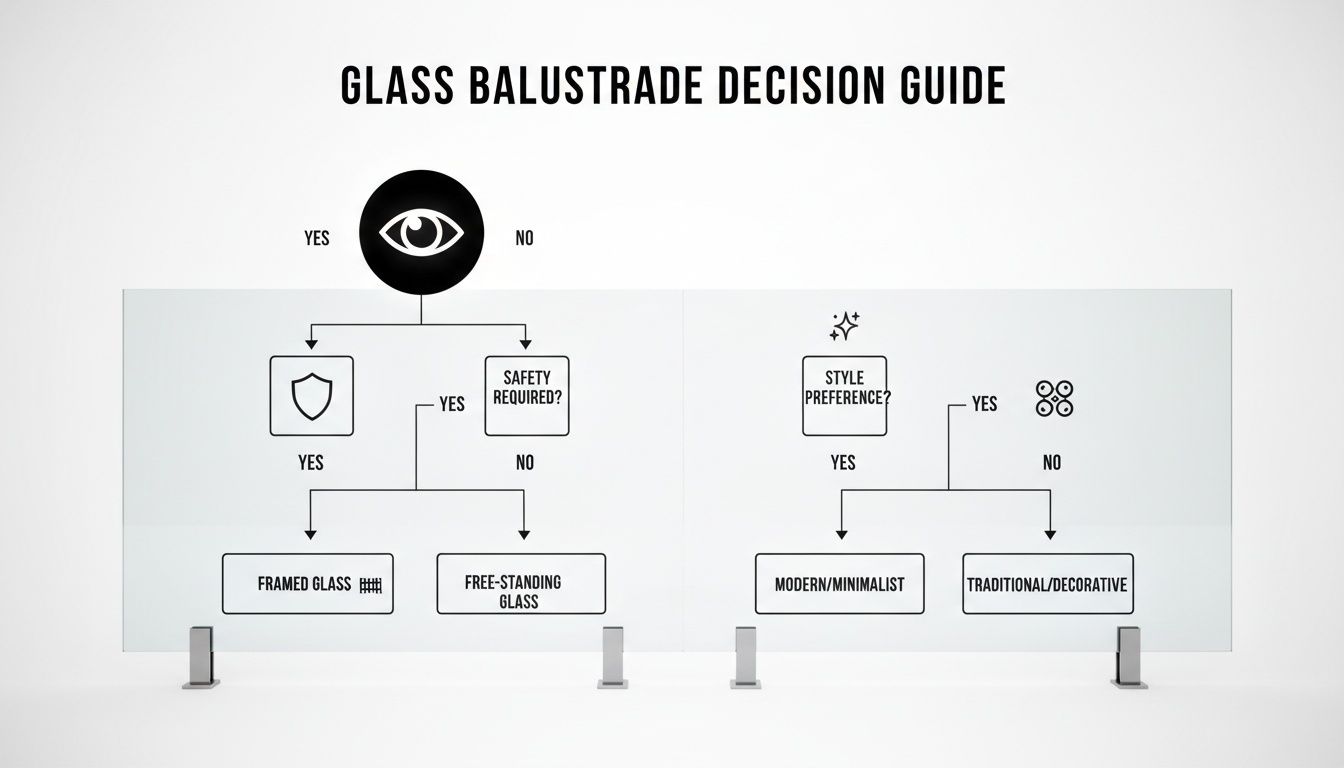
The guide shows how your main priorities—whether it’s keeping that perfect view, matching a specific style, or focusing on a robust feel—point you towards the ideal balustrade for your home.
Beyond the main frame or frameless structure, the finishing touches are what make the design truly yours. These details let you personalise the balustrade to perfectly suit your taste and needs.
When you install a beautiful glass balustrade in your garden, it’s easy to focus on the aesthetics. But its most important job is keeping everyone safe. While it looks incredible, it’s a critical safety barrier, and that means it has to meet specific UK Building Regulations. Getting these right isn't just about ticking boxes; it's about giving you, your family, and your guests complete peace of mind.
Think of it this way: for any raised area in your garden—a deck, patio, or terrace—where there's a drop, a protective barrier is non-negotiable. It's not just a good idea; it’s a legal requirement designed to prevent falls. These rules ensure your stunning new feature is as strong and reliable as it is stylish.
The main guidelines for balustrades in the UK come from Approved Document K (Protection from falling, collision and impact). This document sets out the practical and legal standards for all barriers, whether they're in Darlington or down in Cornwall. For an external balustrade on a garden patio, the rules are very clear.
One of the most crucial rules is about height.
This standard height makes sure the barrier provides an effective guardrail for anyone enjoying your outdoor space. It’s a simple but vital measurement that forms the foundation of a safe system.
Beyond just height, a glass balustrade has to be incredibly strong. Regulations specify the exact forces it needs to withstand without breaking or failing. This strength is measured in kilonewtons (kN), a technical way of ensuring the structure can handle real-world pressures.
Think of the 'kilonewton (kN) load' requirement like this: your balustrade must be strong enough to resist the force of several people leaning against it at once, without any sign of faltering. It’s a test of its real-world resilience.
The balustrade must resist different types of forces, including a uniform line load along the top and a concentrated point load applied to the glass itself. This guarantees its structural integrity, whether it's facing a strong gust of wind or someone stumbling against it.
Under the Building Regulations 2010 (as amended), glass panels for gardens must be strong enough to resist these forces—for instance, a 0.5kN point load applied at a height of 0.5m. It’s a standard we know inside out; in fact, 95% of Binks Balustrades' garden projects in places like Harrogate and Cheshire meet or exceed this using our robust laminated glass options.
You can't just use any old piece of glass for a safety barrier. UK regulations, especially the standard BS 6180:2011, demand the use of specific safety glass. This nearly always means one of two types:
At Binks Balustrades, we ensure every system we supply, whether for a home in York or Leeds, is fully compliant. We use the correct specification of toughened or laminated glass, ensuring your glass balustrade for garden projects meet all safety standards without compromise. For a deeper dive into this topic, you can learn more about how glass balustrades meet building regulations in our dedicated article.
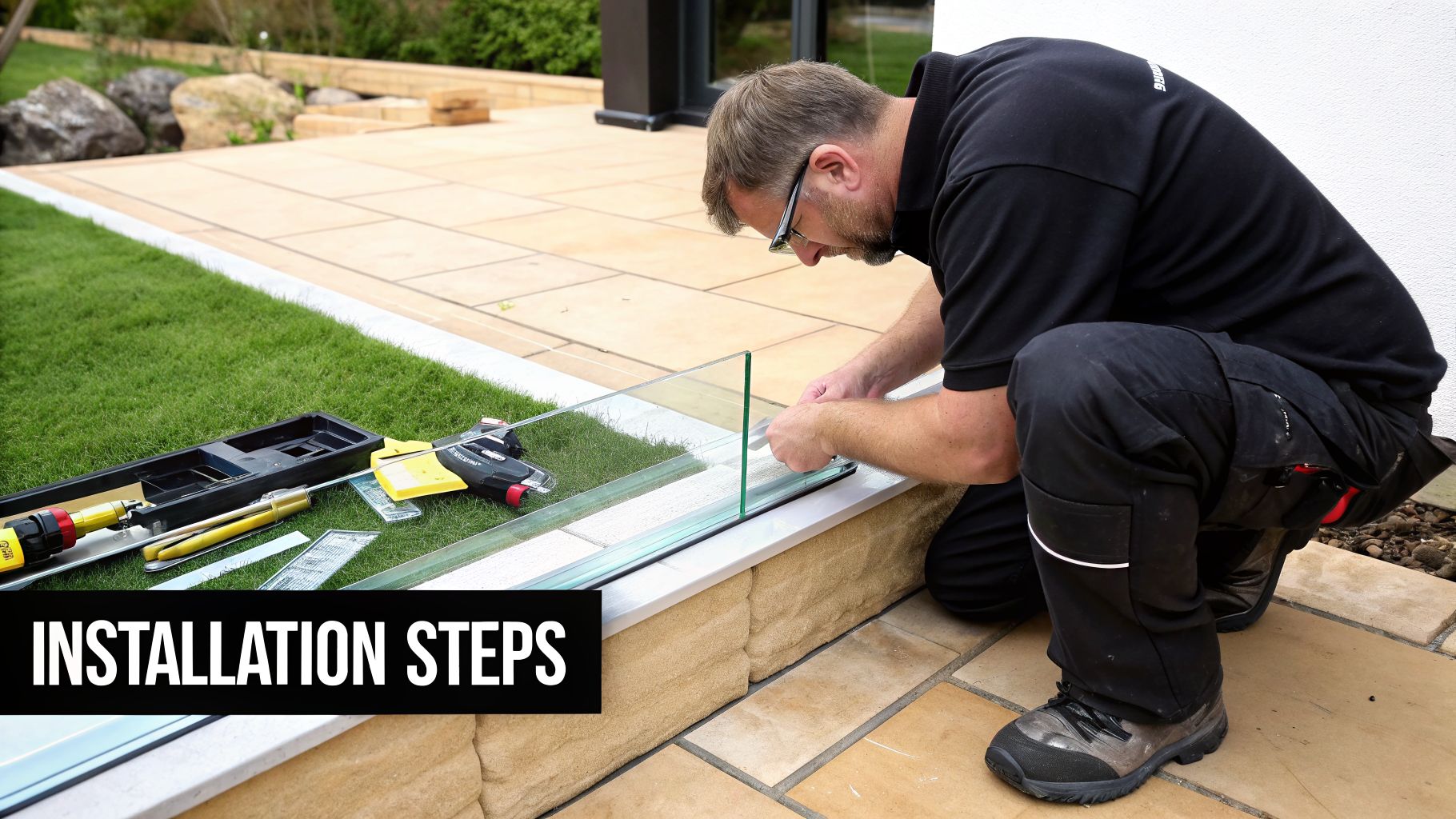
A stunning glass balustrade for your garden doesn't just appear out of thin air. The secret to that professional, flawless finish you see in design magazines starts long before the first panel is lifted into place. It all begins with a solid plan and some diligent preparation.
We've broken the whole process down into a simple roadmap to give you the confidence to move forward. Essentially, the journey from a bare patio to a beautiful, glass-framed view has two main phases: preparing the site and then the installation itself. Get the first part right, and the second becomes infinitely smoother.
Think of it like building a house – if the foundations are weak or uneven, nothing built on top will ever be truly right. This is especially vital for gardens here in the North of England, where our patios and decking have to stand up to everything the weather can throw at them. A strong, stable base isn't just a good idea; it's the absolute bedrock of a safe and durable balustrade.
The single most critical step in this entire journey is making sure your foundation is perfectly strong, sound, and level. Whether you're fitting your balustrade onto timber decking, a concrete patio, or a brick retaining wall, this surface has to bear the full weight of the system and handle the forces it will face over the years.
An uneven or weak base will cause a cascade of problems. You'll find the glass panels refuse to line up correctly, leading to a jarring, unprofessional look. Far more importantly, it critically undermines the structural integrity of the barrier, making it unsafe.
Before you even think about ordering components, take some time to assess the site:
While we won't turn this into a full DIY manual, understanding the basic installation steps is incredibly empowering. It means you can have a meaningful conversation with your installer or feel more in control if you're overseeing the project. The process varies slightly depending on the system you've chosen.
A post-and-clamp system is generally more forgiving for experienced DIYers. The process involves securely fixing the stainless steel posts to your prepared base at precise intervals, then carefully clamping the glass panels into position between them.
A base-channel system, which gives you that incredible frameless look, demands a higher level of precision. The channel track must be fixed perfectly straight and level to the foundation. Once it's bolted down, the glass panels are slotted in and secured with a wedge or gasket system, creating that iconic, seamless wall of glass.
No matter which system you go for, precision is king. The old 'measure twice, cut once' mantra is absolutely crucial here. It’s the key to ensuring every part fits perfectly and aligns beautifully for that truly professional-grade finish.
Here at Binks Balustrades, our kits are designed to make the process as straightforward as possible for a competent professional or a skilled DIYer in North England. We supply all the necessary parts, all cut to your exact measurements, to make sure everything comes together as it should. If you'd like to dig a little deeper, our guide on how to install a glass balustrade offers even more valuable insights for your project.
Let's talk about one of the biggest questions on every homeowner's mind when planning a new garden feature: how much will a glass balustrade for garden spaces actually cost? While these systems deliver incredible style and longevity, it’s crucial to understand what shapes the final price tag.
There’s no "one-size-fits-all" answer. Think of it like commissioning a bespoke piece of furniture; the final figure depends entirely on the materials, the design, and the finishing touches you choose. Each decision you make plays a part in the overall investment.
To help you get a clearer picture, let's break down the main variables that determine the total price of your system. Understanding these allows you to prioritise what matters most, whether that's achieving an ultra-minimalist look or working within a specific budget.
This table shows the key elements that come together to form your final quote.
| Cost Factor | How It Affects the Price | Typical Choice |
|---|---|---|
| Total Length & Complexity | The longer the balustrade, the more materials are needed. Corners and custom angles also add to the complexity and price. | This varies widely, from a short run on a small patio to an extensive barrier around a large terrace. |
| System Type | Frameless systems typically carry a premium due to the thicker glass and heavy-duty base channel needed for structural integrity without posts. | Frameless is incredibly popular for uninterrupted views, while post systems offer a classic, robust look. |
| Glass Specification | Laminated glass, with its plastic safety interlayer, costs more than standard toughened glass but offers superior strength and security. | We highly recommend laminated glass for any raised areas like decking or balconies where safety is paramount. |
| Handrail Option | Adding a stainless steel handrail will increase the cost compared to a bare, polished glass edge. The profile and finish also affect the price. | A slim, stylish top rail is a common choice, adding a comfortable and defined edge to the glass. |
Essentially, all these elements work in combination. A long, frameless system using laminated glass and a top rail will naturally be a higher investment than a short, post-based system with standard toughened glass. For a much deeper dive into these costs, you can explore our guide to the cost of glass balustrades, which provides even more detail.
Getting to grips with these factors is the first step towards creating a balustrade that perfectly fits your space and your financial plans.
Guesswork and budgeting don't mix well. That’s why we created a straightforward online tool to give you clear, instant figures for your project, whether you're in Leeds, Harrogate, or anywhere across the North. Our Balustrade Calculator removes all the uncertainty.
It’s a simple, four-step process that lets you explore different design scenarios in real-time. You can instantly see how choosing a frameless system over a framed one, or adding a handrail, impacts the total cost.
Our calculator is designed to put you in control. It's a practical tool that translates your design ideas into a transparent, itemised quote, ensuring there are no surprises down the line.
The process is refreshingly simple:
In just a few moments, you’ll have a personalised quote. This gives you the financial clarity you need to move forward with confidence, helping you find a high-end solution that perfectly fits your budget and brings your garden vision to life.
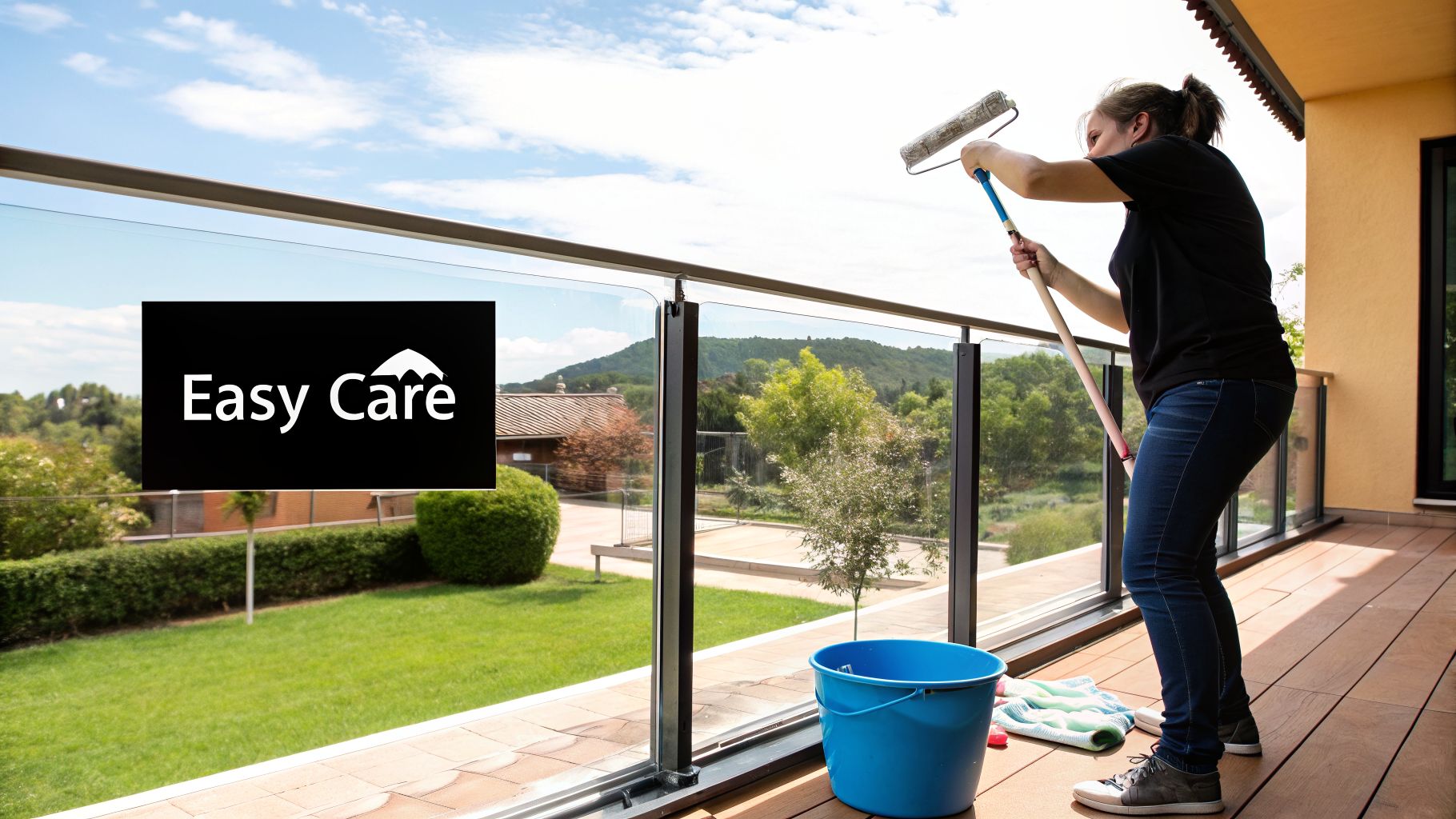
One of the biggest plus points of a glass balustrade for garden spaces is just how little looking after it needs. Forget the endless cycle of staining, painting, and sealing that timber demands to survive the Northern weather. Glass just gets on with it, giving you more time to actually enjoy your garden.
There's a persistent myth that glass is a pain to keep clean, but that couldn't be further from the truth. A simple, infrequent routine is all it takes to keep that perfect, clear finish. In fact, the classic North of England rain will often do most of the hard work for you, rinsing away everyday dust.
When you do want to give it a proper clean, you don't need fancy products. A bucket of warm water with a single drop of washing-up liquid, a soft cloth, and a squeegee are all the tools required to cut through any build-up and leave your panels sparkling.
Keeping your balustrade looking brand new doesn't mean hours of scrubbing. Following these simple steps a few times a year is more than enough.
This entire process is a world away from the annual chore of sanding and treating a wooden fence or railing.
A glass balustrade really is a "fit and forget" solution. Think of it as an investment in lasting beauty that buys back your weekends.
While the cleaning is a breeze, it's good practice to give the fittings and fixtures a quick visual check a couple of times a year. This is especially true if your home is in an exposed spot, perhaps on the Yorkshire or Cumbria coast where the salt air is more demanding.
Just look over the clamps, bolts, and other fixings to make sure everything is tight and secure, with no signs of movement. If you do run into stubborn marks like mineral deposits from hard water, you can find great tips for removing hard water stains from glass. These quick, simple checks guarantee your balustrade remains safe and solid for decades to come.
Even after you've settled on a design, a few lingering questions often pop up. It's completely normal. Making a change to your home is a big decision, and you want to be sure you've covered all the bases.
Here are the most common queries we get from homeowners across the North of England. We've put together some straight-talking answers to give you complete confidence in your project.
Without a doubt. In fact, safety is the core principle behind their entire construction. We use incredibly strong toughened or laminated safety glass, specifically engineered to take significant impacts and create a solid, reliable barrier for any garden, patio, or decking area.
Toughened glass is specially treated so that if it ever did break under extreme force, it shatters into small, blunt, pebble-like pieces, not dangerous shards. Laminated glass takes this a step further; an invisible plastic interlayer holds the pane together even if it cracks, ensuring the barrier always remains in place. It’s all about creating a secure space where the whole family can relax without a worry.
For most garden projects, the answer is no. A balustrade usually falls under 'permitted development', which means you can go ahead without needing to file a formal application.
However, there are a few important exceptions. It's always a good idea to have a quick chat with your local council, especially if your property is a listed building or sits within a Conservation Area. You'll also need to check if the balustrade is part of a new raised platform that stands over 30cm from the ground.
It's also worth remembering that planning permission is a separate issue from UK Building Regulations. Our systems are designed from the ground up to comply with these building regs, which govern safety and construction standards, giving you one less thing to think about.
Our systems are designed for straightforward assembly, but a successful installation really hinges on having a good level of DIY skill, the right tools, and a patient, methodical approach. If you're a seasoned and confident DIYer, it's definitely a project you can tackle.
The most critical part of the entire installation is ensuring the base is securely fixed and perfectly level. Any imperfections at this stage will be magnified when you install the glass, so take your time to get it right.
We supply all the components cut to your specific measurements, along with clear instructions. That said, if you have any doubt at all about achieving a safe, professional finish, we always suggest bringing in a local tradesperson. Our team is always on hand to offer guidance to you or your chosen installer throughout the process.
Yes, and it’s a surprisingly effective one. This is one of the most welcome benefits for our customers, particularly for those dealing with the brisk winds so common across the North of England, from the Cumbrian coast to the open Yorkshire countryside.
By creating a continuous glass barrier, you can form a sheltered little microclimate on your patio or terrace. It dramatically cuts down the wind chill in your seating area, transforming it into a far more comfortable and usable space. This simple feature helps you reclaim your garden for more of the year, extending the season for relaxing and entertaining outdoors.
Feeling confident and ready to take the next step? The expert team at Binks Balustrades is here to help you bring your vision to life with a stunning, safe, and durable glass balustrade. Get in touch with us today for personalised advice and a no-obligation quote for your project. Visit our website or call us to start your journey with Binks Balustrades.