
Cable for Railings: 2026 Guide to Installing, Regulations, and Costs
A top-quality cable for railings system is all about creating a safe, almost invisible barrier using slender, high-tensile stainless steel […]

A top-quality cable for railings system is all about creating a safe, almost invisible barrier using slender, high-tensile stainless steel […]
A top-quality cable for railings system is all about creating a safe, almost invisible barrier using slender, high-tensile stainless steel wires pulled taut between strong posts. It’s a modern design that’s all about maximising your views, whether from a patio, balcony, or stairway, and it’s fast becoming a go-to choice for stylish properties across the North of England.
Picture yourself standing on a Yorkshire patio or a Cumbrian balcony, taking in an uninterrupted view. That’s the real promise of a cable railing system. It’s a design philosophy that puts light and landscape first, creating a feeling of openness that you just don't get with traditional railings.
But how can something that looks so delicate provide serious, robust safety?
The secret is all down to clever engineering and tension. Think of it like a perfectly tuned guitar. The strength isn’t in the thickness of the strings, but in the precise, unyielding tension they’re held under. A cable railing works on the very same principle, using three core parts that work together to deliver security without cluttering up your view.
Let's break down the essential components that make these systems work. It’s a simple setup, but each part has a critical role to play in creating a balustrade that’s both safe and stunning.
| Component | Function | Key Consideration |
|---|---|---|
| Posts | The structural backbone, securely anchored to provide primary support and resist force. | Must be made from a strong, durable material like stainless steel or powder-coated aluminium. |
| Cable | The infill, usually marine-grade stainless steel wires threaded horizontally between posts. | The slender profile is what creates the "barely there" look and keeps sightlines clear. |
| Fittings & Tensioners | The hardware used to secure the cables and apply the necessary tension. | These crucial parts ensure the cables stay taut, preventing sag and maintaining safety. |
At its heart, a cable railing is a tension-based system. Each wire is individually tightened to a specific load, creating a rigid and secure infill that is surprisingly strong despite its minimalist appearance. This tension is non-negotiable for both safety and aesthetics.
The applications for these systems are incredibly versatile. They look just as good framing a contemporary garden in Leeds as they do adding a modern edge to a commercial terrace in Harrogate. Cable railing systems offer a sleek and modern alternative for various applications, including providing effective and aesthetically pleasing pool fencing solutions.
This blend of minimalist design and robust engineering is exactly why more and more property owners across the North of England are choosing cable. It delivers on the promise of security while preserving the very views they want to enjoy. With this foundation, we can now dig into the specifics of cable types, fittings, and the all-important safety regulations you need to know.
Once you’ve settled on a cable railing system, your next big decision is about the wire itself. It might all look the same at a glance, but the cable for railings is the unsung hero of the whole setup. Getting the details right—like its construction and diameter—is absolutely critical for the safety, durability, and final look of your balustrade.
Think of it like choosing the right kind of rope for a job. A single, thick cord has different properties to one that's been intricately woven from dozens of smaller threads. The same principle applies to stainless steel wire, and understanding the difference is key to a successful project.
This concept map shows how the main components—the wires, posts, and tensioners—work together to create a secure, complete system.
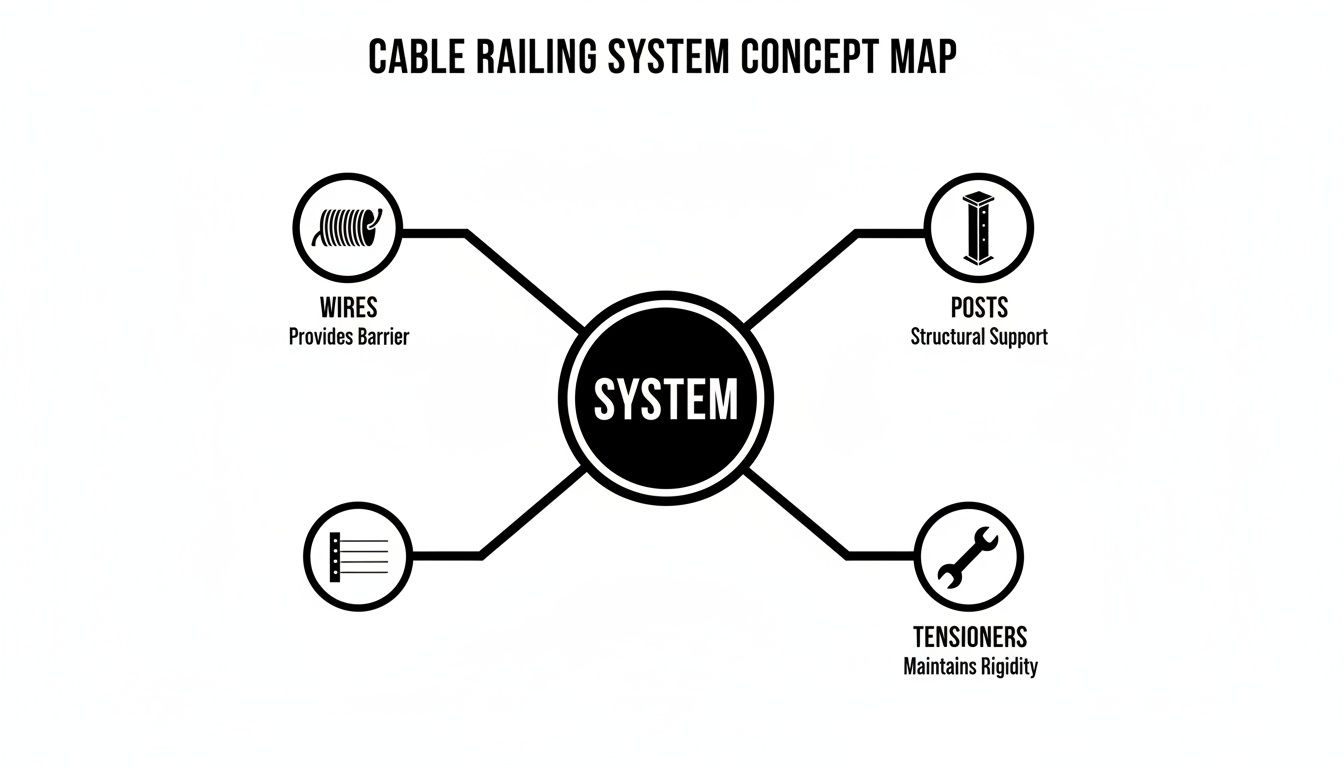
As you can see, the wires are just one part of the equation. The strength of the posts and the quality of the tensioners are just as vital for creating a safe and long-lasting barrier.
The numbers you’ll see—like 1×19, 7×7, and 7×19—are a shorthand for how the cable is constructed. The first number tells you how many strands are twisted together, and the second tells you how many individual wires make up each of those strands.
To make it easier to see the differences, here's a quick comparison of the three main types.
| Cable Type | Construction | Best For | Key Feature |
|---|---|---|---|
| 1×19 | 1 strand of 19 wires | Balustrades & Railings | Very rigid, minimal stretch, clean look |
| 7×7 | 7 strands of 7 wires | General purpose, some rigging | Moderately flexible, more stretch than 1×19 |
| 7×19 | 7 strands of 19 wires | Marine rigging, cranes | Extremely flexible, not suitable for railings |
Let's break down what this means for your project.
1×19 Construction: This is the industry gold standard for balustrades, and for good reason. It’s made from a single strand of 19 tightly wound wires, which makes it incredibly rigid with very little stretch. Once it's tensioned, it stays taut. Its smooth surface also provides a sharp, clean finish that looks fantastic.
7×7 Construction: This cable is made from seven separate strands, each containing seven wires. It's more flexible than 1×19, which can be a drawback for balustrades as it's more likely to stretch and sag over time, requiring re-tensioning.
7×19 Construction: With seven strands of 19 wires each, this cable is built for flexibility. You’ll find it on sailboats and in other applications where the wire needs to run over pulleys and bend constantly. This very flexibility makes it completely unsuitable for railings, as it simply won’t hold the tension required for safety.
For any high-quality railing project in York, Harrogate, or anywhere in the North, 1×19 construction is the industry-preferred choice. Its rigidity ensures that once tensioned, the cables remain taut, consistently meeting the crucial safety requirement of preventing a 100mm sphere from passing through.
The diameter of the cable for railings is your other key decision. This affects both the final look of your balustrade and its strength. The most common diameters for residential and commercial projects are 3mm, 4mm, and 5mm.
Of course, the material itself is just as important. All quality cable railing systems use marine-grade 316 stainless steel. This grade includes a nifty element called molybdenum, which gives it far superior resistance to corrosion—essential for handling the unpredictable weather we get here in the North of England. To find out more about why this specific grade is so crucial for outdoor installations, check out our guide on stainless steel for railings.
The sleek, minimal wires tend to get all the attention in a cable railing system, but the real workhorses are the fittings and tensioners. These small, precisely engineered components are the unsung heroes holding everything together. They’re what turns a simple cable for railings into a safe, stylish, and fully compliant balustrade.
Think of it like a suspension bridge, just on a much smaller scale. The strength doesn’t just come from the cables; it comes from the anchor points and the tensioning mechanisms that lock everything rigidly in place. Without top-quality fittings, even the strongest cable will sag, and that compromises both safety and the sharp look you’re after.
This hardware is what allows us to pull every single wire taut, creating that clean, architectural line while giving you the unyielding strength needed for a protective barrier. Whether you're planning a new deck in Leeds or a commercial terrace in York, understanding these parts is key.

When it comes to attaching the cable to your posts, you’ll generally come across two main families of fittings: swaged and swageless. Both get the job done—securely terminating a cable run—but they go about it in very different ways.
Swaged Fittings: These are our go-to for a factory-perfect finish. We attach them to the cable using a special hydraulic crimping tool which applies immense pressure, permanently deforming the fitting around the wire. This creates an incredibly strong, slim connection that’s favoured by professionals for its clean look.
Swageless Fittings: Often called mechanical fittings, these are the DIY-friendly option. They use a clever internal wedge or grub screw system that grips the cable when you tighten them with standard hand tools, like a spanner. They’re brilliant if you need to make adjustments on-site without specialist equipment.
For projects where the end posts are going into solid materials like concrete or brickwork, you need a seriously reliable anchor. Specialised fixings, like a resin anchor bolt, are what we use to create an incredibly strong, permanent fixing point in masonry. You can learn more in our guide on using a resin anchor bolt for secure installations.
The Golden Rule of Tension: Getting the tension right isn't just a suggestion; it's non-negotiable. It’s what stops a child or pet from pushing the cables apart, ensuring your balustrade complies with the critical ‘100mm sphere rule’ in UK Building Regulations. An improperly tensioned system is simply not a safe system.
While some end fittings just terminate a cable, tensioners are what give you the adjustability to pull the wires drum-tight. You don't always need a tensioner on both ends of every cable, though. A common and cost-effective setup is to use a simple, non-adjustable fitting on one post and a tensioning fitting on the other.
Here’s a quick rundown of the most common tensioners we work with:
A stunning new balustrade is an exciting prospect for any property, but getting the design right is only half the battle. When you’re installing a cable for railings system, making sure it’s safe and fully compliant with UK Building Regulations isn't just a good idea—it’s a legal requirement. For homeowners across Cheshire, Darlington, and the North of England, understanding these rules brings peace of mind that your stylish new feature is also completely secure.
The crucial rulebook here is Approved Document K (Protection from falling, collision and impact). Think of this less as a set of guidelines and more as the mandatory safety standards your balustrade must meet. Let's break down what this means for your project in practical terms.
One of the single most important safety tests for any balustrade, cable systems included, is what’s known as the ‘100mm sphere rule’. It exists for one very simple, very important reason: to protect small children.
The rule states that no gap anywhere on the balustrade can be big enough for a 100mm sphere—roughly the size of a baby’s head—to pass through. For cable railings, this has a direct impact on two key installation details:
This is precisely why professional tensioning, which we talked about earlier, is so non-negotiable. It’s what turns a collection of individual wires into a solid, unbreachable safety barrier.
Building Regulations also set out the minimum height for your balustrade, which changes depending on where it’s being installed. The measurement is always taken from the finished floor level right to the very top of the handrail.
On top of being the right height, the system must also be strong enough to handle specific forces, or ‘loads’, without failing. This ensures it can safely take the weight of people leaning on it. The handrail has to resist a horizontal force, while the infill (the cables themselves) must withstand a different point load to prove the whole system is structurally sound.
Adhering to these regulations is not optional. It is the legal responsibility of both the homeowner and the installer to ensure the balustrade is compliant. A properly specified and installed cable railing system from a reputable supplier will meet and often exceed all these requirements.
Getting these details right is what makes a beautiful railing a safe one. For a more detailed breakdown of the legal requirements, you can learn more by reading our complete guide on building regulations for balustrades in the UK.
While our focus is on UK standards, it can be insightful to see how other countries approach safety; for example, you can explore New Zealand's building code for deck safety and compliance. Ultimately, partnering with a specialist who lives and breathes the specific rules for your project, whether in York or Cumbria, is the surest path to a compliant, safe, and stunning result.
It’s a question we get all the time from property owners across the region: for a modern, open feel, should I choose sleek cable for railings or the seamless look of glass balustrades? Both are a fantastic step up from traditional railings, but they offer completely different aesthetics and come with their own practical considerations. The right choice nearly always comes down to your property’s style, your location, and how you imagine using the space.
This isn't about finding a single winner. Instead, it's about making an informed choice by honestly comparing both systems. We'll look at how they affect your view, what the upkeep is really like, and how they stack up on cost and style to help you decide with confidence.

Both systems are brilliant at preserving a view, but they do it in distinct ways. The real question is, do you prefer a subtle framework or a completely invisible pane of glass?
Cable Railings: The ultra-thin stainless steel wires are designed to almost disappear. From a distance, your eye naturally looks straight through the fine horizontal lines to the landscape beyond. It creates a feeling of openness, with a subtle architectural grid that adds texture and a modern edge.
Glass Balustrades: Glass is the undisputed champion for a completely uninterrupted, panoramic view. It acts like a crystal-clear window to the world, offering zero visual clutter. If every last inch of your vista is precious, there is simply no better option.
While both are excellent choices, glass gives you that perfect "picture-frame" effect. Cable railings, on the other hand, provide a more open-air, slightly structured feel that connects you to the outdoors.
This is where the two systems really part ways. Both need some attention to look their best, but the tasks involved are worlds apart, and your personal preference will play a huge role.
Cable Railing Maintenance
With a cable system, your main task isn't cleaning, but periodic re-tensioning.
Glass Balustrade Maintenance
With glass, the primary job is regular cleaning.
If you'd rather do a quick mechanical check once or twice a year than commit to frequent cleaning, cable is a strong contender. But if you don't mind some window-cleaning duties in exchange for a flawless, uninterrupted view, glass has the edge.
For many, the final decision comes down to the budget and the overall look you want to achieve for your property.
Aesthetic Feel: Cable railings bring a contemporary, slightly industrial or even nautical feel to a space. They pair beautifully with rustic timber decking, modern composite boards, and urban metalwork. Glass, by contrast, is the go-to for a polished, high-end, and flawlessly sleek aesthetic.
Overall Cost: As a general rule, a high-quality cable for railings system is often the more budget-friendly option compared to a frameless or semi-frameless glass balustrade. While costs always vary with the length of the project and the materials chosen for posts, the glass panels themselves typically make it the more premium choice.
Here’s a quick summary to help you weigh things up at a glance.
| Feature | Cable Railing System | Glass Balustrade System |
|---|---|---|
| View | Minimal obstruction with horizontal lines | Completely uninterrupted panoramic view |
| Maintenance | Periodic re-tensioning, infrequent cleaning | Frequent cleaning, no mechanical checks |
| Aesthetic | Modern, industrial, nautical, textured | Sleek, high-end, minimalist, seamless |
| Typical Cost | Often more budget-friendly | Generally the more premium option |
So, which one is right for your project? It's all about context.
Choose cable railings if:
Choose glass balustrades if:
Ultimately, both are fantastic, high-quality solutions. The choice between a cable for railings and a glass balustrade is a personal one, driven by your design goals, practical priorities, and the unique character of your home.
You’ve explored the options, from the sleek 1×7 to the robust 1×19 stainless steel cable, and now you have a good sense of what makes a quality cable railing system. The next step is turning that vision into a reality for your home. But navigating building regulations and sourcing the perfect components can be daunting. That’s where partnering with a local specialist makes all the difference.
Based in Harrogate, we live and breathe the design styles of the North. Whether your property overlooks the historic streets of York, is a modern new-build in Leeds, or a rustic home nestled in the Cumbrian countryside, we bring a deep understanding of what works here. We know the local planning nuances and the practical demands of our wonderful, and sometimes wild, weather.
Choosing a local team isn't just about convenience. It’s about getting a partner who gets the regional aesthetic, ensuring your balustrade doesn’t just meet regulations, but truly belongs to its surroundings.
Working with us means your project is specified correctly right from the get-go. We’ll help you select the ideal 1×19 stainless steel cable and the right fittings to bring your design to life, guaranteeing a balustrade that’s not only stunning but structurally sound for decades.
Want to get a clear idea of costs right now? Our online Balustrade Calculator is the quickest, easiest way to do it. We designed this tool to give you a transparent price guide in just a few clicks, with no obligation.
It’s a straightforward way to explore your options and budget effectively from the comfort of your own home.
Of course, sometimes you just need to talk it through with a person. If you have specific questions or a complex project in mind, our team is always here to help. Get in touch with Binks Balustrades today to discuss your plans, and let’s create that perfect modern finish for your property together.
It’s completely normal to have a few practical questions pop up when you're considering a new feature for your home. We get it. Here are the answers to some of the most common queries we hear from homeowners across the North of England, giving you the clarity you need to feel confident in your choice.
This is usually the first question people ask, and we’re happy to say the answer is yes, absolutely – as long as they are installed by a professional who follows the rules. Safety is all about correct installation, and that means sticking rigidly to UK Building Regulations.
A compliant system ensures the horizontal wires have no more than a 99mm gap between them and are tensioned to be drum-tight. This specific gap is designed to stop a 100mm sphere from passing through, which is the official benchmark for preventing a small child's head from getting stuck. This makes the balustrade a secure barrier for children and most pets, though it’s worth noting that a very determined, tiny pet might find a way.
Like many new installations, your cable system will do a bit of "settling in" during its first year. This is just a tiny amount of natural cable stretch, and it's normal to need a quick tension check and a minor tweak within the first 6-12 months.
After that initial period, the high-quality 1×19 stainless steel cable we use is incredibly rigid and holds its tension remarkably well. You’ll likely only need to check it every few years. The adjustment process is simple, just a matter of using basic tools to tighten the fittings and keep everything perfectly taut and safe.
Think of it like tuning a brand-new guitar. The strings need a few adjustments at first as they settle in, but once they do, they hold their tune for a long time. It's the same principle with your cable railing—a moment of attention early on ensures long-term safety with minimal fuss.
Keeping your cable for railings looking sharp is refreshingly low-effort. We use marine-grade 316 stainless steel, which is built to resist corrosion and stand up to our often damp Northern English weather.
A couple of times a year, a simple wipe-down with a soft cloth and some warm, soapy water is all it takes to remove everyday grime from the cables and posts. If you're in a coastal area and notice any "tea staining," a specialist stainless steel cleaner will have it gleaming again in no time. It's a small task that pays big dividends in keeping your view pristine.
Ready to bring your vision to life? At Binks Balustrades, we specialise in designing and installing stunning, compliant, and durable cable railing systems for homes across Harrogate, York, and the North. Get in touch with us today for some friendly, expert advice and a personalised quote.