
Your Guide to External Handrails for Steps in the UK
An external handrail isn't just a finishing touch for your steps; it’s one of the most vital safety features you […]

An external handrail isn't just a finishing touch for your steps; it’s one of the most vital safety features you […]
An external handrail isn't just a finishing touch for your steps; it’s one of the most vital safety features you can install on your property. In a place like the UK, where a bit of rain or a sudden frost can make outdoor surfaces incredibly treacherous, thinking of steps without a handrail is like imagining a car without seatbelts—an unnecessary risk you just shouldn't take.
Every year, thousands of slips and falls happen on outdoor steps, and many could have been easily prevented by a sturdy, well-placed handrail. Here in Northern England, we know all too well how unpredictable our weather can be. From the steep garden paths in Yorkshire to the slick stone steps of a Cumbrian cottage, the danger is real. A bit of rain, a layer of ice, or even just morning dew can turn a simple flight of stairs into a serious hazard.
A handrail provides that crucial point of contact, giving you the stability you need to navigate steps safely. It’s the one thing that can turn a potential major fall into a minor stumble. For any homeowner, installing a reliable handrail is one of the single most effective things you can do to protect your family, friends, and anyone visiting your property.
While safety is always the number one priority, a modern external handrail for steps can do so much more for your home. It can frame an entryway, guide visitors along a path, and add a sharp, polished look to your property's exterior. The right design choice complements your home's architecture, boosting its overall appeal and even its value.
Here’s what a great handrail really delivers:
A well-designed handrail does more than just meet a requirement; it provides constant, reliable support. It’s the silent guardian of your home's entrance, offering peace of mind every time someone walks up or down your steps, regardless of the weather.
This guide is your practical roadmap to choosing, installing, and maintaining the perfect external handrails for steps. We'll walk through everything from the specific regulations you need to know to the best materials for surviving a harsh winter in Harrogate or Leeds. By the end, you'll have the confidence to select a solution that is safe, compliant, and looks fantastic.
Trying to make sense of the official rules for external handrails can feel a bit like wading through legal jargon. The good news is, it all boils down to a handful of straightforward safety principles. For anyone installing steps at home in the UK, the key document is Approved Document K, which sets the standards for protecting people from falls. Let's translate that official guidance into plain English.
One of the first questions we always get is, "When do my steps actually need a handrail?" The general rule of thumb is this: if your flight of steps has three or more risers (that’s the vertical bit of each step), you’re required to have a handrail. This applies to most domestic settings, ensuring even shorter sets of steps have the support people need.
It’s not enough to just have a handrail; it needs to be the right size and in the right place to be genuinely safe and easy to use. These dimensions aren’t arbitrary—they're designed to make the handrail effective for everyone, from children to the elderly.
Here is a quick reference table to summarise the essential measurements and rules from Approved Document K for domestic external staircases.
| Requirement | Specification | Why It Matters |
|---|---|---|
| Handrail Height | Between 900mm and 1000mm from the pitch line of the stairs. | This height provides a comfortable and secure grip for the average adult, preventing them from stooping or over-reaching. |
| The "100mm Sphere Rule" | No gap in the balustrade should be large enough for a 100mm sphere to pass through. | This is a critical child safety feature, designed to prevent a small child from getting their head stuck or falling through. |
| Handrail Quantity | One handrail for stairs under 1 metre wide. Two handrails (one on each side) for stairs over 1 metre wide. | Ensures adequate support is always within reach, especially on wider staircases where people may walk on either side. |
These rules, also reflected in standards like BS6180:2011, are there to prevent accidents. In places like Yorkshire, where damp garden steps can get notoriously slippery, getting these details right is non-negotiable.
The 100mm sphere rule is one you absolutely must get right, especially if you have kids or grandchildren visiting.
Think of the 100mm sphere rule as the "toddler-proofing" measurement. It’s based on the approximate size of a baby’s head, and its entire purpose is to prevent a small child from getting stuck or falling through a gap in the railing. It’s a safety rule that simply can't be bent.
This decision tree helps visualise the key points you need to consider when planning your project, from the first safety check to the final stylistic choice.
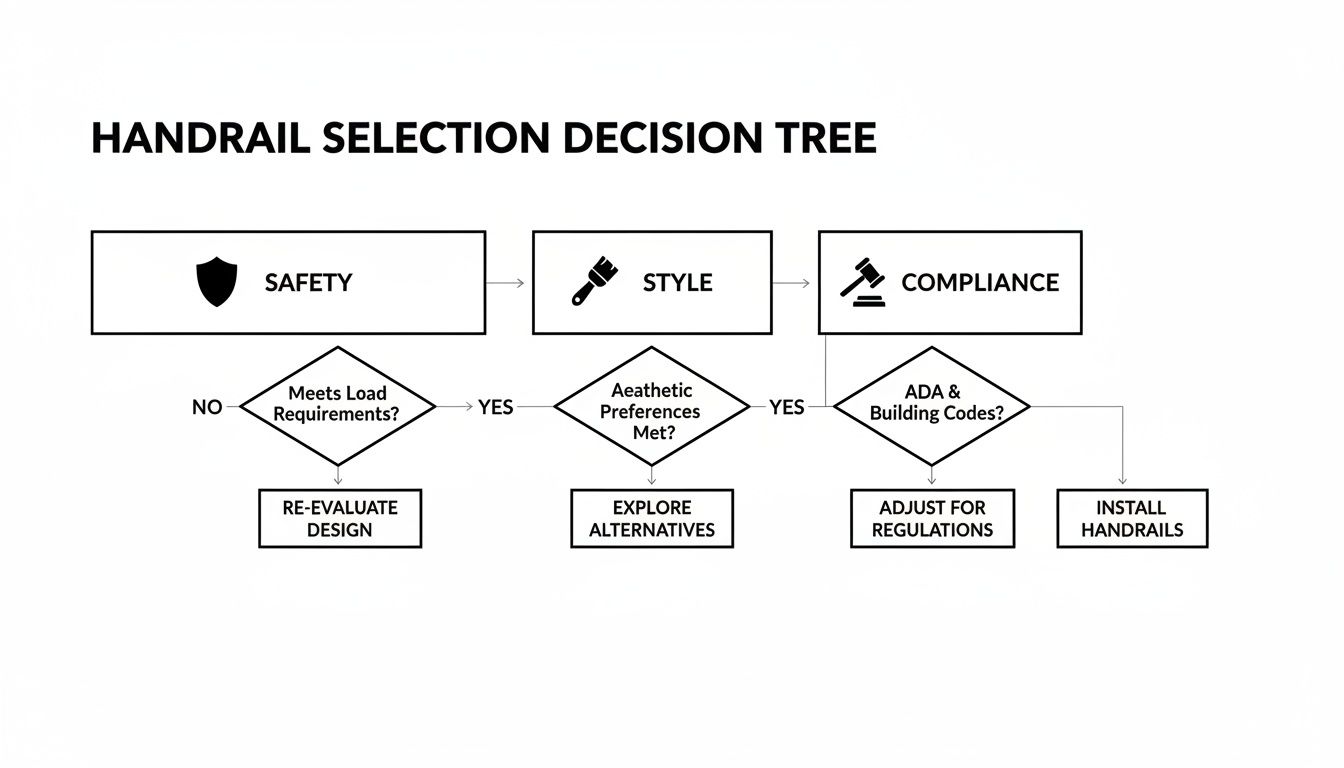
As you can see, safety and compliance are the foundation upon which great design is built.
So, how do you know if you need a handrail on one side or both? It all comes down to the width of your staircase.
For a standard set of garden steps outside a Leeds home that are less than one metre wide, a single handrail is perfectly fine and fully compliant.
But if you’re dealing with a wider staircase—maybe for a shared access path in Harrogate or a grand entrance to a terrace—the rules change. If the stairs are wider than one metre, you must install a handrail on both sides. This is just common sense; it makes sure that no matter which side someone uses, support is right there for them. For a deeper look at the specifics, check out our comprehensive guide to building regulations for balustrades.
Picking the right material for your external handrails for steps is a huge decision, especially when you’re up against the famously unpredictable weather here in Northern England. The choice you make will dictate how your handrail looks, how much work it needs, and how long it lasts. It’s a bit like choosing a coat for a winter walk in the Pennines; you need something that performs brilliantly against the elements but still looks the part.
Our climate’s relentless cycle of rain, frost, and the odd sunny spell means materials have to be tough enough to fend off rot, rust, and general wear and tear. And while a handrail is first and foremost a safety feature, it’s also a big part of your home’s kerb appeal. The trick is to strike that perfect balance between rock-solid performance and a style that genuinely complements your property.

Let's walk through the most common options and see how they fare against the demands of our local weather. Each one brings something different to the table.
Timber: A timeless, traditional choice, wood gives off a warm, natural feel. But to stand a chance against the damp northern climate, it must be pressure-treated and regularly painted or sealed to keep rot at bay. It’s the most demanding in terms of upkeep, but it can look fantastic on rustic or period homes.
Powder-Coated Aluminium: This is a fantastic modern, low-maintenance solution. It’s perfect for a sleek garden in York or a contemporary new-build in Leeds. The material is lightweight, it can't rust, and the powder coating gives it a tough, colourful finish that just needs an occasional wipe-down.
Stainless Steel: When it comes to sheer durability, stainless steel is the clear winner. It’s incredibly strong and highly resistant to damage, making it a proper long-term investment you can rely on.
For properties in coastal or heavy industrial areas like Hull, it's absolutely vital to use marine-grade 316 stainless steel. This specific grade includes molybdenum, a key ingredient that gives it superior protection against corrosion from salt spray and pollution. It ensures your handrail stays looking pristine for years.
Never underestimate the importance of a sturdy handrail, especially on outdoor steps. Government findings on domestic stair safety reveal the shocking scale of the risk; falls on stairs in the UK lead to an estimated 338,000 A&E visits every year. That’s roughly one accident every 93 seconds.
Ultimately, the best material for you comes down to your priorities. If you’re after a modern aesthetic with next to no maintenance, powder-coated aluminium is a brilliant option. For those who want the gold standard in strength and corrosion resistance, particularly if you're near the coast, nothing beats the performance of 316 stainless steel.
You can learn more about the specific advantages of using stainless steel for outdoor railings in our detailed guide.

How do you add a safe and practical external handrail for steps without ruining a beautiful view or clashing with a clean, modern garden design? It’s a question we hear a lot from homeowners across the North of England, from the rolling hills of Cheshire to the stunning coastlines. The answer is found in the perfect partnership between modern glass balustrades and a well-chosen handrail.
A glass balustrade system is all about opening up your space and creating an almost invisible safety barrier between your home and the outdoors. But looks aren't everything; safety and Building Regulations are non-negotiable. This is where a handrail comes in, providing that essential secure grip. When it's done right, the handrail doesn't spoil the look of the glass—it actually enhances it.
Think of the top rail on a glass balustrade as the frame on a masterpiece. It doesn't obstruct the view; it defines it, adding just the right amount of structure and strength while guiding the eye. It's proof that safety and high-end style can absolutely go hand-in-hand.
This combination is your ticket to maintaining that open, airy feel while providing the robust support you need. For a contemporary patio in Cheshire with frameless glass, a slim, round stainless steel top rail can act as the handrail. It offers a comfortable grip without adding any visual clutter, which is ideal for anyone wanting uninterrupted views of their garden.
The secret to a successful balustrade and handrail system is choosing components that work in harmony. The design of the handrail and the type of glass you use are completely interdependent, working together to create a single, strong safety barrier. You have two main choices for the glass, and your decision will directly affect your handrail options.
Toughened Glass: This is a strong, cost-effective choice. However, if it does break, it shatters into lots of small, granular pieces. For this very reason, it must be used with a continuous top handrail. This handrail provides crucial structural support, ensuring that even if a panel were to fail, the rail would stay in place as a protective barrier.
Laminated Glass: Made of two sheets of glass bonded together with a tough plastic interlayer, this is the premium option. If one of the glass panes cracks, the interlayer holds all the fragments together, keeping the barrier intact. This unique strength allows for 'frameless' systems without a continuous top rail, although an offset handrail might still be required to meet regulations or simply to provide extra support and comfort.
The rules governing external handrails for steps have become much stricter over the years, all in the name of safety. Approved Document K of the UK Building Regulations 2010 lays out precise standards, making handrails mandatory on most stairways and defining heights between 900mm and 1000mm. And there’s a good reason for it; even with these rules, post-2016 data shows 26,368 annual hospital admissions from falls on stairs in homes. This statistic really hammers home why compliant, professional installations are so vital.
For a family home in Leeds with steps leading down to the garden, a sturdy system using laminated glass and a robust top rail offers the ultimate peace of mind. To see how these systems are designed to withstand our local weather, you can explore a range of stylish and safe outdoor glass balustrades that are perfect for the UK climate.
Working out the budget for new external handrails for steps can feel like a bit of a guessing game. But once you pull it apart, you’ll see the final price comes down to just a few key things: the materials you choose, the size of the job, and whether you call in the pros to fit it. Getting your head around these elements is the best way to get a realistic quote and plan your spending properly.
The biggest ticket item, without a doubt, will be your choice of material. A simple, off-the-shelf timber handrail will always have a lower starting price than a bespoke system made from marine-grade 316 stainless steel. But it's crucial to look past the initial price tag and think about the true cost over the life of the handrail.
Let's break down the main things that will shape the total cost of your project.
Material Choice: As we’ve seen, high-end materials like stainless steel or powder-coated aluminium come with a higher upfront cost but pay you back with decades of durability and almost no maintenance. Timber is cheaper to buy, but you have to factor in the time and money for regular treatments to keep rot at bay.
Length and Complexity: It stands to reason that a short, straight handrail for three steps will be much more affordable than one for a long, winding staircase that needs custom-bent sections and more complex fixings. The more corners, curves, and unique angles you have, the more specialist work is involved.
Professional Labour vs. DIY: A simple kit might be a tempting weekend project if you’re handy with a spirit level. For anything more complex, however—especially if glass is involved—getting a professional in is non-negotiable. Labour costs vary, but a proper installation is what ensures your handrail is safe, secure, and fully compliant with regulations.
Think of quality materials and professional fitting not as an expense, but as an investment in safety. A cheap, poorly installed handrail can give way exactly when you need it most, and the cost of that failure—in every sense of the word—is far greater than doing it right the first time.
It’s always a good idea to gather inspiration from other outdoor projects, even if they aren't steps. Looking at different ideas, for example, from home and garden blogs in places like Yorkshire or Lancashire can spark ideas for your own handrail design. It’s a great way to see how different materials look out in the wild and visualise how they might work with your home.
Ultimately, your budget needs to strike a balance between the look you want and the non-negotiable demands of safety and durability. When you know exactly where your money is going, you can make smart choices that result in a safe, compliant, and long-lasting handrail that’s a perfect fit for both your home and your wallet.
Feeling ready to get started? We've covered a lot of ground, so let's pull it all together into a straightforward checklist. Think of this as your game plan, designed to take you from the first spark of an idea to a confident final decision on your external handrails for steps.
Walking through these questions will help you nail down what you really need. It means that when you talk to suppliers, you'll have a clear, confident vision for your project, making sure every detail is right for a safe and stunning installation.
Before thinking about materials or finishes, start by walking the steps themselves and considering the day-to-day practicalities. Answering these simple questions will build the foundation for your entire project.
Safety & Compliance: First things first – is a handrail a legal must-have? If your steps have three or more risers, UK Building Regulations usually require one. And if they're wider than one metre, you'll likely need handrails on both sides.
Usage: Who will be using these steps the most? Think about children, elderly parents, or anyone with mobility challenges. For them, a comfortable, easy-to-grip rail isn't just a nice-to-have; it's essential for their safety and confidence.
Location & Climate: Is your home exposed to the salty sea air of a coastal town like Hull, or is it in a more sheltered spot inland, like Leeds? The local environment plays a huge role in choosing the right material for long-term, hassle-free durability.
With the practical needs sorted, you can move on to the more exciting part: defining the look and feel, and being honest about long-term upkeep.
Choosing a handrail is always a balance: you have to meet the safety requirements first, but you also want a style you love. Get the safety part right, and the style will naturally fall into place.
Material Preference: What look are you drawn to? Do you prefer the sleek, modern finish of stainless steel, the low-maintenance appeal of powder-coated aluminium, or the classic, natural warmth of timber?
Maintenance Commitment: How much time are you genuinely willing to spend on maintenance? Be honest with yourself. If the idea of yearly sanding and treating sounds like a chore, then timber, for all its charm, probably isn't the right choice for you.
Integration: Is this handrail going to be part of a larger glass balustrade system? If so, think about the overall aesthetic. Are you aiming for a minimalist frameless look where the handrail is subtle, or a design where a prominent top rail becomes a key feature?
When you’re planning a project, a few questions always crop up. We get it. Here are some quick, straightforward answers to the queries we hear most often from homeowners across the North of England.
Technically speaking, UK Building Regulations (Approved Document K) don't make a handrail mandatory for a flight with fewer than three risers. But regulations are the bare minimum, not the benchmark for real-world safety.
Think about the wet and icy conditions we so often get here in Yorkshire and Cumbria. Even a short set of steps can become treacherous, particularly for young children or anyone with mobility concerns. We always see an external handrail as a sensible, highly recommended precaution for any number of outdoor steps.
It’s tempting to go the DIY route, and for an experienced hand, installing a simple off-the-shelf handrail kit is certainly possible. The real challenge isn’t just getting it on the wall; it’s making sure it’s secure, safe, and fully compliant.
An improperly fitted handrail is worse than no handrail at all—it gives a false sense of security and can fail right when someone needs it most.
To be certain the installation meets all the crucial standards for load-bearing capacity and height, we strongly advise using a professional installer. This is absolutely vital for more complex systems involving glass or bespoke fittings, where total precision is the key to both safety and a flawless look.
For our variable UK weather, two materials stand head and shoulders above the rest for low-maintenance external handrails: powder-coated aluminium and marine-grade (316) stainless steel.
Aluminium is a fantastic, modern choice. It’s lightweight, it will never rust, and the powder-coated finish comes in a huge range of colours to match your home’s aesthetic.
For ultimate durability, marine-grade 316 stainless steel is the champion. It offers incredible resistance to corrosion, making it the perfect choice for coastal properties, perhaps in places like Hull, or even homes near industrial areas. Unlike timber which demands constant sealing and painting to fend off rot, both these metals just need a simple clean with soap and water to look as good as new.
Ready to find the perfect, safe, and stylish handrail solution for your property? The team at Binks Balustrades offers local expertise across Harrogate, Leeds, York, and the North of England. Get a free, instant quote with our balustrade calculator or contact us today for professional advice.