
A Homeowner’s Guide to Glass Balcony Balustrade Systems
At its heart, a glass balcony balustrade is simply a safety barrier for a balcony that swaps out traditional spindles […]

At its heart, a glass balcony balustrade is simply a safety barrier for a balcony that swaps out traditional spindles […]
At its heart, a glass balcony balustrade is simply a safety barrier for a balcony that swaps out traditional spindles or rails for sleek glass panels. This design choice is where essential safety meets sophisticated style, and it's become a go-to for modernising homes right across the North of England, from Leeds to Cumbria. It’s the perfect way to secure your space without ever sacrificing the view.
Imagine stepping out onto your balcony and being met with a completely uninterrupted vista of your garden, or perhaps the stunning Yorkshire skyline. That’s the immediate, powerful impact of a glass balcony balustrade. It fundamentally changes how you experience your outdoor space, turning a simple safety feature into a key element of your home's entire design.
Instead of a bulky barrier that chops up your view, think of a glass system as a crystal-clear frame for the world outside. This transparency has a profound effect on the whole feel of your property. Natural light floods into adjacent rooms, making your home feel instantly brighter and more open—a huge plus given the often-overcast weather in Northern England, where we all want to maximise every bit of daylight.
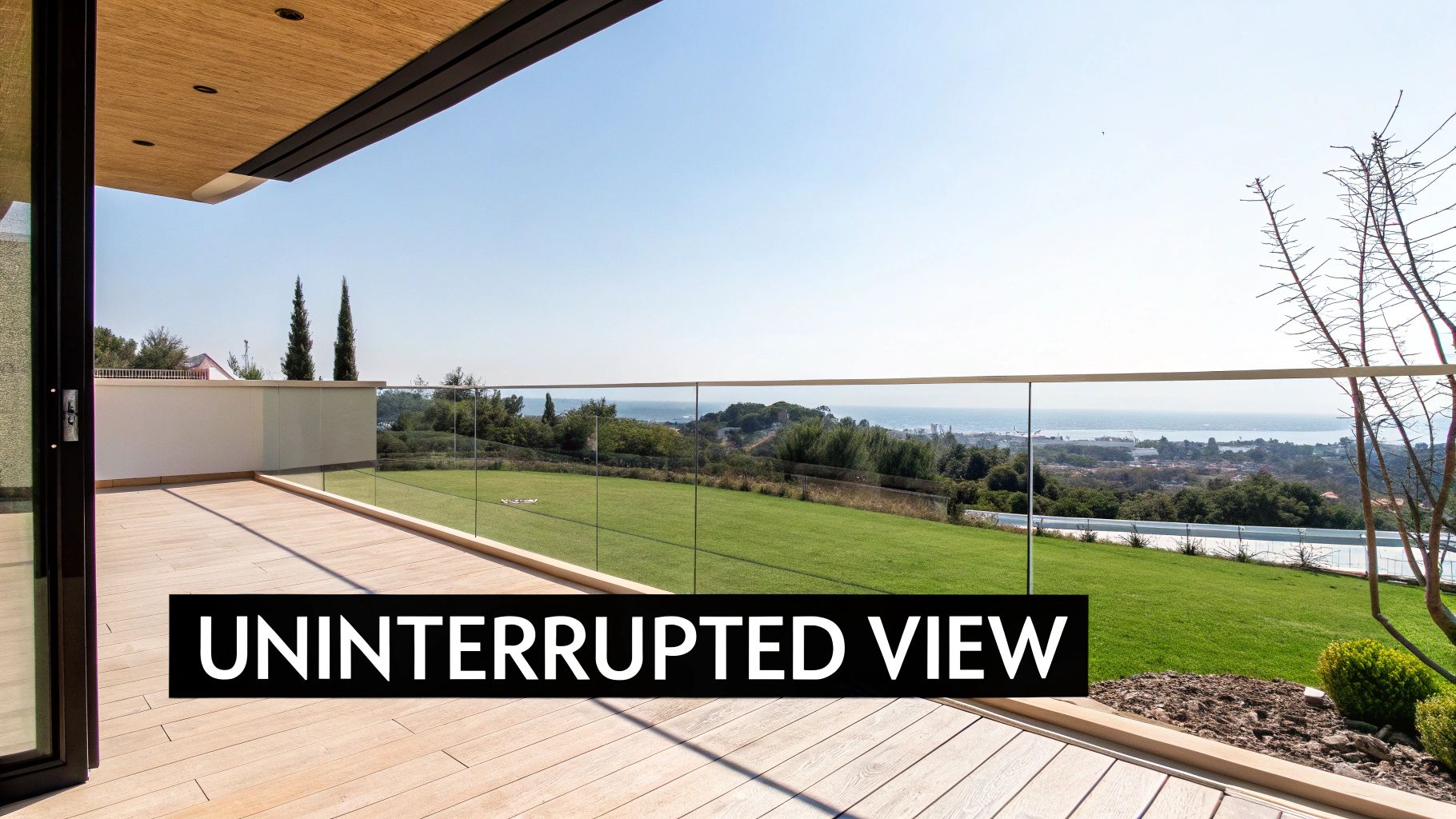
The benefits go well beyond just what you can see. A glass balcony balustrade creates a brilliant illusion of greater space. For homes with smaller patios, terraces, or Juliet balconies, this is a game-changer. By removing those solid visual blocks, the system seamlessly connects your indoor and outdoor living areas, making both feel larger and more integrated.
This one upgrade can redefine your home's look and add considerable value. It's a modern touch that signals quality and attention to detail, hitting all the right notes for contemporary design. A sleek glass installation can instantly update an older property or provide the perfect finishing touch to a brand-new build.
The core idea is simple: achieve safety without sacrificing style or scenery. A well-designed glass balustrade protects the edge of your balcony while making the space feel more expansive and connected to its surroundings.
Throughout this guide, we'll walk you through everything you need to know to get it right. We'll explore the real-world benefits, compare the different system types, break down the crucial safety regulations, and help you plan and budget for your project.
Whether you're a homeowner in Harrogate, an architect in York, or a contractor in Darlington, you'll find clear, practical information to make a confident choice. You can also learn more about how glass balustrades are transforming homes in our related article.
We will cover essential topics, including:
Of course, the clean lines of a glass balcony balustrade look fantastic, but its real value lies in the practical advantages that make it a genuinely smart investment for your property. When you look past the aesthetics, you start to see the functional benefits that bring real improvements to your daily life and your home’s value, especially for properties right here across the North of England.
A glass system does more than just secure the edge of your balcony; it completely transforms the feel of the space. One of the biggest impacts is the way it plays with natural light. Think about traditional barriers made of wood, metal, or even brickwork—they all cast long, dark shadows, often making the rooms next to them feel gloomy. Glass panels, on the other hand, let the sunlight pour straight through.
This simple fact brightens up not just your terrace but also the indoor spaces connected to it, like your living room or kitchen. For anyone in Yorkshire, where we want to make the most of every bit of daylight, this can make a world of difference to the warmth and atmosphere of your home.
Another huge win for glass is the incredible sense of spaciousness it creates. A solid balustrade puts up a hard visual wall, effectively shrinking how big your balcony or patio feels. A glass balustrade just gets rid of that barrier, creating a seamless flow from your home out to the view beyond.
This works wonders for smaller balconies or compact garden terraces, making them feel open, airy, and much larger than they actually are. The transparent barrier naturally draws your eye outwards—whether you’re looking over the rolling Yorkshire Dales or just your back garden—making the whole area feel more expansive.
It’s a common myth that glass is fragile. The reality is that modern balustrade systems use toughened or laminated safety glass, which is engineered to be incredibly strong and resilient. It’s built to handle the sort of weather we’re used to in the North of England, from driving rain in Cumbria to biting coastal winds in Hull, without warping, rotting, or rusting like other materials.
This strength leads to one of the best practical benefits of all: low maintenance. Unlike timber that needs staining or painting every couple of years, or metal that can start to corrode, a glass balustrade just needs a simple clean with soapy water to keep it looking brand new.
This means you can spend more time actually enjoying your balcony and less time on tedious upkeep. Over its lifespan, this long-term durability also makes it a very cost-effective choice, saving you money on future repairs and replacements. It's this blend of elegance and resilience that really adds to a property's appeal.
All these practical perks translate directly into increased property value. That combination of better light, a feeling of space, and a sharp, modern design makes a home far more attractive to potential buyers. In fact, industry data shows that 62% of UK homeowners who chose glass balustrades did so for the 'unobtrusive views', and this contributed to an 18% uplift in the perceived value of their property after installation. It’s not just homes, either; commercial managers of Darlington offices and Cumbria hotels have noted 20% higher guest satisfaction scores after upgrading their terraces. You can dig into more of this data in the European glass railings market report to see these trends for yourself.
Ultimately, choosing a glass balcony balustrade isn’t just an upgrade for today—it's a lasting investment in your home's future.
Diving into the world of glass balcony balustrades might feel a bit overwhelming at first, but it really boils down to a handful of core styles. Getting to grips with these is the first step in choosing a system that not only keeps you safe but also looks the part, whether it’s for a sharp new-build in Leeds or a classic terrace home in York.
Picking the right system is about more than just what looks good; it's about striking the perfect balance between transparency, structural design, and your budget. Let’s break down the three main designs to help you feel confident in your choice.
If you’re after that ultimate minimalist, high-end finish, the frameless glass balustrade is the one for you. This design creates a completely seamless, almost invisible barrier, giving you a totally clear view of your surroundings. It’s the closest you can get to an open-air feel while being completely secure.
The real magic is in the engineering. Instead of using posts, the system gets its strength from thicker, structural glass panels, typically between 12mm and 21.5mm thick. These are held securely right at the base. The base fixing is the unsung hero, usually a heavy-duty aluminium channel that grips the glass panel along its entire bottom edge, making the whole thing incredibly strong and rigid.
This is the perfect choice for any property where the view is the star of the show, like those overlooking the Yorkshire Dales or a beautifully kept garden. The clean lines deliver a sophisticated look that adds real value and a premium feel to any balcony or terrace.
A semi-frameless system hits that sweet spot right in the middle, blending the crystal-clear look of a frameless system with the defined structure of traditional posts. With this design, glass panels are held firmly in place by upright posts, but there's no top or bottom rail running between them.
The result is a clean, modern aesthetic that still feels wonderfully open and airy. The posts offer a visible structural anchor, which many people like, while the lack of a top handrail keeps the profile sleek and uncluttered. It’s a really versatile style that works brilliantly with all sorts of architectural designs.
The posts themselves are typically made from durable materials like stainless steel or powder-coated aluminium, providing a subtle but stylish frame for the glass. This system is often a more budget-friendly route to achieving that sought-after contemporary look compared to a fully frameless installation.
The framed system is the most traditional approach to a glass balustrade. Here, the glass panels are fully enclosed within a frame, complete with posts, a top handrail, and often a bottom rail too. This creates a highly robust and secure barrier with a classic, well-defined appearance.
While it doesn’t quite give you the ‘invisible’ look of the other systems, a framed balustrade offers a strong visual outline that can be tied in with other features of your property, like window frames or door handles. The handrail also adds a practical touch, giving you something solid to lean on while you’re enjoying the view. The components that hold it all together, like the clamps, are crucial to its integrity. You can learn more about how they work in our guide to the modern glass balustrade clamp and the role it plays.
The infographic below shows the fantastic benefits that all these glass balustrade systems bring to your home.
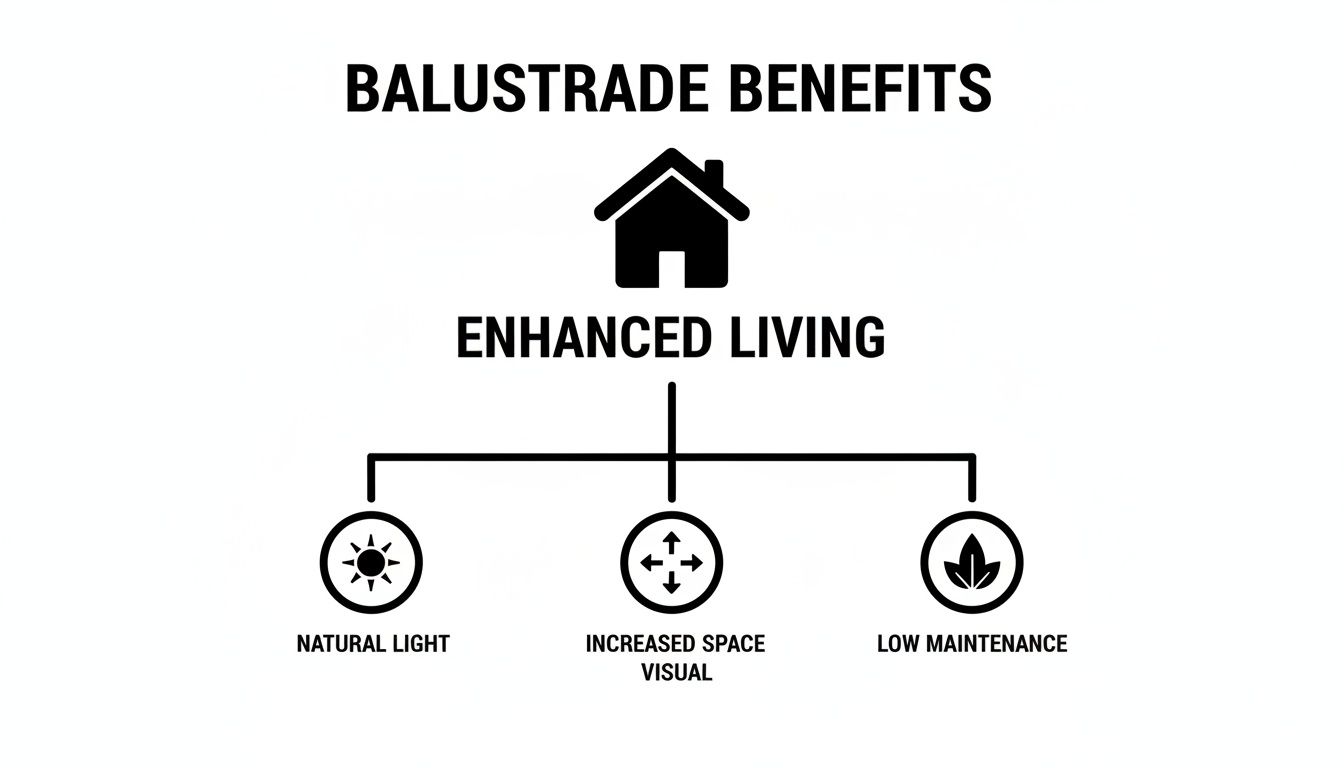
As you can see, a glass balustrade really opens up your home, flooding it with light, creating a sense of space, and being wonderfully easy to look after.
To make the choice even clearer, here’s a quick comparison of the systems we’ve discussed.
This table gives you a straightforward comparison of the main balustrade systems, helping you pick the best option for your home's look and your practical needs.
| System Type | Key Feature | Best For | Handrail Option |
|---|---|---|---|
| Frameless | Uninterrupted, seamless glass barrier | Maximising views, minimalist and high-end contemporary properties | Optional (can be top-mounted) |
| Semi-Frameless | Glass panels supported by posts, no rails | A balance of modern aesthetics and visible structure; versatile designs | No (posts provide the structure) |
| Framed | Glass enclosed by posts and rails | A classic, robust feel; properties with traditional architectural details | Required (part of the frame) |
Ultimately, deciding on the right system is about matching your personal taste with what you need functionally. Whether you crave an unbroken panorama or prefer a more defined structure, there’s a glass balustrade style that will be a perfect fit for your Northern England home.
While the sleek, minimalist look of a glass balcony is a massive draw, let's be clear: its number one job is always safety. Making sure your new installation is fully compliant with UK building regulations isn't just about ticking boxes for an inspector. It’s about creating a secure, reliable barrier that protects you, your family, and your guests, day in and day out.
For any project, from a home in Cheshire to a new build in Darlington, getting to grips with these rules is non-negotiable.
The main regulations are laid out in official government guidance, specifically Approved Document K (Protection from falling, collision and impact) and the British Standard BS 6187:2011. Now, these aren't exactly light bedtime reading, but their core principles are refreshingly straightforward. They dictate the essential requirements for height, strength, and the types of materials you can use to ensure every balustrade is fit for purpose.
For external balconies, UK building regulations are crystal clear. They mandate a balustrade height of at least 1100mm (1.1 metres) from the finished floor level. This isn't a suggestion; it's a critical minimum designed to prevent accidental falls, and it's a key figure to remember for any residential project.
Beyond just height, the regulations get specific about how much force a balustrade must be able to withstand. This is called the load requirement, and it's measured in kilonewtons per metre (kN/m). Think of it as a stress test, ensuring the barrier won’t fail under pressure—for instance, if several people lean against it during a summer barbecue.
For a typical domestic property, the requirements are:
A correctly specified glass balcony balustrade is engineered to handle these forces with ease. It’s the combination of the right glass thickness, appropriate fixings, and professional installation that guarantees compliance and total peace of mind.
You can't just use any old glass for a balustrade. It absolutely must be a recognised type of safety glass. The two main players here are toughened and laminated glass, and the right choice often depends on the design of the system and specific regulations.
Toughened Glass is put through a heat-treatment process that makes it around four to five times stronger than standard glass. Its real safety feature, though, is how it behaves if it does break—it shatters into thousands of tiny, blunt pieces, massively reducing the risk of serious injury.
Laminated Glass is a bit different. It’s made of two or more sheets of glass bonded together with a tough plastic interlayer (usually PVB or SGP). If one of the panels breaks, the interlayer does a brilliant job of holding all the fragments in place. This maintains the barrier and stops a dangerous opening from appearing.
For many frameless systems, especially those without a continuous handrail to provide extra support, UK regulations actually mandate the use of toughened laminated glass. This offers the ultimate level of safety, as the balustrade will remain structurally intact even if the glass itself is compromised.
Our guide offers a more detailed breakdown of everything you need to know about glass balustrade regulations in the UK.
By getting these details right, your glass balcony becomes more than just a beautiful feature. It becomes a robust, reliable, and fully compliant safety structure that you can enjoy with confidence for years to come.
Turning the vision for a stunning glass balcony into a reality begins long before the first panel is installed. It starts with a solid plan. This is the practical phase where ideas meet logistics, making sure your project runs smoothly from the first measurement to the final, gleaming installation. Taking the time to plan and budget properly helps sidestep any nasty surprises and guarantees the end result is exactly what you hoped for.
First things first, you need accurate measurements. Grab a tape measure and carefully record the total length of the area where the balustrade will go. Precision here is key, as this single number is the bedrock for all your cost calculations. Make sure to measure each straight run and corner section separately to build a complete picture.
Next, take a look at the surface where the system will be fixed. Is it solid concrete? A timber deck? A steel framework? The strength and integrity of this fixing surface are absolutely critical for safety and stability. While a professional will always confirm this on-site, having an initial idea helps you understand any potential complexities. For instance, a timber deck might need its joists reinforcing to handle the weight, which would naturally have an impact on the budget.
Building a realistic budget is all about knowing what drives the price. Several key variables influence the cost of a glass balcony balustrade, and getting to grips with them puts you firmly in control. There’s simply no one-size-fits-all price tag, because every single project is unique.
The main factors that will shape your quote include:
For those who love to visualise the end result, it's worth noting that many modern designers use advanced tools like architectural rendering software to create lifelike mock-ups of how your new view might look.
Once you have a handle on these variables, you can start to put together a realistic budget. A brilliant starting point is an online estimation tool. Our own Balustrade Calculator, for example, lets you get a tailored quote in just a few clicks, giving you a clear and instant cost breakdown based on your exact measurements and choices.
This approach gives you complete transparency. You’ll see exactly how your decisions—from the system style to the glass type—affect the overall cost. For property developers in Leeds or facilities managers in York, this level of detail is crucial for project profitability. In fact, profitability analyses show gross margins can reach 25-30% for glass installations compared to just 15% for traditional metal, a difference driven by premium pricing and far superior durability. This mirrors wider UK trends, where 40% of balcony projects in urban renewal areas now feature glass to boost light and the sense of space.
Remember, a good quote isn't just about the lowest price. It's a clear, itemised breakdown that shows you exactly what you're paying for. This empowers you to manage your project effectively and ensures there are no surprises down the line.
By taking the time to plan carefully and understand what goes into the cost, you can approach your project with confidence. Whether you’re upgrading a terrace in Hull or designing a new-build balcony in York, a well-managed budget is the key to a successful, stress-free installation. You can always contact us for clear guidance and support at every stage.
Even after you’ve explored all the benefits and stunning designs, it’s completely normal to have a few practical questions before starting a glass balcony project. It’s a big decision! This is where we tackle the common queries we hear from homeowners right across Yorkshire and the North. We’ll give you clear, straightforward answers to help you feel 100% confident.
We’re covering the real-world stuff here – from cleaning routines to the genuine safety of those amazing minimalist designs.
This is probably the number one concern we hear, but the reality is surprisingly simple. A glass balustrade is often far less work than traditional timber or metal, which demand constant painting, staining, or treating for rust.
For your day-to-day cleaning, a quick wipe with a soft cloth and some warm, soapy water is all it takes to get rid of fingerprints and general grime. Pro tip: use a squeegee afterwards for a perfect, streak-free finish. If you’re in a coastal spot like Hull or a city like Leeds where airborne dust is more common, you might just need to wipe it down a little more often.
A fantastic way to cut down on cleaning is to opt for an easy-clean coating. This clever treatment creates a surface that literally repels water and dirt, so rainwater often does most of the cleaning for you. It’s a game-changer.
And what about those stubborn marks? For tougher blemishes like hard water spots, which can be an issue in certain parts of the North, there are specific tricks of the trade. You can find some great advice in home and garden blogs focused on the North of England, which often have tips tailored to our specific weather and water conditions.
It’s a fair question. The sleek, barely-there look of a frameless system, with no visible posts, can seem almost too good to be true. But rest assured, its safety isn’t just a feature; it’s the absolute core of its design. These systems are engineered to be incredibly strong.
The secret is in the materials and the engineering. Frameless balustrades use much thicker structural glass – typically toughened and laminated panels between 12mm and 21.5mm thick. This seriously robust glass is then locked into a heavy-duty base channel or secured with powerful point-fixings, anchoring it solidly to your balcony.
Every reputable system in the UK is rigorously tested to meet or smash the tough requirements of British Safety Standards like BS 6187. This certification is your guarantee that the balustrade can handle significant force, making it a completely safe and reliable barrier for any home.
Glass balustrades are incredibly versatile and can be fitted to most common surfaces, including concrete, timber decking, and steel frames. The most important factor isn’t the material itself, but its structural integrity.
Put simply, the base has to be solid enough to take the weight of the glass system and handle the load of people leaning against it. A professional survey is absolutely essential to confirm this.
It's vital to have an expert assess your balcony's construction. Whether it’s a new build in Cheshire or a renovation in Cumbria, they can recommend the right fixing method to guarantee a secure installation that will stand the test of time.
Both are safety glass, but they act very differently when they break. Understanding this is key to choosing the right glass for your project.
Toughened Glass: This is a single sheet of glass that’s been heat-treated to make it four to five times stronger than normal glass. If it does break, it’s designed to crumble into thousands of small, blunt, cube-like pieces. This "dicing" massively reduces the risk of serious injury.
Laminated Glass: Think of this as a glass sandwich. It’s made of two or more sheets of glass bonded together with a tough plastic interlayer (PVB). If the glass cracks, the fragments stick to this interlayer. The panel stays in one piece, maintaining a barrier and preventing a dangerous gap from opening up.
Because of this crucial difference, UK building regulations often insist on using laminated (or toughened laminated) glass for balconies that don’t have a continuous top handrail. It’s an essential layer of fall protection that ensures the barrier remains intact, even if a panel gets damaged.
Ready to transform your view with a safe, stylish, and low-maintenance glass balcony balustrade? The team at Binks Glass Solutions is here to provide expert advice and a clear, no-obligation quote for your project.