
A Complete UK Guide to Glass Balustrade for Decking
So, what exactly is a glass balustrade for decking? Put simply, it’s a safety barrier made from strong, secure glass […]

So, what exactly is a glass balustrade for decking? Put simply, it’s a safety barrier made from strong, secure glass […]
So, what exactly is a glass balustrade for decking? Put simply, it’s a safety barrier made from strong, secure glass panels. It’s designed to give your outdoor space a sleek, modern finish, replacing traditional wood or metal railings to create a feeling of openness and truly uninterrupted views.
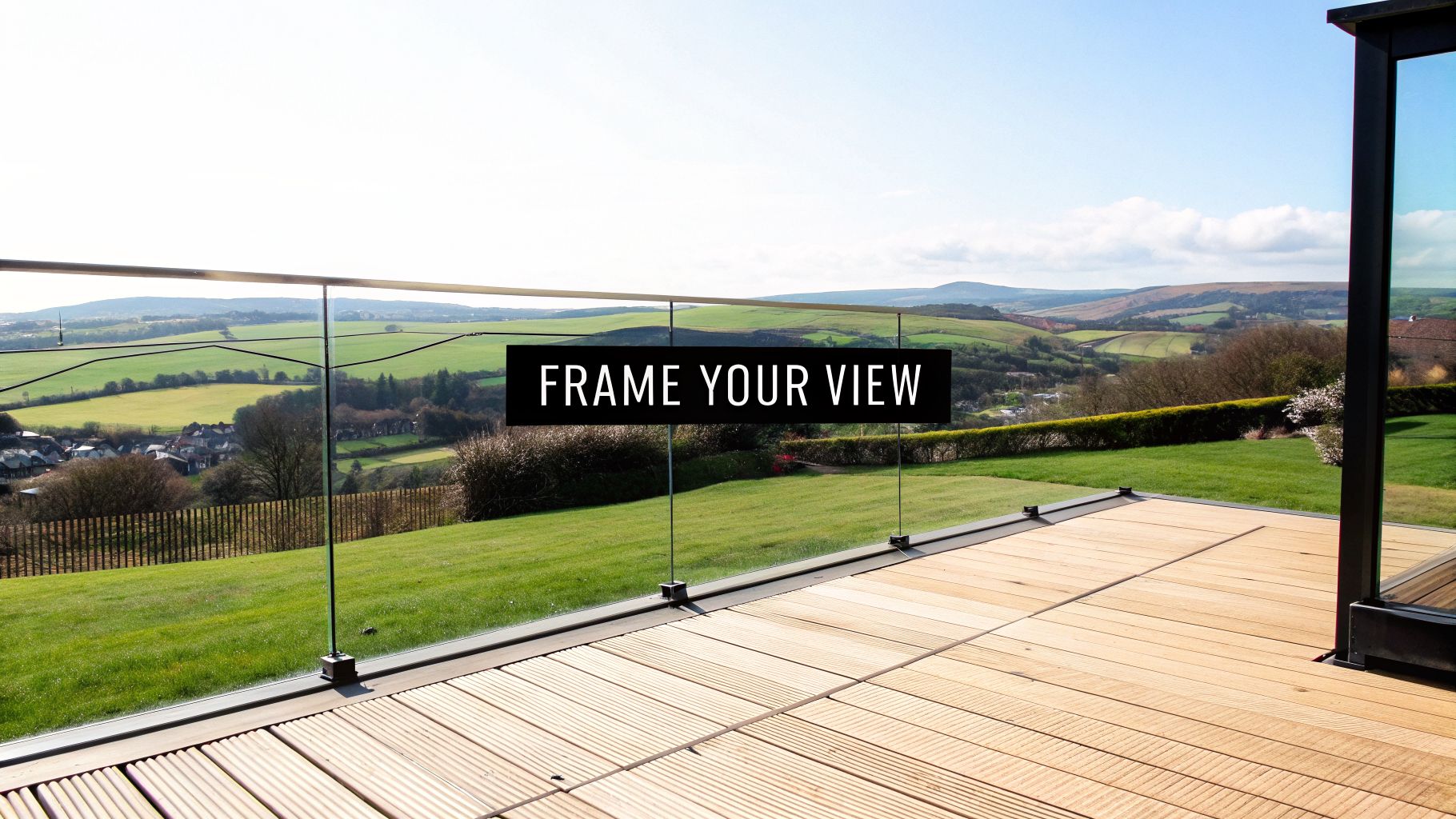
Imagine swapping out a chunky garden fence for a seamless barrier that perfectly frames the view from your home. That’s the real magic of a glass balustrade for decking. It has the power to turn an ordinary outdoor space into a premium extension of your living area, a feature we’ve seen work beautifully in homes across Northern England, from the rolling hills of Yorkshire to the stunning landscapes of Cumbria.
But this decision is about more than just a modern look; it’s a practical and valuable investment in your home. By removing the visual clutter of traditional railings, glass systems create a remarkable sense of spaciousness, making even smaller decks feel larger and more inviting.
One of the biggest wins with a glass balustrade is how it handles natural light. Unlike timber or composite railings that cast long shadows and block sunlight, glass panels let light flood onto your decking and into the adjacent rooms of your house. This instantly creates a brighter, more welcoming atmosphere all day long.
Of course, this transparency is also the key to protecting your home’s best feature: its view. Whether you overlook a beautifully kept garden in Harrogate or the vast Cheshire plains, a glass barrier ensures your line of sight is completely clear.
A well-designed glass balustrade doesn't just fence off a space; it connects it to the world around it. It acts like an invisible shield, giving you safety and shelter from the wind without ever sacrificing the beauty of your garden or the landscape beyond.
While the visual impact is undeniable, a glass balustrade for decking brings some serious practical advantages to the table, making it a smart long-term choice for your property. These systems are incredibly tough and built to handle the often-unpredictable weather we get across Northern England.
The benefits keep stacking up:
When you look past the stunning aesthetics, you start to see that a glass balustrade is a truly functional upgrade. By working with local specialists like Binks Balustrades, you can ensure your project is designed and specified correctly for your home, making it a premium, modern, and intelligent investment.
Choosing the right style of glass balustrade for your decking is the first major decision you'll make, and it’s one that will define the entire look and feel of your garden. It’s the difference between a seamless, modern finish and a more structured, classic perimeter.
Let's walk through the three main system types—frameless, semi-framed, and framed. We’ll help you find the perfect match for your home, whether that's a new-build in Leeds or a traditional stone cottage in the heart of the Yorkshire Dales. Each style strikes a unique balance between visual impact and practicality, so understanding what makes them different is key.
If you want a completely uninterrupted view of your garden, this is the one for you. A frameless system is the closest you can get to an "infinity barrier"—a solid wall of glass that seems to float in place without any vertical posts getting in the way. It’s the perfect glass balustrade for decking when the goal is to make the barrier itself all but disappear.
This clean, pure aesthetic is ideal for showcasing a beautiful garden in Harrogate or soaking in a panoramic view over the Cheshire plains. The magic is in the engineering: the glass panels are secured at their base by a structural channel or individual clamps (known as spigots), which are fixed directly into your deck's substructure. The result is an incredibly strong barrier that is almost invisible.
It's no surprise this style has become so popular. As experts in the field, we’ve seen a huge shift towards these minimalist designs. In fact, the market for frameless systems shows a steady 4.6% annual growth rate in the UK. It’s a testament to great architectural design and a booming renovation market, with global projections set to grow from USD 702.6 million in 2025 to over USD 1,188.9 million by 2035.
Semi-framed systems are a fantastic middle ground. They blend the open, modern feel of glass with the reassuring presence of structural support posts. With this design, the glass panels are held securely in place by slim posts, usually made from stainless steel or powder-coated aluminium.
This approach creates a more defined edge for your decking area, but without the heavy, closed-in feeling you get from traditional railings. It’s a hugely versatile option that works with almost any style of property. The posts add a certain rhythm and visual structure to the design, breaking up the long runs of glass while still keeping things wonderfully transparent. It’s a go-to for homeowners who love a contemporary look but prefer a more visible framework.
One of the best things about this system is its adaptability. You can choose from different post shapes—round or square—and finishes to match your home’s character. A satin-finished stainless steel post, for example, offers a classic, sophisticated look. Meanwhile, a matte black aluminium post creates a bold, modern edge that looks fantastic with composite decking.
A semi-framed balustrade acts like a picture frame for your view. It provides just enough structure to feel secure and intentional, while the large glass panels ensure the scenery remains the main attraction.
To help you visualise the differences, here’s a quick comparison of the styles we've covered so far, plus the framed option we'll discuss next.
| Style | Best For | Key Feature | Typical Aesthetic |
|---|---|---|---|
| Frameless | Maximising views and creating a "wow" factor | Uninterrupted glass panels with no vertical posts | Ultra-modern, minimalist, high-end |
| Semi-Framed | A balanced, versatile look with visible structure | Glass panels fitted between slim metal posts | Contemporary, adaptable, stylishly structured |
| Framed | High-traffic areas and a comfortable, tactile feel | A continuous handrail along the top of the glass | Practical, traditional with a modern twist, secure |
Each option offers a distinct advantage, and the best one for you really depends on your personal taste and how you plan to use your deck.
Finally, we have framed systems. These feature a continuous handrail that runs along the top of the glass panels, supported by posts. This top rail adds extra rigidity to the whole structure and, just as importantly, gives you a comfortable and practical place to rest your hands or lean as you enjoy your morning coffee.
This style is a firm favourite for family homes and busy decking areas where the tactile comfort of a handrail is a big plus. The design possibilities are also huge, and you can create very different looks depending on the material you choose for the handrail:
This versatility makes it easy to match the balustrade to other features in your home and garden. If you want to dive deeper into how glass pairs with different decking materials, our guide on glass panel decking has plenty more detail. It just goes to show that a glass balustrade for decking can be every bit as functional as it is beautiful.
The incredible visual impact of a glass balustrade is what grabs your attention, but its real value lies in something you can't see: its robust safety and structural strength. To get your project right, you need to look beyond the aesthetics and get to grips with the technical side of things. It all comes down to two crucial choices: the right type of glass and the most secure way to fix it to your decking.
Getting these details sorted means you can ask the right questions and be confident that your installation, whether for a home in Leeds or a property in Darlington, is both compliant and built to last. Let’s demystify the key materials that provide the strength behind the style.
Not all safety glass is the same, and the type you choose has a massive impact on the safety and performance of your glass balustrade for decking. Your two main options are toughened glass and toughened laminated glass.
Think of toughened glass as being like a car's side window. It’s heat-treated to become around four to five times stronger than ordinary glass. If it ever breaks, it shatters into thousands of small, blunt pieces rather than dangerous, jagged shards.
Now, think of toughened laminated glass as being like a car's windscreen. It's essentially a glass sandwich, made from two sheets of toughened glass bonded together with a strong plastic interlayer (usually PVB). If one or even both panes break, that interlayer holds all the fragments together, keeping the panel intact and maintaining a safe barrier.
For any balustrade protecting a drop of 600mm or more, UK Building Regulations make toughened laminated glass a legal requirement. It provides an essential layer of protection by preventing a dangerous opening from appearing if the glass were to fail.
Ultimately, the choice comes down to safety regulations and your own peace of mind. For low-level, ground-floor decking, toughened glass is often perfectly sufficient. However, for any raised deck, balcony, or terrace where there's a drop, laminated glass is the only correct and safe choice.
Once you've picked your glass, the next step is deciding how to anchor it securely to your decking. The fixings do all the heavy lifting, transferring the forces on the glass down into the deck’s underlying structure. Your choice here will be guided by the look you want—frameless or semi-framed—and the way your deck is built.
Here’s a quick look at how the different styles come together with their fixing methods.
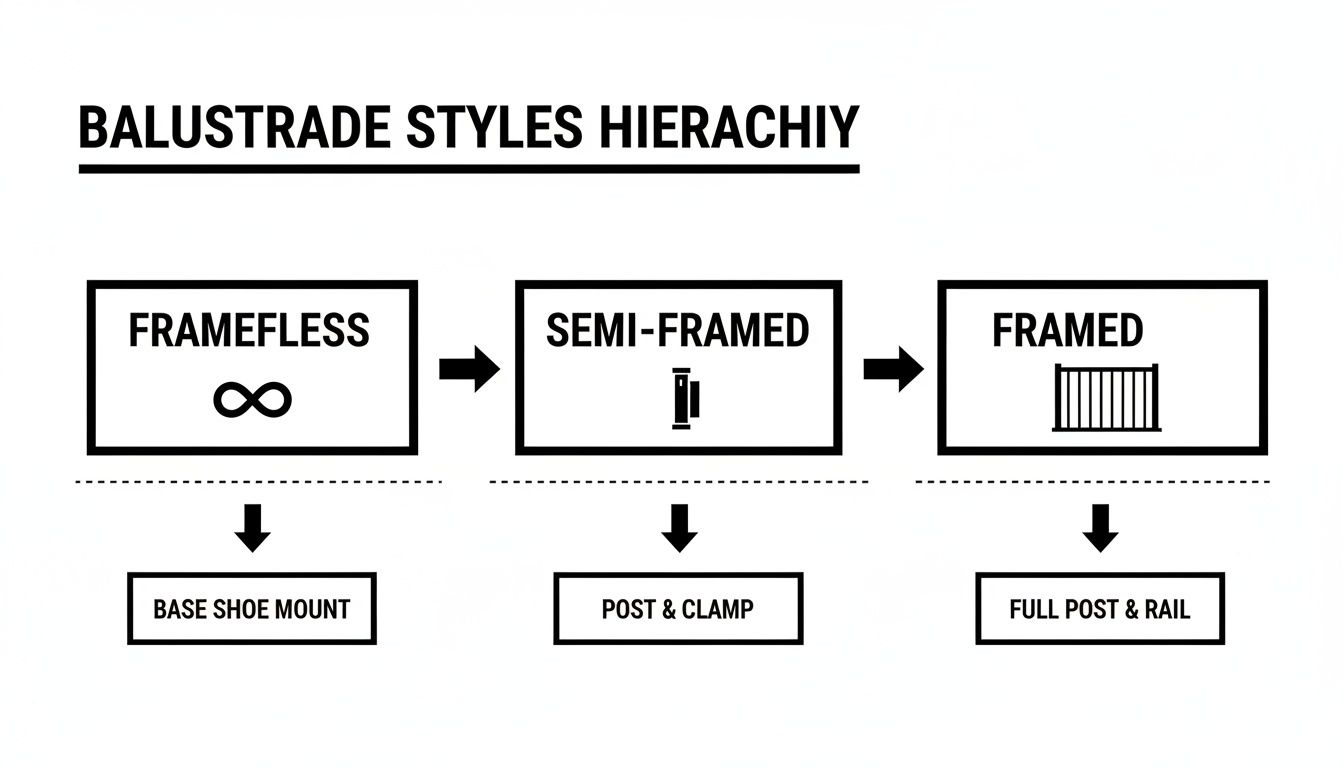
As you can see, different aesthetic goals—from completely frameless to fully framed—are achieved with distinct fixing hardware.
Let's dig into the most common fixing systems for both timber and composite decking.
It doesn’t matter if your deck is natural wood or a modern composite; the balustrade must always be fixed to the substructure, not just the surface boards. Decking boards simply aren't strong enough on their own to support the loads a balustrade must handle.
Here are the primary methods we use:
Base Channel Systems: This is the most popular way to achieve a true, uninterrupted frameless look. A continuous aluminium channel is bolted directly onto the deck's joists. The glass panels are then slotted into the channel and secured with a clamp system, creating a solid and seamless wall of glass. It provides incredible strength, especially for long, straight runs.
Glass Spigots (Clamps): For another minimalist approach, spigots are a fantastic choice. These are individual stainless steel clamps that are bolted securely through the decking boards and into the structural joists below. Each glass panel is typically held by two spigots, creating an elegant illusion that the glass is floating just above the deck surface.
Post and Clamp Systems: This is the go-to method for classic semi-framed designs. Stainless steel or aluminium posts are bolted firmly to the deck's substructure. The glass panels are then held securely in place between the posts using high-quality glass clamps. This method offers a great balance between a visible, reassuring structure and beautiful, clear views.
Whichever system you choose, using the correct hardware is non-negotiable. For homes in coastal areas or exposed locations across the North of England, opting for marine-grade 316 stainless steel is vital to prevent corrosion and ensure your balustrade looks its best for years to come.
It’s easy to get caught up in the exciting part of planning your new decking – the finish, the style, the uninterrupted views. But before you get too far down the line, we need to talk about something that’s even more important: safety and compliance.
In the UK, the rules for barriers aren't just good advice; they're legal requirements designed to keep everyone safe. Getting your head around these regulations isn't about becoming a legal boffin, but about understanding your responsibilities so you can plan with total confidence.
Thankfully, the rules are pretty straightforward. For any domestic property, the key document is Approved Document K, which covers protection from falling. It gives clear, practical guidance that every homeowner needs to be aware of before a single screw is turned. Getting this right from day one means your finished balustrade is not only stunning but completely safe and problem-free.
One of the first and most critical rules to understand is the minimum height for your balustrade. It’s all determined by one simple factor: the height of your deck. Specifically, it’s the distance from the deck's surface down to the ground below.
For low-level decking or patios where the drop is less than 600mm (about two feet), the rules state your balustrade must be at least 900mm high. This is the standard height you'll see on internal stairs, and it provides a perfectly secure barrier for everyday use.
However, the moment your deck is raised and that drop to the ground becomes 600mm or more, the risk increases, and so does the required height. In this situation, your balustrade must be at least 1100mm high. That extra height provides a much more substantial barrier, giving you the protection needed for an elevated space.
Beyond just height, there’s another incredibly important safety check known as the "100mm sphere rule." It’s a simple test with a serious purpose: to ensure no gap in the balustrade is large enough for a small child to get through.
The regulation is clear: a 100mm sphere (roughly the size of a baby’s head) must not be able to pass through any opening. This applies to the gaps between individual glass panels, the space underneath them, and any gaps between posts and fixings.
This is precisely why a professionally designed glass balustrade for decking is such a fundamentally safe choice. By their very nature, the solid glass panels don’t have any footholds for climbing and, when installed correctly, they effortlessly meet this 100mm rule, creating a complete and effective safety barrier.
A great blog post by North Yorkshire-based landscapers 'Up a Garden Path' covers these regulations from a practical perspective, showing how they apply to real-world garden projects.
As the homeowner, the final responsibility for making sure your installation complies with UK Building Regulations rests with you. That might sound a bit daunting, but this is exactly where partnering with an experienced, reputable supplier makes all the difference.
A specialist company will:
Bringing in experts from the start simply removes the guesswork. It gives you complete peace of mind, knowing that your beautiful new decking area is built on a foundation of professional knowledge and an absolute commitment to safety.
Let's talk about one of the most practical parts of planning your project: the budget. It’s easy to get swept up in the vision of your finished deck, but getting a firm grip on the costs from the very beginning is the key to a smooth, stress-free project without any nasty financial surprises down the line.
The final price isn't a single number pulled out of thin air. Think of it more as a recipe, where each ingredient you choose—from the style of the balustrade to the specific glass you select—affects the final taste, and in this case, the total cost.
Four main elements will shape the overall cost of your new decking balustrade. Once you understand how they work, you can make smart decisions that perfectly balance your dream design with your budget.
This focus on creating high-quality, durable outdoor spaces is a trend we're seeing right across the UK and Europe. In fact, the decking and railing market, which includes glass balustrades, had a European market size of USD 1.17 billion as of 2023. It just goes to show how much homeowners value investing in premium, long-lasting garden features.
While a rough "price per metre" can give you a vague idea, these ballpark figures can be incredibly misleading. They rarely account for the unique details of your decking, the fixings required, or any of the complexities we just mentioned.
The only way to budget effectively is to move from a hazy estimate to a precise, detailed quote. The price for a sleek, frameless system on a curved composite deck in York will be completely different from a straight run of a semi-framed balustrade on a timber deck in Hull.
To get that level of clarity, you need a tool built for the job. For a deeper dive into all the components that make up the final figure, you might find our full guide on decoding the true cost of glass balustrades really helpful.
Stop guessing and start planning. You can get a tailored, reliable quote for your project in just a few minutes.
Our own Binks Balustrades Balustrade Calculator is designed to do exactly this. Just enter your measurements, your chosen style, and the glass type you want, and it will generate a detailed cost breakdown. This is the single most powerful step you can take towards creating an accurate budget for your dream decking project.
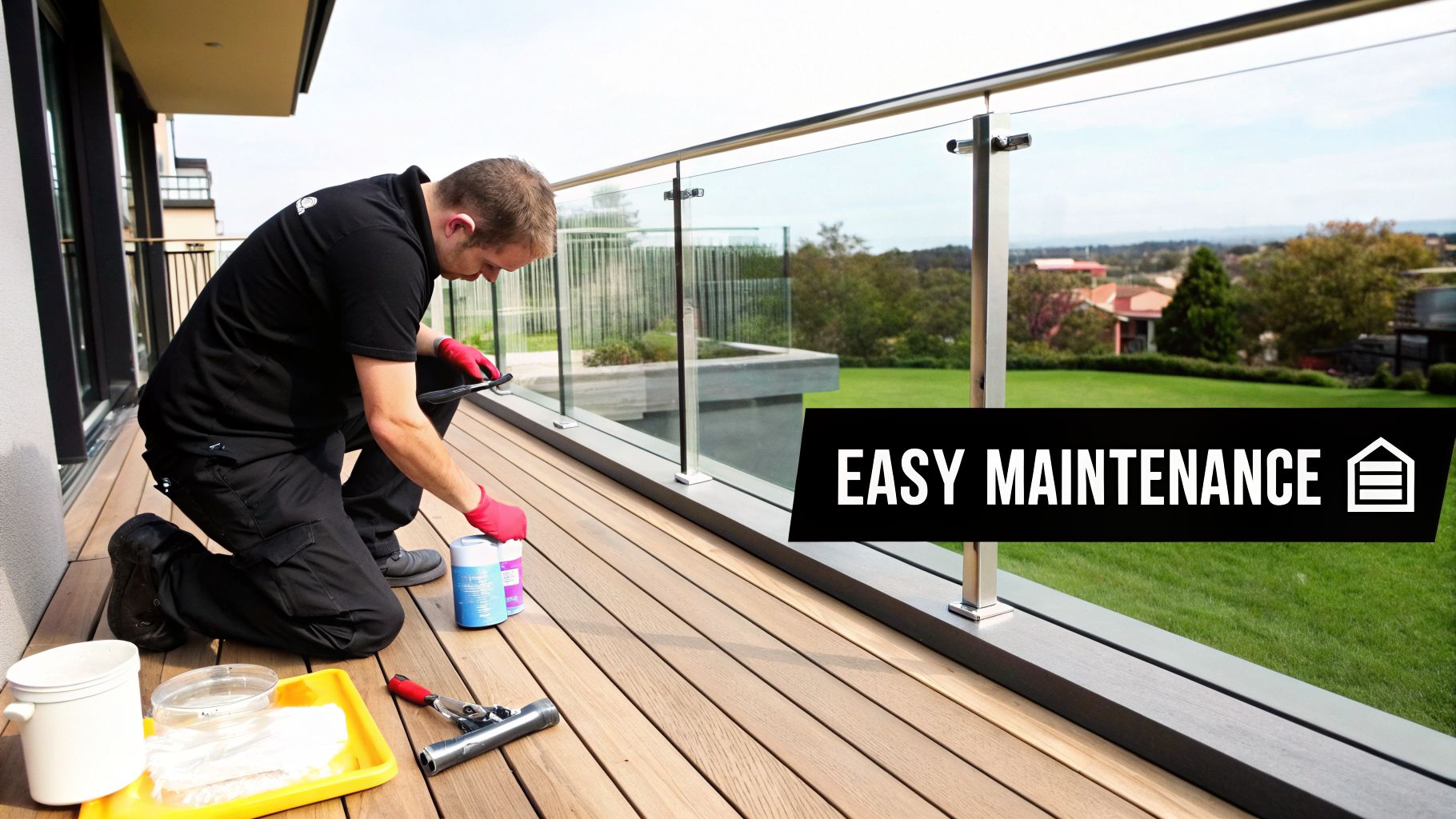
Getting that flawless finish and ensuring your investment stands the test of time comes down to two things: a precise installation and a little bit of simple care. Knowing what a professional fitting involves—and how easy it is to look after—will give you the confidence that your decking area will remain a stunning, safe feature for many years.
The real secret to a rock-solid glass balustrade isn't what you see; it's what you don't. A professional team will never fix a balustrade directly onto the decking boards. Instead, every fixing must anchor securely into the deck's substructure—the strong timber or composite joists that form the skeleton of your deck. For safety, this is completely non-negotiable.
By attaching the system directly to the joists, any force pushed against the glass—whether it's from a gust of wind or someone leaning on it—is transferred safely down into the main frame of the deck. This is the crucial step that guarantees the structural integrity of your glass balustrade for decking, preventing any risk of it working loose or failing.
It’s also why any good installer will first assess the health of your substructure. Understanding things like how long a wood deck lasts helps ensure the entire assembly is built on a sound foundation.
A correctly installed glass balustrade is a true "fit and forget" system. The initial care and precision taken during installation directly translate into decades of secure, worry-free performance with almost no effort from you.
This focus on structural integrity is exactly why professional fitting is so vital. It’s what turns a collection of high-quality components into a single, unified safety barrier that you can rely on completely.
One of the biggest myths we hear about glass balustrades is that they’re a pain to keep clean. The reality couldn't be more different. Glass is a non-porous, incredibly tough material that needs far less maintenance than traditional timber railings, which demand constant staining, painting, and sealing.
Maintaining that crystal-clear view is refreshingly simple. For most of the year, a quick and easy routine is all it takes to keep your glass panels looking brand new.
Here’s a simple method that works every time:
Beyond cleaning, it's good practice to give the fixings a quick visual check once or twice a year—perhaps in spring and autumn. Just make sure all the bolts, clamps, and post connections are still nice and tight. This tiny bit of effort confirms that a high-quality glass balustrade is a durable, low-hassle investment that beautifully enhances your garden.
Even after you've explored the styles, safety aspects, and potential costs, it's natural to have a few more practical questions. We get it.
Here, we tackle the most common queries we hear from homeowners right across the North of England, from Leeds to Harrogate. Our goal is to give you clear, straightforward answers and the confidence you need to move forward with your decking project.
Absolutely. In fact, when it’s professionally designed and installed, a glass balustrade is one of the safest barriers you can choose for a family home. The secret lies in using the right materials and sticking to UK building regulations without compromise.
Here’s what gives homeowners like you complete peace of mind:
These features work together to create an incredibly secure barrier, making glass an outstanding choice for homes with young families.
This is a fair question, especially given our famously unpredictable weather! The good news is that high-quality glass balustrades are engineered from the ground up to withstand everything the elements can throw at them, from the salty sea winds in Hull to the frosty winters up in Cumbria.
These systems are built to last. The glass itself is incredibly tough and completely unfazed by rain or UV rays. Just as important, all the metal components—the posts, clamps, and fixings—should be made from marine-grade 316 stainless steel, which is exceptionally resistant to rust and corrosion.
A fantastic side-benefit we hear about all the time is how the solid glass panels act as a brilliant windbreak. This simple feature can make your decking a far more pleasant and usable space on those breezy days that might otherwise send you back indoors.
This blend of resilience and smart design is why these modern systems are becoming so popular. The global market for composite decks and railings is set to grow at a 5.4% rate, expected to top USD 4.27 billion by 2026, with homeowners driving much of that demand. You can delve deeper into the market trends and explore the full research on frameless glass balustrade systems.
In many cases, yes, you can—but this comes with one very important condition. Before you do anything else, you absolutely must get a professional to assess the structure of your existing deck.
The reason is simple: a glass balustrade has to be anchored firmly into the deck's substructure (the main joists), not just screwed onto the top decking boards. The boards themselves just aren't strong enough to handle the load a balustrade must bear. An experienced installer needs to inspect your deck's framework to confirm it can safely support the system without any risk of failure down the line.
This is another common worry we hear, but thankfully, it's rarely a major issue in the real world. While the glass is incredibly clear, it isn't completely invisible to wildlife.
Subtle reflections on the glass, plus the visual cues from posts, handrails, or the base channel, are usually more than enough for birds to see the barrier and fly around it. On the rare occasion that you have a specific problem spot with a fully frameless system, you can apply small, discreet decals to the glass to make it more obvious, but this is seldom necessary.
Ready to take the next step and transform your decking? The team at Binks Balustrades offers expert advice and local support for homeowners across Yorkshire and the North of England. Get a free, no-obligation quote tailored to your project.