
A Homeowner’s Guide to Outdoor Glass Balustrades
An outdoor glass balustrade is so much more than a safety barrier—it's a modern design choice that completely transforms your […]

An outdoor glass balustrade is so much more than a safety barrier—it's a modern design choice that completely transforms your […]
An outdoor glass balustrade is so much more than a safety barrier—it's a modern design choice that completely transforms your garden, patio, or balcony. By using strong safety glass panels, it provides essential protection while giving you uninterrupted views and flooding your space with natural light. The result is a seamless, elegant link between your indoor and outdoor living areas.
For homeowners right across Northern England, from the rolling hills of Yorkshire to our stunning coastlines, an outdoor glass balustrade is the perfect blend of style, safety, and practicality. It’s a world away from traditional wood or metal railings, which often feel bulky and block the very views you want to enjoy. Glass, on the other hand, opens up your space, making it feel larger, brighter, and more connected to the world outside.
This modern solution isn't just about looks; it's about adding real, tangible value to your property. The clean, minimalist aesthetic works beautifully with any architectural style, whether you have a contemporary new build in Leeds or a classic stone house in Harrogate.
The move towards glass is one of the biggest trends in home improvement right now. It offers a low-maintenance, durable, and elegant alternative that stands up to our unpredictable British weather. Unlike wood that needs constant staining or metal that can rust, a quality glass system keeps its clarity and strength for years with very little effort.
This isn’t just a local trend. Industry analysts report that glass has become the fastest-growing material for balustrade installations in both homes and commercial properties. This is part of a global market now valued at over USD 4.68 billion, with glass expected to take an even bigger share—especially in regions like the UK with high rates of renovation. You can read more about the growth of the balustrade market to see the full picture.
A well-designed glass balustrade does more than just secure an edge; it frames a view. Think of it as an invisible wall that protects without confining, allowing you to fully appreciate your garden or landscape.
This guide is designed to cut through all the technical jargon. We'll walk you through everything you need to know, making sure you feel confident as you plan your project. We’ll cover the key areas, including:
Whether you're updating a terrace in York or building a new balcony with a view, our goal is to give you the clear, straightforward advice you need to choose the perfect outdoor glass balustrade.
Choosing the right outdoor glass balustrade system is a bit like selecting the perfect frame for a piece of art—it should enhance the view, not distract from it. Each system has a distinct aesthetic and structural approach. Getting to grips with the main types is the key to finding a perfect match for your home, whether you're in Cheshire or Cumbria.
The three primary systems you'll come across are frameless, semi-frameless, and channel-glazed. Each one strikes a different balance between minimalism, structure, and visual impact, letting you tailor the final look to your specific needs and the style of your property.
Think of the infinity pool of balustrades—that’s the frameless system. It uses thick, structural glass panels secured only at the base, creating a completely uninterrupted, crystal-clear barrier. With no posts or top rail to break your line of sight, this design offers the most minimalist and modern look you can get.
This system is the ultimate choice for spaces where the view is the star of the show. Picture a balcony overlooking the Yorkshire Dales or a raised terrace with a sea view. Its 'barely there' appearance makes spaces feel larger and more open, seamlessly blending your garden or patio with the landscape beyond.
This concept map shows how an outdoor glass balustrade centres on improving views, maximising light, and adding value to your home.
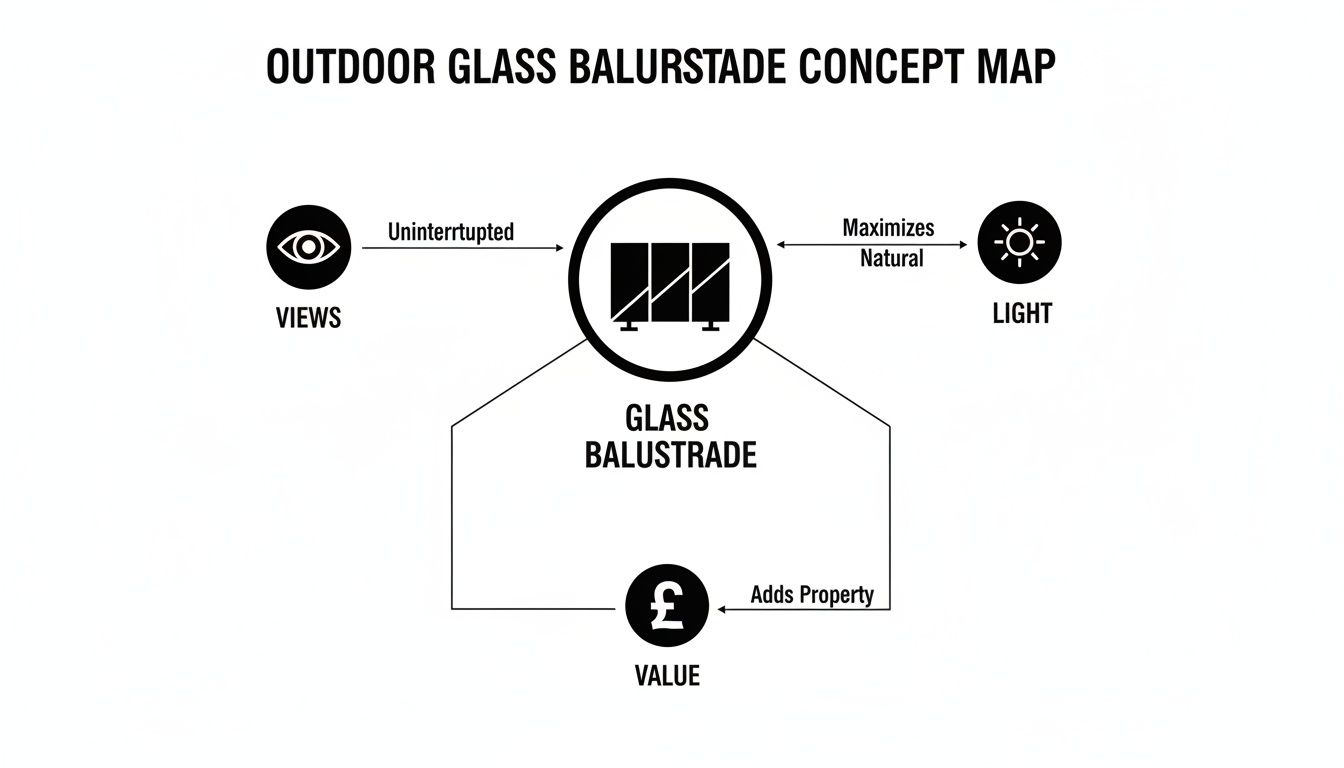
As you can see, the core benefits are all connected, with improved views and light directly contributing to a higher perceived property value.
If a frameless system is an invisible barrier, a semi-frameless balustrade is like a modern picture frame. It uses stainless steel posts between the glass panels to provide structural support, which adds definition and a subtle architectural element to the design.
This style offers a fantastic middle ground. It maintains a sense of openness and light while introducing a more defined boundary. It's an excellent choice for garden decking, patios, or stairways where you want the security and presence of posts without the bulk of traditional railings. The posts themselves can be customised in various finishes, from brushed steel to powder-coated black, to match your home's exterior.
The popularity of these systems, particularly frameless designs, is clear across the North of England. In fact, the UK represents one of Europe's largest markets for frameless structural glass, accounting for 24.6% of the market value. This trend is visible in countless extensions, loft conversions, and rooftop terraces in cities like Leeds, Manchester, and York, where an outdoor glass balustrade is the preferred choice for maximising light and views. You can find more insights about the European balustrade market on their website.
A channel-glazed system offers a sleek, secure foundation where the glass panels are set directly into a structural base channel fixed to the floor. This U-shaped channel runs along the entire length of the balustrade, gripping the bottom of the glass firmly and creating a continuous, post-free barrier.
This method provides a clean, unobtrusive look that is incredibly strong and secure. It’s a popular choice for modern commercial properties and high-end residential projects, especially for Juliette balconies or raised patios where a solid, minimalist base is desired. The channel itself can even be concealed within the flooring for a truly seamless finish.
To help you visualise which might work best for you, here’s a quick-glance comparison of the three main systems.
| System Type | Key Feature | Best For | Typical Price Point |
|---|---|---|---|
| Frameless | Completely uninterrupted views with no vertical posts. | Balconies and terraces where the view is top priority. | £££ |
| Semi-Frameless | Glass panels supported by intermittent steel posts. | Decking, patios, and stairways needing added structure. | ££ |
| Channel-Glazed | Glass secured in a continuous U-shaped base channel. | Juliette balconies and modern terraces needing a secure, minimalist base. | £££ |
Ultimately, the best outdoor glass balustrade for your home comes down to your priorities. Whether you crave the pure minimalism of a frameless design or the defined structure of a semi-frameless system, there is an option that will perfectly complement your home and enhance your enjoyment of your outdoor space.
Once you've got a style in mind for your outdoor glass balustrade, the next step is getting to know the materials that will bring it to life. Thinking about the technical bits doesn't have to be complicated; it's really about making a couple of key, practical choices. The two most important decisions you'll make are about the glass itself and the metal fixings that hold it all securely in place.
The type of glass you choose is absolutely fundamental to the safety and longevity of your balustrade. This isn't just any old glass; it has to be a specialist safety glass, properly engineered to handle impacts and, most importantly, protect people from falls. There are two main types you’ll come across, and each has unique properties that make it suitable for different jobs.
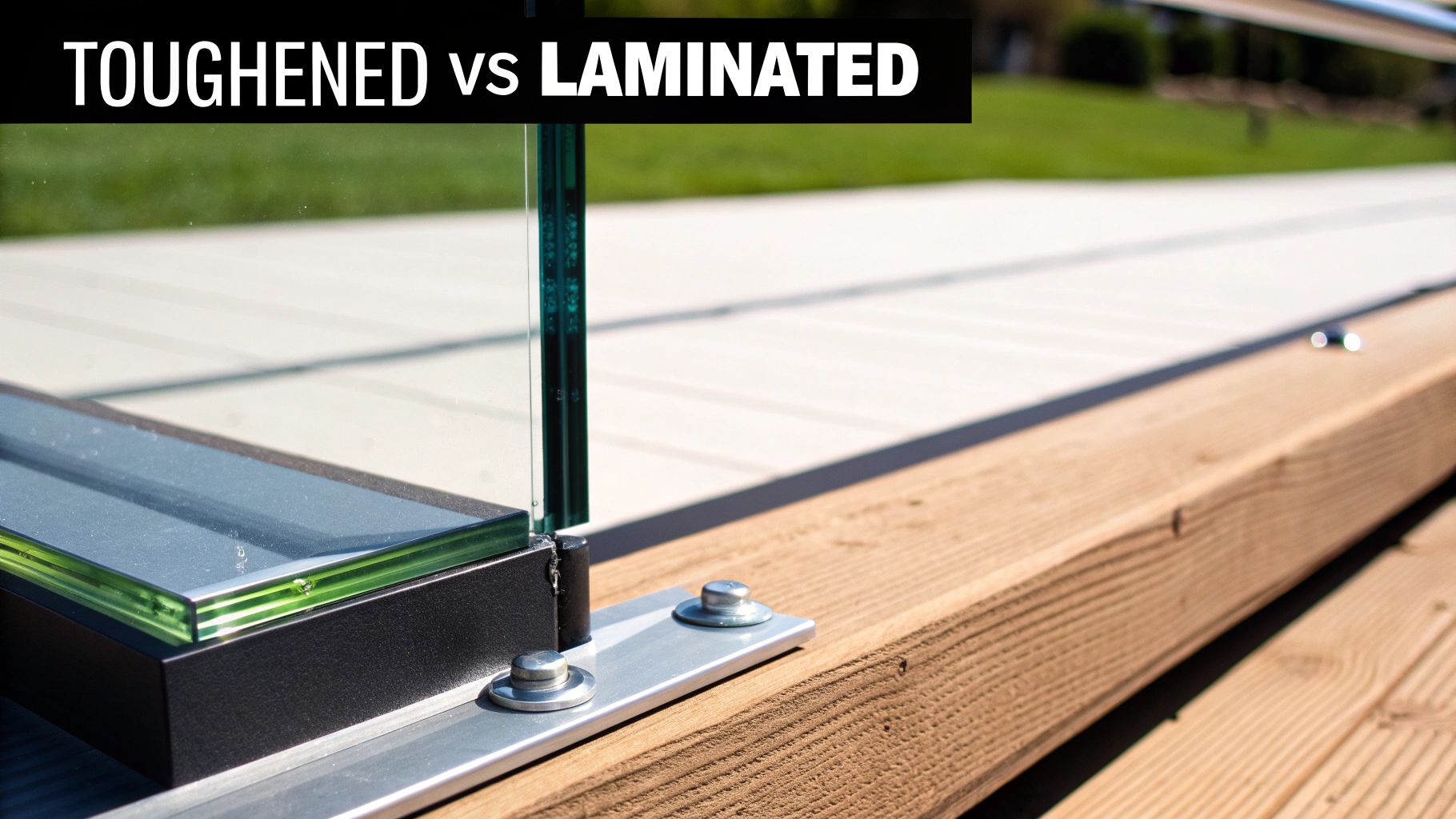
Think of toughened glass as being like a car's side window. It goes through an intense heating and rapid cooling process which makes it up to five times stronger than standard glass. Its real safety feature is what happens if it breaks—it shatters into thousands of tiny, blunt, cube-like pieces. This dramatically reduces the risk of serious injury compared to large, jagged shards.
On the other hand, laminated glass is more like a car's windscreen. It's a sandwich made of two or more sheets of glass bonded together with a tough plastic interlayer (usually polyvinyl butyral, or PVB). If this glass breaks, the interlayer does a brilliant job of holding all the fragments together, keeping the panel intact. It maintains a protective barrier even when damaged.
For most outdoor glass balustrades, especially those at height, laminated glass is the go-to choice. Because it stays in place if it breaks, it prevents a dangerous gap from suddenly appearing. This is a critical safety feature for any balcony, raised patio, or terrace until a replacement can be sorted.
Your installer will always advise on the right type and thickness for your project, taking into account its location, height, and how it will be used, ensuring it fully complies with UK safety standards. If you want to dive deeper into the nuts and bolts, our guide explains more about our laminated and toughened glass options.
The fixings—all the clamps, posts, and base channels—are the unsung heroes of your balustrade. Their job is to hold those heavy glass panels firmly in place, year after year, no matter what our wonderful weather throws at them. Here in Northern England, where we see everything from driving rain to salty coastal spray, choosing the right material is essential.
Stainless steel is the industry standard for its strength and resistance to corrosion, but not all stainless steel is created equal. There are two grades you really need to know about: 304 and 316.
Getting this grade right from the start is a crucial decision. It protects your investment and guarantees the long-term safety and look of your outdoor glass balustrade. When the installation involves mounting onto hard surfaces like porcelain or stone, it demands specialist tools; understanding how to go about mastering diamond drill bits for precise results can offer some useful insight into the precision required.
When you’re thinking about an outdoor glass balustrade, it's easy to get swept up in the aesthetics—the clean lines, the uninterrupted views. But its most important job is safety. A balustrade isn't just a design feature; it's a critical safety barrier that protects you, your family, and your guests.
This is why UK Building Regulations aren't just guidelines; they're a set of non-negotiable rules every installation must follow. Getting to grips with the basics helps you ask the right questions and ensures your project is compliant from the get-go. The rulebook we all work from is BS 6180:2011, which sets out the code of practice for barriers. For professional installers, this document is our bible.
One of the most clear-cut rules is all about height. The minimum height of your balustrade is dictated by the potential fall, or the vertical drop from the walking surface to the ground below. It’s simple, really.
These heights are specifically designed to prevent an average adult from accidentally toppling over, making the barrier effective and secure.
A balustrade has to do more than just look good; it has to stand up to real-world forces. Imagine people leaning against it during a garden party. The regulations are very specific about the loads a barrier must withstand without any sign of failure. This covers everything from the distributed load of a group of people to a single, sharp impact.
Your outdoor glass balustrade must be engineered to handle specific pressures, measured in kilonewtons per metre (kN/m). For residential properties, the system must withstand a horizontal line load of at least 0.74 kN/m applied to the top edge. This ensures it won’t give way under predictable pressure.
This is precisely why professional installation is so important. A certified expert ensures the glass thickness, the type of fixings, and the base structure all work in harmony to meet these critical strength requirements. It’s a complete system, and every part has to be right.
If you have young children, this next rule is one of the most important. The regulations enforce the '100mm sphere rule'. Put simply, this means no gap anywhere in the balustrade—between the panels, under the glass, or next to a post—can be large enough for a 100mm sphere to pass through.
It’s a straightforward test designed to prevent small children from squeezing through a gap and falling. It’s a crucial detail that guarantees peace of mind for families.
Complying with these standards isn't optional; it's a legal must for a safe, secure installation. If you're looking to understand more about safety compliance in a broader context, you might find this an essential guide to flawless life safety inspections useful. For a more detailed dive into the specifics, check out our own guide on UK glass balustrade regulations, which covers these topics in greater depth.
Figuring out the costs involved with a new outdoor glass balustrade is the first step to planning your project properly and making sure there are no nasty surprises down the line. The final price isn't just a single number; it's built from several key factors, and understanding them gives you a much clearer picture of what to expect.
Think of it like choosing the finishes for a new kitchen. Every decision you make, from the style of the system to the type of glass, will nudge the final quote up or down. A little bit of planning at this stage means you can make smart choices that deliver the look you want within a budget you're comfortable with.
A few main variables will shape the final price of your balustrade. The most obvious one is the total length you need – put simply, a longer run requires more materials and more installation time, which increases the cost. But the price per metre itself can also vary quite a bit depending on the specifics.
Here are the main things that will influence your budget:
To help visualise how these elements come together, here’s a breakdown of the main cost factors.
| Cost Factor | Description | Impact on Price (Low/Medium/High) |
|---|---|---|
| Total Length (Metres) | The overall length of the balustrade required for your area. | High |
| System Style | Frameless systems are premium; semi-frameless (post systems) are more economical. | High |
| Glass Type | Laminated safety glass is more expensive than standard toughened glass. | Medium |
| Site Complexity | Straight runs are simple; multiple corners, stairs, or curves increase labour costs. | Medium |
| Fixing Surface | Fixing to solid concrete is easier (and cheaper) than to timber or steel structures. | Low/Medium |
| Handrail Option | Opting for a top handrail can add to the material and fitting costs. | Low/Medium |
| Custom Features | Special requests like tinted glass, privacy frosting, or custom metalwork will add to the budget. | Varies |
Ultimately, each of these choices contributes to the final investment, allowing you to balance aesthetics, performance, and cost.
To give you a realistic idea, prices for professionally supplied and fitted outdoor glass balustrade systems typically start from around £250 per linear metre for simpler, semi-frameless designs. For a high-specification frameless channel system using thick laminated glass, you could be looking at £500 per linear metre or more.
It’s helpful to think of your budget not just as an upfront expense, but as a long-term investment. A high-quality, correctly specified balustrade adds real aesthetic and financial value to your property and needs very little maintenance, saving you money for years to come.
For a more detailed look at what goes into the final figure, a proper guide can be incredibly useful. Understanding the specific elements that contribute to the cost of a glass balustrade can help you build an accurate budget for your own project.
While these price ranges are a great starting point, the only way to get a truly accurate number is to get a quote tailored to your specific project. That’s exactly why we developed online tools like our Balustrade Calculator—to make the process simple and transparent.
Just by entering your project’s dimensions, picking your preferred system, and selecting your glass, you can get a precise estimate in minutes. It takes all the guesswork out of the equation and gives you a solid foundation for planning your new outdoor space.
One of the best things about a glass balustrade is just how little work it takes to keep it looking pristine. Forget the yearly sanding and staining that timber demands, or the constant worry about corrosion with certain metals. Glass gives you a stunningly durable, low-maintenance barrier that stands up to the British weather and protects your views with minimal fuss.
All it really takes to maintain that crystal-clear finish is a simple, regular clean. For most of us, this is a job you'll only need to think about a few times a year to shift the general build-up of dust, rain spots, and garden debris. A quick wash-down is enough to keep your system looking brand new.
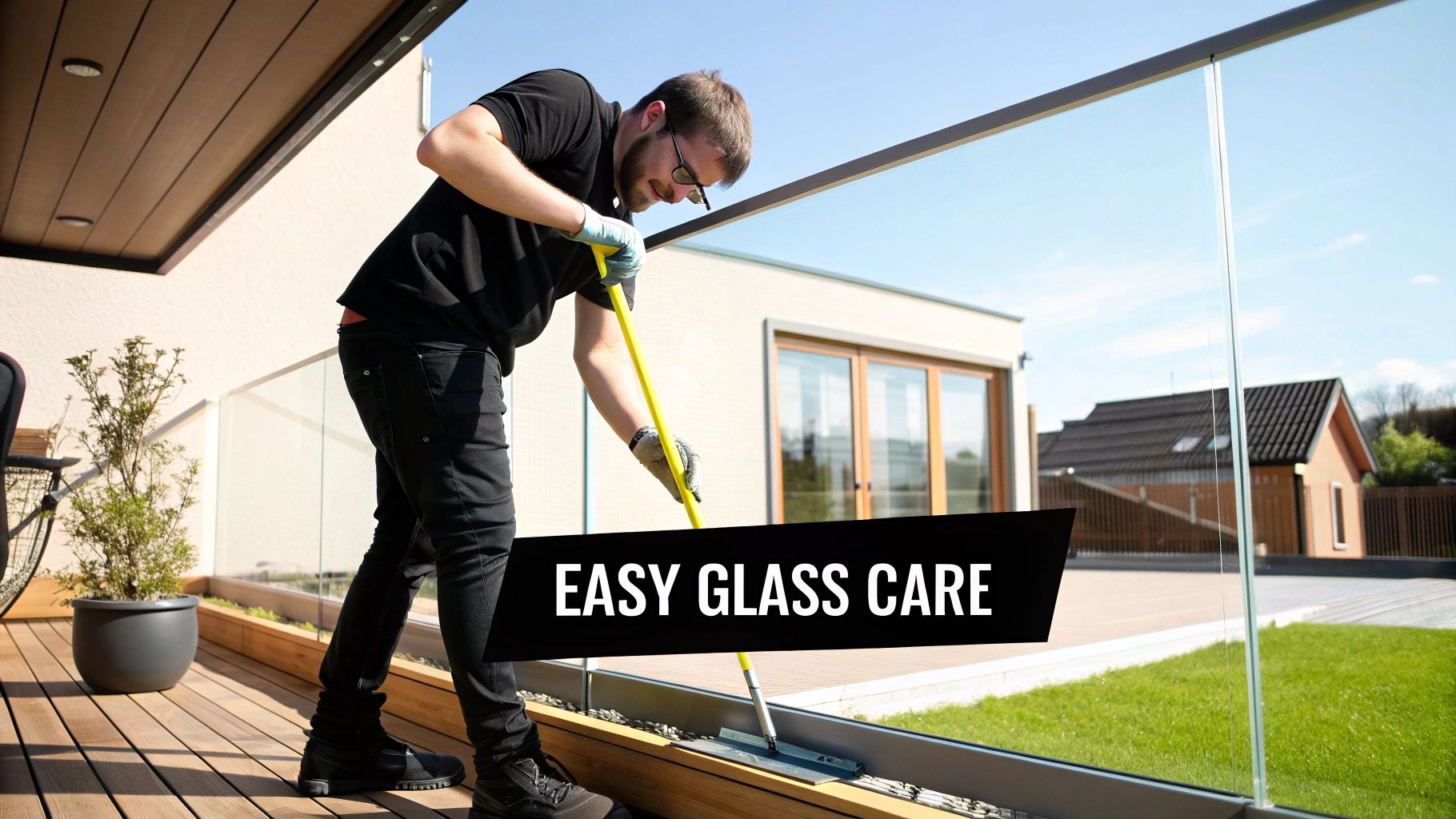
You can put away any thoughts of specialist products or expensive chemicals. The best tools for the job are probably sitting under your sink right now. A bucket of warm, soapy water and a soft, non-abrasive cloth are perfect for washing down both the glass panels and the stainless steel components.
Want that professional, streak-free finish? Just follow up with a standard window-cleaning squeegee. It’s a quick, easy, and incredibly effective trick that avoids leaving any residue behind.
Crucial Tip: Never, ever use harsh, abrasive cleaners or scouring pads on your balustrade. Chemicals containing bleach or chlorine, as well as rough sponges, can easily scratch the glass and will permanently damage the protective finish on stainless steel fittings, which can lead to corrosion over time.
A straightforward, gentle clean is all it takes to protect your investment and keep your outdoor glass balustrade looking immaculate.
Beyond cleaning, it’s a good habit to give your balustrade a quick physical check, especially after a rough season. The strong winds and storms we get across Northern England can put any outdoor structure to the test, so a quick inspection now and then is vital for long-term safety.
Here’s a simple checklist of what to look for:
If you find any fittings have worked themselves loose, they can usually be retightened with the right tools. However, if you spot any significant movement, or any damage to the glass itself, it’s always best to call a professional installer for advice. These simple checks, done just a couple of times a year, are all you need to do to preserve your balustrade's safety and stunning clarity for decades to come.
Thinking about a new outdoor glass balustrade brings up a few questions for most homeowners. It's completely normal. Here, we tackle some of the most common queries we hear from our customers across Northern England, giving you the clear, straightforward answers you need to plan your project with confidence.
Absolutely. When a balustrade is professionally installed and meets UK Building Regulations (specifically BS 6180:2011), it's one of the safest barriers you can choose. These rules aren't just guidelines; they’re designed to protect everyone, especially curious little ones.
We only use toughened or laminated safety glass, which is incredibly difficult to break and can withstand serious impacts. More importantly, the regulations demand specific minimum heights and maximum gap sizes. The famous 100mm sphere rule is a key part of this, ensuring no gap is big enough for a small child's head to pass through, making it a secure and sensible choice for any family home.
While it might look like a straightforward weekend job on the surface, we can’t stress this enough: always use a professional for outdoor glass balustrades. This isn't just about getting the panels to look straight; it's about structural safety and complying with the law.
Getting the structural integrity right, ensuring perfect alignment, and meeting crucial safety load requirements is a specialist job. It needs the right tools, knowledge, and experience. A professional fit doesn't just look better—it guarantees your balustrade is safe, durable, and fully compliant with all building regulations.
Yes, they’re built for it. We live and work here too, so we understand the challenges, from the driving rain across the Pennines to the salty sea air along the Yorkshire coast. Our systems are specified to handle the UK climate without issue.
For any coastal or highly exposed properties, we use 316 marine-grade stainless steel for all clamps, posts, and fixings. This grade has superior resistance to rust and corrosion caused by salt and moisture. The glass itself is completely unfazed by wind, rain, or frost, so your installation will stay strong and clear for years to come.
The quickest and most reliable way to get a solid idea of cost is to use a proper online quoting tool. Our own Balustrade Calculator, for instance, is designed to give you a clear estimate in just a few minutes.
It’s a simple process:
This will generate an instant, transparent price based on your specific choices. If your design is a bit more complex, or you just want some expert advice for your property in Leeds, York, or anywhere nearby, the best next step is to chat with a local specialist. That way, you get guidance that's perfectly matched to your home.
Ready to transform your outdoor space? For expert advice and a precise quote for your project, get in touch with Binks Glass Solutions today. Use our online calculator or contact our team for guidance.