
Stainless Steel Handrails A UK Guide for 2026
If you're looking at a new balcony, patio edge, stair, or raised terrace in Yorkshire, the handrail usually becomes the […]

If you're looking at a new balcony, patio edge, stair, or raised terrace in Yorkshire, the handrail usually becomes the […]
If you're looking at a new balcony, patio edge, stair, or raised terrace in Yorkshire, the handrail usually becomes the decision that holds everything else up. The glass might carry the visual weight, but the handrail decides how the system feels in the hand, how it weathers, and whether the whole installation will still look right after a run of wet winters and bright summer spells.
That matters more in the North of England than many brochures admit. A handrail here has to cope with driving rain, grime, temperature swings, and the practical reality that most owners want something smart without signing up for constant upkeep. Stainless steel handrails remain a strong answer because they suit modern glass balustrades, they sit comfortably in domestic and commercial settings, and they can be specified to meet UK regulations without compromising the look of the project.
A lot of people start with appearance. They want a cleaner line than timber, less bulk than painted steel, and something that doesn't block the view from a garden deck, Juliet balcony, or rooftop terrace. That's where stainless steel earns its place. It works with frameless and post-supported glass because it gives you a visible grip point without turning the balustrade into a heavy-looking barrier.
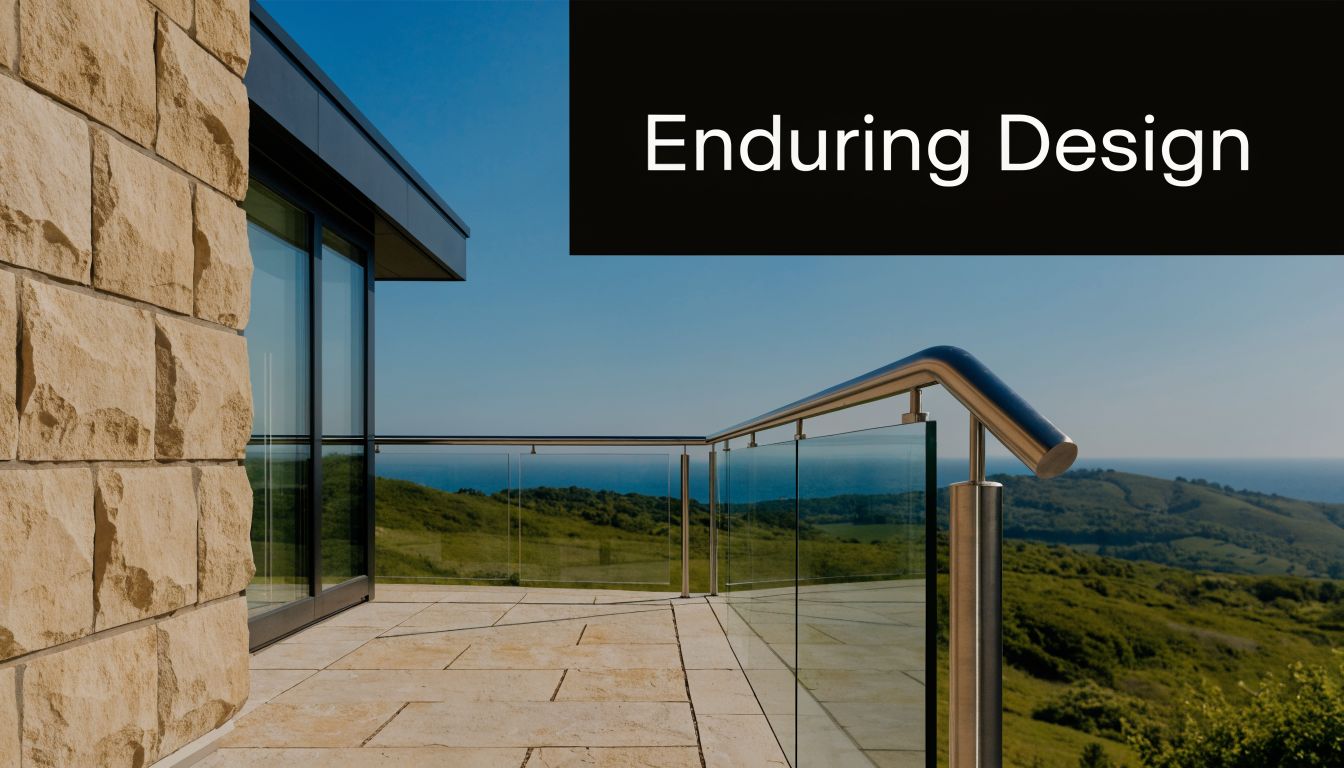
There's also a local reason the material still carries weight. The story of stainless steel begins in the North of England. In 1913, Sheffield-born metallurgist Harry Brearley discovered "rustless steel" while developing erosion-resistant gun barrels, a breakthrough that would revolutionise architecture and industry worldwide, as outlined in this history of stainless steel.
For most handrail projects, stainless steel makes sense when you need a mix of the following:
Stainless steel handrails suit projects where the view matters as much as the guarding.
Homeowners in Harrogate often want a handrail that doesn't date the property. Architects in Leeds tend to want consistency across internal stairs, terraces, and entrance areas. Contractors usually want a material that fabricates cleanly and doesn't create needless aftercare issues for the client.
Those priorities all point in the same direction. Stainless steel isn't the right answer for every site, but when the setting calls for a crisp, durable, low-fuss handrail on a glass balustrade, it's one of the most dependable choices available.
The biggest mistake with stainless steel handrails isn't usually the profile. It's choosing the wrong grade for the environment. On paper, Grade 304 and Grade 316 can look similar. On site, they serve different jobs.
For inland locations such as York, Leeds, or much of North Yorkshire, Grade 304 is often the sensible standard choice. It suits many domestic and commercial projects where the handrail isn't dealing with sea air or a particularly aggressive environment.
For coastal and corrosive environments, the decision changes. Grade 316 stainless steel is specified over Grade 304 because it contains 2 to 3% molybdenum, which improves resistance to chloride-induced pitting and salt spray, as shown in these stainless steel handrail specifications.
Think of it this way. Grade 304 is a good raincoat. Grade 316 is the marine jacket you wear when the weather gets harsher and the exposure is constant.
| Feature | Grade 304 (Standard) | Grade 316 (Marine Grade) |
|---|---|---|
| Typical use | Inland homes, internal stairs, sheltered external balustrades | Coastal sites, exposed terraces, harsher outdoor environments |
| Corrosion resistance | Strong in normal service conditions | Better where salt and chlorides are present |
| Material makeup | Standard architectural stainless option | Includes molybdenum for added resistance |
| Best fit | York, Leeds, inland North Yorkshire | Cumbria coast, Hull, seafront or exposed sites |
| Budget impact | Usually the more economical route | Usually chosen when environment matters more than first cost |
Once the grade is right, the finish affects how the handrail looks day to day.
A polished finish gives a brighter, more reflective appearance. It can work well on premium terraces and contemporary commercial settings, especially where you want the metal to echo glazing and light. The drawback is simple. It shows fingerprints, water marks, and minor marks more readily.
A brushed or satin finish is often the more forgiving option for busy family homes, apartment balconies, hospitality terraces, and access routes. It softens reflections and tends to mask handling marks better.
Practical rule: If the handrail will be touched often and cleaned like a normal household item rather than a showroom feature, brushed stainless is usually easier to live with.
On some schemes, especially where appearance control is tight, stainless isn't the only finish strategy under discussion. Architects sometimes review architectural coatings for balustrades and railings alongside stainless specification to compare visual effect, maintenance expectations, and site conditions. That's useful when a project mixes different metals or aims for a particular colour palette.
If you're comparing available systems and material options, it's worth reviewing stainless steel for railings to see how the choice of grade and finish affects the final assembly.
The style of handrail changes the character of the whole balustrade. The same glass can look sharp and architectural with one profile, or softer and more familiar with another. That's why profile and fixing method should be chosen together, not as separate decisions.
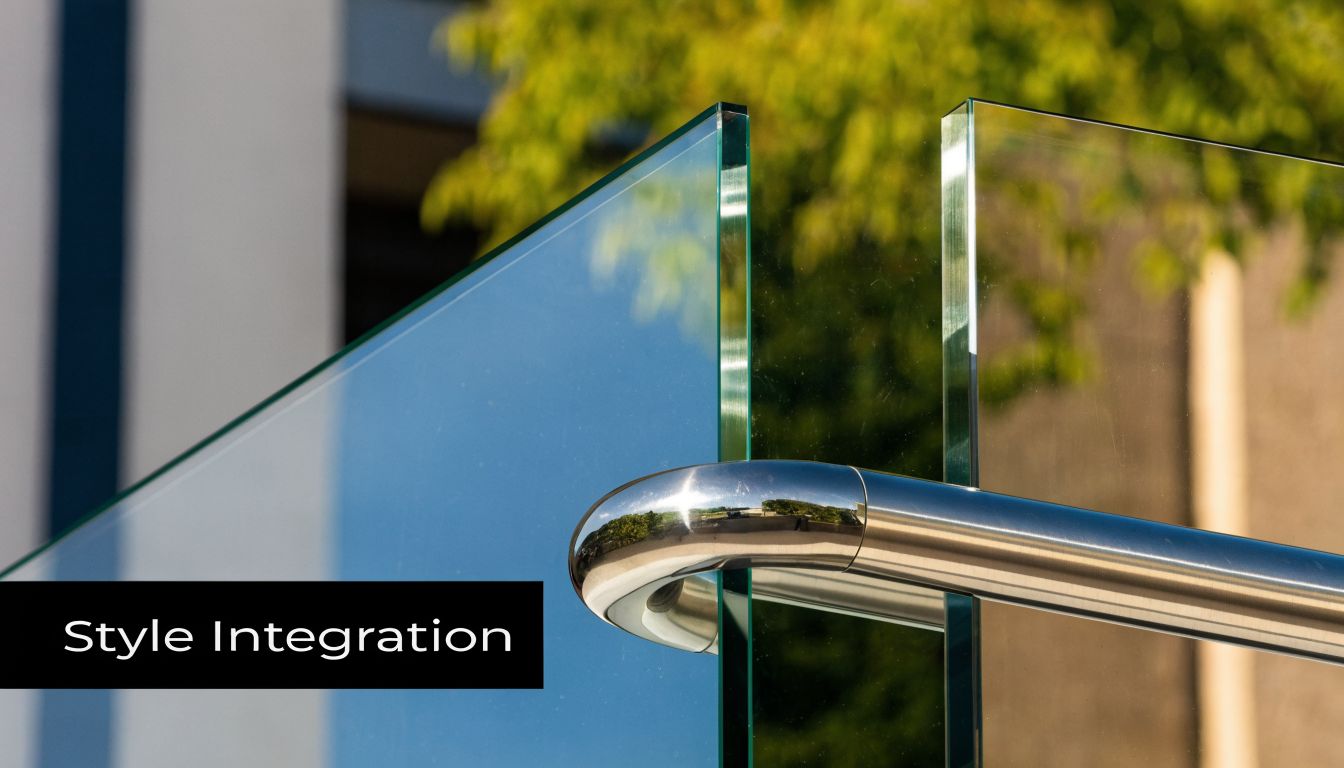
A round tube handrail remains the most intuitive option for the hand. On garden steps, raised patios, and family balconies, it tends to feel familiar and comfortable. It also suits projects where the handrail will be used as much for support as for defining the top of the glass.
A square or rectangular profile gives a more architectural finish. This is often the look people want on urban terraces, apartment schemes, and commercial frontages where straight lines dominate.
A slotted top rail is a common choice for glass balustrades because it caps the top edge of the glass neatly and creates a unified line across the run. It can help the balustrade read as one complete system rather than glass plus a separate rail.
The handrail can be installed in a few distinct ways, and each one changes both appearance and installation detail:
On a city terrace in Leeds, a square stainless profile on clear glass usually gives a crisp, restrained finish. On a garden deck outside Harrogate, a round rail can feel more natural because it softens the overall look and gives a better everyday grip.
Video can help if you're trying to visualise how these systems come together in practice:
What works is alignment. Slim glass, slim rail, and discreet fixings usually produce the cleanest result. What doesn't work is forcing a heavy handrail profile onto a very minimal glass design, or choosing a profile that looks good in elevation but feels awkward in use.
A handrail shouldn't look like an afterthought. It needs to feel proportionate to the glass thickness, the post detail if there is one, and the architecture around it.
A stainless steel handrail often gets signed off in drawings because it looks tidy. The actual test comes later, when Building Control asks for heights, loading, fixing details, and proof that the full guarding system works as installed.
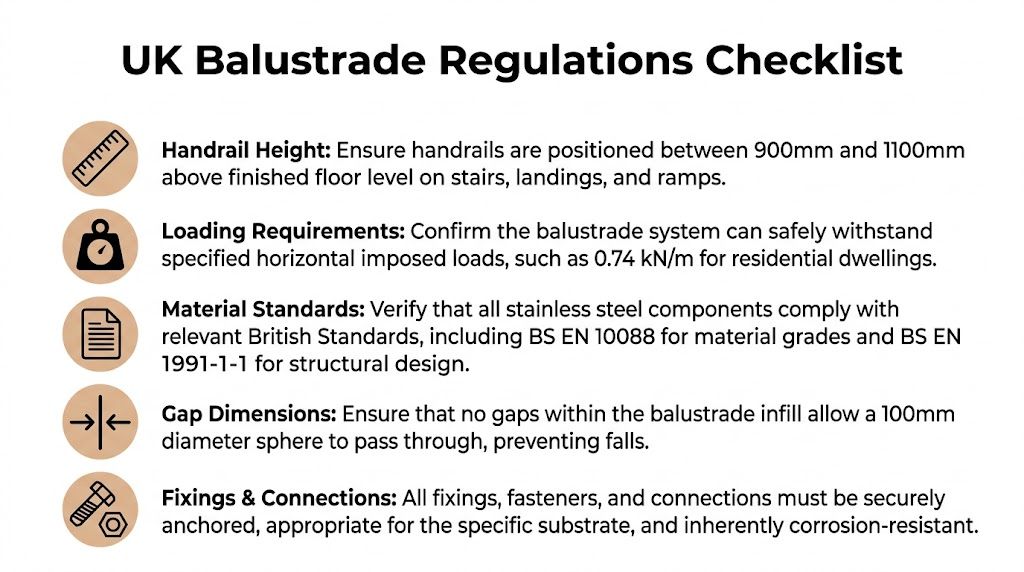
For UK balustrades and handrails, the two documents that come up first are Approved Document K and BS 6187. Part K sets the basic legal expectations for protection from falling, collision, and impact. BS 6187 gives the practical design guidance for barriers in and around buildings, including issues such as barrier height, loading, and suitability for the setting.
Those rules matter more on glass systems because the handrail is rarely working alone. The rail, the glass, the posts or base channel, the anchors, and the structure beneath all have to perform together. If one part is under-specified, the whole assembly can fail a compliance check.
In North Yorkshire and across the wider North of England, I see the same snags turn up repeatedly. A stair rail may look smart in elevation but be awkward to grip in use. A balcony handrail may meet the visual brief yet sit at the wrong height once finishes are added. A frameless glass detail may be drawn cleanly, then lose compliance because the fixing substrate was never properly checked.
Load is another area where people get caught out. The rail has to resist the use it will encounter, not the use shown in a tidy CAD detail. Family balconies, pub terraces, holiday lets, and communal access stairs all attract leaning, gathering, and sideways pressure near corners and changes in level. That is why the engineer's loading assessment and the installer's fixing method matter just as much as the choice of rail profile.
A few questions sort the job early:
One missed detail here can mean remaking glass, redrilling steelwork, or delaying sign-off on site.
With glass balustrades, compliance sits in the junctions. A strong stainless steel rail will not make up for a weak base shoe, poor post spacing, or fixings too close to a slab edge. The opposite is true as well. Good anchors do not solve a poor handrail choice on a stair where people need a comfortable, continuous grip.
For a practical overview of the full assembly, including common UK height and guarding requirements, review these building regulations for balustrades before the design is signed off.
Compliance is not only about the drawing pack. Site workmanship affects the result. Brackets set out unevenly, top rails cut too tight at corners, or dissimilar metal contact left untreated can all create problems later, especially on exposed external work.
Water marks can also become a maintenance complaint on external stainless long before there is any structural issue. On projects with hard water run-off from glazing or masonry above, it is worth keeping these expert tips for removing hard water stains to hand for aftercare planning.
The safest route is simple. Confirm the use of the area, set the correct heights from finished levels, check the loading with the engineer, and make sure the rail profile suits how people will use it. Do that before fabrication, and stainless steel handrails are usually straightforward to approve and straightforward to live with.
Stainless steel gets described as low maintenance so often that some people hear it as no maintenance. That isn't how it works on a real site in Yorkshire, Cumbria, or along the Humber. Stainless lasts well, but it still needs sensible care if you want the finish to stay clean and consistent.
Northern England gives handrails a proper test. Rain leaves spotting. Airborne dirt settles on horizontal surfaces. On sheltered sections, grime can sit longer than you'd expect. On exposed sites, repeated wetting and drying can leave the rail looking dull even when the structure is sound.
Temperature matters too. Due to its high thermal conductivity of about 16 W/mK, a stainless steel handrail can become uncomfortably cold in a -5°C Harrogate winter or reach over 50°C in direct summer sun, as noted in this discussion of stainless steel railing drawbacks.
That doesn't make stainless steel a bad choice. It just means the user experience changes with the weather.
For most domestic and commercial projects, a straightforward approach is enough:
Brushed finishes usually hide day-to-day marks better. Polished finishes reward more regular wiping.
On site note: The handrails that age best are usually the ones that get light, routine cleaning rather than occasional aggressive cleaning after months of neglect.
One common frustration is the pale residue left behind when water dries on the rail, particularly on balconies and terraces where run-off is uneven. If your site has hard water, ordinary wiping isn't always enough. In those cases, these expert tips for removing hard water stains are useful background reading before anyone reaches for harsh cleaners.
Avoid turning maintenance into a surface damage exercise. Abrasive methods can create a bigger visual problem than the marks you're trying to remove.
If the handrail will be used regularly by children, older occupants, or guests moving between indoor and outdoor areas, think about touch temperature early. On a very exposed south-facing terrace, a polished rail in full sun can feel less comfortable than many owners expect. In colder locations, the opposite is true in winter.
Practical responses can include:
Stainless steel handrails hold up well in the North. They just perform best when the specification reflects the climate rather than assuming every site behaves the same.
The cost of stainless steel handrails isn't driven by one headline figure. It comes from a set of decisions that stack up quickly. If you understand those decisions, budgeting becomes far easier and the quote makes more sense.
The first driver is material grade. A project specified in Grade 316 for a harsher environment will usually cost more than the same layout in Grade 304 because the material itself is different.
The second is design complexity. A straight balcony run is simpler than a stair with landings, corners, returns, and awkward transitions. Every bend, joint, and connection adds fabrication and installation detail.
A handrail project usually shifts in cost because of some combination of these points:
Length of run
More metres means more tube, more brackets, more glass interface components, and more labour.
Profile selection
Round, square, and slotted rails don't fabricate in exactly the same way.
Finish level
Brushed and polished finishes create different expectations around fabrication quality and final appearance.
Mounting method
Top-mounted, side-fixed, and integrated glass-top systems require different components and fixings.
Site conditions
Easy access and straightforward substrates help. Tight access, awkward levels, and uncertain structure rarely do.
A useful estimate starts with clear information. Before you request pricing, have these details ready:
The setting
Internal stair, external patio, balcony, terrace, or landing.
The exposure
Inland, coastal, sheltered, or very open.
The look you want
Round, square, slim, minimal, more architectural, brushed, or polished.
Approximate dimensions
Even early-stage measurements help shape a realistic conversation.
If you want a quicker starting point, an online calculator can help turn those basics into a more customized estimate. The Binks Balustrades calculator lets you choose the balustrade style, glass type, top rail option, and run length so you can build a clearer picture before moving into detailed specification.
A stainless steel handrail that suits a Harrogate townhouse will not always suit a windswept balcony on the Yorkshire coast. The right choice depends as much on your role in the project as the product itself. Homeowners usually focus on appearance and upkeep. Architects need a detail that reads well and still satisfies UK standards. Contractors need clean setting-out and predictable fixing. Facilities teams need something that will still look presentable after years of daily use.
Start with use, not just appearance.
On a domestic stair, raised decking area, or first-floor terrace, the handrail has to feel comfortable in the hand, suit the property, and cope with North Yorkshire weather without turning into a constant cleaning job. Brushed stainless is often the safer choice for family homes because it hides fingerprints, light marking, and water spotting better than a polished finish.
Exposure matters. An inland site in a sheltered garden gives you more flexibility than an exposed elevation that catches rain and winter grime. If you are still narrowing the options down, the simplest next step is to send the basics through the balustrade project booking form so the specification can be matched to the site rather than guessed from photos.
Good stainless detailing comes from control. Handrail lines, bracket positions, glass junctions, and terminations all need resolving early if the finished balustrade is going to look deliberate rather than compromised.
The common mistake is pushing too hard for visual lightness and ending up with a top rail that is awkward to grip, poorly supported, or difficult to justify under BS 6187 and Approved Document Part K. On UK projects, the handrail should be treated as a working safety element first and an aesthetic element second. The best schemes satisfy both by keeping proportions tight, support centres sensible, and interfaces with the glass properly coordinated.
A restrained detail usually looks better on site anyway. It ages better, fabricates more cleanly, and is less likely to get watered down during value engineering.
Site problems usually start before stainless arrives.
Final dimensions drift. Finished floor levels move. Structural edges are not where the drawing suggested they would be. That is why handrails need checking against the physical opening, the actual substrate, and the agreed glass detail before fabrication is signed off.
Keep the job practical:
Stainless steel is forgiving in service, but it does not forgive poor setting-out. A tidy install nearly always comes from accurate survey work and clear coordination between fabricator, glass supplier, and installer.
Commercial settings put different pressure on a handrail. Apartment blocks, schools, hospitality venues, and office terraces all bring higher touch rates, more cleaning, and more visible wear. In those environments, the finish has to be easy to maintain by the team looking after the building.
That usually points towards practical specification rather than showpiece detailing. A sensible grade, a forgiving surface finish, and accessible fixing details will serve the building better than a highly polished rail that looks impressive at handover and tired six months later. On exposed northern sites, that trade-off is rarely theoretical. It shows up quickly in cleaning time, appearance, and long-term replacement cost.
A good stainless steel handrail does three jobs at once. It provides a safe, usable grip. It completes the look of the balustrade. It stands up to the climate and the level of use the site will experience.
In the North of England, the best results usually come from getting three decisions right early. Choose the correct grade for the environment. Make sure the handrail sits within the right regulatory framework for height, support, and use. Then choose a profile and finish that suit both the building and the people using it.
That approach avoids most of the common regrets. It stops inland projects being overspecified for no reason, and it stops exposed sites being underspecified to save money at the wrong point in the job. It also helps the final installation feel coherent rather than assembled from disconnected product choices.
If you'd like to move from ideas to a real specification, the simplest next step is to use the balustrade booking form and set out the basics of your project clearly.
If you're planning stainless steel handrails for a balcony, terrace, stair, or glass balustrade, contact Binks Balustrades for practical guidance on specification, layout, and next steps.