
Toughened vs Laminated Glass for Balustrades a UK Guide
When you're choosing the glass for your balustrade, the decision often boils down to two options: toughened or laminated. At […]

When you're choosing the glass for your balustrade, the decision often boils down to two options: toughened or laminated. At […]
When you're choosing the glass for your balustrade, the decision often boils down to two options: toughened or laminated. At first glance, they might seem similar, but the real difference lies in how they behave under pressure. Think of it as safety versus security.
Toughened glass is designed for safety, shattering into thousands of small, blunt pieces upon impact. In contrast, laminated glass is engineered for security, cracking but holding together to maintain a barrier, which is absolutely vital for high-level balconies or high-traffic commercial areas.
When you're planning a new glass balustrade for your property, picking the right type of safety glass is one of the most critical decisions you'll make. It’s a choice that impacts everything from the final look and feel of your space to its safety, compliance with building regulations, and, of course, the overall budget.
Both toughened and laminated glass are officially classified as 'safety glass', but they get there in very different ways and offer distinct advantages depending on your project's needs.
Toughened Glass: This starts life as a single pane of glass, which then goes through an intense thermal tempering process. It's heated to over 600°C and then rapidly cooled. This process makes it incredibly strong—about four to five times stronger than standard glass—and determines how it breaks.
Laminated Glass: This is more like a high-tech sandwich. It's made by bonding two or more layers of glass together with a tough, clear plastic interlayer, usually Polyvinyl Butyral (PVB). Its whole purpose is to stay in one piece, even after it breaks.
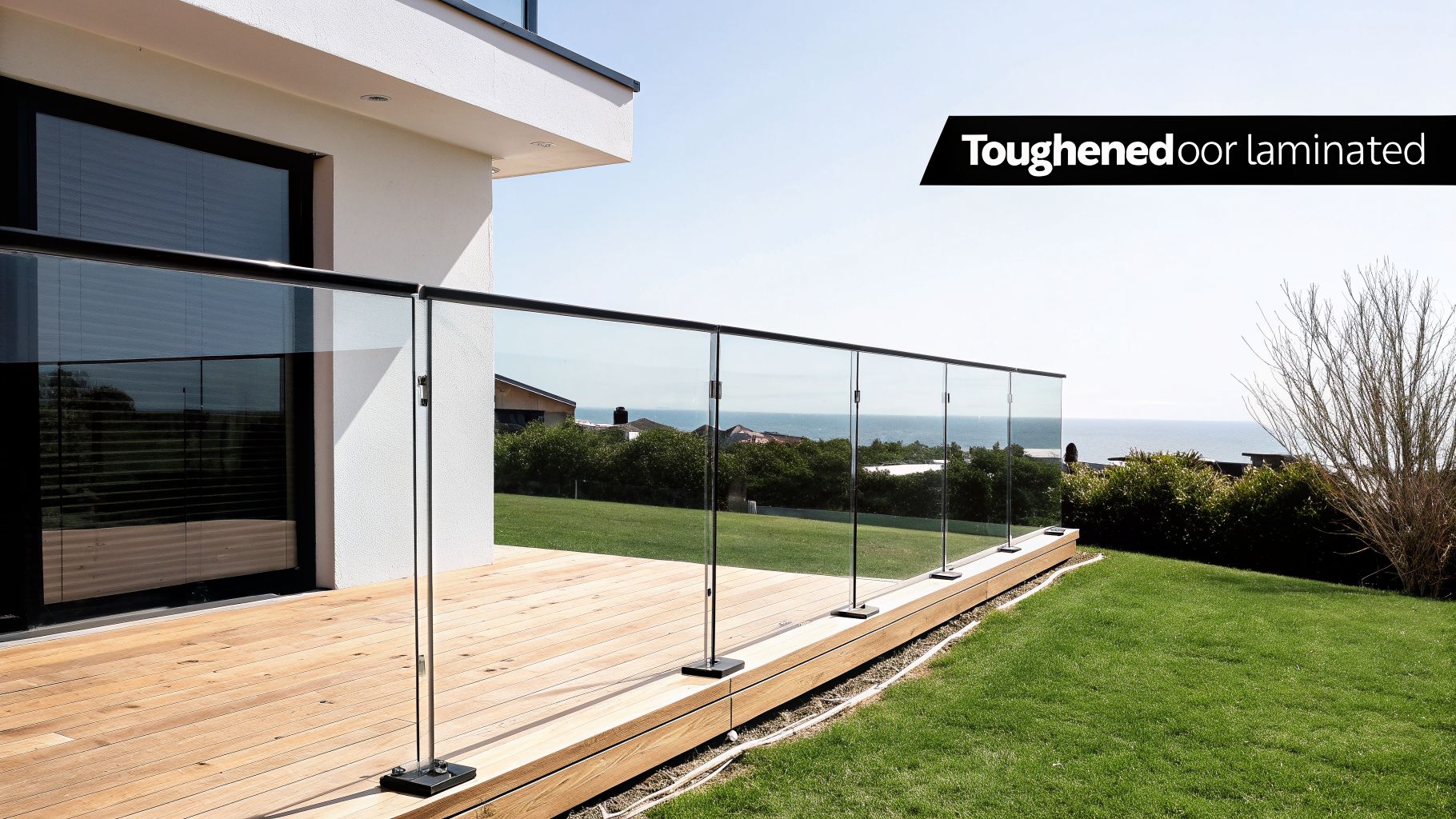
To help you see which one fits your project, let’s put them side-by-side.
This table gives a quick, at-a-glance summary of the fundamental differences when you’re considering toughened or laminated glass for your balustrade.
| Attribute | Toughened Glass | Laminated Glass |
|---|---|---|
| Breakage Pattern | Shatters into thousands of small, blunt, pebble-like pieces. | Cracks in a spiderweb pattern but is held together by the interlayer. |
| Primary Safety Feature | Reduces the risk of serious injury from sharp shards upon failure. | Maintains a protective barrier, preventing falls even after impact. |
| Typical Cost | The more budget-friendly option for most applications. | Generally 10-30% more expensive due to its complex construction. |
| UV Protection | Offers minimal protection from the sun's UV rays. | The interlayer blocks up to 99% of harmful UV radiation. |
| Sound Insulation | Provides standard sound dampening. | Offers superior acoustic performance, noticeably reducing noise. |
Ultimately, the right choice depends heavily on your project's specific location, the potential fall height, and what your local building codes demand.
For projects like high-rise balconies or terraces where preventing a fall is the absolute top priority, laminated glass is often the required choice. You can learn more about the specific regulations and recommendations for glass for a balcony in our detailed guide.
This comparison should give you the foundational knowledge needed to weigh up your options and make an informed decision.
To really get to grips with why toughened and laminated glass behave so differently, you have to look at how they’re made. Their distinct manufacturing processes are precisely what give them their unique safety characteristics. While both start life as standard annealed glass, they go on entirely different journeys that turn them into the robust materials we rely on for balustrades.
Think of it as a tale of two sciences: one is all about intense heat and thermal stress, while the other is about building up layers. One forges strength with fire and rapid cooling; the other builds resilience by bonding multiple sheets into a single, cohesive unit. Grasping these fundamental differences is the first step in choosing the right glass for your project.
Toughened glass, often called tempered glass, gets its incredible strength from a dramatic process of extreme heating and cooling. It starts as a single pane of standard glass, which is first cut to the exact size and shape needed for the final balustrade panel. It’s absolutely critical that any drilling for fixings or shaping of the edges is done at this stage—once the glass is tempered, it cannot be altered.
With the prep work done, the glass moves into a tempering oven where it’s heated to a blistering 600°C, bringing it close to its softening point. What happens next is the magic moment: the glass is hit with high-pressure air jets in a process known as "quenching."
This quenching cools the outer surfaces of the glass almost instantly, causing them to solidify while the centre remains molten for a moment longer. As the inner core finally cools and contracts, it pulls on the already rigid outer surfaces. This creates a state of permanent stress, with the surfaces under high compression and the core under tension.
This locked-in stress is the secret behind toughened glass. The powerful compressive forces on the surface make it around four to five times stronger than ordinary glass, giving it a much higher resistance to impact and thermal shock.
Making laminated glass is less about thermal drama and more about meticulous construction. The goal is to create a "sandwich" of glass and plastic, a composite structure that provides its unique post-breakage safety.
The process begins with two or more sheets of glass—this can be standard annealed glass or even toughened glass for extra strength. These sheets are thoroughly cleaned before a tough, flexible interlayer, usually made from Polyvinyl Butyral (PVB), is placed between them. This PVB interlayer is the hero of the story; it’s what gives laminated glass its integrity.
The glass-and-interlayer assembly is then passed through rollers to squeeze out any trapped air and create an initial bond. For the final step, the unit is placed inside an autoclave—essentially a high-pressure oven. Here, a combination of intense heat and pressure permanently fuses the glass and the PVB interlayer into a single, incredibly durable panel.
This process ensures that if the glass breaks, the shattered fragments stick firmly to the PVB interlayer instead of falling away. It stops the panel from collapsing and maintains a protective barrier, a crucial safety feature for balustrades in high-level areas or public spaces from York to Hull, where you simply can't take any risks.
When you’re weighing up toughened versus laminated glass for a balustrade, nothing matters more than how each one behaves under pressure. It's not just a simple question of which is stronger on paper. The real decider is how they react to an impact and what happens if they fail. This is what determines the safety of your installation, whether it’s for a garden patio in Leeds or a coastal terrace in Hull.
The way each glass is made gives it a completely different character. Toughened glass gets its incredible surface strength from a thermal tempering process, while laminated glass gets its resilience from a clever sandwich-like construction. Getting to grips with how they break is the key to meeting UK building regulations and making sure your balustrade is right for the job.
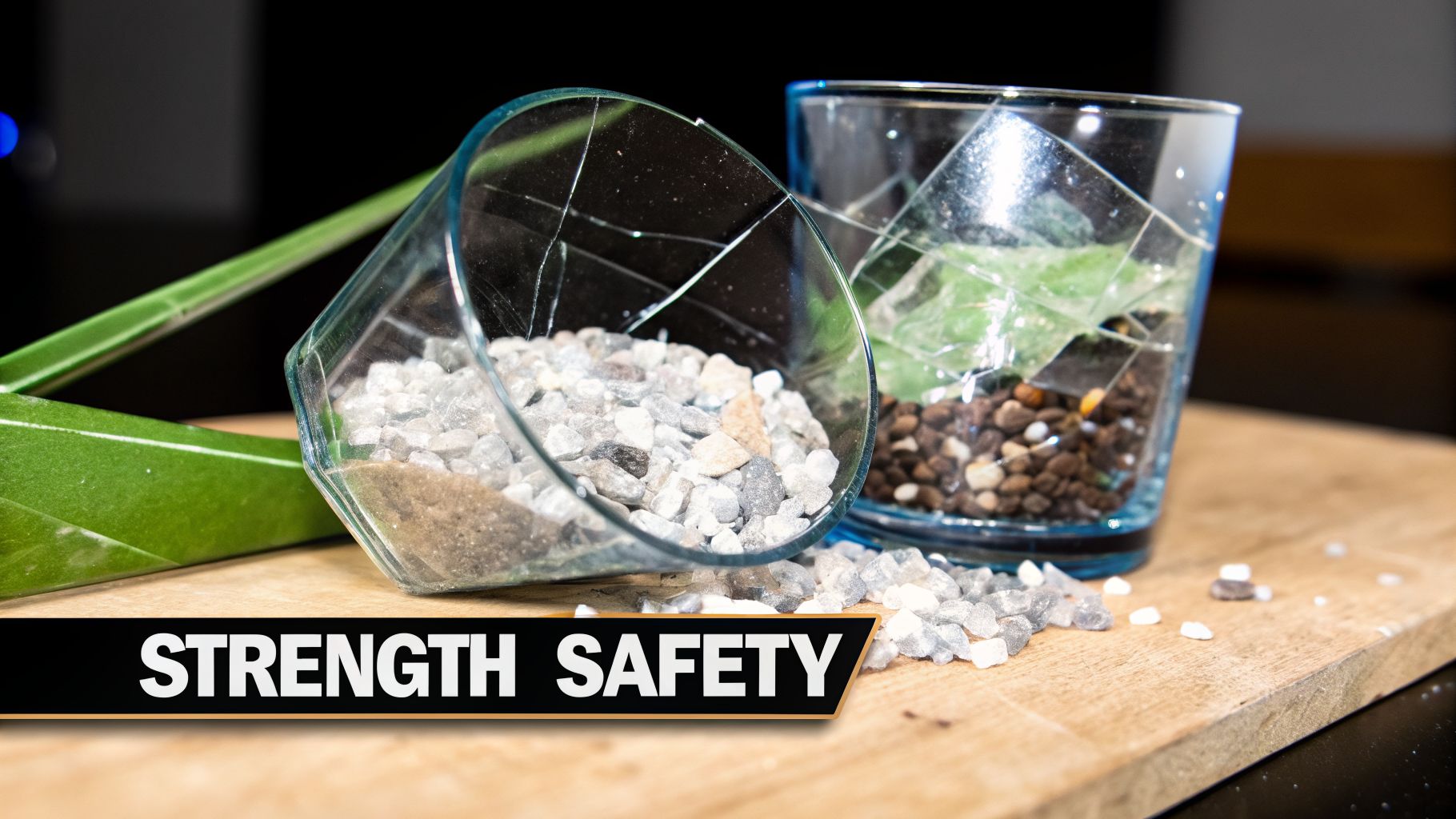
Toughened glass is famous for its muscle, boasting a surface strength around four to five times greater than ordinary annealed glass. This means it can shrug off everyday bumps and knocks without a problem. Its strength is born from the high compression locked into its surface during the rapid cooling stage of manufacturing.
But the real magic of toughened glass isn't its strength—it's how it fails. When it finally gives way under extreme force, it doesn't break into large, jagged daggers of glass. Instead, it crumbles into thousands of small, granular, pebble-like pieces. These fragments are relatively harmless, drastically cutting the risk of serious injury. It's this predictable 'safe-fail' characteristic that earns it the "safety glass" classification.
The biggest selling point for toughened glass is its safe-shatter failure. It’s an ideal choice for ground-level balustrades where the main concern is preventing injury from broken shards, not preventing a fall from a height.
Laminated glass brings a different kind of safety to the table—one built around integrity and containment. While a single pane might not have the same raw surface hardness as toughened glass, its layered structure gives it phenomenal performance after it breaks.
When struck hard enough, the glass layers will crack, often in a distinctive spiderweb pattern, but the broken pieces stay glued to the PVB interlayer. This is the crucial difference. Laminated glass holds together, maintaining a barrier even when it’s completely shattered. The panel stays in the frame, stopping a person or object from falling through the gap. For large-scale commercial construction services, this post-breakage integrity isn't just a feature; it's a vital safety requirement.
Choosing between toughened and laminated glass is often dictated by UK Building Regulations, which set strict standards for safety barriers. Documents like Approved Document K and BS 6180:2011 define the minimum forces balustrades must withstand.
Here’s a quick breakdown of how each glass type stacks up against these critical UK standards.
Performance Under UK Building Regulations
| Performance Metric | Toughened Glass Performance | Laminated Glass Performance | Relevant UK Standard |
|---|---|---|---|
| Post-Breakage Integrity | Shatters and vacates the opening, losing its barrier function completely. | Remains in place, held by the interlayer, maintaining a protective barrier. | BS EN 12600 (Impact test) |
| Line Load Resistance | Can meet requirements like 0.36 kN/m and 0.74 kN/m with appropriate thickness and fixing. | Also meets and exceeds line load requirements with correct specification. | BS 6180:2011, Approved Doc K |
| Suitability for 'Protective Barriers' | Excellent for preventing injury from glass fragments on breakage. | Essential where the barrier must remain in place to prevent a fall from height. | Approved Document K |
| Impact Classification | Typically achieves Class 1(C)1, indicating safe breakage pattern. | Also achieves Class 1(B)1, indicating high penetration resistance. | BS EN 12600 |
As you can see, both materials are strong, but their failure modes make them suitable for different applications. The UK market reflects this; toughened glass held a dominant 44.16% revenue share in 2023, largely due to its wide use in applications where falling from height isn't the primary risk. Its ability to withstand a 0.36 kN line load aligns perfectly with many domestic requirements in Approved Document K.
For a deeper dive into how these rules apply to your specific project, our comprehensive guide on building regulations for balustrades is a must-read. It’ll help ensure your project in Harrogate or York is not just stunning, but fully compliant and safe.
While how the glass breaks is a massive factor in safety, your choice between toughened and laminated glass also shapes the everyday experience of your space. It’s not just about strength. The subtle differences in sound insulation, UV protection, and even visual clarity can make a huge difference, whether you're planning a city balcony in York or a lakeside deck in Cumbria.
These are the details that dictate how your balustrade doesn't just look, but how it feels as a part of your home.
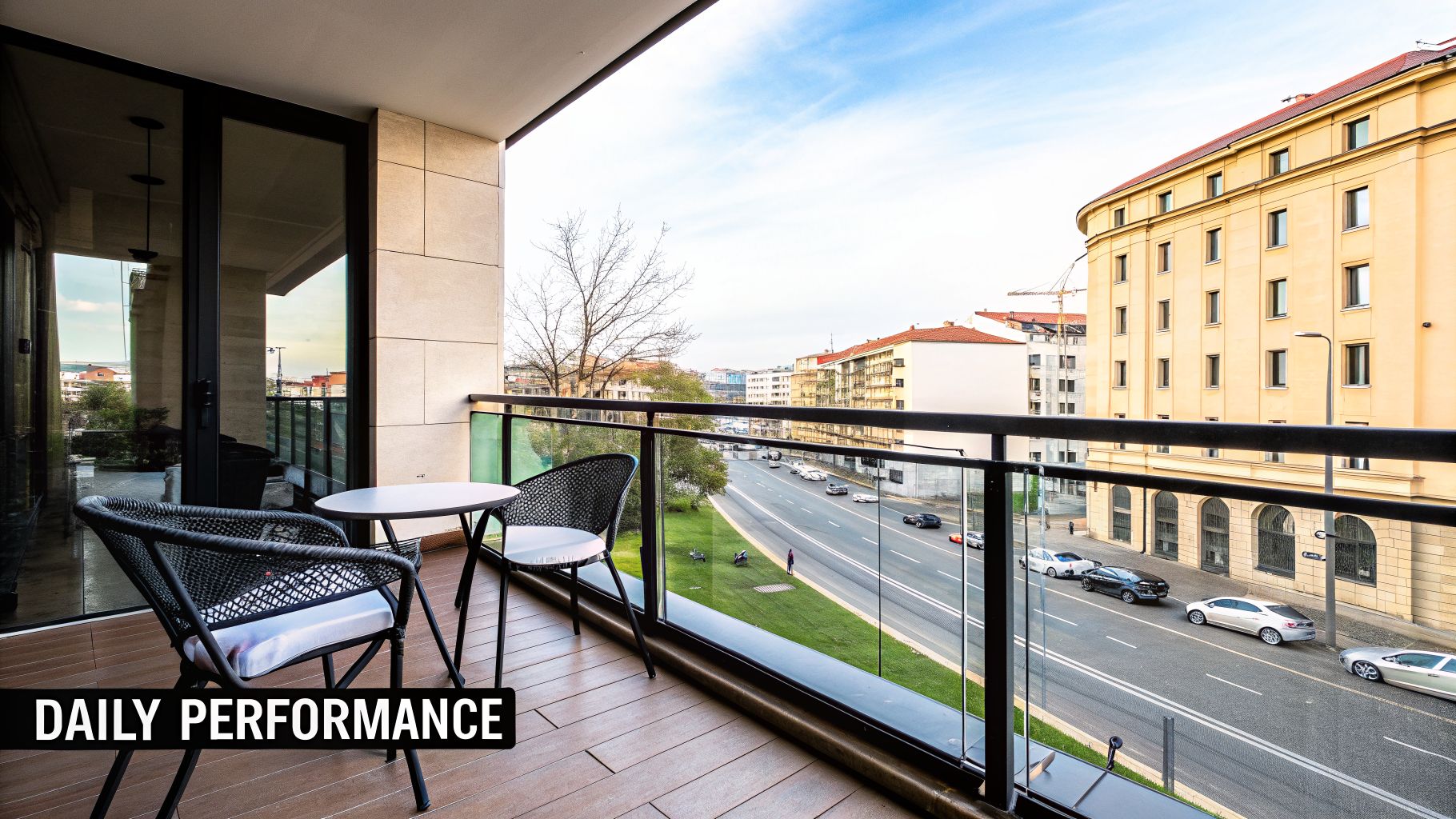
One of the most surprising benefits of laminated glass is its fantastic soundproofing. That flexible PVB interlayer is an absolute champion at dampening sound vibrations before they can pass through the glass.
In noisy areas, this is a genuine game-changer. For a balcony overlooking a busy Leeds street or a terrace near a town centre, laminated glass can dramatically cut down traffic noise, helping to create a much more peaceful and usable outdoor space.
Toughened glass offers basic sound insulation, but laminated glass is on another level. The interlayer physically disrupts sound waves, which can be a real blessing for urban properties craving a bit of tranquillity.
We all love sunlight flooding into our homes, but it brings along ultraviolet (UV) radiation that’s notorious for fading fabrics, wooden floors, and furniture over time. This is another area where laminated glass really shines.
The PVB interlayer acts as a powerful UV filter, blocking up to 99% of damaging UV rays. This quality helps protect the inside of your home, safeguarding expensive furnishings from sun damage without sacrificing any of that lovely natural light. Toughened glass, as a single pane, offers next to no UV protection.
This makes laminated glass a smart pick for any south-facing balustrades in Cheshire or wherever you want to protect your indoor-outdoor living areas.
When it comes to pure, uninterrupted visual clarity, toughened glass technically has a slight edge. Being a single sheet, it delivers a pristine, crystal-clear view with maximum light, which is why it’s so popular.
It’s worth noting, however, that the tempering process can sometimes create a tiny optical imperfection known as ‘roller wave’. This is a very subtle waviness on the glass surface, usually only visible from certain angles and generally unnoticeable in most installations.
Laminated glass, being a multi-layered sandwich, has a couple of minor points to consider:
The rising demand for laminated glass across the UK really speaks to its all-round benefits. Market forecasts show its popularity is growing, especially as construction picks up. For homeowners in the North of England, where the weather can be a real factor, the fact that laminated glass can reduce energy loss by 15-20% in glazed barriers is a significant plus. While it might be 10-15% more expensive upfront, its superior soundproofing, UV blocking, and durability often make it a sound investment by reducing future replacement costs. Discover more about the growing market for laminated glass and its benefits.
Beyond the technical specs and safety ratings, the practical realities of your budget and the installation itself play a massive part in choosing between toughened and laminated glass. Getting to grips with the financial and logistical differences is crucial for a smooth project, whether you’re a homeowner in Harrogate updating a patio or a builder in Darlington managing a large-scale development.
A smart decision here isn't just about the upfront cost. It’s about understanding the total picture: the material price, how that choice affects labour, and the genuine long-term value each option brings to the table.
The first thing you’ll notice is the price tag. Laminated glass is generally 10-30% more expensive per square metre than its toughened counterpart. This isn't a markup for its own sake; the price difference comes directly from a far more involved manufacturing process that sandwiches a specialist PVB interlayer between multiple sheets of glass.
Of course, that higher initial spend buys you the superior safety, security, and sound-dampening qualities we’ve already covered. For many projects, particularly where there’s a significant fall-from-height risk, that extra investment delivers invaluable peace of mind.
A common question we get is whether the higher cost of laminated glass is really worth it. Our answer? For frameless systems, Juliet balconies, or any high-level balustrade where the glass absolutely must stay in place if it breaks, the answer is always yes.
The differences don't stop at the checkout. Once on-site, the physical properties of each glass type come into play. Laminated glass is considerably heavier than a toughened panel of the exact same size, all thanks to its multi-layered construction. This extra weight has a direct knock-on effect on the installation.
Toughened glass, being lighter, is generally a bit quicker and easier to handle and install, which can help keep labour costs down. We cover how these elements impact your final quote in our North Yorkshire-focused blog on balustrade costs.
When you look at the long game, both types of glass are fantastically durable and a breeze to maintain with just a simple clean. Neither will rot, rust, or need repainting like traditional materials.
The real difference in long-term value circles back to durability under stress. While both are incredibly strong, laminated glass offers far greater resilience against an impact that would cause a toughened panel to shatter into thousands of pieces. Having to replace an entire panel is a significant cost, and the robust, stay-in-place nature of laminated glass can save you from that expense.
Data from UK flat glass processors really highlights these trade-offs. Toughened glass was used in around 60% of balustrade projects for its cost-effectiveness, typically ranging from £150-£200 per square metre, compared to laminated's £200-£300. Yet, in commercial audits, laminated glass was found to reduce breach incidents by 18%, proving its superior security credentials. Local experts often suggest toughened glass for budget-conscious home modernisations, while strongly recommending laminated for premium, frameless terraces where maximising the view and safety are non-negotiable.
So, how do you decide between toughened and laminated glass? It really boils down to one critical factor: location. The right choice depends entirely on where your balustrade is being installed and the level of risk involved.
This isn’t just about ticking boxes on a spec sheet. It's about applying real-world knowledge of how each glass performs. A ground-floor patio in Harrogate has entirely different safety demands than a high-level commercial terrace in Leeds. Context is everything.
To make the decision clearer, let's walk through a few common scenarios. Each situation has a different set of safety requirements, making one glass type the obvious, correct choice over the other.
Internal Staircases and Landings: For indoor areas where there's no significant drop, toughened glass is an excellent and cost-effective solution. Its job here is to create a stylish, safe barrier without needing to hold together after a break.
Ground-Floor Patios and Garden Decking: Much like internal stairs, ground-level outdoor spaces in places like Cheshire or Cumbria are perfect for toughened glass. The main safety concern is preventing injury from sharp shards if a panel breaks, which its dicing fracture pattern handles perfectly.
High-Level Balconies or Terraces: For any installation where there is a risk of falling from height, laminated glass is the non-negotiable choice. If a panel breaks, it absolutely must remain in place to act as a protective barrier. Only laminated glass can do this.
Frameless Systems Without a Top Rail: In sleek, minimalist designs where there's no continuous handrail for support, laminated glass is essential. Its structural integrity ensures the system remains a secure barrier even after an impact.
This simple diagram helps to visualise the most critical question you need to ask.
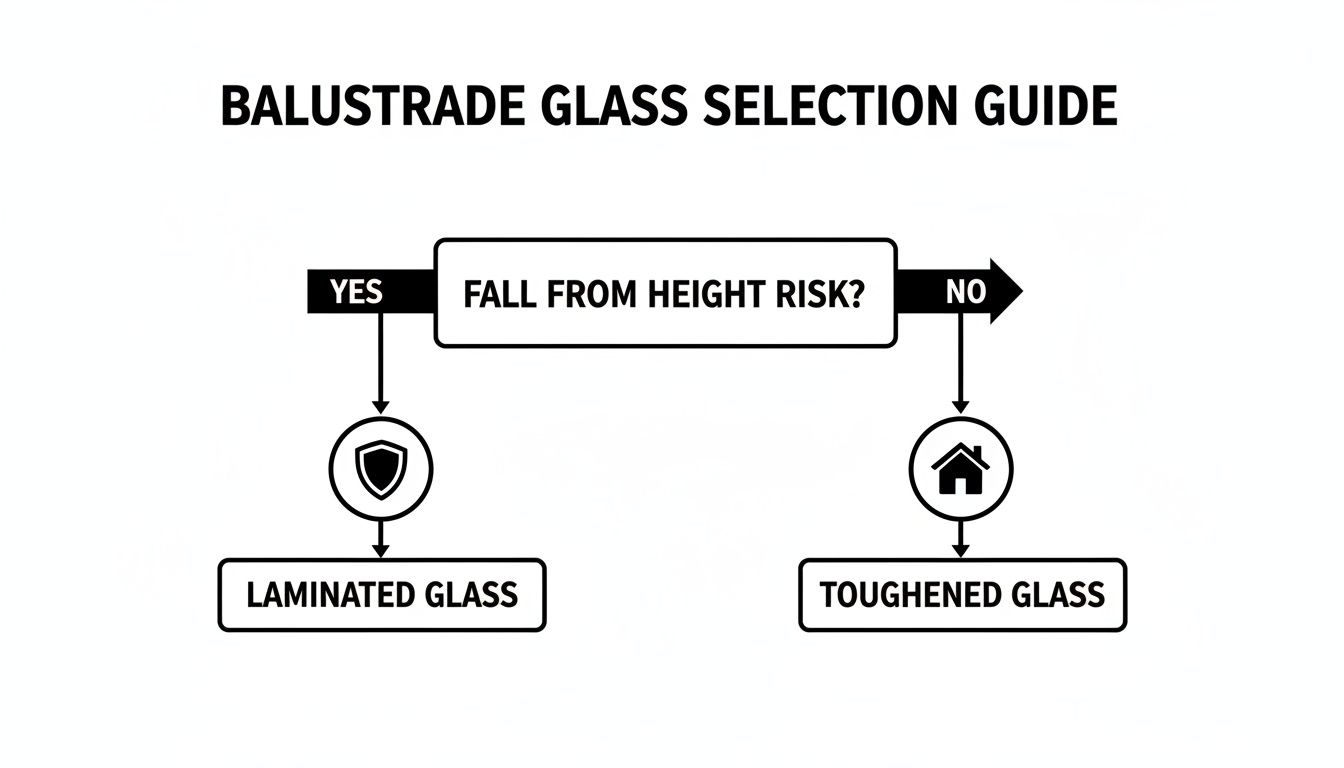
The key takeaway is simple: if there’s a risk of falling, laminated glass is the only option that meets safety standards.
While these guidelines are a solid starting point, every project has its own unique quirks. Local conditions, specific building designs, and keeping up with the latest regulations are all crucial. This is where getting professional guidance becomes invaluable.
When comparing toughened vs laminated glass, the ultimate goal is peace of mind. Consulting with a local specialist ensures your balustrade isn't just visually stunning but is also fully compliant and, most importantly, completely safe for everyone who uses it.
For projects across Yorkshire and the North of England, from Darlington to York, speaking with an expert is the surest way to guarantee a successful outcome. At Binks Balustrades, our team lives and breathes the local requirements and can provide personalised recommendations based on your exact needs.
We encourage you to contact us for clear, practical guidance on selecting the perfect glass for your balustrade project.
When you get down to the finer details of a glass balustrade project, a few practical questions always come up. Here are the straightforward answers to some of the most common queries we get from homeowners and builders across the North of England, helping you finalise your plans with confidence.
This is a really important one, as it affects your entire project timeline. Once a piece of glass goes through the thermal tempering process, it becomes toughened glass, and it absolutely cannot be cut, drilled, or altered. The extreme tension locked inside means any attempt to modify it will cause the whole panel to shatter into thousands of tiny pieces. All holes and shaping have to be done before it heads into the tempering oven.
Laminated glass is a different story. It can sometimes be cut by specialists using the right equipment to slice through the glass layers and the plastic interlayer. However, for the best possible finish and guaranteed structural integrity, we always recommend ordering laminated panels to the exact size you need from the start.
If you're dreaming of that pure, minimalist look of a frameless balustrade without a continuous handrail, there's only one choice: laminated glass. It’s not just the better option; it's a mandatory one for safety.
The reason is all about what happens if a panel breaks. If a toughened glass panel in a frameless system shatters, it disappears completely, leaving a dangerous, open gap. A laminated panel, however, will crack but stay firmly in place, held together by its interlayer. It continues to act as a protective barrier, preventing a fall. This is a non-negotiable safety requirement under UK building regulations.
There’s no single answer to this – the right thickness depends entirely on the design of your specific balustrade. It’s a calculation that needs to be done correctly to ensure safety and full compliance with regulations.
A few key factors determine the final specification:
Generally, you'll see thicknesses ranging from 10mm to 21.5mm, but this must be determined by an expert.
For day-to-day cleaning, there’s no difference at all. Both toughened and laminated glass can be kept sparkling with a standard glass cleaner and a soft cloth. Simple.
The real difference comes down to long-term resilience and cost. While both are incredibly strong, laminated glass has an edge. Its layered construction can absorb an impact that might cause a toughened panel to shatter completely, forcing a full, costly replacement. Because it cracks without failing, it can often save you money and hassle in the long run.
Ready to get a clear, no-obligation quote tailored to your project? The expert team at Binks Balustrades is here to provide specialist advice for projects across the North of England. Contact us today for personalised guidance on choosing the perfect glass for your balustrade.