
Inspiring Deck Balustrade Ideas for North England Homes
When you start thinking about deck balustrade ideas, you could go for the pure, clean lines of frameless glass for […]

When you start thinking about deck balustrade ideas, you could go for the pure, clean lines of frameless glass for […]
When you start thinking about deck balustrade ideas, you could go for the pure, clean lines of frameless glass for that uninterrupted view, choose powder-coated aluminium for a modern, low-maintenance finish, or maybe even a stainless steel wire system for a sharp, industrial look. The best choice always comes down to a careful balance between your home’s unique style, your family's safety needs, and the specific weather challenges of where you live.
Picture your garden deck for a moment. It’s not just a functional space, is it? It’s a stunning extension of your home, a place for relaxing and entertaining. The right balustrade is the key that unlocks this transformation, acting as much more than a simple safety rail—it’s a real design statement.
For homeowners right across the North of England, from the rugged coasts of Yorkshire to the serene landscapes of Cumbria, the goal is always the same. We all want to create a secure, beautiful outdoor area that makes the most of every last bit of light and every single view. This guide will walk you through some of the most inspiring deck balustrade ideas out there, from sleek frameless glass that brings the horizon closer to durable metal systems that add a modern edge.
A balustrade does so much more than just prevent falls. It frames your view, properly defines your outdoor living area, and can add significant value to your property. Think of it as the crucial finishing touch that pulls your entire garden design together. The right system can make a small deck feel wonderfully open or give a large terrace a welcome sense of intimacy and structure.
To get a better handle on how balustrades fit into the bigger picture of your garden's look and feel, this practical guide to outdoor living space design is a fantastic resource. It offers some really valuable context for planning out your project from the start.
When you're choosing a balustrade, you have to think beyond just how it looks. Here in the North, durability is everything. Your chosen system absolutely must be able to withstand everything our climate can throw at it—we’re talking driving rain, coastal salt spray, and plenty of frosty mornings.
Here are a few initial points to chew on:
For example, wire rope systems are becoming incredibly popular for their sleek, contemporary feel and how little they obstruct the view. Looking into a professionally designed wire balustrade kit can give you a streamlined solution that combines that modern style with robust, long-lasting performance.
We’ll dig into materials, safety, and budgeting in more detail to help you find the perfect match for your home's character and your family’s needs.
Before diving into the nuts and bolts of different materials, it’s worth getting your head around the main design systems. Think of it like choosing a picture frame; some are designed to be almost invisible, letting the artwork shine, while others add sharp definition and character. Your choice here will set the entire tone for your outdoor space.
A frameless glass balustrade is the true ‘infinity edge’ of the decking world. It creates a barely-there barrier that lets your garden flow seamlessly into the landscape beyond—perfect for protecting those priceless views across the Yorkshire Dales. This system is all about maximising light and creating an incredible sense of openness.
At the other end of the spectrum, a fully framed system neatly encloses your outdoor area with visible posts and a continuous handrail. This style offers a more traditional, structured feel, adding a reassuring sense of security and definition to your deck's perimeter. It's a classic choice that works beautifully with countless architectural styles.
Slotting neatly between these two is the semi-framed system, a hugely popular choice that strikes a great balance between structure and openness. This design typically uses posts to support the glass panels but often leaves off a top handrail, keeping the sightlines much cleaner than a fully framed option. It’s a contemporary look without the absolute minimalism of a frameless setup.
Getting to grips with this vocabulary is the first step to confidently discussing your vision. Knowing the difference between framed, semi-framed, and frameless helps you explain exactly what you’re after, making sure the final result is a perfect match for your home. To see how these systems look in practice, you can explore the various options for glass panel decking and get a feel for what might suit your project.
To help you quickly compare the options, here’s a simple breakdown of how each style stacks up.
| Style Feature | Frameless Glass | Semi-Framed System | Fully Framed System |
|---|---|---|---|
| View Obstruction | Minimal to none | Low | Moderate |
| Primary Aesthetic | Ultra-modern, minimalist | Contemporary, clean | Traditional, structured |
| Visible Structure | Base channel or clamps only | Vertical posts visible | Posts and handrail visible |
| Feeling of Space | Maximum openness | Open and airy | Secure and enclosed |
| Best For | Uninterrupted panoramas | Balancing views with structure | Defining deck boundaries |
This table should give you a good starting point for deciding which system aligns best with what you want to achieve with your deck.
What’s the main reason for your new balustrade? Is it all about safety for the kids, preserving that stunning view, or making a bold style statement? Your core motivation is often the best guide to the right system.
This decision tree helps visualise how your goal points you in the right direction.
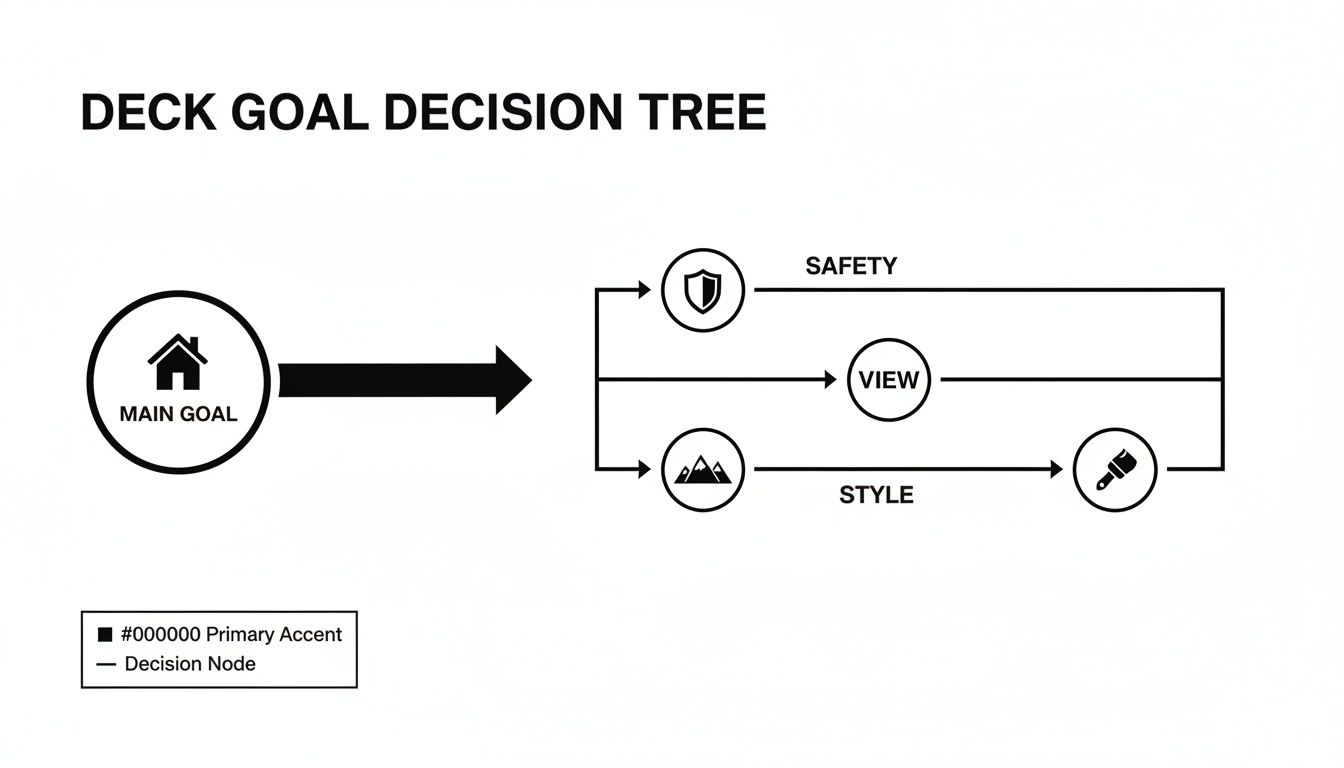
As you can see, if an unbroken view is your number one priority, a frameless system is the obvious front-runner. But if you’re leaning towards a more classic look, a fully framed design is likely the better fit.
No matter which style you go for, every balustrade is built from a few core elements that work together. Understanding what they do will help you appreciate the subtle differences between designs.
The interplay between these parts is what gives each system its unique character. A chunky stainless steel post makes a bold, modern statement, while a discreet base channel makes a frameless system look as though the glass is growing right out of the decking itself.
Choosing the right materials for your deck balustrade in the North of England isn’t about chasing fleeting trends; it’s about demanding enduring performance. Our weather, from the salty air whipping along the Northumberland coast to the sharp frosts in the Pennines, calls for materials that are both beautiful and incredibly tough. Get this decision right now, and you’ll save yourself a world of maintenance, money, and disappointment down the line.

This is where your balustrade proves its worth. The ideal material has to stand firm against damp, shrug off corrosion, and keep its smart appearance year after year. Let’s break down the top contenders that strike the perfect balance of style and strength for our challenging northern climate.
Glass is a fantastic choice for any deck, but it’s a game-changer in places where we want to soak up every bit of natural light. It gives you that uninterrupted view and a clean, modern look that complements just about any style of home. But it’s crucial to understand that not all glass is created equal.
For a balustrade, you absolutely must use safety glass. This comes in two main forms:
Both options give you brilliant clarity and durability, making sure your view remains the star of the show while keeping your family safe and secure.
When it comes to the bones of your balustrade—the posts, handrails, and clamps—metal is the natural choice for its strength and sleek finish. The type of metal you pick, however, is what makes all the difference to its lifespan in the North of England.
Often called marine-grade stainless steel, this is the undisputed champion for outdoor use, especially if you live in a coastal spot like Yorkshire or Cumbria. It contains an alloy called molybdenum, which gives it superior resistance to corrosion from salt spray and driving rain. Yes, it’s a bigger initial investment, but its ability to fight off rust and pitting makes it a smart long-term choice for a pristine finish that lasts.
Choosing a lower grade of stainless steel, like 304, is a false economy for outdoor projects in our climate. It will inevitably show signs of tea-staining and corrosion, meaning you’ll be constantly cleaning it to stop it from deteriorating.
Aluminium is another fantastic option. It’s lightweight, strong, and naturally resistant to rust. To make it even tougher and add some aesthetic flair, it’s almost always powder-coated. This process involves applying a dry powder that’s cured under heat, forming a hard finish that’s much more resilient than ordinary paint.
The result is a low-maintenance surface that won't peel or flake, and it comes in a huge range of colours to match your home’s exterior. It’s a versatile and cost-effective way to get that sharp, contemporary look without the worry of corrosion.
Ultimately, your decision comes down to balancing aesthetics, your specific location, maintenance, and budget. If you have a windswept coastal property, investing in Grade 316 stainless steel and laminated glass is a no-brainer. For a sheltered garden inland, a powder-coated aluminium frame with toughened glass panels is a brilliant, durable, and stylish solution. To keep everything looking its best, understanding proper deck painting and staining techniques is also key, especially with our weather. By understanding how these materials perform, you can choose a combination that won’t just look fantastic on day one, but will continue to enhance your home for years.
It’s easy to get carried away with the exciting design possibilities for your deck balustrade, but the most important part of any project is, without a doubt, safety. UK building regulations aren’t just red tape; they are a vital framework put in place to protect you, your family, and your guests. Getting your head around these core principles is the first step to making sure your beautiful new deck is also a completely secure haven.
Wading through technical documents can feel a bit daunting, but the key rules for residential decking are actually refreshingly straightforward. By understanding a few critical numbers, you can plan your project with confidence, knowing it will be fully compliant and, most importantly, safe for everyone to enjoy.
The first rule of thumb is all about the height of your balustrade. This is tied directly to how high your deck is from the ground, as the risk of a fall becomes more serious the higher you go.
For any domestic deck where the finished floor level is more than 600mm (about two feet) off the ground, a balustrade is mandatory. Regulations state this barrier must be at least 1100mm (1.1 metres) high, measured from the deck surface to the very top of the handrail. This height has been carefully worked out to prevent an average adult from accidentally falling over the side.
Think of the 1100mm rule as your non-negotiable safety net. It provides a solid, reliable barrier that offers real peace of mind, especially when you have children or guests over. Following this ensures your balustrade is a proper guardrail, not just a decorative trim.
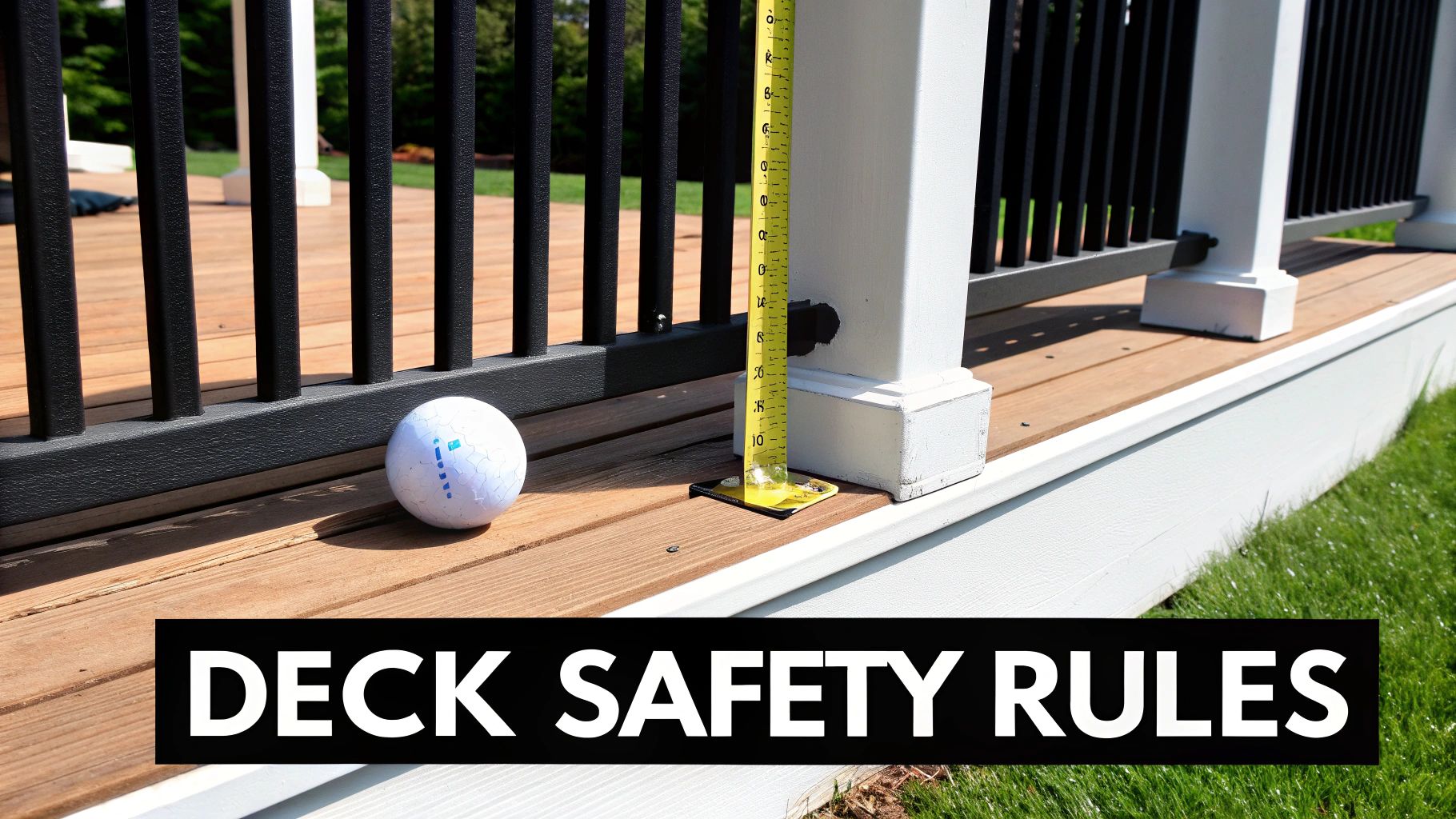
This is probably the most crucial regulation, especially for anyone with young children. It’s known as the ‘100mm sphere rule’, and it’s simple: no gap anywhere in your balustrade should be large enough for a 100mm sphere to pass through. This applies to the space between glass panels, between vertical posts, or under the bottom rail.
That measurement isn't random; it’s based on the average size of a baby’s head, making it a critical child safety feature. This rule has to be front and centre in your design thinking. It guarantees there are no openings where a small child or pet could get stuck or, worse, fall through. It’s also the reason that certain styles, like horizontal wire railings, need extremely careful planning to be compliant in the UK.
A balustrade is a safety barrier, so it has to be strong enough to do its job. It must be able to withstand people leaning on it, the odd accidental bump, and even the force of strong winds—a key point for homes across the North of England. Building regulations specify exactly what kind of forces a balustrade must be able to resist.
For residential homes, this is typically a horizontal line load of 0.74 kN/m applied to the top rail. You don’t need to be a structural engineer, but it's vital that your chosen system and its fixings are certified to meet this standard. A professional installer will make sure the entire structure is anchored securely to a solid subframe, so you can be confident it won’t fail under pressure.
These rules are all part of a common-sense, evidence-based approach to keeping people safe. For a deeper dive, you can get more information on the official building regulations for balustrades to ensure every last detail is covered.
A stunning new balustrade doesn't just happen. The most successful projects are born out of thoughtful planning, long before the first post ever gets fixed into place. Think of it as the essential groundwork that guarantees a smooth installation and a final result you'll be proud of for years to come. For homeowners here in the North of England, that means getting practical about what our unique environment demands, from the strength of your deck to its spot in the garden.
Before you dive into the exciting world of deck balustrade ideas, taking a moment to consider these practical points is crucial. A bit of preparation now saves a world of headaches and costly mistakes down the line, ensuring your new balustrade is not only beautiful but safe and perfectly suited to your home.
First things first: you need to look underneath your deck. The substructure—that hidden framework of joists and beams holding everything up—is the anchor for your entire balustrade system. It absolutely must be strong enough to handle the weight and forces of your chosen design.
This is non-negotiable when it comes to glass balustrades. Glass is heavy, and a sleek frameless system that uses a base channel puts a huge, concentrated load right on the edge of the deck. Your substructure needs to be rock-solid, free from any rot, and may even need reinforcing to create a secure fixing point. An unstable base will undermine the safety of the entire installation.
Where your deck sits in your garden makes a big difference. Up here in the often-blustery conditions of Yorkshire and Cumbria, a deck that's exposed to the elements needs a balustrade system engineered to cope with high wind loads. Getting the glass thickness and fixing method right isn't just a design choice; it's a critical safety requirement.
It’s also worth giving a thought to your neighbours. While a balustrade creates a lovely sense of enclosure, you might want to enhance your privacy. A few strategically placed frosted or opaque glass panels can create a wonderfully secluded spot without blocking out that precious sunlight. It’s a simple touch that can make your outdoor space feel far more personal and relaxing.
You’ll find plenty of balustrade systems sold as DIY-friendly kits, and for someone with the right skills and tools, they can be a great option. For a straightforward, rectangular deck, these kits provide all the components and instructions you need.
However, it’s vital to be honest about the complexity of the job.
Choosing a trusted local installer who knows the ins and outs of regional building practices is often the smartest investment you can make. A professional ensures the installation isn't just flawless but is also fully compliant with UK safety regulations, giving you total peace of mind. A skilled team that understands the conditions in Northern England can also provide priceless advice on the best materials and positioning for your home.
Turning your deck balustrade ideas from a pleasant daydream into a tangible reality starts with one crucial step: understanding the costs. A clear, realistic budget is your best tool for avoiding nasty surprises down the line, ensuring you can choose a system that looks fantastic and offers brilliant long-term value.
The final price tag hinges on a few key factors, and breaking them down is the best way to get a solid grip on your potential investment.
Unsurprisingly, the biggest single influence on your budget is the material and style you choose. A sleek, frameless glass balustrade is typically a premium investment. This is because it demands thicker, tougher glass and precision-engineered base channels to ensure it's completely secure without the support of posts. On the other hand, a framed aluminium system is often more budget-friendly, while still delivering superb durability and a sharp, modern finish.
Beyond that headline choice of system, several other elements will layer on top to determine the overall cost of your project.
This is where you can really put your own stamp on the design, but it’s also where the budget can start to creep up. Adding bespoke touches is a fantastic way to elevate your project from standard to standout, but it’s vital to account for them from the very beginning.
Think of your base balustrade system as the canvas. Every custom feature you add is a brushstroke that adds character and uniqueness to the final picture, each with its own associated cost.
It’s worth considering how these popular customisations might fit into your financial plan:
Embarking on a new decking project always throws up a few questions. To help you finalise your plans with complete confidence, we’ve put together straightforward answers to the queries we hear most often from homeowners right across the North of England.
From simple cleaning tips to how materials stand up to our famously unpredictable British weather, a little extra knowledge goes a long way. It’s the key to making sure your new balustrade doesn’t just look the part, but performs flawlessly for years to come.
Keeping that crystal-clear, premium finish on a glass balustrade is much easier than most people think. For day-to-day grime, a simple wash with a soft cloth and some warm, soapy water will do the trick. Just rinse it off and give it a quick once-over with a squeegee to prevent streaks.
If you want an even lower-maintenance solution, ask about a hydrophobic coating. It's a clever, invisible layer that makes rainwater simply bead up and roll away, taking dirt and dust along for the ride. For homeowners in the wetter parts of Yorkshire and Cumbria, it’s a game-changer that keeps your view pristine with minimal effort.
Absolutely. In fact, when they’re installed correctly to UK standards, they are one of the safest balustrade options you can choose. The glass isn't ordinary window glass; it has to be either toughened or laminated safety glass, which is engineered to be incredibly strong and withstand serious impacts.
Child safety is baked into the regulations. The rules are strict, preventing any gap from being larger than 100mm. This is specifically designed to stop small children or pets from squeezing through, giving you complete peace of mind.
This is a really important question up here, and the answer comes down to one thing: choosing the right material from the start. Aluminium is a fantastic choice as it’s naturally rust-proof. We finish it with a tough powder coating, which adds another layer of protection and lets you pick a colour that matches your home’s style.
If you’ve got your heart set on the timeless look of stainless steel, it is absolutely essential to use Marine Grade 316. This specific grade has alloys that give it superior resistance to corrosion from rain and salty air, making it a must for any outdoor project, especially if you're near the coast. Get this right, and your balustrade will look pristine for years, no matter what the northern weather throws at it.
Think of it as a long-term investment in your home. The lifespan really depends on the quality of the materials and the expertise of the installation. A high-quality system from a reputable supplier isn't a temporary fix; it's engineered to last for decades.
Materials like Grade 316 stainless steel and powder-coated aluminium are exceptionally durable and built to resist corrosion and fading. Toughened safety glass is just as robust and won't degrade over time. By choosing quality materials and a professional installation, you’re not just getting a balustrade—you’re adding a permanent, low-maintenance feature that will bring enjoyment and value to your home for a lifetime.
Ready to bring your deck balustrade ideas to life? The team at Binks Glass Solutions offers local expertise and high-quality systems designed for the North of England. Contact us today for a no-obligation quote and friendly advice.