
Stainless Steel Wire: A Guide for UK Balustrades
You are at the stage where the balustrade design looks settled on paper. Clean glass. Slim posts. Open views. Then […]

You are at the stage where the balustrade design looks settled on paper. Clean glass. Slim posts. Open views. Then […]
You are at the stage where the balustrade design looks settled on paper. Clean glass. Slim posts. Open views. Then the detail work starts, and one question keeps coming up. What stainless steel wire should you use?
That question matters more than many expect. In a wire or glass balustrade system, the wire isn’t decorative trim. It affects how the whole installation feels, how it performs in bad weather, how often it needs attention, and whether it stays smart after years of Yorkshire rain, airborne grime, and winter exposure.
In Harrogate and across the North of England, I’ve found that the best-looking balustrades often come from the least glamorous decisions. Choosing the correct steel grade. Specifying the right strand construction. Matching fittings correctly. Respecting UK load requirements. None of that is exciting in a showroom, but it’s what separates a crisp, long-lasting installation from one that starts looking tired, loose, or tea-stained far too early.
A lot of homeowners begin with the view. They want the patio edge to disappear, the balcony to feel open, or the garden terrace to look modern without blocking the view. That’s a good instinct. A glass and wire balustrade can do that effectively.
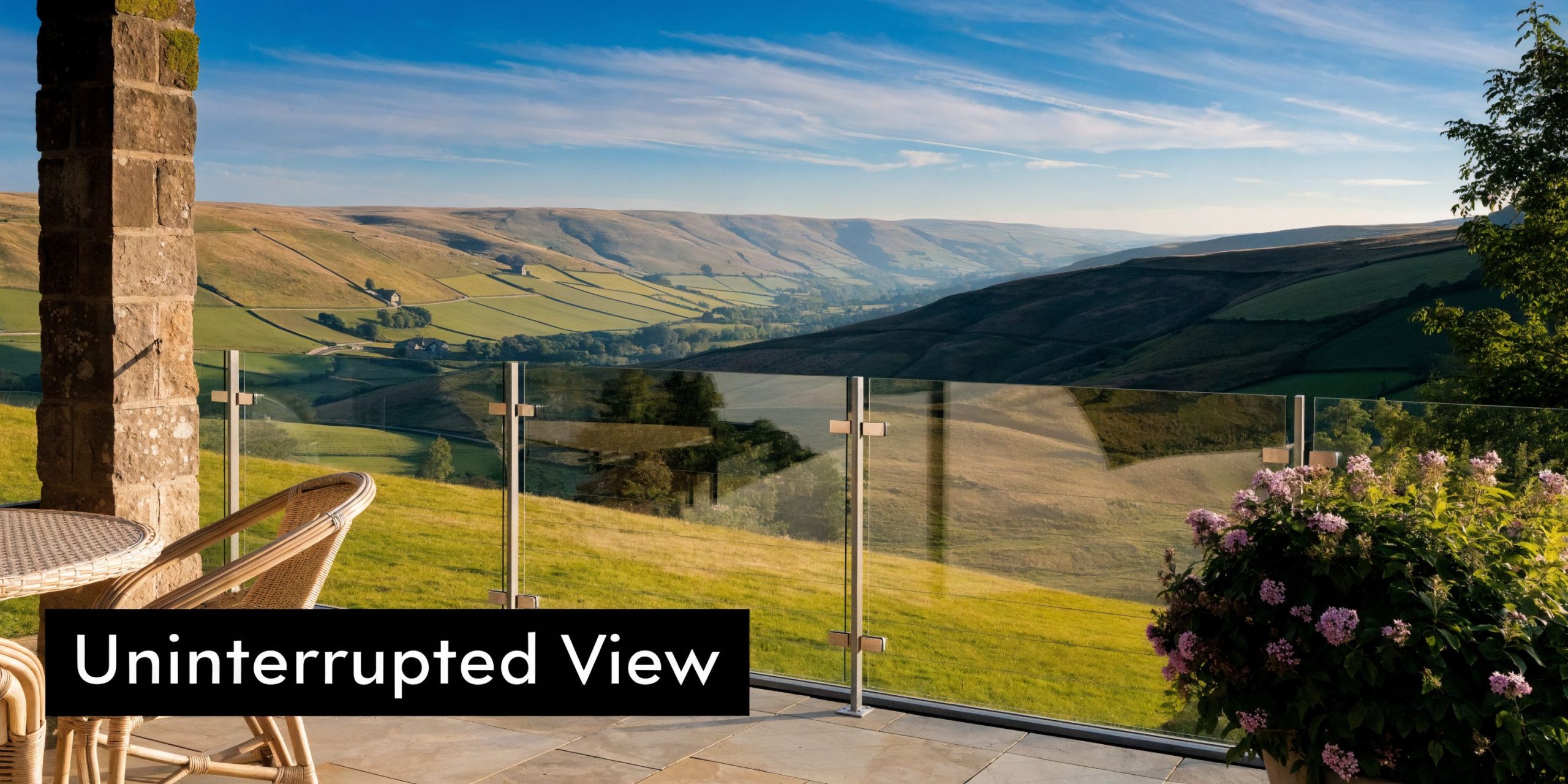
The problem is that people often treat the stainless steel wire as a finishing detail. It isn’t. This material is one of the first specification decisions that should be made, because it influences safety, stiffness, maintenance, and appearance all at once.
On a finished balustrade, stainless steel wire has to do several jobs at the same time:
If one of those parts is wrong, the whole system feels wrong. You see it in wavy cable lines, staining around fittings, or a balustrade that never quite looks settled.
There’s also a bit of northern pride in this material. In 1913, Harry Brearley discovered stainless steel in Sheffield while trying to create erosion-resistant gun barrels. That early “rustless steel” work helped establish Sheffield as a global hub and laid the groundwork for the architectural wires used in balustrades today (history of stainless steel wire in Sheffield).
That history matters because it reminds people that stainless steel wire wasn’t developed for looks alone. It came from a practical engineering problem. That mindset still applies.
Practical rule: If you choose wire by appearance alone, you’re already halfway to the wrong specification.
The most common mistake is assuming all stainless steel wire is more or less the same. It isn’t. Grade matters. Strand construction matters. The environment matters. A sheltered internal stair in Leeds doesn’t need the same material strategy as an exposed terrace near the coast or a rooftop project dealing with driving rain and polluted air.
Another mistake is focusing too heavily on the glass and leaving the wire decision until late. By then, someone often grabs whatever seems standard. That’s how jobs end up over-specified in one place and under-specified in another.
For a balustrade to stay safe and look right, the wire needs to be chosen with the same care as the glass, posts, and base fixings. Get that part right first, and the rest of the system tends to fall into place.
When people ask which stainless steel wire they need, they’re often asking one thing. How long will it last where I live?
That comes down first to grade. For balustrades, the practical discussion often starts with 304 and 316, then moves to duplex 2205 when the site is especially exposed.
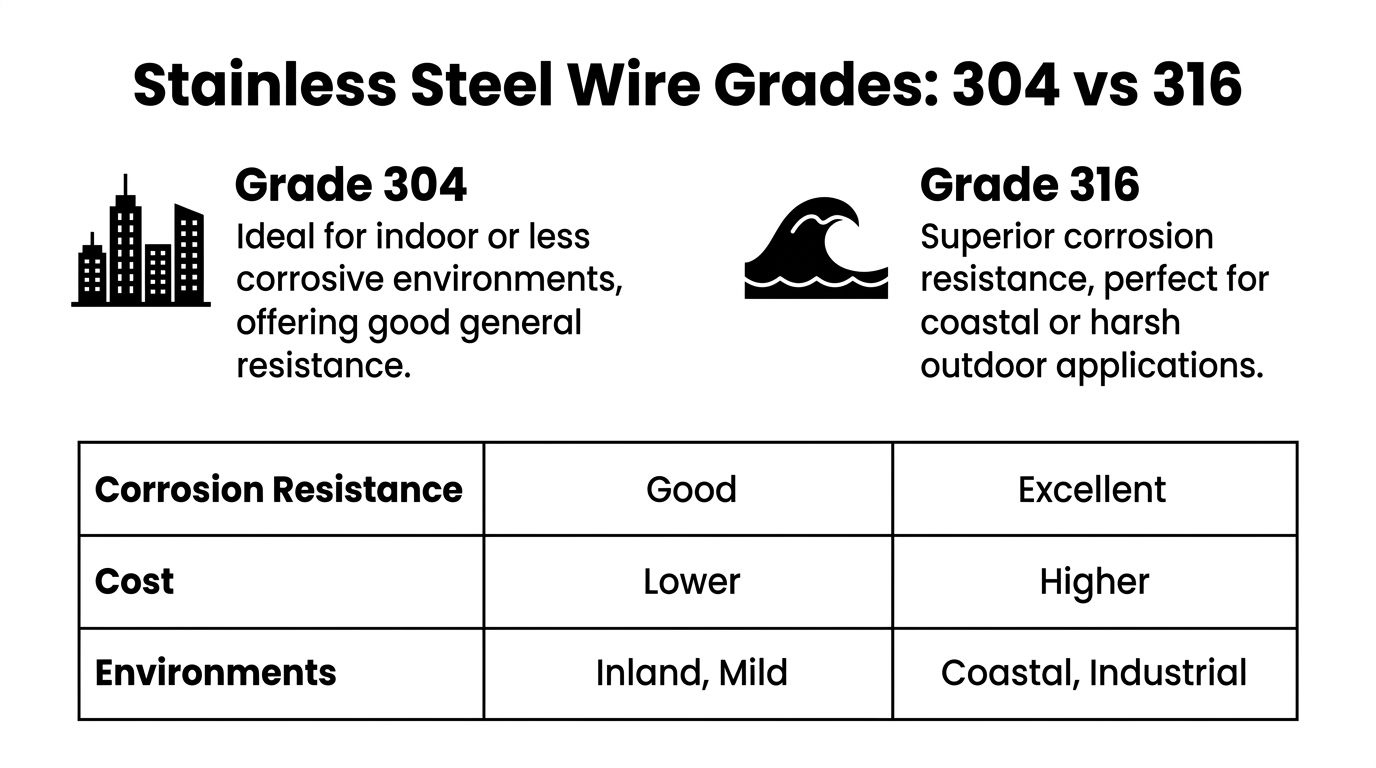
A simple way to look at it is this.
304 is your everyday jacket. Fine for indoor settings and milder inland conditions where the environment isn’t constantly attacking the metal.
316 is more like proper outdoor kit. It’s the default choice for many external balustrades because it offers better resistance when the weather gets harsher.
Then there are sites where even that isn’t enough. Exposed coastal settings, particularly where salt hangs in the air, need more careful thinking.
A lot of people hear “marine grade” and assume 316 can handle any coastal condition. That’s too simplistic. 316 stainless steel has a PREN score of 25, which is below the 32 needed for full saltwater resistance. Duplex 2205 has a PREN score of 34, making it the stronger technical choice for true coastal resilience (2205 stainless steel and PREN comparison).
That matters in places along the North Yorkshire coast, and it also matters for properties that combine weather exposure with industrial or polluted air. Hull is a good example of the kind of location where being casual about grade can come back to bite later.
| Grade | Common Name | Ideal Environment | Corrosion Resistance (PREN) |
|---|---|---|---|
| 304 | Standard stainless | Indoor or milder inland locations | Not specified here |
| 316 | Marine grade stainless | General outdoor balustrades, including many inland and moderately exposed sites | 25 |
| 2205 | Duplex stainless | Severe coastal exposure and harsher salt-laden conditions | 34 |
For most domestic work in inland Yorkshire, the answer depends on exposure, not just postcode.
The cheapest grade that can technically be installed isn’t always the best value. If the site is aggressive, replacing stained or pitted components later costs more than specifying properly at the start.
The right grade isn’t the one with the best marketing label. It’s the one that matches the air, moisture, and contamination your balustrade will face.
There is a trade-off. Better corrosion resistance generally means a higher material cost. That doesn’t mean every project should jump to duplex. It means the specification should be honest.
If the property is inland, sheltered, and not subject to harsh exposure, there’s no point paying for performance you won’t use. On the other hand, if you’re close to the coast or dealing with an exposed terrace, underspecifying to save money is often a false economy.
For anyone comparing materials more broadly, this guide on how to protect metal from rust is a useful general read because it helps explain why environment and surface care matter even when the base metal is corrosion-resistant.
If you’re also weighing stainless options for railings more generally, this page on https://binksbalustrades.co.uk/stainless-steel-for-railings/ is a practical reference point.
The failure point with 304 isn’t always dramatic. Often it starts as disappointment. Light staining. Surface discolouration. More cleaning than expected. A finish that no longer looks crisp against the glass.
That’s why I rarely like seeing 304 used outdoors unless the site conditions support it. It can be the right material in the right place. But “stainless” is not a licence to ignore climate.
Once the grade is chosen, the next decision is the one many non-specialists never ask about. Construction.
Here, two cables can look similar in a sample tray and behave very differently on a real balustrade.
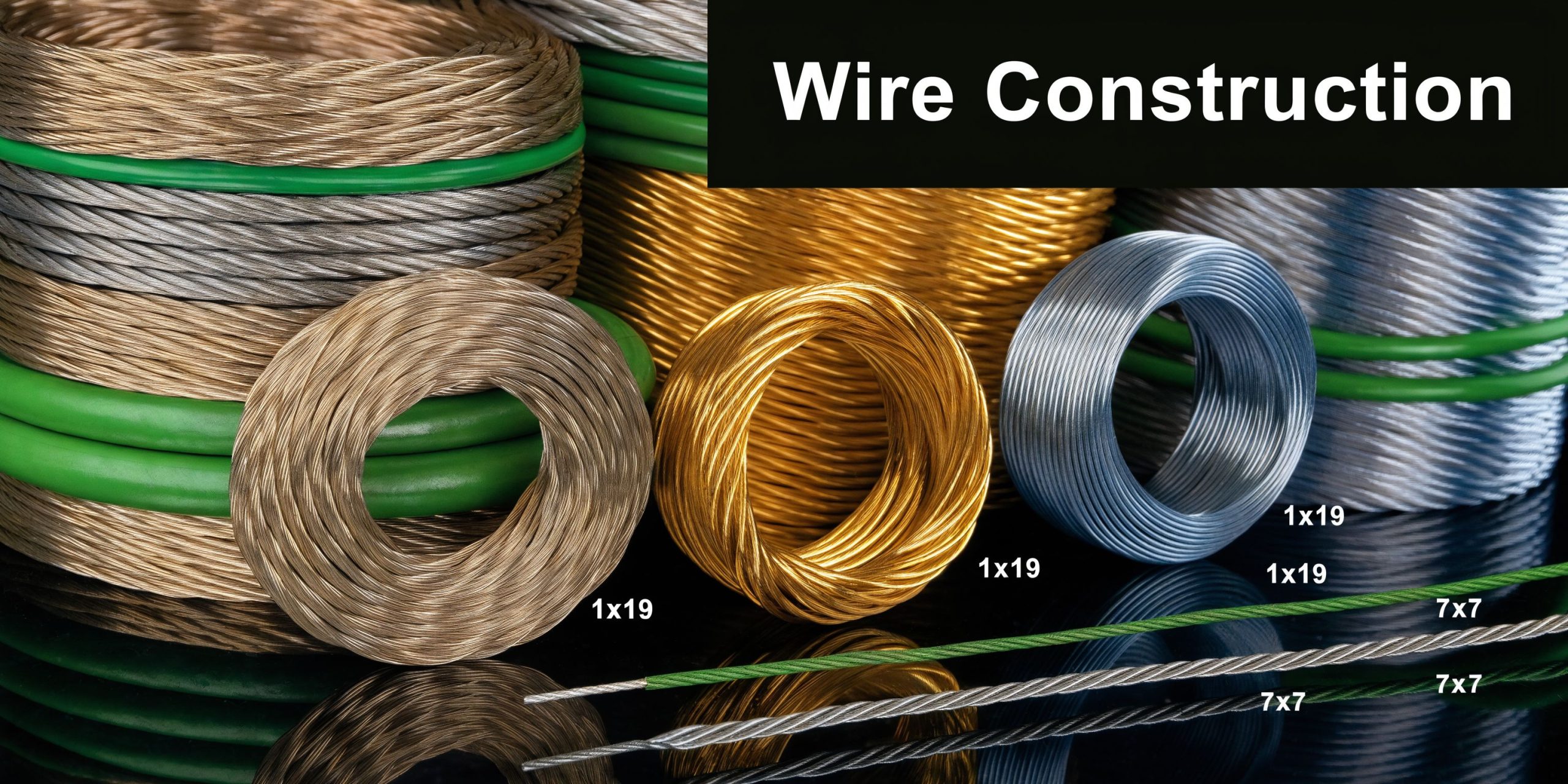
Wire rope isn’t just one solid piece of metal. It’s made up of strands, and the way those strands are arranged affects flexibility, rigidity, surface finish, and stretch.
For balustrades, 1×19 type 316 is the standard recommendation because it offers maximum rigidity and minimal stretch compared with 7×7 or 7×19. It also has a smoother surface and can maintain correct tension over a service life that can exceed 25 years when properly specified and installed (wire rope balustrade design guidance).
That’s not a minor technical preference. It affects how straight the cable line stays and how often the system needs re-tensioning.
A 7×7 cable is built more like a bundle of smaller threads. It bends more easily. That flexibility can be useful in some cable applications, but for balustrades it often creates compromise.
A 1×19 cable behaves more like a slim, disciplined rod. It’s still wire rope, but it feels much firmer and gives a cleaner line.
If someone wants a minimalist result, 1×19 is often the answer.
People often ask whether they should use 3mm, 4mm, or 5mm wire. The honest answer is that diameter should be chosen with the whole system in mind.
The right size depends on things like:
I’d be wary of anyone giving a one-size-fits-all answer on diameter without asking about post centres, fixing details, and the overall layout.
A balustrade cable that looks slim and elegant in a brochure can look underpowered on a long exposed run if the diameter and spacing haven’t been thought through together.
For many domestic balustrades, the best result comes from treating diameter as part of the visual and structural package, not an isolated product choice.
One practical way to approach it is:
The jobs that age well nearly always follow that sequence. The ones that develop sagging lines or awkward detailing often skip it.
A balustrade is a barrier before it’s a design feature. If it doesn’t perform safely, the finish, the view, and the material choice don’t matter.
That’s why regulation has to sit at the centre of any wire balustrade specification, particularly on decks, balconies, raised patios, stair voids, and commercial terraces.
For domestic settings, UK Building Regulations Part K requires balustrades to withstand a horizontal line load of 0.74kN/m (UK guidance on stainless steel wires and balustrade compliance).
That figure is where a lot of casual online advice falls short. People talk about “strong cable” in vague terms, but compliance doesn’t come from sounding sturdy. It comes from a tested, well-designed barrier system.
The same source also notes that a significant portion of balustrade failures stems from undersized wire ropes. That’s exactly the kind of issue that appears when a system is chosen by appearance or price first and engineering second.
One of the biggest misunderstandings is thinking the cable rating is the whole story. It isn’t.
A compliant installation depends on the combined performance of:
You can specify excellent stainless steel wire and still end up with a weak balustrade if the posts flex too much or the fixing points aren’t adequate. The barrier only performs as well as its weakest component.
Manufacturers often publish impressive figures for cable strength, but those headline numbers don’t tell a homeowner what the installed system can safely do day to day.
In practice, what matters is whether the complete balustrade has been specified so it can resist the required load without excessive movement, failure at the fittings, or unacceptable deflection. That is why proper design matters more than isolated product claims.
Site advice: If somebody can’t explain how the wire, posts, and fixings work together under load, they haven’t finished specifying the balustrade.
On projects in places like York, Cheshire, and across the wider North, building control or project sign-off often turns a vague specification into a real problem. Drawings that looked fine at concept stage suddenly need proper technical backing.
That often brings up questions such as:
Those questions are far easier to answer before the order is placed than after the installation is complete.
For a clear overview of the relevant requirements, this guide to https://binksbalustrades.co.uk/building-regulations-for-balustrades/ is worth reviewing.
The safest approach is simple. Treat wire balustrades as engineered barriers, not just architectural details.
That means avoiding undersized cable, resisting the temptation to copy generic online layouts, and making sure the specification reflects the actual setting. A small internal landing, a family patio, and a public-facing terrace don’t all ask the same of the system.
When the wire is properly chosen and the structure around it is well designed, a wire balustrade can look light without being flimsy. That balance is exactly what good specification is supposed to achieve.
Good stainless steel wire won’t rescue poor hardware. In practice, fittings decide whether the system feels precise or frustrating.
The parts are small, but they do serious work. Terminals anchor the cable. Tensioners pull it into line. Posts carry the forces back into the structure. If one part is mismatched, cheap, or badly installed, the weakness can show itself quickly.
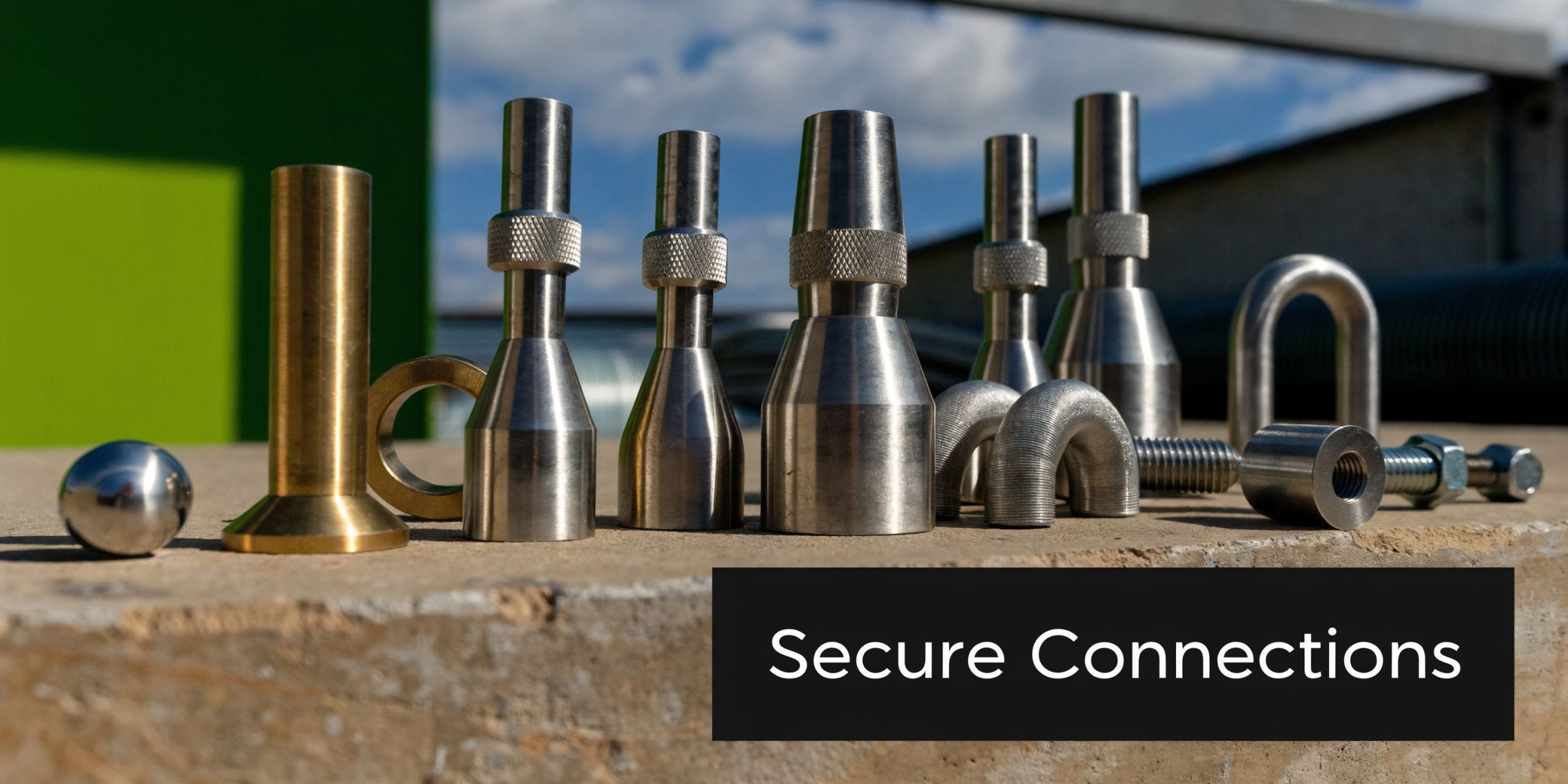
You don’t need a catalogue-level understanding to make sound choices, but you do need to know what each main fitting is there to do.
These secure the cable ends. A swaged fitting is mechanically compressed onto the wire, while a swageless fitting is assembled without that specialist process.
Swageless systems are popular because they can simplify installation and adjustment. The key point is fit. The terminal must be designed for the exact cable construction and diameter being used.
These connect the cable neatly to brackets or posts and create an adjustable end for tensioning.
On a tidy installation, these fittings should look like part of the design, not like an afterthought. Oversized or clumsy terminals can spoil the whole line of the balustrade.
Tensioners do exactly what the name suggests. They allow the cable to be tightened until the run is straight and stable.
Installers can either make the system look sharp here or create problems. Too little tension leaves the line loose. Too much can overload the end posts and fittings.
The best comparison is a guitar string. A string that’s too slack sounds wrong. One that’s over-tightened risks damage. Cable balustrades work in much the same way.
You want a balanced tension across all runs so the visual lines match and the forces stay sensible. Good installers don’t wind each cable as tight as possible. They bring the system up evenly and watch how the posts respond.
Most bad cable installations don’t fail because the material was stainless. They fail because someone treated tensioning like tightening a bolt.
Fittings should also be grade-matched to the cable wherever possible. Mixing metals carelessly is asking for trouble outdoors.
That’s particularly true on exposed sites where moisture sits on the metal and contamination builds up. A balustrade should behave like one coordinated system, not a collection of unrelated shiny parts.
For those doing associated metal prep or trimming on site, this guide to choosing an angle grinder for metal work is useful background. Clean cutting and tidy prep help avoid damage that can undermine the finish later.
A neat result often comes from small disciplined steps:
If you want to see the type of product range people often consider for these systems, https://binksbalustrades.co.uk/cable-for-railings/ gives a helpful overview.
A short visual walkthrough can also help when you’re trying to understand how the components come together in practice.
Most stainless steel wire enquiries end with two practical concerns. What’s this going to cost, and how much looking after will it need?
Both are fair questions. The problem is that people often compare quotes without knowing what’s been specified.
The headline price is shaped by several factors at once:
A cheap quote may still be legitimate. But it can also mean compromises on grade, fittings, finish quality, or the amount of design attention given to compliance and durability.
This isn’t a static market. UK stainless steel wire prices surged by 18% from late 2024 to early 2026 due to import tariffs and supply chain disruption, affecting project budgets in places such as Leeds and Hull (stainless steel wire pricing and strength overview).
That’s one reason written quotations don’t always age well. If you’re planning a larger project or phasing the work, it’s worth checking whether the price is time-limited and whether the specified material is available.
More clients now ask where the steel comes from and whether recycled content is available. That’s sensible. The same source notes that using recycled 316 wire can reduce embodied carbon by 65% compared with virgin material.
That doesn’t remove the need for proper specification, but it does mean sustainability and durability can work together. A lower-impact product still has to be the right product for the environment.
“Stainless” causes confusion because people hear it as “maintenance-free”. It isn’t.
In normal domestic use, the maintenance routine is straightforward:
A well-specified system doesn’t demand constant attention, but it does reward routine care. Most long-term appearance problems start with neglect, not with the concept of stainless steel itself.
If you want the balustrade to keep its crisp finish, treat cleaning as part of ownership, not as a repair job once a problem becomes obvious.
The best way to budget is to work from a clear specification rather than a vague allowance. Decide the grade, the layout, the construction, and the fitting style first. Then compare like with like.
If you’re costing a full balustrade rather than wire alone, using a calculator tool can help you sense-check the numbers before you commit. It’s a practical way to understand how design choices affect the final figure without relying on guesswork.
The same questions come up again and again with homeowners, builders, and specifiers. Often, they’re not asking for theory. They want to avoid a bad decision.
| Question | Answer |
|---|---|
| Is all stainless steel wire suitable for outdoor balustrades? | No. Outdoor suitability depends on the grade, the exposure, and the fittings used with it. |
| Is 316 always enough for coastal locations? | Not always. In harsher salt-laden environments, duplex 2205 is the stronger technical option. |
| Why is 1×19 preferred for balustrades? | Because it gives greater rigidity, lower stretch, and a cleaner appearance than more flexible constructions. |
| Can I pick wire diameter on looks alone? | You shouldn’t. Diameter needs to suit the run length, post spacing, hardware, and barrier performance. |
| Do wire balustrades need maintenance? | Yes. They need periodic cleaning and inspection even when the material is corrosion-resistant. |
| Are the cables the only thing that matters for compliance? | No. Posts, fixings, terminals, and the supporting structure all affect whether the balustrade performs properly. |
That depends on the look you want and how the system is being used. Wire can give a lighter, more open feel and works well where you want definition without visual bulk.
But wire also asks for precision. If the cables aren’t straight, or the fittings look clumsy, the whole balustrade suffers visually. Fully glazed systems can hide poor detailing less graciously in some ways, but cable systems punish sloppy installation very quickly.
Under normal conditions, genuine stainless steel wire is rust-resistant for indoor and outdoor use. In practice, problems tend to arise when the material is damaged, exposed to harmful chemicals, or used in an environment the grade wasn’t suited for.
That’s why proper grade selection and sensible maintenance matter so much. People often blame “bad stainless” when the issue was the wrong alloy in the wrong place.
It can be, provided the design is compliant and the cable spacing, post layout, and tensioning are handled properly. This is one area where cutting corners is risky.
For homes with children, installers and designers also need to think carefully about how the barrier behaves in daily use. A wire balustrade shouldn’t just pass a drawing review. It should perform safely in the habits of the household.
Some can. But stainless steel wire balustrades are less forgiving than they look.
The challenge isn’t just fixing posts and threading cable. It’s getting the whole assembly straight, evenly tensioned, cleanly detailed, and structurally sound. If a builder is experienced with this type of work and the system is well engineered, fine. If not, the margin for awkward results is quite small.
A few warning signs show up repeatedly:
Choose the wire as part of a complete balustrade system, not as a standalone item. That means matching grade to environment, matching construction to use, and making sure the terminals, posts, and fixings belong to the same design logic.
When that happens, stainless steel wire does exactly what people want from it. It disappears into the view, holds its line, and still looks right years later.
If you’re planning a patio, balcony, terrace, or internal landing in Harrogate or the wider North, Binks Balustrades can help you work through the right balustrade option for your site, budget, and level of exposure. You can get practical advice, clear pricing, and support with a system that looks clean and performs properly.