
Expert Guide to Glass Railing for Balcony: Types, Costs & UK Safety
A modern glass railing for a balcony isn't just a safety barrier; it’s a design choice that opens up your […]

A modern glass railing for a balcony isn't just a safety barrier; it’s a design choice that opens up your […]
A modern glass railing for a balcony isn't just a safety barrier; it’s a design choice that opens up your home, connects you with the outdoors, and adds a real touch of class. It’s the perfect blend of strength, style, and surprisingly little upkeep, making it a brilliant investment for any property.
Picture this: you step out onto your balcony, and there’s absolutely nothing between you and the landscape. That's what a glass railing delivers. It acts as an invisible frame for your view, flooding your home with natural light and adding genuine value to your property.
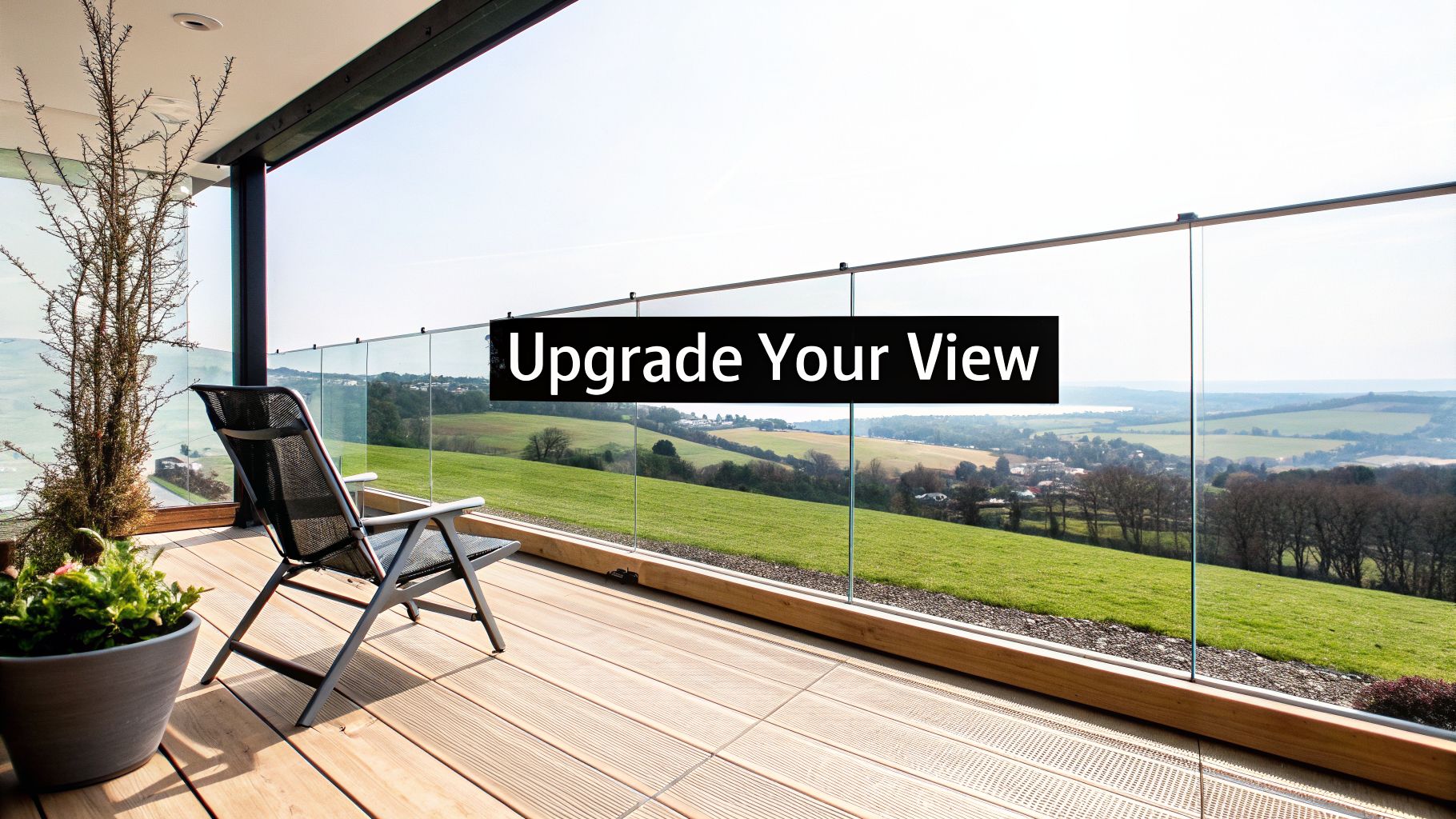
This guide is for homeowners across Northern England, from the beautiful hills of Harrogate to the leafy suburbs of Cheshire, who want to understand their options inside and out. Glass has quickly become the go-to material, and for good reason—it offers a fantastic mix of durability, elegance, and low maintenance.
Picking a balustrade is a huge decision for any balcony project. While traditional materials like timber or iron have their place, glass brings a unique set of benefits that are perfect for the modern home.
For more inspiration, looking at different modern outdoor decks designs can be really helpful. These spaces often share the same principles of clean lines and open-air living that make glass balconies so popular.
A glass railing for your balcony is akin to installing a large picture window for your outdoor area. It frames the view without interrupting it, blending safety with a seamless connection to the environment.
Our goal with this guide is to give you the confidence to get your project started. We’ll introduce you to helpful tools like the Balustrade Calculator, a simple way to get a custom price for your specific needs. By arming you with clear information from the get-go, we want to empower you to make great decisions and bring your vision to life. Let's dive in and see how a glass railing can truly transform your balcony.
When you’re thinking about a new balustrade, it’s natural to focus on how it looks. But the reason so many homeowners across the UK are choosing a glass railing for balcony projects goes far deeper than just its clean, modern style. The practical advantages offer real, day-to-day value, turning what is a safety requirement into a genuinely smart upgrade for your property.
Think of a glass balcony railing less as a barrier and more like a huge, invisible window at the edge of your home. Unlike timber posts or metal bars that can chop up a view and create a caged-in feeling, glass panels let natural light pour in without interruption. This doesn't just brighten up your balcony; it floods the adjoining rooms with light too, making your entire home feel more spacious and airy.
Anyone living in Northern England, from the windswept coasts of Cumbria to the urban sprawl of Leeds, knows that durability isn’t a luxury—it’s a necessity. Our weather can be brutal on exterior fittings, and this is where glass truly comes into its own. It holds its own against driving rain, high winds, and freezing temperatures without flinching.
Wood can rot, warp, and demands constant repainting. Iron is always fighting a battle with rust. Toughened safety glass, on the other hand, is non-porous and incredibly resilient. It won't degrade or turn brittle over time, giving you the peace of mind that your balcony is safe and looks immaculate year after year, no matter what the season throws at it.
In a world where everyone is short on time, low-maintenance features are a godsend. One of the standout benefits of a glass railing for a balcony is how simple it is to look after. Forget the annual chore of sanding, staining, or sealing. Keeping your view crystal-clear usually takes nothing more than a quick wash with soapy water and a squeegee.
This is a world away from the constant upkeep required by other materials. Wrought iron, for example, needs regular checks for rust and a fresh coat of paint every few years to maintain both its look and its structural strength.
Industry data shows that for managers of residential blocks, glass railings can cut maintenance costs by as much as 40% compared to traditional wrought iron systems, purely because of their non-porous, easy-to-clean surfaces.
This easy-care quality doesn't just save you time and hassle; it reduces your long-term costs, making glass a truly practical and economical choice.
Perhaps the most compelling benefit of all is the direct impact a glass balustrade can have on your property's value. A sleek, modern glass balcony is a premium feature that seriously boosts a home’s kerb appeal and, ultimately, its resale price. It tells potential buyers that a property is high-quality, stylish, and connected to the outdoors—a combination that is hugely attractive, especially in competitive markets like York and Harrogate.
This isn’t just speculation; it’s backed by hard data. In high-end property developments, the addition of glass panels that offer unobstructed views is a major selling point. Architectural surveys show that features like this can increase property resale values by up to 20-30% in desirable urban areas. For more details, you can explore the research on railing industry analysis. A beautiful, functional glass balcony isn’t just an expense; it’s a strategic investment in the future worth of your home.
Now that we’ve covered the practical advantages, it’s time for the exciting part: choosing the system that brings your vision to life. Picking the right glass railing for a balcony isn't just a technical decision; it's about matching the design to your home's character, your budget, and how much of that stunning view you want to let in.
Let's walk through the main styles available. Each one uses a different method to hold the glass in place, which is what gives it a unique look and feel. Understanding these core components—the channels, spigots, and posts—is the key to finding the perfect fit for your project.
If you're after that 'wow' factor and a completely seamless connection with the outdoors, nothing beats a frameless glass railing. These systems are the pinnacle of minimalist design, creating a breathtaking 'floating glass' effect by doing away with vertical posts altogether. The toughened or laminated glass panels are secured only at their base, forming a barrier that’s as close to invisible as you can get.
There are two main ways we achieve this clean, modern look:
The appeal of frameless systems is undeniable, and their popularity is soaring. The UK's frameless glass railing market is a leader in Europe, with projections showing steady growth of around 6.6% annually from 2024 to 2029. This is driven by their ability to deliver superior aesthetics while exceeding strict safety standards. For instance, UK regulations require railings to resist a horizontal force of 0.74 kN/m, and the thicker 12-15mm glass used in these systems provides incredible strength while often reducing the overall structural load by up to 30%.
Perhaps you love the clarity of glass but prefer a more defined structure. If that's the case, a semi-frameless system offers the perfect middle ground. This popular style uses slim, elegant posts between the glass panels, providing clear structural support without ever dominating the view.
The posts are typically made from marine-grade stainless steel or powder-coated aluminium, giving them excellent durability to stand up to the North of England's weather. It's a fantastic compromise, balancing the open, airy feel of a frameless system with the cost-effectiveness and visible structure of a more traditional railing.
To help you decide, here’s a quick comparison of the most popular glass railing systems we offer.
| System Type | Key Feature | Best For | Aesthetic | Typical Cost |
|---|---|---|---|---|
| Frameless Channel | Continuous base channel | Ultimate minimalist look; uninterrupted views | Clean, seamless, 'floating glass' | £££ |
| Frameless Spigot | Discrete floor clamps | Airy, modern feel; minimal hardware | Elegant, raised glass panels | £££ |
| Semi-Frameless | Posts between panels | Defined structure with good visibility | Classic, versatile, and robust | ££ |
Each system offers a distinct aesthetic, and seeing how they compare on cost and style can make your decision much clearer.
The type of glass you choose is just as important as the system that holds it. The best way to think about the two main safety glass options is to compare them to your car's windows.
Toughened Glass is like your car's side windows. It's heat-treated to be much stronger than normal glass. If it ever breaks, it shatters into thousands of small, pebble-like pieces that are far less likely to cause injury. This is why it’s a standard for safety glass.
Laminated Glass is like your car's windscreen. It's actually a sandwich, made of two sheets of glass with a clear plastic interlayer (PVB) bonded between them. If the glass breaks, that interlayer holds all the fragments in place, keeping the panel intact and preventing anything from passing through.
For many balcony projects, especially those at height or in public spaces, we recommend laminated glass for that extra layer of safety and complete peace of mind. To explore this topic in more detail, you might find our guide on choosing the right glass for your balcony helpful.
This infographic neatly sums up the core benefits that all these glass systems will bring to your property.
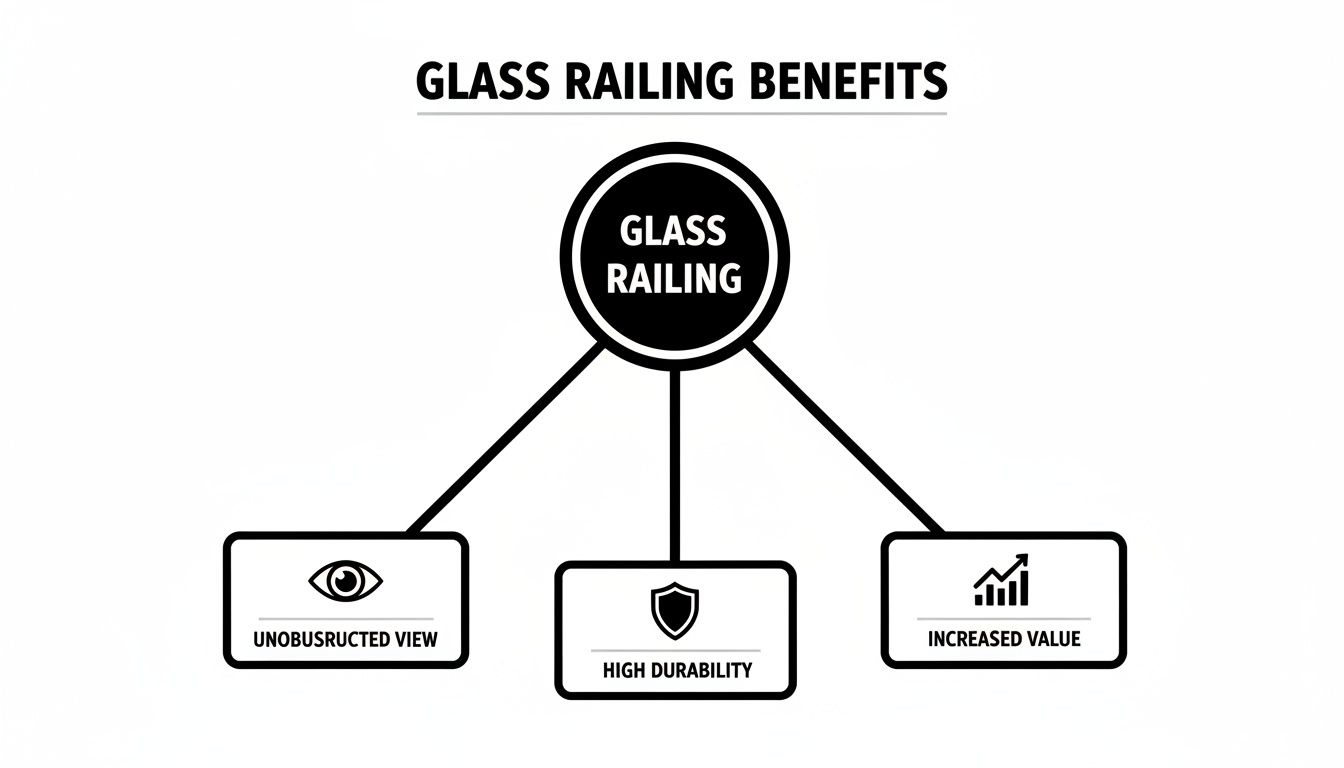
As you can see, a glass balustrade is a fantastic investment, delivering unobstructed views, exceptional durability, and a genuine boost to your property's value. Your choice of system—whether frameless or semi-frameless—simply allows you to tailor these benefits to your exact style and budget. You can explore all of these options and get instant pricing using our online Balustrade Calculator.
A beautiful glass railing for a balcony does more than just look good; its most important job is keeping you and your loved ones safe. This is where UK Building Regulations come in. While the rules can seem a bit daunting, getting to grips with the core safety standards empowers you to choose a system that’s not just stylish, but completely secure and compliant.
For any balcony, staircase, or raised area, the key rulebook is Approved Document K, Protection from falling, collision and impact. This isn’t just a set of friendly suggestions; it’s a legal requirement designed to prevent accidents and ensure every installation is absolutely fit for purpose.
The most critical measurement for an external domestic balcony is the height of the railing itself. To provide proper protection from falls, UK regulations are very clear on this point.
Another vital rule relates to the gaps within the balustrade. This one is specifically designed to protect small children who might otherwise try to squeeze through.
These rules are not arbitrary. Shockingly, falls from balconies are a significant cause of domestic accidents. HSE reports indicate they account for 10% of such incidents, which has rightly led to much stricter enforcement. It’s also why modern laminated glass options, which far exceed the older 6mm toughened glass standards for shatter resistance, have become the go-to choice. You can see how safety drives the market in recent European glass railing market reports.
Beyond just height and gaps, a glass railing must be strong enough to handle real-world forces. Imagine several people leaning against the railing at once—it has to hold firm, without question. This is where load-bearing requirements, outlined in BS 6180:2011, become crucial.
This British Standard specifies the forces a barrier must be able to resist. For a typical single-family home, the railing must withstand a uniform distributed load of 0.74 kN/m (kilonewtons per metre), which simulates the pressure of people leaning along its length.
A simple way to picture this is to think of the railing needing to be strong enough to support the weight of a heavy adult leaning firmly against every single metre of its length, all at the same time, without flexing or failing.
This is exactly why professional specification is so important. A specialist will ensure the glass thickness, fixing type, and materials are all correctly engineered to meet this standard, giving you absolute confidence in its strength.
Finally, where you live in the North of England can play a big part in your balustrade's specification. A coastal property in Cumbria or an exposed hilltop home near the Yorkshire Dales will face far higher wind loads than a sheltered city balcony in Leeds.
These environmental forces have to be calculated and factored into the design to ensure the glass and fixings can handle the extra stress. This is another area where an expert’s knowledge is invaluable, as they can specify a system that is robust enough for your specific location. Navigating these rules is essential, and you can learn more by checking out our detailed guide on UK glass balustrade regulations. Getting it right from the start means no costly compliance headaches and, most importantly, total peace of mind.
Right, you’ve seen the possibilities and you're picturing that perfect glass railing on your balcony. Now for the exciting part: turning that vision into a real, workable plan. This is where we move from the daydream to the details, mapping out the practical steps and getting a firm grip on the costs involved. A solid plan is what gives you the confidence that the final result will be every bit as good as you imagined.
Before you can get a quote, you need to grab a tape measure and get some basic information. First, take careful measurements of the total length where the new balustrade will run. Just as important is identifying the substrate—that’s the surface your balustrade will be fixed into. Is it timber decking, a solid concrete base, or steelwork? Knowing this is crucial because it dictates the specific fixings needed for a rock-solid, secure installation.
Once you have those measurements, figuring out the cost is refreshingly simple. We developed our online Balustrade Calculator to give you an instant, transparent quote in just four quick steps. It takes all the guesswork out of budgeting.
The calculator gets to work instantly, generating a detailed estimate based on your exact choices. It’s designed to make the budgeting process clear and predictable right from the very start.
While our calculator is an excellent starting point, several variables can fine-tune the final price of your glass balcony railing. When you’re pulling your budget together, it’s helpful to keep these factors in mind.
For larger or more intricate jobs, accurately estimating every detail is vital. It’s why professionals in the trade often use tools like Exayard construction estimating software to help manage all these moving parts.
As a general guide, you can expect professionally supplied and installed glass balustrades to range from around £250 to £500+ per linear metre. Semi-frameless systems typically sit at the lower end of this scale, while high-specification frameless systems will be at the upper end.
This price range usually covers the glass, all the necessary hardware, and the professional installation itself. For a more precise breakdown tailored specifically to your project, you can dive deeper by exploring our guide on glass balustrade costs.
Getting to grips with these elements puts you in the driver’s seat. It empowers you to create a realistic budget and make smart decisions that perfectly balance style, safety, and cost.
One of the best things about choosing a glass railing for a balcony is just how refreshingly easy it is to look after. Forget the constant upkeep of other materials; with a simple, consistent routine, your view will stay crystal-clear for years, keeping your outdoor space looking as pristine as the day it was installed.
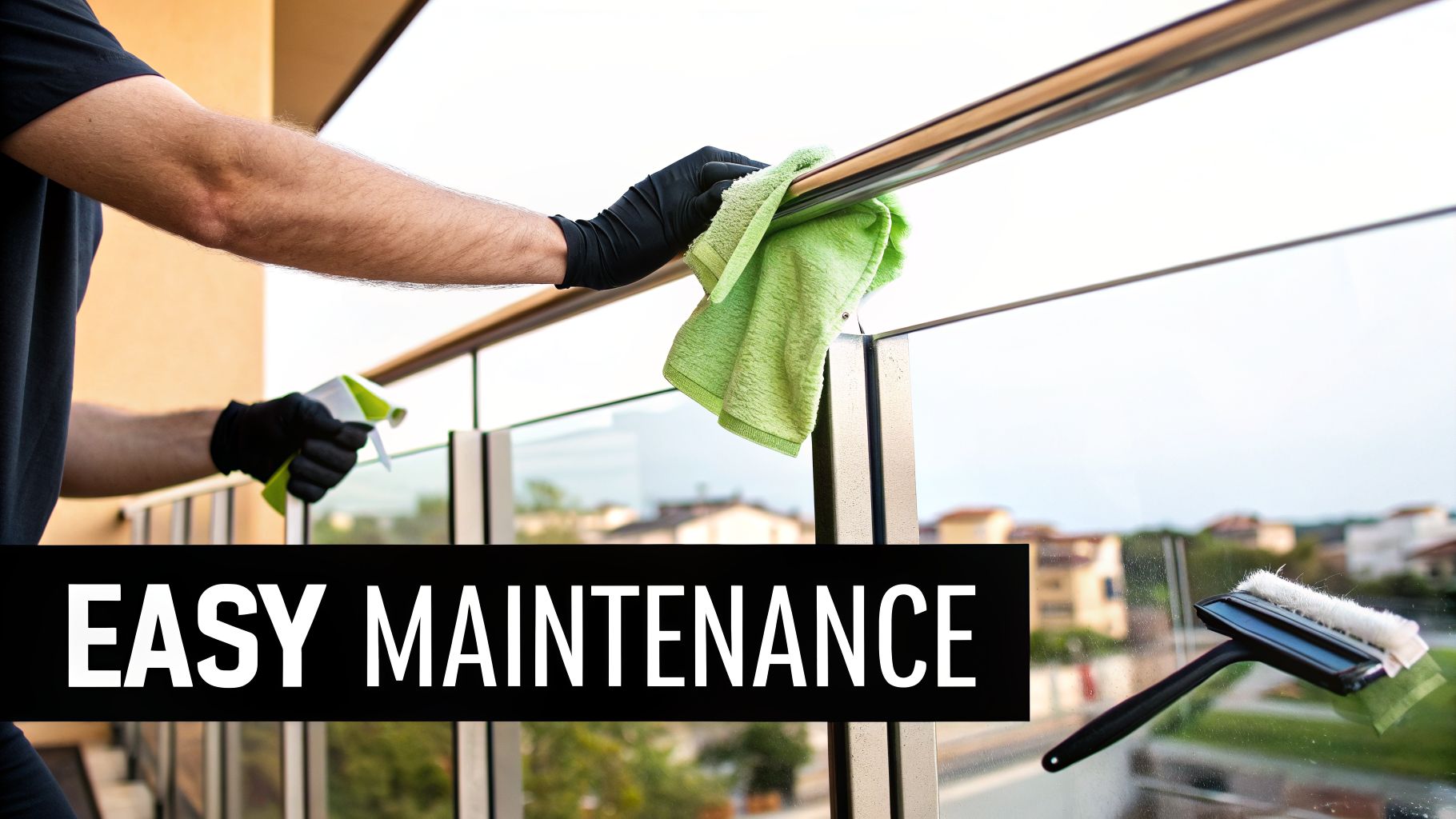
Unlike timber that demands endless staining or iron that needs constant rust treatment, glass asks for very little in return. A straightforward clean is really all it takes to preserve its sparkle and transparency.
You can put away the harsh chemicals and expensive, specialised products. To keep your glass looking its absolute best, all you really need is a bucket of warm water with a few drops of standard washing-up liquid.
For stubborn hard water spots, a common headache in many areas of the UK, just mix a solution of equal parts white vinegar and water. Spray it on, let it work its magic for a few minutes, then give it a gentle scrub with a non-abrasive cloth before rinsing clean.
While the glass itself is incredibly low-maintenance, it’s just good sense to spend a few minutes once a year checking over the hardware holding your system together. This simple inspection gives you complete peace of mind that everything is still solid and secure.
Have a quick look to ensure all fixings, clamps, and posts are tight and show no signs of movement. If you have stainless steel components, a quick wipe with a dedicated stainless steel cleaner will bring back their shine and add a protective layer against the elements.
This brief yearly check is all it takes to ensure your glass railing for balcony remains a safe, beautiful, and valuable feature of your home for decades.
Even after diving into the details, you probably still have a few questions floating around. That’s completely normal. We’ve put together some of the most common queries we hear from homeowners across the North of England, giving you the straight-talking answers you need to make your final decision with confidence.
This is often the very first question we get asked by families, and it’s the most important one. The answer is a resounding yes. Modern glass railings for a balcony are engineered with safety as the absolute top priority. We use incredibly strong toughened or laminated safety glass.
These systems are not just designed to meet UK Building Regulations; they are built to exceed them. This includes the rules on minimum height (1100mm for external balconies) and the critical "100mm sphere rule," which ensures no gap is large enough for a small child to squeeze through. For the ultimate peace of mind, laminated glass provides an extra layer of security—if it ever did crack, it holds together, much like a car’s windscreen.
This is a very practical concern, whether you’re in the Yorkshire Dales or looking out over the Cumbrian coast. Our glass railing systems are built specifically for the demanding UK climate. The glass itself is non-porous, which means it’s completely unfazed by driving rain, frost, or sharp temperature changes. It won’t degrade, warp, or go brittle over time.
Of course, the supporting hardware is just as important.
For any project in a coastal or high-moisture area, we will always specify marine-grade 316 stainless steel for all posts and fixings. This grade includes an element called molybdenum, which dramatically boosts its resistance to corrosion from saltwater and rain. It’s our guarantee that your railing will stay strong and look pristine for years to come.
While some highly skilled DIY enthusiasts might feel up to the challenge of a simple system, we strongly advise against it for a balcony project. A glass railing is a critical safety feature, and its entire integrity relies on a secure and correct fixing to the building’s main structure.
Getting this wrong can have serious consequences, not just for safety but also for compliance with building codes. Local experts and trusted installers across the North, from Leeds to York, can offer detailed advice and ensure the job is done perfectly.
Getting a clear and accurate cost for your project is much simpler than you might think. The quickest way is to use our online Balustrade Calculator. It’s a simple tool that walks you through the process in just four steps.
The calculator will give you an instant, itemised estimate tailored to your exact needs. If you have a more complex design or would just rather talk it through with a person, our team is always on hand. We can put you in direct contact with specialists who know the ins and outs of projects in areas like Harrogate and Cheshire, ensuring you get expert local service.
Ready to take the next step and see what’s possible for your home? The team at Binks Balustrades is here to provide expert advice and connect you with the best local specialists in the North of England. Contact us today to bring your vision to life.