
Laminated Toughened Glass A Guide to Balustrade Safety and Cost
When it comes to choosing the glass for a balustrade in your Northern England home, the decision really boils down […]

When it comes to choosing the glass for a balustrade in your Northern England home, the decision really boils down […]
When it comes to choosing the glass for a balustrade in your Northern England home, the decision really boils down to two main options: standard toughened glass and laminated toughened glass. While both are official safety glasses, the way they perform after a heavy impact is worlds apart. The key takeaway is this: laminated toughened glass stays in one piece when it breaks. This provides a continuous barrier to prevent falls, making it absolutely essential for balconies, raised patios, and any area where a fall from height is a risk.
Picking the right glass is easily the most critical step in any balustrade project. It's a careful balancing act between safety regulations, the look you want to achieve, and your budget. This choice doesn't just shape the appearance of your property—from a patio in Harrogate to a commercial terrace in Leeds—it also determines whether you’re compliant with UK Building Regulations.
Ultimately, the decision comes down to understanding how each type of glass behaves under pressure. Both are miles stronger than the standard annealed glass you'd find in an old window, but what happens after they break creates two very different safety situations.
Toughened Glass: This glass is engineered to shatter into thousands of small, blunt, pebble-like pieces upon a severe impact. While this design prevents life-threatening injuries from large, sharp shards, it also means the opening is left completely empty and unprotected.
Laminated Toughened Glass: This is a composite material. It’s made of two sheets of toughened glass bonded together with a strong plastic interlayer (PVB or SGP). If the glass shatters, the broken fragments stick firmly to this interlayer, keeping the panel intact and maintaining a crucial safety barrier.
This image really drives the point home, showing exactly how each glass type fails.
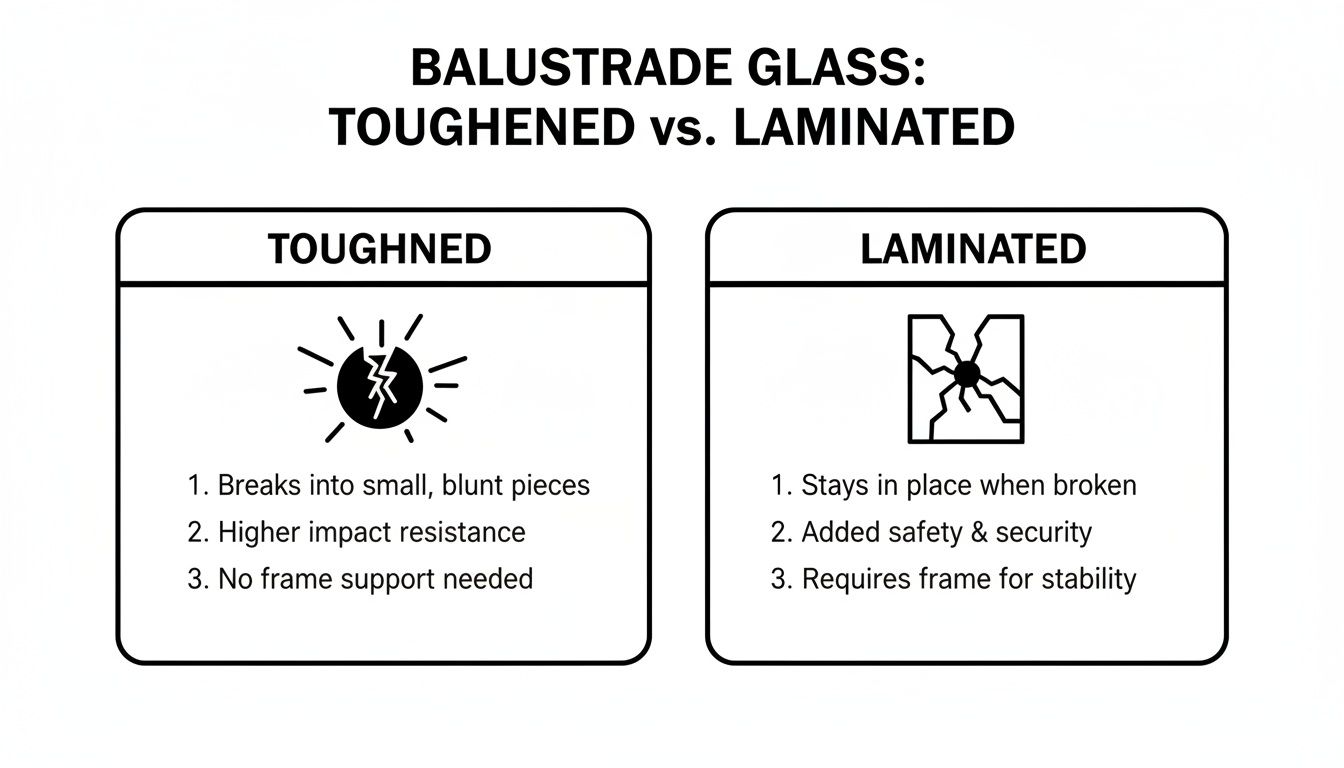
As you can see, toughened glass simply disintegrates, while the laminated panel holds its form—a vital safety feature for any balustrade at height. To see how these materials look in real-world settings, you can find inspiration from a range of stunning North Yorkshire architectural projects.
For a proper deep-dive into the technical side of things, we cover more on material specs in our detailed guide on selecting the right glass for your balcony. Getting to grips with these fundamental differences is the first step to making a safe, informed choice for your project.
To really get why toughened and laminated glass perform so differently in a balustrade, it helps to peek behind the curtain at how they’re made. Their unique manufacturing journeys are what give each type its specific strength and safety credentials. While both start life as ordinary annealed glass, the paths they take couldn't be more different.
This transformation is what turns a fragile sheet of glass into a robust safety barrier, perfect for a modern home in Yorkshire or a busy commercial space in Leeds.
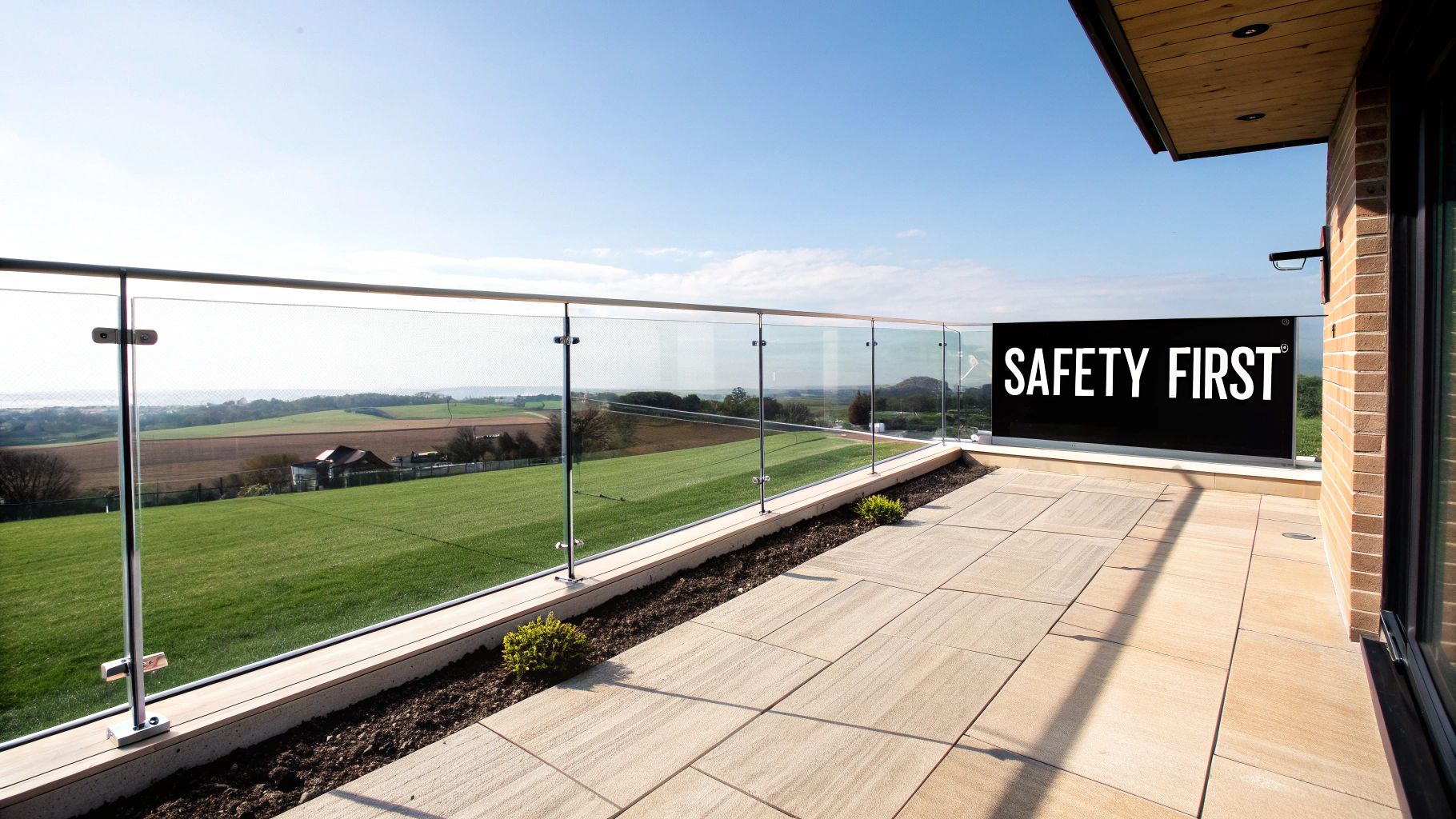
Creating standard toughened glass involves a dramatic process of intense heat and rapid cooling, a technique known as thermal tempering. Think of it as being a bit like forging steel, but for glass.
The process is quite specific:
This quenching stage is where the magic happens. As the outside of the glass cools and solidifies first, the slower-cooling inside pulls inwards. This creates a state of permanent, high tension locked in the centre of the glass, while the outer surfaces are forced into powerful compression.
This carefully engineered internal stress is precisely what gives toughened glass its incredible strength—making it four to five times stronger than normal glass of the same thickness. It’s also why, on the rare occasion it does break, it shatters into small, blunt-edged cubes, releasing all that stored energy in a controlled, safer way.
Laminated toughened glass takes this already strong material and elevates its safety performance to the next level. Instead of a single pane, it’s a composite structure; you can think of it as a "glass sandwich."
The manufacturing process involves bonding two or more sheets of toughened glass together. This is done using a tough, transparent interlayer, usually made from Polyvinyl Butral (PVB). The glass sheets and the PVB interlayer are then fused together under intense heat and pressure inside a specialised oven called an autoclave.
This layering technique is the secret to its incredible post-breakage strength. If a panel of laminated toughened glass is hit with enough force to break, the shattered fragments stick firmly to the PVB interlayer. The panel stays whole, maintaining a protective barrier and preventing a dangerous hole from opening up—an absolutely critical feature for any balustrade protecting a fall.
The true test of safety glass isn’t just how strong it is, but what happens when it finally fails. This post-breakage performance is the single most important factor separating standard toughened glass from laminated, and it dictates exactly where and how each type can be safely used.
While both are engineered to take a serious knock, their reactions upon shattering are worlds apart, leading to completely different outcomes in a real-world scenario.
To really get to grips with this, it’s helpful to start by understanding the inherent vulnerabilities that cause glass to break. This basic knowledge is the foundation upon which safety glass is designed. Both toughened and laminated glass are engineered specifically to overcome these weaknesses, but they do so with very different end goals in mind.
When standard toughened glass reaches its breaking point, it releases all its internal stress in one dramatic moment. The entire panel instantly fractures into thousands of small, granular, cube-like pieces. This is by design—the fragments are relatively blunt, which massively reduces the risk of deep cuts compared to the large, sharp shards from ordinary annealed glass.
But here’s the problem, especially for balustrades: the opening is left completely vacant. The glass essentially vanishes, removing the protective barrier in an instant. For a ground-level patio in Harrogate, that might be a low-risk situation. But for a first-floor balcony in Leeds, it creates an immediate and severe fall hazard.
This is where laminated toughened glass truly proves its worth. When one or even both of its glass layers break, the tough PVB interlayer holds the shattered pieces firmly together. Instead of disintegrating, the panel remains intact, usually with a characteristic 'spider-web' pattern of cracks.
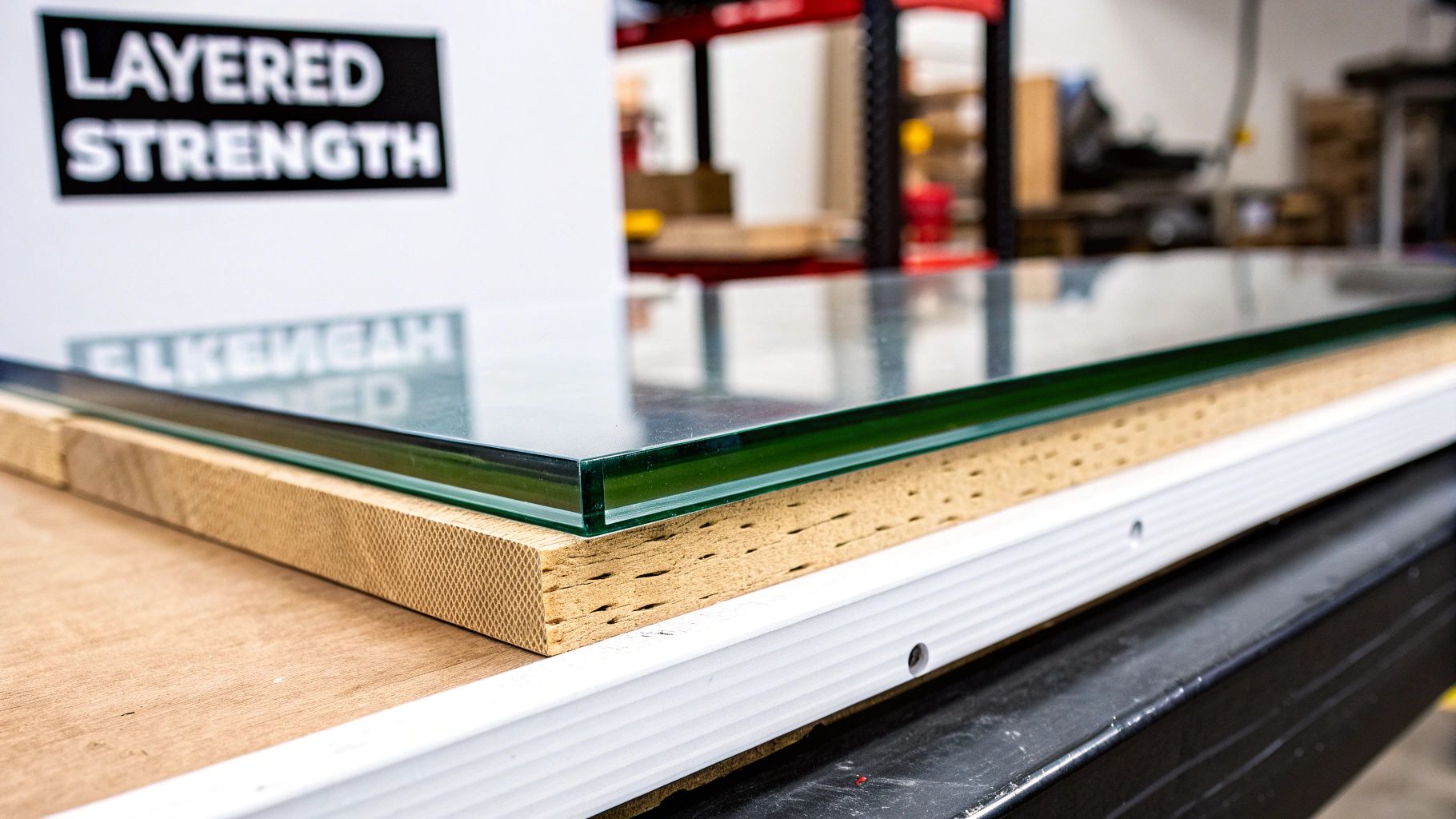
This ability to remain in the frame as a protective barrier is precisely why it is mandated for 'critical locations' under UK safety standards like BS 6180. Even when broken, it continues to provide a vital safeguard against falls—a non-negotiable feature for architects and builders working on projects from Cumbria to Cheshire where safety at height is paramount.
This performance gap is a key reason for its growing specification in the UK. The demand for laminated toughened glass is a major factor in the strength of the UK's overall toughened glass market, which is projected to hit USD 2,563.86 million by 2025. This growth is fuelled by safety-conscious builds, signalling its booming appeal for homeowners in Cheshire and architects in Hull who need to specify glass barriers that can slash injury risks by over 90% in fall-related scenarios.
Meeting these safety standards isn’t just good practice; it's a legal requirement. For homeowners and developers alike, getting the details right is vital. You can learn more by reading our detailed guide on the building regulations for balustrades, which explains exactly when and where laminated glass must be used to ensure your project is both safe and fully compliant.
Beyond its strength, the type of glass you choose has a huge impact on the look and feel of your space. While both toughened and laminated options deliver that sleek, modern finish, laminated toughened glass has a few extra tricks up its sleeve, especially when it comes to peace and quiet.
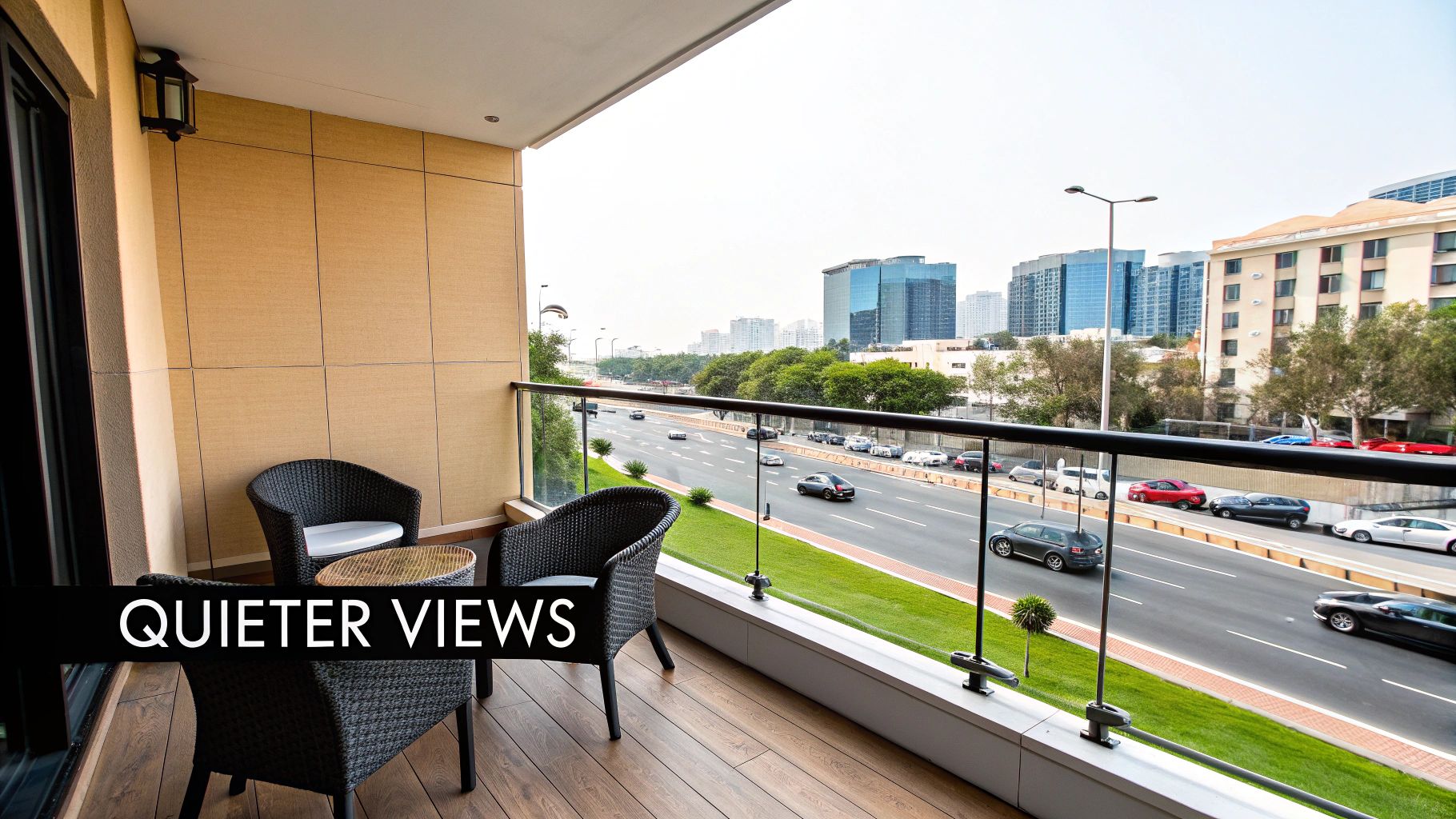
The secret lies in the PVB interlayer sandwiched within laminated glass. This slim plastic core is surprisingly brilliant at disrupting sound waves, meaning it can significantly cut down on noise pollution. For a property in a busy urban centre like Leeds, or a hotel in York wanting to create a tranquil terrace for guests, this single feature can be a complete game-changer.
Let’s be clear: standard toughened glass does very little to block out sound. Laminated glass, on the other hand, makes a real, noticeable difference in reducing ambient noise and creating a more serene environment.
Think about the impact in a commercial setting. We’ve seen hospitality managers in York upgrade their terraces and find that laminated glass can reduce external noise by up to 30-40%, particularly when using specialist acoustic interlayers. That’s a direct improvement to the customer experience, all from a simple architectural choice. This technology, refined in premium electric cars to create quieter cabins, is now being adopted for high-end building projects. Further insights on this can be found in discussions around modern building design in Northern England.
Visually, both glass types offer fantastic clarity and can be finished with perfectly polished edges. But once again, laminated glass opens up a world of creative possibilities that toughened glass just can't match.
The interlayer in laminated glass doesn’t just have to be clear. It can be produced in a huge range of colours or with a frosted finish, allowing for bespoke privacy screens or unique decorative effects that standard toughened glass simply cannot replicate.
This flexibility allows you to truly integrate your balustrade into a wider design scheme. Need an opaque privacy barrier for a city-centre balcony? Or perhaps a subtly tinted panel to complement your property’s colour palette? Laminated toughened glass gives you that creative freedom, making it the perfect choice when your project demands both uncompromising safety and a very specific aesthetic.
Let's talk about the practical side of things: the budget for your balustrade project. It's no secret that laminated toughened glass carries a higher price tag upfront compared to standard toughened glass. This difference is down to its more involved manufacturing process and the extra materials, specifically the PVB interlayer that bonds the glass panels together.
However, just looking at this as an added expense doesn't tell the whole story. It's much smarter to see it as an investment, weighing that initial cost against the significant long-term value it delivers – value that goes far beyond the initial quote.
That higher price directly translates into superior safety, compliance with the strictest UK building codes for critical areas, and a durability that can prevent costly and dangerous replacements down the road. Think about it: a single breakage of a toughened glass panel on a balcony could have devastating consequences, leaving a gaping hole. A laminated panel, on the other hand, would crack but remain securely in place, continuing to protect the opening and prevent a fall.
The real value of laminated toughened glass isn't just in the material itself, but in the peace of mind it provides. It’s an investment in the safety of your family, guests, or customers, ensuring your balustrade performs when it matters most.
This added resilience makes it a sensible, safety-first decision for property owners from Darlington to Hull. If you want to see exactly how these material choices affect project budgets, we break it all down in our guide to the cost of a glass balustrade.
When it comes to upkeep, the good news is that both glass types are simple to look after. A standard clean is all it takes to maintain their sparkle, with no special treatments needed. In the past, some older laminated panels could suffer from 'delamination' at the edges after years of exposure to the elements.
Thankfully, those days are long gone. Modern manufacturing techniques and vastly improved sealants have all but eliminated this issue. Today's high-quality laminated toughened glass is engineered for longevity, guaranteeing a pristine, high-performance installation that will stand up to the famously unpredictable weather of Northern England for years to come.
After digging into all the technical details, the choice between standard toughened and laminated toughened glass boils down to one simple question: where is it being used? The answer drives not just the final look, but more importantly, the safety and compliance of your balustrade. Each glass type has its place, and getting it right means your project is both beautiful and uncompromisingly safe.
Your specific location and application are everything. For a ground-level patio in a quiet Harrogate suburb where there's no significant drop, standard toughened glass is often a perfectly suitable and more cost-effective choice. It gives you the strength you need for a windbreak and creates a durable, elegant boundary.
However, the moment you introduce a potential fall from height, the decision becomes crystal clear. For these critical safety applications, laminated toughened glass isn't just a recommendation; it's essential for meeting UK Building Regulations.
Think about these common scenarios we see across the North of England:
In any of these situations, the ability of laminated glass to hold together after an impact is what provides a continuous, life-saving barrier. Choosing standard toughened glass here would create a serious safety risk and would almost certainly fail to meet legal standards.
Assessing your specific needs is the first step. You must consider the height, the environment, and who will be using the space. Consulting with specialists who understand local requirements ensures your balustrade is specified correctly from the start.
This sharp focus on safety-compliant glazing is driving significant growth in the UK. The flat glass market, which includes materials like laminated toughened glass, was valued at USD 4,786.2 million in 2023 and is projected to climb to USD 7,873.4 million by 2032. This trend highlights the rising demand for safe architectural features on patios, balconies, and terraces—exactly the expertise offered by specialists serving Yorkshire and the North. You can explore more data on the UK flat glass market growth.
When choosing glass for a balustrade, a few key questions always come up. Here are the straight answers our specialists in Harrogate, Leeds, and across Yorkshire give to our clients every day, helping you make the right call for your project.
In many cases, yes. For any balustrade in what the regulations call a 'critical safety' location, UK Building Regulations (specifically BS 6180) generally mandate the use of laminated glass. Think balconies, raised patios, mezzanine floors—essentially, anywhere a fall from height is a real risk.
The logic behind this is simple but crucial: if the glass breaks, it stays held together by the interlayer, continuing to act as a protective barrier. For applications at ground level where there’s no drop, like a simple patio windbreak, standard toughened glass might be perfectly fine. We always recommend a quick chat with an expert to be certain your project is fully compliant.
For any kind of frameless balustrade system, there's really only one choice: laminated toughened glass. It’s the industry standard and the only option we would ever recommend for this application.
Its ability to hold itself together after an impact provides the structural integrity that is absolutely essential when there's no frame or handrail to offer back-up support. If standard toughened glass were to shatter in a frameless system, it would leave a completely open and dangerous gap. The exact thickness you'll need—whether it's 17.5mm or 21.5mm—will depend on engineering calculations based on your specific design and its location.
There's no getting around it—laminated toughened glass comes with a higher price tag than standard toughened glass of the same dimensions. This is down to the extra materials, like the PVB interlayer, and the more involved manufacturing process needed to fuse the layers together.
However, it’s far better to view this not as an extra cost, but as a vital investment. You're paying for superior safety, guaranteed regulatory compliance, and long-term peace of mind. That added layer of protection is priceless in any elevated area or a busy commercial space, making it a sound and responsible financial decision.
Ready to discuss the perfect glass for your project? The experts at Binks Glass Solutions provide clear guidance for homeowners and professionals across the North of England. Contact us today for a no-obligation quote.