
Your Guide to Stainless Steel Wire for Balustrades
More than just a safety feature, stainless steel wire for balustrades is a design statement that marries impressive strength with […]

More than just a safety feature, stainless steel wire for balustrades is a design statement that marries impressive strength with […]
More than just a safety feature, stainless steel wire for balustrades is a design statement that marries impressive strength with a light, minimalist touch. It's a sleek, safe, and incredibly low-maintenance solution that’s a perfect match for modern homes, preserving precious views and creating a wonderful sense of openness.
For homeowners across the North of England, from the rolling Yorkshire hills to Cumbria's stunning coastline, keeping a beautiful view is often the top priority. Traditional barriers can feel bulky and intrusive, but a stainless steel wire balustrade offers a completely different approach. It’s designed to practically disappear, letting your garden, landscape, or interior design take centre stage.
Imagine relaxing on your patio in Harrogate, your garden view completely uninterrupted by solid panels or thick spindles. This is the real magic of a wire system: it provides essential safety without demanding you sacrifice the aesthetics. The thin, taut cables create a secure barrier that still feels open and airy, making spaces feel larger and more connected to their surroundings.
Don't let the minimalist look fool you; stainless steel wire is incredibly strong. A great way to think of it is like the rigging on a sailboat—slender and elegant, yet engineered to withstand immense forces. This inherent strength allows for a sleek, unobtrusive design that doesn't compromise on safety, whether it’s for a garden deck in Leeds or an internal landing in York.
The material's durability is another huge part of its appeal. This isn't some new, untested trend; stainless steel has a long and proven history in UK architecture.
Its widespread use in balustrades really took off from the 1950s, aligning with the post-war boom in modern architecture that valued durability and clean aesthetics. Thanks to an exceptional strength-to-weight ratio, it became the go-to material for railings designed to withstand the harsh British weather.
This history shows how the material proved its worth decades ago. In fact, by the 1960s, studies found that stainless steel could reduce maintenance costs by up to 70% over a decade compared to traditional wrought iron. You can explore its journey from an industrial workhorse to a design feature by reading more about the history of stainless steel wire and its versatility.
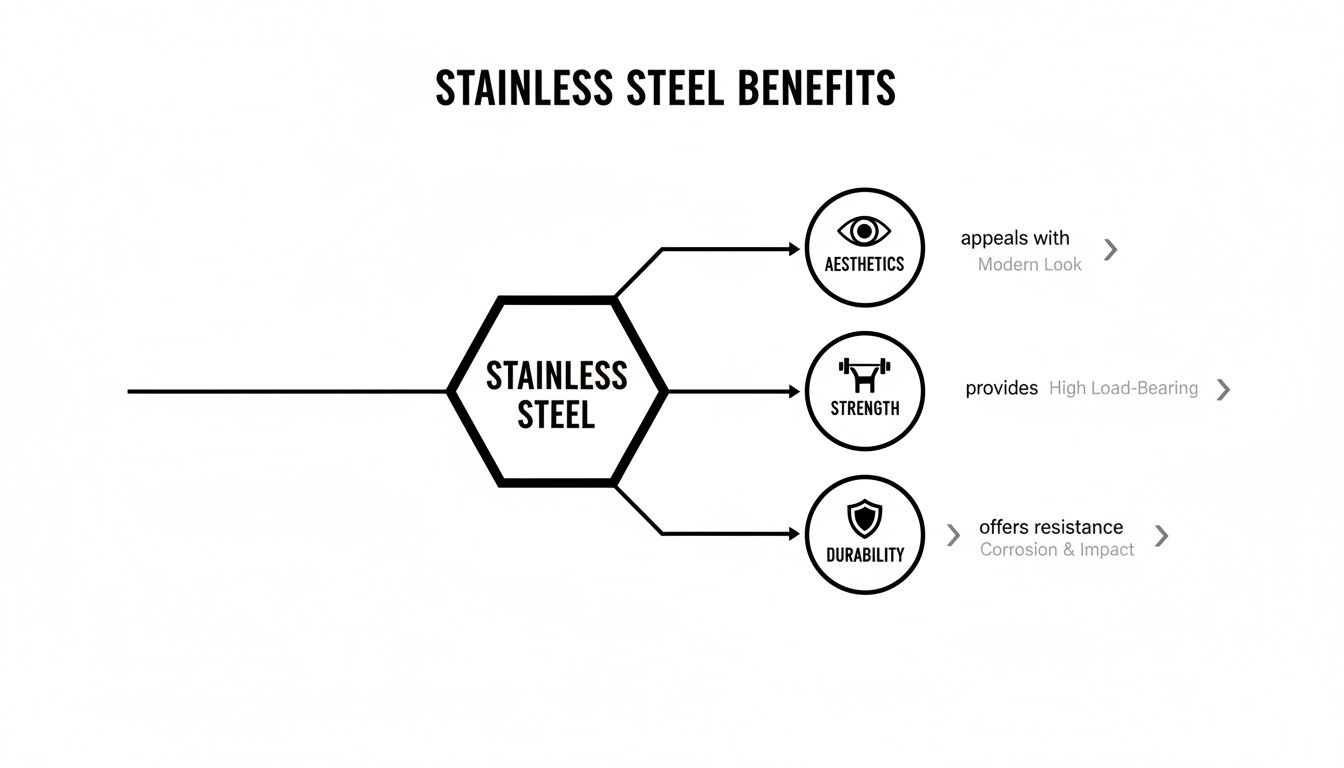
Opting for stainless steel wire balustrades brings a host of clear benefits, making it an intelligent investment for any property.
So, you’ve settled on a stainless steel wire balustrade. Excellent choice. Now comes the part that can feel a bit technical, but getting these next few decisions right is what separates a good result from a truly fantastic one that stands the test of time.
This is where the details matter. We’re talking about the specific grade of steel, the construction of the wire, and its diameter. Think of it as choosing the engine for your car – the right combination ensures performance, longevity, and safety for years to come.
When it comes to stainless steel in the UK, your choice almost always boils down to two options: Grade 304 and Grade 316. The difference is simple but absolutely critical.
Choosing the right stainless steel grade for your project is crucial for ensuring longevity and maintaining a pristine finish, especially in the UK's varied climate. This table breaks down the key differences between the two most common options.
| Feature | Grade 304 Stainless Steel (Interior Grade) | Grade 316 Stainless Steel (Marine Grade) |
|---|---|---|
| Best For | Internal applications like staircases and mezzanines, away from moisture. | External applications, especially coastal, poolside, or near industrial areas. |
| Corrosion Resistance | Good resistance to rust in dry, indoor environments. | Superior resistance to rust and corrosion, including from salt spray and pollution. |
| Key Component | Chromium and nickel alloy. | Contains molybdenum, which significantly boosts its anti-corrosion properties. |
| Common Issue | Prone to "tea staining" (brown discolouration) and pitting if used outdoors. | Highly resistant to tea staining, maintaining its clean look for years. |
| Cost | More affordable upfront. | Higher initial cost, but a better long-term investment for outdoor projects. |
Essentially, Grade 304 is perfectly fine for indoor use—a balustrade on a landing or an internal staircase, for example, where it’s protected from the relentless British weather.
But the moment you step outside, the game changes. For any external project, from a garden deck in Darlington to a coastal balcony in Cumbria, Grade 316 is the only sensible option.
Grade 316 is often called ‘marine grade’ for a reason. It contains an element called molybdenum, which gives it vastly superior protection against corrosion from salt in the air and other pollutants. Trying to save a few pounds by using an interior grade outdoors is a classic false economy. It might look good for a few months, but rust spots and ugly brown ‘tea staining’ are inevitable, ruining the very aesthetic you paid for.
For a fit-and-forget solution that will look pristine through damp winters and humid summers, Grade 316 isn’t just a recommendation; it’s a necessity.
Beyond the grade of the steel, the wire itself comes in different constructions and thicknesses, each with its own look and performance characteristics. The two you’ll most likely encounter are 7×7 and 1×19.
7×7 Construction: This wire is made of seven strands, which are themselves made of seven smaller wires twisted together. It’s quite flexible, making it easier to work with around corners, and has a slightly more traditional, textured "rope-like" look.
1×19 Construction: This is a much more rigid wire, formed from a single strand of 19 individual wires. This rigidity gives it incredible strength and a very smooth, clean surface for a more modern, architectural finish. It is also less prone to stretching over time, but its stiffness means installation requires more precision.
Finally, you have the diameter. For residential projects, you’ll typically be looking at 3mm, 4mm, or 5mm wire. A 3mm wire offers a very sleek, minimalist look. However, 4mm often hits the sweet spot, providing a fantastic balance of minimalist design and robust strength.
For commercial jobs or systems with longer spans between posts, we often specify 5mm wire. Its extra rigidity and load-bearing capacity provide an added layer of security and strength. You can explore these specifications in more depth in our complete guide to stainless steel for railings.
Getting this combination of grade, construction, and diameter right from the outset is the key to a project that not only meets all safety standards but also perfectly achieves the look you’ve envisioned for your space.
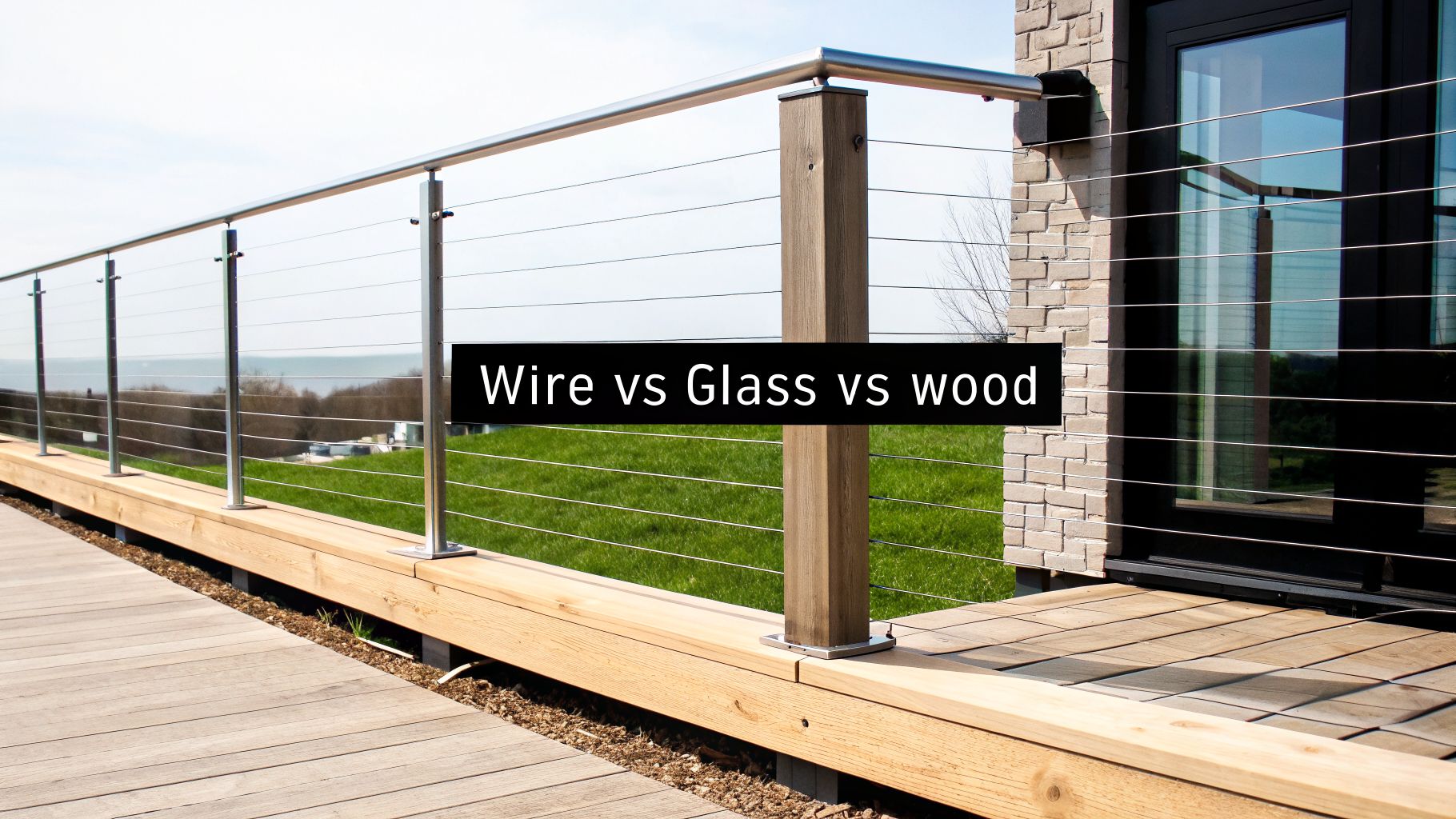
Choosing a balustrade isn't just a practical decision; it’s about defining the look and feel of your space. While stainless steel wire for balustrades offers a fantastic modern solution, it's crucial to see how it performs against popular alternatives like glass and wood to make a choice you'll be happy with for years to come.
Each material brings its own unique character, benefits, and practical considerations to a project.
For a homeowner in York wanting to preserve a stunning garden view, the choice often boils down to wire versus glass. Frameless glass promises complete transparency, but this comes with the constant chore of cleaning fingerprints, water spots, and daily grime. Wire, in contrast, offers exceptional visibility with a fraction of the upkeep.
Let's break down how these systems compare in the real world, looking at aesthetics, maintenance, and the experience of living with them. You'll soon have a much clearer picture of what’s right for your home, your lifestyle, and your budget.
The main draw for both wire and glass is their ability to provide robust safety without sacrificing a view. They get there, however, in very different ways.
Aesthetic and Feel:
Maintenance Demands:
Think of a large glass panel as another window—it shows every single smudge, streak, and speck of dust. Keeping it looking pristine demands regular, sometimes daily, cleaning. This can become a real headache for large installations or those exposed to the elements.
Wire, on the other hand, is far more forgiving. It’s a low-maintenance dream for busy homeowners, requiring little more than an occasional wipe-down to look its best.
A key advantage of wire is how it interacts with the environment. Wind passes straight through the cables, placing almost no pressure on the structure. This is a significant benefit in exposed locations across the North of England, where strong gales can exert considerable force on solid glass panels.
The contest between wire and traditional wooden spindles is a classic tale of modern minimalism versus timeless, natural charm. Wood has been a go-to choice for centuries, and for good reason—it offers a warmth and character that many people love.
With their thicker vertical posts, wooden balustrades create a definite sense of enclosure and privacy. While this can feel cosy and secure, it inevitably chops up your view and can make a deck or landing feel smaller. This is where stainless steel wire provides a dramatic contrast, opening up sightlines and making the whole area feel more expansive.
The most significant difference, though, is long-term upkeep. Wood simply demands a lot of work to protect it from the famously damp UK climate.
By contrast, a Grade 316 stainless steel wire system is essentially a "fit-and-forget" solution. It will never need painting, staining, or sealing. Its incredible resistance to corrosion means it will keep its clean look and structural integrity for decades.
For homeowners who value their time, the low-maintenance appeal of stainless steel wire is a game-changer. For those interested in easy installation, you can learn more about our self-assembly options by checking out our comprehensive wire balustrade kit guide.
When you're installing a stainless steel wire balustrade, safety isn't just a box to tick—it's everything. It’s about creating a protective barrier that you, your family, and your guests can trust without a second thought. Fortunately, the UK Building Regulations give us a clear, non-negotiable framework to make sure every single installation is secure.
Diving into these rules can seem daunting, but at their heart, they’re all based on straightforward, common-sense principles. The key piece of guidance is Approved Document K, which lays down the law on protection from falling, collision, and impact. Whether your project is in Leeds, Darlington, or anywhere across Yorkshire, these aren't just suggestions; they're a legal must-have for safety.
Ultimately, the whole point of these regulations is to prevent accidents, especially those involving young children. This simple goal informs every detail, from the height of the handrail to the spacing between the wires themselves.
If there's one rule to burn into your memory for wire balustrades, it's the 100mm sphere rule. The test is as simple as it is effective: if a sphere with a 100mm diameter (think a tennis ball or the approximate size of a baby’s head) can pass through any opening in your balustrade, the gap is too wide, and the system fails compliance.
This rule directly impacts how your stainless steel wire for balustrades must be set up. The wires need to be tensioned with absolute precision to stop them from being pushed apart. If the wires are left even slightly slack, they can easily flex to create a gap larger than 100mm under pressure, creating a very real hazard.
A professional installer will never eyeball this. We use a specialist tension gauge to ensure every wire is perfectly taut. This removes all the guesswork and guarantees the system doesn't just look sharp and linear, but more importantly, it meets this fundamental safety benchmark.
Full compliance with building regulations is paramount, and it often involves rigorous practices beyond the initial install, such as routine anchor testing and inspection to ensure structural components remain secure over time. This is especially important for commercial installations and public spaces in built-up areas like Leeds or Manchester.
Beyond the wire spacing, Approved Document K is also very specific about the minimum height of the balustrade, which changes depending on where it's located. These heights are there to prevent an adult from accidentally falling over the barrier.
Height is only half the story; the entire system has to be strong enough to handle significant force. The regulations state that a balustrade must be able to withstand a uniformly distributed line load of 0.74 kN/m. High-quality stainless steel wire for balustrades, especially grade 316, is more than capable of meeting this standard, giving you a system built to handle the rigours of everyday life.
Making sure your balustrade ticks all these boxes is about more than just buying some posts and wire. Every single part—from the end fittings and tensioners to the posts and how they're anchored—has to be designed and tested to function as a complete, compliant system.
This is where working with a specialist gives you invaluable peace of mind. A reputable supplier like Binks Balustrades ensures that every component has been engineered to meet or exceed the required standards. We can provide all the technical paperwork to prove compliance, which is something building control will almost certainly want to see before signing off on the project.
For a deeper dive, you can read our detailed guide on the building regulations for balustrades. In the end, these rules exist to keep people safe, and partnering with experts ensures your project is built correctly from the ground up.

One of the biggest draws of a stainless steel wire for balustrades is its fantastic long-term value. Once our team has installed it, the system asks for very little in return, giving you decades of reliable safety and clean, modern lines. But we need to bust a common myth right away: "stainless" doesn't mean "stain-proof."
The incredible resilience of stainless steel comes from a super-thin, invisible layer of chromium oxide that naturally forms on the surface. This "passive layer" is what does the hard work, protecting the steel underneath from corrosion. However, everyday dirt, grime, and airborne pollutants can settle on this layer, and if left for too long, they can begin to compromise its protective shield.
This is why a little periodic maintenance is the key to ensuring your balustrade looks just as sharp in ten years as it does the day it's installed. It’s not about hard graft, but more about a consistent, gentle approach.
Keeping your stainless steel wires and posts pristine doesn’t require any special kit or harsh chemicals. In fact, aggressive cleaners and abrasive pads can do more harm than good by scratching the surface and damaging that all-important passive layer.
For a regular clean, all you really need is:
The process couldn't be simpler. Just mix a little detergent with warm water, wipe down the wires and posts with one cloth, then rinse away the soap with a second clean, damp cloth. To finish, dry the steel with a third clean, dry cloth. This prevents water spots and really brings back its original lustre.
If you live in a coastal area or near industrial sites, you might eventually notice a light brown discolouration on the steel’s surface. This is known as “tea staining.” It's important to know this is a purely cosmetic issue; it affects the look of the steel but not its structural strength or integrity.
Tea staining happens when salt spray or pollutants cling to the steel's surface and aren't regularly washed away by rain. It's more common on Grade 304 steel when it's used outdoors, but it can occasionally appear on the tougher Grade 316 in particularly harsh environments. The good news is, it's easy to remove.
For stubborn tea staining or more ingrained grime, a specialised stainless steel cleaner will be your best friend. Just apply it following the manufacturer's instructions, always rubbing gently in the direction of the steel's grain—never in circles. This will lift the contaminants off the surface without scratching it.
This minimal upkeep is where the true financial benefit of a stainless steel wire for balustrades really shines. When you stack it up against materials like painted steel or wood—which need costly and time-consuming repainting or re-staining every few years—the long-term savings are significant.
Industry reports back this up, showing that stainless steel now makes up 85% of balustrade infill materials in new UK residential builds since 2015. With an expected lifespan easily exceeding 50 years, the value is undeniable. Maintenance stats show annual cleaning costs for stainless steel can be as low as £50-£100 for a 10-metre run. Compare that to the £300+ needed for painted systems, which also demand complete repainting. You can explore more expert takes on the longevity of stainless steel cable railings on CMP Online.
This "fit-and-forget" quality makes it an intelligent investment for any property, freeing up your time and budget for years to come. A few simple cleans a year is all it takes to protect your balustrade and keep it looking its absolute best.
Even with a clear idea of the final look, it's natural to have a few practical questions. When we talk to homeowners and developers across the North of England, a few queries always come up.
Here are the straightforward answers you need, straight from the experts.
This is probably the most critical question we get, as it touches on both the look and the safety of the system. Getting the tension right is non-negotiable.
Your two main goals here are simple:
As a quick field test, try pressing firmly on a wire halfway between two posts. You shouldn't be able to move it more than a few centimetres. While we use calibrated tension gauges for guaranteed precision, the end goal is a rigid, unyielding feel that ensures total safety and compliance.
For a skilled DIY enthusiast with the right tools and a lot of patience, a self-install is certainly possible. However, it’s a job that demands absolute precision.
The real challenges lie in drilling the posts with perfect accuracy, cutting the wire without it fraying, and—most importantly—achieving the correct, consistent tension on every single wire.
For anything safety-critical like a raised deck, a balcony, or any balustrade in a commercial setting, we always recommend bringing in a professional. An experienced installer has the specialist equipment and know-how to guarantee a secure, compliant, and flawless finish.
The final cost of a wire balustrade can vary quite a bit, depending on a few key factors. We need to consider the total length you need, how many posts are required, the grade of steel (we always use Grade 316 for outdoor projects), and how complex the layout is, especially with corners or stairs.
As a rough guide, the material cost for a stainless steel wire system is often in the same ballpark as a fully frameless glass balustrade, sometimes even a little less.
But the best way to get a clear figure for your project is to use an online calculator. It lets you pop in your own dimensions and get a tailored, instant estimate right from the start. It gives you complete price transparency.
One of the best things about a stainless steel wire balustrade is just how easy it is to look after. A little bit of cleaning is all it takes to protect the finish and keep it looking brand new.
For day-to-day upkeep, all you need to do is wipe the wires and posts with a soft cloth, some warm water, and a mild detergent. Rinse it off with a clean, damp cloth and dry it afterwards to stop any water spots from forming.
If your property is near the coast, you might occasionally see some light brown marks known as 'tea staining'. Don't worry, a specialist stainless steel cleaner will remove this easily.
The most important thing to remember is to avoid abrasive pads (like scouring pads) or harsh chemicals like bleach. These can scratch the steel and permanently damage its protective surface. A gentle clean a few times a year is all that’s needed to keep your balustrade looking pristine.
Ready to bring the sleek, modern look of a balustrade to your property in Harrogate, York, or anywhere in the North of England? The team at Binks Balustrades has the local expertise to guide you through every step. Get in touch with us today for advice and a personalised quote.