
Your Guide to Stainless Steel Wire Rope Balustrades
Stainless steel wire rope is the backbone of any modern cable balustrade. It’s what gives the system its incredible strength, […]

Stainless steel wire rope is the backbone of any modern cable balustrade. It’s what gives the system its incredible strength, […]
Stainless steel wire rope is the backbone of any modern cable balustrade. It’s what gives the system its incredible strength, lasting durability, and sleek, minimalist look. We’ve seen it time and again on projects across the North of England—it’s the go-to choice for providing a secure, see-through barrier that opens up a space rather than closing it in.
Picture a crisp morning in Yorkshire, looking out from your patio across the rolling dales without a single clunky rail blocking your view. That’s the simple, understated elegance stainless steel wire rope brings to a project. It’s far more than just a material; it’s a deliberate design choice that puts light, space, and safety first. Unlike bulky timber posts or even solid glass panels, wire rope provides a nearly invisible barrier that blends right into its surroundings.
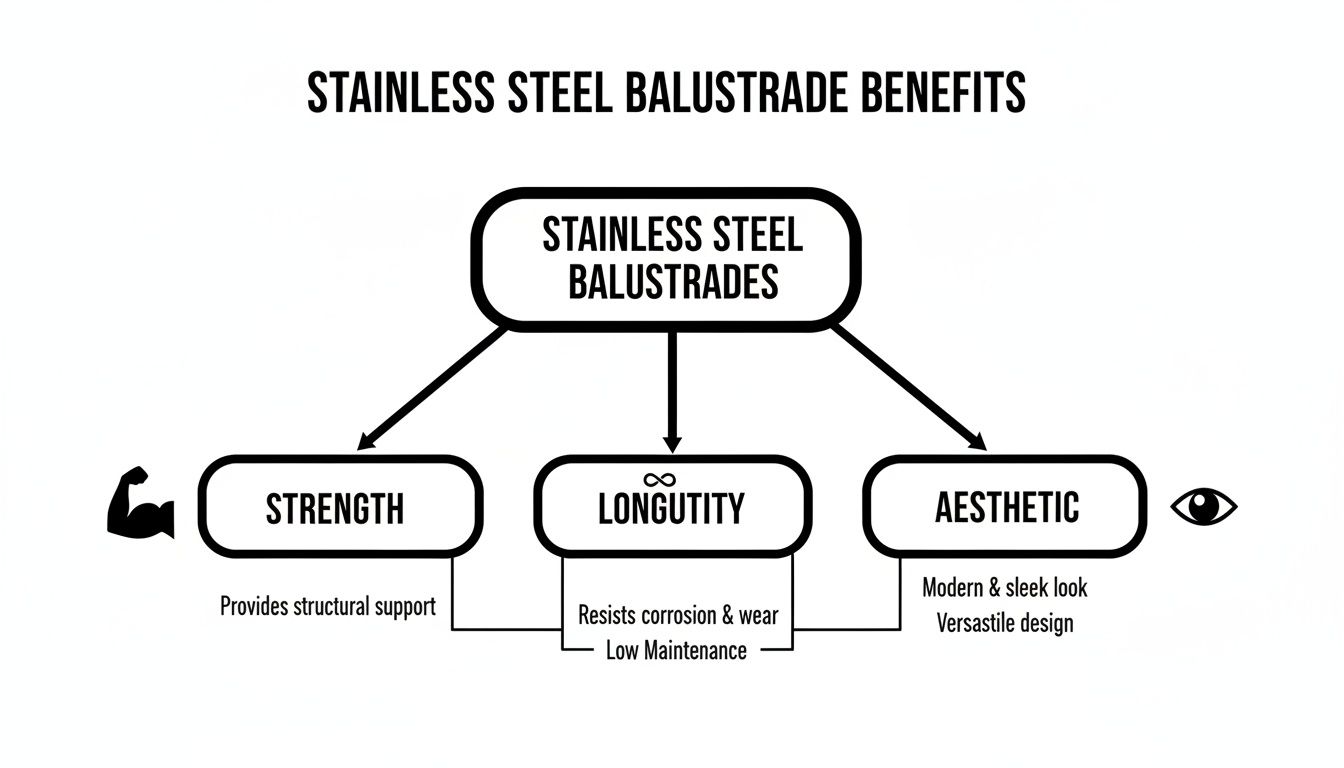
For our clients, from homeowners in Leeds to architects in the Lake District, the decision to use stainless steel wire rope always comes down to three core benefits that work together to create a truly superior balustrade.
Unmatched Strength and Safety: Think of each wire not as a single thread, but as a bundle of smaller, high-tensile steel strands twisted tightly together. This construction gives it immense strength, easily exceeding the safety demands for a typical domestic balustrade. When it’s properly installed and tensioned by professionals, you get a robust safety barrier you can absolutely trust.
Exceptional Durability and Longevity: The North of England’s weather, with its driving rain and salty coastal air, is notoriously tough on building materials. This is where high-quality stainless steel shines. ‘Marine grade’ 316 steel, in particular, is engineered specifically to resist these harsh conditions, preventing rust and looking pristine for decades with very little looking after.
A Minimalist Look for Unspoiled Views: Perhaps the most powerful reason for choosing wire rope is its visual subtlety. The thin, clean lines encourage your eye to look straight past the barrier and onto the landscape beyond, whether that’s a beautiful garden in Harrogate or a stunning coastal view in Cumbria. It’s the perfect way to make any area feel more open and connected to its environment.
At its heart, stainless steel wire rope strikes the perfect balance between form and function. It delivers the structural integrity required by UK building standards while giving you that clean, modern, and unobtrusive finish that defines contemporary design.
This guide will walk you through the important decisions you'll face when choosing the right stainless steel wire rope for your balustrade. We'll break down the differences in wire construction, like 7×7 versus 7×19, and help you decide between Grade 304 and 316 steel.
Getting these details right is crucial, as every choice affects the safety, final look, and cost of your system. To get a head start, you can also explore our detailed guide on the various types of cable for railings. By the end, you'll have a clear plan for creating a stunning and secure balustrade for your patio, deck, or staircase.
Getting the details right on your stainless steel wire rope is the secret to a balustrade that looks fantastic and lasts for decades. At first glance, most wire ropes look pretty much the same. But dive a little deeper, and you’ll find the real difference lies in how they’re made and the specific grade of steel used. These details are what determine strength, flexibility, and how well your balustrade will stand up to the unpredictable weather here in Northern England.
Let's break down the technical jargon. The two main types you'll come across for balustrade systems are 7×7 and 7×19. Those numbers might look like a code, but they're just a simple description of how the rope is put together.
Think of it like this. A 7×7 wire rope is built from seven strands, and each of those strands is woven from seven individual wires. This construction results in a rope that is quite stiff but incredibly strong. It’s the go-to, reliable choice for long, straight runs where you don't need much flexibility.
A 7×19 wire rope, however, is also made from seven strands, but each strand is packed with nineteen much finer wires. All those extra, thinner wires make the finished rope far more flexible. This is what you need when your balustrade system has to navigate corners or bend around posts. It’s simply easier to work with where curves are involved.
For a more detailed look at material choices and how they suit different environments, our guide on choosing the right stainless steel for UK railings is a must-read. Getting the construction right means your balustrade won’t just look the part—it will perform safely for its entire life.
Beyond how it’s woven, the grade of the stainless steel is the single most critical factor for a long-lasting balustrade. This is especially true for projects across Yorkshire and the North, where we know the weather can be a real challenge. Your two main options are Grade 304 and Grade 316.
Making the right choice between these two grades is crucial for the longevity of your balustrade, particularly in the varied conditions we see across the North. This table breaks it down.
| Feature | Grade 304 (Interior Grade) | Grade 316 (Marine Grade) |
|---|---|---|
| Best For | Interior applications, protected from weather | All outdoor applications, coastal areas |
| Corrosion Resistance | Good against general atmospheric corrosion | Excellent, resists chlorides (salt) |
| Key Component | Chromium-Nickel alloy | Chromium-Nickel-Molybdenum alloy |
| Common Uses | Indoor staircases, landings, sheltered patios | Balconies, garden decking, coastal properties |
| Cost | More affordable | Higher initial investment |
| Appearance | Bright, clean finish | Identical bright, clean finish |
As you can see, Grade 304 is a brilliant, corrosion-resistant steel that does a fantastic job indoors. It’s the standard for staircases, landings, and other protected spaces where it won't face rain, frost, and salty air.
Grade 316, on the other hand, is what we call 'marine grade' for a reason. It contains a crucial extra ingredient: molybdenum. This element gives the steel a massive boost in corrosion resistance, especially against chlorides found in sea spray and the grit on our winter roads. For any outdoor project, Grade 316 stainless steel wire rope isn't just a suggestion; it's an essential.
For a balustrade on a coastal balcony in Whitby, a garden patio in the Peak District, or a city-centre terrace in Leeds exposed to the elements, Grade 316 is the only sensible choice. It’s the only way to protect your investment from the damp UK climate and prevent that unsightly rust or 'tea staining'.
This is about getting the specification right from the start to ensure your balustrade remains as stunning as the day it was installed.
It’s no surprise that stainless steel is the benchmark for modern balustrades. It’s a material with a legacy right here in the heart of British industry. Back in 1913, metallurgist Harry Brearley, working in a Sheffield lab, accidentally discovered this corrosion-resistant alloy while trying to improve gun barrels.
Today, that same spirit of robust innovation means this material underpins 85% of glass balustrade systems in homes and businesses, according to 2026 data from the UK Construction Federation. It’s a testament to a material that delivers on every front.
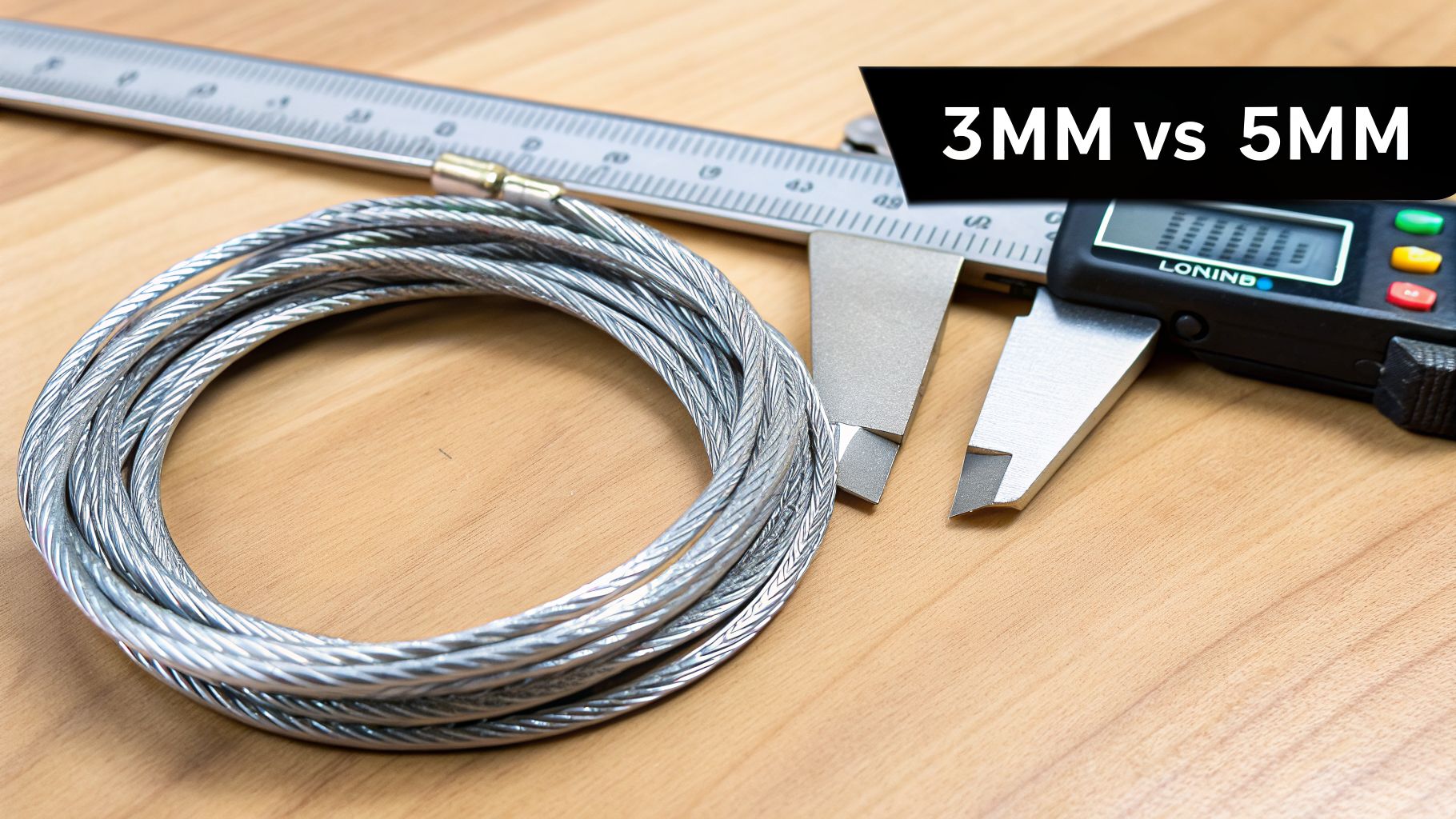
Once you’ve settled on the perfect wire construction and steel grade for your balustrade, the next big decision is getting the diameter right. This choice isn't just about the final look; it’s a critical safety decision that underpins the strength and compliance of your entire system.
Think of it like choosing the foundations for a house. A wire that’s too thin might look wonderfully discreet, but it could fail to hold the necessary tension and strength, putting the safety of your deck or balcony at risk. On the other hand, an oversized wire can be overkill for a small residential patio, just adding needless cost. The real skill is finding that sweet spot between visual appeal, robust strength, and meeting all the rules.
The relationship between a wire rope's diameter and its strength is refreshingly simple: a thicker wire is a stronger wire. Every millimetre you go up in diameter brings a significant jump in the rope's minimum breaking load—the amount of force needed to make it fail. This is the single most important figure for ensuring your balustrade is safe and secure.
For most residential balustrade projects we see across places like Leeds and York, a 3mm diameter wire is an incredibly popular and effective choice. It offers that minimalist, almost-invisible aesthetic that homeowners love, letting you enjoy clear, uninterrupted views. Crucially, it still provides more than enough strength to meet all residential safety standards when it's properly installed and tensioned.
Of course, some projects demand an even greater margin of safety, and that’s when stepping up the size is a smart move.
This isn’t just a matter of personal preference. The choice is directly tied to UK Building Regulations, which lay out non-negotiable safety requirements for all balustrades and railings.
Selecting the correct wire diameter is the cornerstone of a compliant and secure balustrade. It ensures the system can withstand the required loads, providing peace of mind for homeowners, architects, and contractors alike across the North of England.
In the UK, the safety of barriers is governed by Part K of the Building Regulations. These rules exist to prevent people from falling and to ensure the balustrade is structurally sound. For a typical single-family home, the key requirement is that the balustrade must be able to withstand a horizontal line load of 0.74 kilonewtons per metre (kN/m).
That might sound technical, but it simply means the top rail and the infill wires have to be strong enough to resist the force of someone leaning or falling against them. A correctly specified and installed stainless steel wire rope system, even using 3mm wire, can comfortably meet this standard.
The impressive strength-to-size ratio of these systems has also led to their rapid adoption in commercial settings. For example, using 316 marine-grade wire with breaking loads that can exceed 10 tonnes for an 8mm diameter allows venues to maintain stunning, unobtrusive views while meeting rigorous BS EN 1090 standards. In fact, local Yorkshire surveys from 2026 show a 35% increase in hospitality upgrades using these systems. For venues like the terraces in York, this shift not only looks great but slashes lifecycle costs by 28% thanks to corrosion-free performance. You can learn more about the history and application of these systems and their benefits.
Ultimately, getting the diameter right ensures your balustrade is not just a beautiful design feature but a robust, compliant safety barrier. It’s how you create a secure space that maximises your view, perfectly aligning with your design goals.
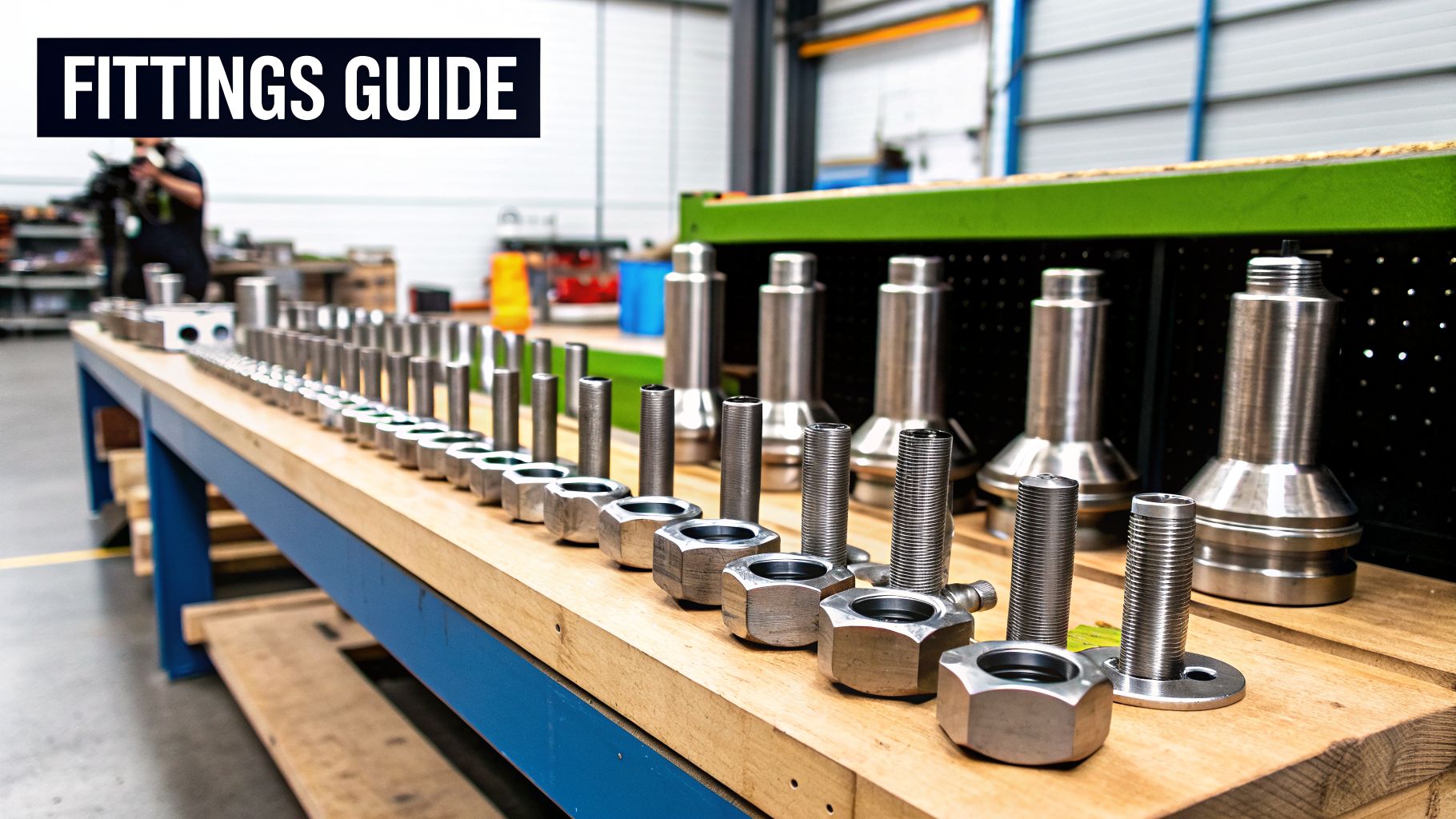
A stunning stainless steel wire rope balustrade is much more than just the wire. While the rope provides the sleek lines and strength, it’s the fittings and terminals that do the real heavy lifting. These are the critical connection points that anchor the wires, pull them taut, and ultimately guarantee the safety of the entire system.
Think of it like this: your wire rope is only ever as strong as its weakest link. Those links are the fittings. Getting this choice right is just as crucial as selecting the right wire diameter or steel grade. They must be tough, precisely engineered from the same Grade 316 stainless steel to fend off corrosion, and perfectly suited to your project’s needs and the final look you're after.
When it comes to fixing the wires to your balustrade posts, you’ll come across two main families of fittings: swage-less and swaged. Each offers a different way of creating that vital, secure connection, with real-world advantages depending on who is doing the installation.
Swage-less terminals are the go-to for DIY installations and have become incredibly popular for home projects across Yorkshire and the North. They are essentially sophisticated compression fittings. You simply slide the wire rope into the terminal and tighten it up with standard hand tools, like a couple of spanners. Inside, a clever wedge or jaw mechanism clamps down on the wire with immense force, locking it solidly in place.
Hydraulically swaged fittings, on the other hand, deliver that flawless, factory-finished look. Here, the fitting is permanently compressed onto the wire rope using a powerful hydraulic press. This creates an incredibly strong, tamper-proof bond that is seamless and minimalist in its appearance.
Once your wires are attached, they must be tensioned correctly. A sagging wire rope isn't just an eyesore; it's a serious safety failure that won't pass building regulations. This is where tensioning fittings earn their keep. They allow you to pull the wire taut after installation and make small tweaks down the line if the wire settles or stretches.
Choosing the right fitting isn’t just a technical decision—it’s about matching the system to your skill level, budget, and the final look you want to achieve for your Northern England home. A well-chosen fitting ensures your balustrade is safe, secure, and beautiful.
Common tensioning fittings include:
By understanding how these different fittings work, you can make an informed choice that’s perfectly matched to your project. Whether you go for the hands-on approach with swage-less terminals or the professionally finished look of hydraulic swaging, getting the connections right is the key to a successful stainless steel wire rope balustrade.
A stainless steel wire rope system is celebrated for being incredibly low-maintenance, but that doesn't mean you can skip the basics. Getting the installation right from the very beginning is the single most important step. It’s what separates a sharp, professional-looking balustrade from one that looks untidy and fails to perform.
Proper installation and a bit of simple, consistent care are all it takes to ensure your balustrade remains a stunning feature for decades. The goal is to get those wires perfectly tensioned, creating the clean, crisp lines that are the hallmark of this modern style. It’s a job that definitely rewards patience and attention to detail, whether you're working on a city terrace in Leeds or a garden deck overlooking the Cheshire plains.
Getting the installation right from the start helps you avoid common pitfalls like sagging wires and ensures your balustrade is fully compliant and, most importantly, safe. The two things you absolutely need to focus on are the spacing of your posts and the quality of your wire cuts.
Post Spacing: The distance between your balustrade posts is critical. It might be tempting to stretch the span to maximise your view, but spacing posts too far apart—generally anything beyond 1.5 metres—is a recipe for trouble. It will almost certainly lead to excessive wire sag, known as deflection. A sagging wire not only looks sloppy but can also fail the load requirements set out in UK Building Regulations.
Clean Cuts: When you cut the wire rope to length, your aim is a clean, square end that won't fray. This is non-negotiable for getting the fittings to attach securely and look neat.
One of the biggest myths about stainless steel is that its name means it's maintenance-free. While Grade 316 steel is incredibly tough and resistant to corrosion, it isn't completely immune to surface marks, especially with the damp, pollutant-heavy air we often get across the UK.
You might eventually notice a faint brownish discolouration, often called ‘tea staining’. It's crucial to understand this is not rust and doesn't compromise the structural integrity of the steel in any way. It’s simply a surface deposit caused by airborne salt and pollutants settling on the steel. Thankfully, keeping it at bay is incredibly easy.
A simple cleaning routine twice a year is all it takes to keep your stainless steel wire rope balustrade looking immaculate. Think of it as a quick spring and autumn clean to protect both your view and your investment.
Just follow this straightforward maintenance schedule:
For any stubborn blemishes or the first signs of tea staining, a dedicated stainless steel rust remover can work wonders to restore the original gleam. This simple, proactive approach is the key to ensuring your balustrade remains a stunning, hassle-free feature for many years to come.
Getting a stainless steel wire rope balustrade right is all about nailing the details from the very beginning. Think of this as your project blueprint, a step-by-step guide to help you navigate the choices for your project here in the North of England.
Following this simple plan ensures every angle is covered. It will help you manage costs, pick the right parts, and make sure the finished balustrade is safe, stunning, and built to withstand a Yorkshire winter (or three).
Define Your Application (Grade 304 vs 316): First things first, where is this balustrade going? For any system exposed to the elements—from a Leeds patio to a windswept balcony in Whitby—Grade 316 stainless steel is essential. For purely indoor projects, like a staircase, the more budget-friendly Grade 304 is a perfectly good choice.
Select Your Wire Construction (7×7 vs 7×19): Now, think about the design. If you have long, straight runs, the rigidity of 7×7 construction will give you a beautifully clean and taut line. However, if your design needs to navigate around corners or tight bends, the extra flexibility of 7×19 construction will make your life much, much easier during installation.
Choose the Right Diameter (3mm vs 5mm): For the vast majority of home projects, 3mm diameter wire hits the sweet spot. It offers that minimalist, barely-there look while being more than strong enough to meet UK Building Regulations. For busier commercial settings or high-traffic areas, stepping up to 5mm wire provides extra rigidity and an even greater margin of safety.
Once you've settled on the wire, your attention needs to turn to the hardware that pulls it all together. This stage is just as critical for a secure, professional-looking job.
Decide on Fittings (Swage-less vs Swaged): Your choice here really comes down to how you plan to install it. Swage-less fittings are brilliant for DIY enthusiasts. They only need standard hand tools and give you the freedom to make adjustments on-site. Hydraulically swaged fittings, on the other hand, provide a super-slim, factory-perfect finish but are best left to the professionals with specialist crimping equipment.
Plan for Tensioning: Every single wire run needs a way to be pulled taut. This is non-negotiable for safety. Whether you choose functional, easy-to-adjust turnbuckles or more discreet threaded studs, you must have a reliable tensioning mechanism planned for each wire.
Sourcing your materials from a reputable UK-based specialist is paramount. A good supplier not only provides high-quality, certified materials but also understands the specific building codes and environmental challenges we face in the North of England, offering advice you can trust.
By working through this checklist methodically, you can confidently specify every single part of your stainless steel wire rope balustrade. This organised approach helps you keep control of your budget, as every choice in grade, diameter, and fittings impacts the final cost.
For those looking to make the process even simpler, exploring a pre-configured system can be a fantastic time-saver. You can learn more about these streamlined solutions and find inspiration in our complete wire balustrade kit guide. This helps guarantee a smooth project, from your initial idea to the final, stunning result.
When you're planning a new stainless steel wire balustrade, a few key questions always come up. Getting these details right is crucial for safety, compliance, and achieving that crisp, professional look. Here, we tackle some of the most common queries we hear from homeowners and contractors across Yorkshire.
For safety, UK Building Regulations are crystal clear: a 100mm sphere must not be able to pass through any gap in your balustrade. You’ll often hear this referred to as the 'baby's head' test, and it’s non-negotiable.
To meet this rule, we always recommend spacing your wires between 80mm and 95mm apart, measured from the centre of each wire. This might seem a little tighter than the 100mm rule, but it's essential. This spacing cleverly accounts for any slight give or flex in the wire when under tension, ensuring your balustrade remains a secure, compliant barrier no matter what.
A DIY installation is certainly possible, especially with modern systems using swage-less fittings. These are a game-changer for the self-installer, as they let you attach the terminals on-site with basic spanners, avoiding the need for specialist hydraulic crimping tools.
The real question is one of confidence. Are you comfortable with precise measurements, drilling perfectly level holes in your posts, and getting the tension just right? If you have any hesitation, bringing in a professional is the smart move. It’s the only way to guarantee a flawless, safe, and legally compliant finish that will stand the test of time.
It can be tempting to push the distance between posts to maximise the view, but this is where you need to be careful. The maximum recommended span between support posts is 1.5 metres (1500mm).
Going any wider than 1.5 metres is a recipe for problems. You'll almost certainly get noticeable wire sag, or 'deflection'. Not only does this look sloppy, but it critically compromises the balustrade's strength. It may not hold up under pressure, failing to meet the required safety loads and putting people at risk.
Stick to the 1.5-metre rule. It's the secret to keeping your stainless steel wire rope taut, sharp, and, most importantly, a robust and reliable safety barrier. For more on this, you can find some great insights on blogs that discuss deck railing safety and design.
Ready to start planning your perfect balustrade? The team at Binks Balustrades offers expert advice and high-quality materials for projects across Harrogate, Leeds, York, and the North of England. Get in touch today for a no-obligation quote and let us help you create a stunning, safe, and durable system. Contact Us.